"Earlier this month, a second major wealth tax proposal was introduced by Sen. Bernie Sanders and Rep. Ro Khanna, both of whom have been vocal supporters of the California initiative.
-
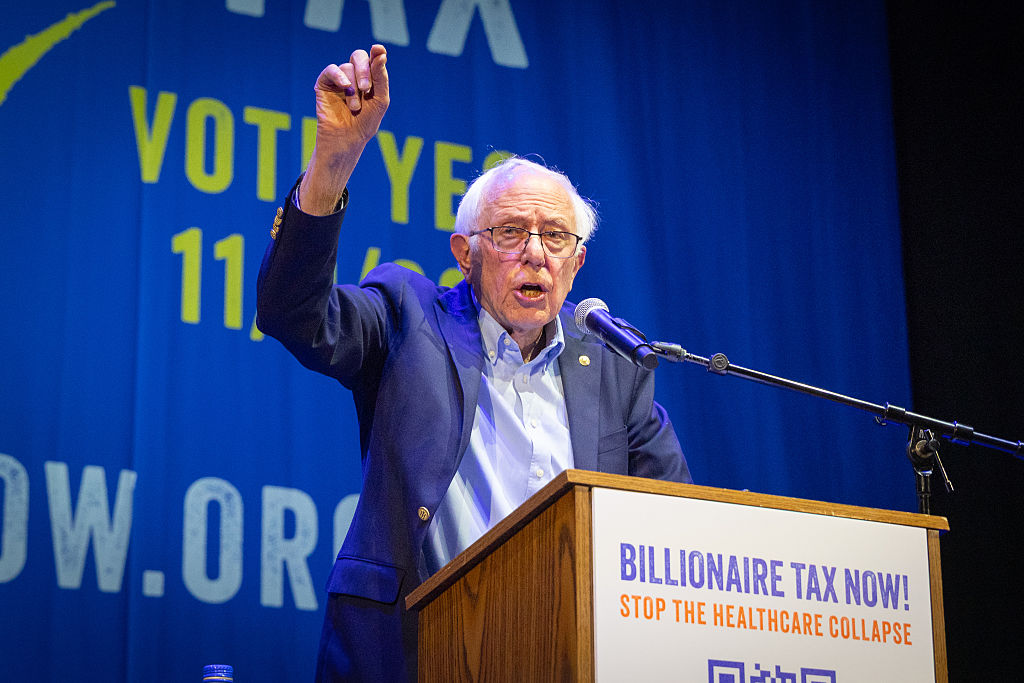
"Earlier this month, a second major wealth tax proposal was introduced by Sen. Bernie Sanders and Rep. Ro Khanna, both of whom have been vocal supporters of the California initiative. The more aggressive Sanders-Khanna proposal calls for a 5 percent annual wealth tax on the country’s approximately 950 billionaires, which they project would raise up to $4.4 trillion over the next decade. In their bill, that revenue would go toward funding half a dozen policy measures, including a $3,000 direct payment to every American in households earning under $150,000 and the complete reversal of Republican cuts to Medicaid and the Affordable Care Act.
So far, the public response to a billionaire tax has been largely positive. Early polling indicates that most Californians support the wealth tax, which currently has the best shot at becoming a reality. Last month, a survey from the Republican-leaning pollster Nestpoint found that 60 percent currently back the proposal, while just 24 percent oppose it. Even when respondents were given opposition messaging, 54 percent continued to favor the proposition.
Not surprisingly, most of California’s billionaires have reacted to the ballot initiative with alarm bordering on panic, denouncing it as “asset seizure” and threatening to leave the state. Billionaire-backed business groups have already launched their campaign to defeat the proposal, with tech oligarchs like Peter Thiel and Google cofounder Sergey Brin chipping in millions to fund the effort. If past campaigns are any indication, the opposition is likely to spend tens if not hundreds of millions of dollars more to defeat the proposal if it gains the necessary signatures to appear on the ballot in November."
We Can’t Income-Tax Ultra-Elites. We Must Tax Their Wealth.
To tax the richest Americans, we need to go after their wealth, not just their income. Two proposals — one in California, one in Congress — could finally do it. The alternative is an ever-more-powerful billionaire class that threatens democracy itself.

(jacobin.com)
-
"Earlier this month, a second major wealth tax proposal was introduced by Sen. Bernie Sanders and Rep. Ro Khanna, both of whom have been vocal supporters of the California initiative. The more aggressive Sanders-Khanna proposal calls for a 5 percent annual wealth tax on the country’s approximately 950 billionaires, which they project would raise up to $4.4 trillion over the next decade. In their bill, that revenue would go toward funding half a dozen policy measures, including a $3,000 direct payment to every American in households earning under $150,000 and the complete reversal of Republican cuts to Medicaid and the Affordable Care Act.
So far, the public response to a billionaire tax has been largely positive. Early polling indicates that most Californians support the wealth tax, which currently has the best shot at becoming a reality. Last month, a survey from the Republican-leaning pollster Nestpoint found that 60 percent currently back the proposal, while just 24 percent oppose it. Even when respondents were given opposition messaging, 54 percent continued to favor the proposition.
Not surprisingly, most of California’s billionaires have reacted to the ballot initiative with alarm bordering on panic, denouncing it as “asset seizure” and threatening to leave the state. Billionaire-backed business groups have already launched their campaign to defeat the proposal, with tech oligarchs like Peter Thiel and Google cofounder Sergey Brin chipping in millions to fund the effort. If past campaigns are any indication, the opposition is likely to spend tens if not hundreds of millions of dollars more to defeat the proposal if it gains the necessary signatures to appear on the ballot in November."
We Can’t Income-Tax Ultra-Elites. We Must Tax Their Wealth.
To tax the richest Americans, we need to go after their wealth, not just their income. Two proposals — one in California, one in Congress — could finally do it. The alternative is an ever-more-powerful billionaire class that threatens democracy itself.
(jacobin.com)
"There is a rich tradition in the United States of utilizing taxes not just to raise revenue but to deliberately limit concentrated wealth. The original push to tax the rich developed toward the end of the first Gilded Age, when populists and reformers advocated the income tax as a progressive alternative to the tariff. The movement to replace the tariff viewed the income tax as an effective tool to curb inequality and corporate power. As tax law scholar Michael Graetz notes in his recent book The Power to Destroy: How the Antitax Movement Hijacked America, the income tax was viewed by Gilded Age advocates as “necessary for economic justice in an industrializing nation.”
During the New Deal, Franklin Delano Roosevelt openly endorsed this egalitarian use of taxes to curb “great accumulations of wealth” and reduce the country’s towering levels of inequality. In 1936, the top marginal rate was increased to 79 percent and during the war it reached 94 percent. These rates, which Zucman and Saez have aptly described as “quasi-confiscatory,” only applied to those making the equivalent of several millions of dollars in income today and were largely designed to “reduce the inequality of pre-tax income,” which they did."
-
R relay@relay.infosec.exchange shared this topic