A great article by @APC looking back at @NGIZero and software and community sustainability in #FOSS
-
@onepict @APC @NGIZero ... commercial activity - hold down jobs - because commons tending needs to either fly under the radar (fully legal stuff: I bake a cake and invite my neighbours, for example), or disguise itself as commercial activity via hacks.
Because commons tending as a primary activity is not imaginable nor imagined by law.
So what the future of FLOSS needs to do in the short term is to commoditize those hacks that make the disguise work, to enable much easier access to them.
I wholeheartedly agree, of course, as we have discussed these matters at length in the past on Social coding commons channels.
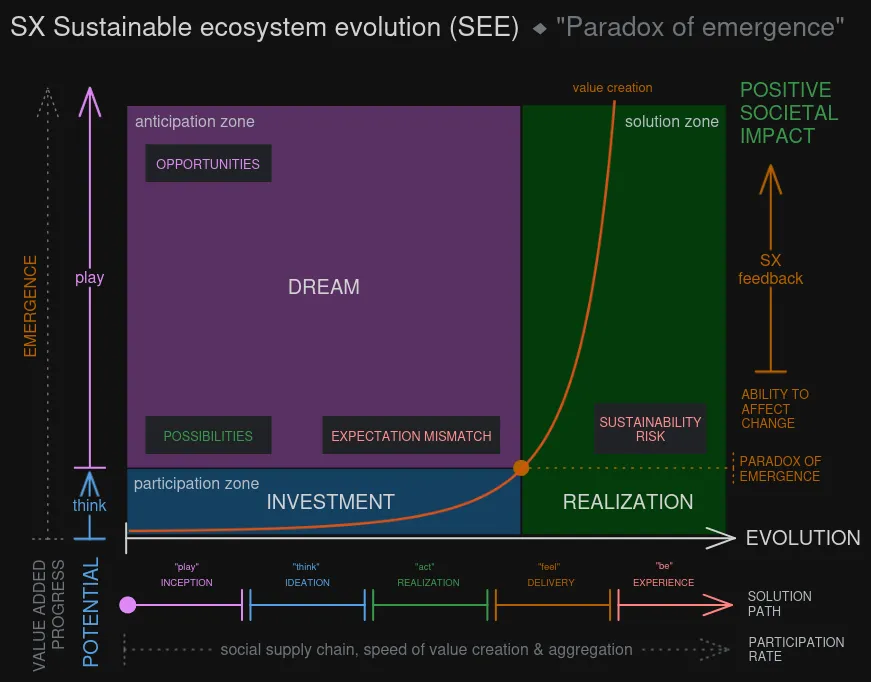
The most interesting part starts directly after the "what [we] need to do" i.e. after defining the SX solution on a sticky note, in Social experience design terminology.
We know generally very well what we ought to do at scale, as a movement, and we try to deduce what we can do as individuals to move in that general direction.
Our challenge then shifts, and the wicked problem becomes one of prolonged coordination between many people in an utterly chaotic commons, on operational, tactical, and strategic levels. The struggle isn't grasping the concept, but picturing how to get to that desirable future state. Paving the path to a solution, and walking it.
This is where SX focuses, and unique oppprtunities exist on the intersection of social networking technologies, sustainable FOSS (i.e. SOSS), and chaordic commons organization.
-
@onepict @APC @NGIZero ... the commons is not sufficiently covered.
Enclosure is somewhat addressed in copyleft, but leaves massive loopholes. And extraction is actively encouraged, it seems, through the insistence of the blanket "any use" principle.
A human rights first, commons oriented movement is what is required.
Quite a few folk here understand this, but the vast majority seems to be struggling with those concepts. But there is your future of FLOSS.
Anything less won't cut it.
@jens @onepict @APC @NGIZero
 People treat the "for any purpose"/freedom 0 requirement of free/open software definitions with near *biblical* reverence. But it is arguably anti-labor to require allowing corporate exploitation, apart from numerous other wrongs.
I think one of the biggest questions is how do we move to more ethical licensing while preserving at least some of the broad license compatibility we enjoy today.
-
@jens @onepict @APC @NGIZero
People treat the "for any purpose"/freedom 0 requirement of free/open software definitions with near *biblical* reverence. But it is arguably anti-labor to require allowing corporate exploitation, apart from numerous other wrongs.I think one of the biggest questions is how do we move to more ethical licensing while preserving at least some of the broad license compatibility we enjoy today.
@jens @onepict @APC @NGIZero I find no inherent problem, ethically, with SSPL but it is fair to admit that if you have an SSPL-licensed component involved you have fun and exciting license compatibility concerns if you need to combine it with any other licenses. You can sort of assume it's "like AGPL as long as you don't sell that software as a service" in practice but the line is fuzzy.
-
@jens @onepict @APC @NGIZero I find no inherent problem, ethically, with SSPL but it is fair to admit that if you have an SSPL-licensed component involved you have fun and exciting license compatibility concerns if you need to combine it with any other licenses. You can sort of assume it's "like AGPL as long as you don't sell that software as a service" in practice but the line is fuzzy.
@ocdtrekkie @jens @onepict @APC @NGIZero
Imho the biggest 'mistake' is in how we generally treat FOSS-the-software and FOSS-the-movement of its creators as one and the same, leaning way too heavily on licensing of the software as the sole tool to assure the sustainability of participants in the movement.
"Ethical licensing" is a fundamentally weird concept, if you come to think of it, yet we discuss it because of this dogmatic license focus.
If one wants to conduct ethical sustainable business, we choose partners that align to our values, and we address externalities of our work. That last bit also involves not delivering our goods to the bad actors.
In FOSS the whole working-in-public paradigm has cultist proportions and imho has serious ethical flaws to which the people involved are myopic.
https://social.coop/@smallcircles/116316524763055082
Yes, by all means lets take licenses as a tool. But let us not by default also deliver the Ring of Power at Sauron's doorstep.
We need a commons-based value economy.
-
@ocdtrekkie @jens @onepict @APC @NGIZero
Imho the biggest 'mistake' is in how we generally treat FOSS-the-software and FOSS-the-movement of its creators as one and the same, leaning way too heavily on licensing of the software as the sole tool to assure the sustainability of participants in the movement.
"Ethical licensing" is a fundamentally weird concept, if you come to think of it, yet we discuss it because of this dogmatic license focus.
If one wants to conduct ethical sustainable business, we choose partners that align to our values, and we address externalities of our work. That last bit also involves not delivering our goods to the bad actors.
In FOSS the whole working-in-public paradigm has cultist proportions and imho has serious ethical flaws to which the people involved are myopic.
https://social.coop/@smallcircles/116316524763055082
Yes, by all means lets take licenses as a tool. But let us not by default also deliver the Ring of Power at Sauron's doorstep.
We need a commons-based value economy.
@smallcircles @ocdtrekkie @jens @APC @NGIZero
Yeah we do need a commons based ecosystem, but that does also mean being open about our values and recognition of when perhaps they are utterly incompatible.
See for example Framework (hardware) and the desire of its founders to have a "big tent" for it's community, to justify it's support of DHH and Omarchy.
We can't expect licenses to fix that, nor can we expand the conversation to folks on the sharp edges of society if we aren't explicit.
-
@smallcircles @ocdtrekkie @jens @APC @NGIZero
Yeah we do need a commons based ecosystem, but that does also mean being open about our values and recognition of when perhaps they are utterly incompatible.
See for example Framework (hardware) and the desire of its founders to have a "big tent" for it's community, to justify it's support of DHH and Omarchy.
We can't expect licenses to fix that, nor can we expand the conversation to folks on the sharp edges of society if we aren't explicit.
@smallcircles @ocdtrekkie @jens @APC @NGIZero This is where choosing a certain kind of licence is part of that. How often are projects advised or think choosing MIT over the GPL to appeal to corporate?
In the same way as we must be explicit in our values and understand we can't and shouldn't try to appeal to everyone. After all we're on here because we are trying to create new spaces for this conversation to happen.
But more than one space can and should exist.
-
@smallcircles @ocdtrekkie @jens @APC @NGIZero This is where choosing a certain kind of licence is part of that. How often are projects advised or think choosing MIT over the GPL to appeal to corporate?
In the same way as we must be explicit in our values and understand we can't and shouldn't try to appeal to everyone. After all we're on here because we are trying to create new spaces for this conversation to happen.
But more than one space can and should exist.
@onepict @smallcircles @ocdtrekkie @APC @NGIZero I've also been on the corporate side of FLOSS licensing more than once, and I think a fair few licenses don't actually serve businesses all *that* well.
Nor does SPDX's license list, FWIW.
Though CC doesn't apply well to code, at least the CC framework is very explicit about what your rights and obligations under a license are. Other licenses need to be analyzed to arrive at the same understanding. That alone is a major hurdle to clear.
-
@onepict @smallcircles @ocdtrekkie @APC @NGIZero I've also been on the corporate side of FLOSS licensing more than once, and I think a fair few licenses don't actually serve businesses all *that* well.
Nor does SPDX's license list, FWIW.
Though CC doesn't apply well to code, at least the CC framework is very explicit about what your rights and obligations under a license are. Other licenses need to be analyzed to arrive at the same understanding. That alone is a major hurdle to clear.
@onepict @smallcircles @ocdtrekkie @APC @NGIZero But I agree fully that it should not start with the license, but with a set of shared values, which would be similar to, but ultimately incompatible with the OSD or FSF's requirements.
Which, to get back to the core of this, is really the main issue. I mean, I wrote some about this a while ago: https://interpeer.org/blog/2024/04/in-search-of-foundational-floss-freedoms/
It's been two years now. Feedback at the time seemed to have been largely positive, but nitpicky about the details. I still...
-
@onepict @smallcircles @ocdtrekkie @APC @NGIZero But I agree fully that it should not start with the license, but with a set of shared values, which would be similar to, but ultimately incompatible with the OSD or FSF's requirements.
Which, to get back to the core of this, is really the main issue. I mean, I wrote some about this a while ago: https://interpeer.org/blog/2024/04/in-search-of-foundational-floss-freedoms/
It's been two years now. Feedback at the time seemed to have been largely positive, but nitpicky about the details. I still...
@onepict @smallcircles @ocdtrekkie @APC @NGIZero ... think it's one of the better starting points, if I do say so myself. But it seems it wasn't catchy enough to get people engaged beyond a few comments and discussion threads.
-
@smallcircles @ocdtrekkie @jens @APC @NGIZero This is where choosing a certain kind of licence is part of that. How often are projects advised or think choosing MIT over the GPL to appeal to corporate?
In the same way as we must be explicit in our values and understand we can't and shouldn't try to appeal to everyone. After all we're on here because we are trying to create new spaces for this conversation to happen.
But more than one space can and should exist.
@onepict @ocdtrekkie @jens @APC @NGIZero
The licensing of a software component is but a strategic choice. It depends.
I think a lot boils down to the formation of collaboration networks that are based on true and well-earned trust, where relationships rely on trustworthiness of our partners that have been proven over time.
The definition SX uses for social networking as "any direct and indirect human activity between people" is very useful here. Because we know quite well how to foster these trust networks offline. People do social networking for 1,000's of years.
Only online we suddenly make it all weird. Our tech still hampers us to be social, narrows our social bandwidth in communication.
Software development is social networking, and way beyond the often seen gut reaction of "pff, github stars". Software is useless if it doesn't match the (social) needs of its stakeholders. Coding is social, and social coders social code the social code (of society).
My hobby and fascination.
-
R relay@relay.infosec.exchange shared this topic