Skip to content
  • Categories
  • Recent
  • Tags
  • Popular
  • World
  • Users
  • Groups
Skins
  • Light
  • Brite
  • Cerulean
  • Cosmo
  • Flatly
  • Journal
  • Litera
  • Lumen
  • Lux
  • Materia
  • Minty
  • Morph
  • Pulse
  • Sandstone
  • Simplex
  • Sketchy
  • Spacelab
  • United
  • Yeti
  • Zephyr
  • Dark
  • Cyborg
  • Darkly
  • Quartz
  • Slate
  • Solar
  • Superhero
  • Vapor

  • Default (Cyborg)
  • No Skin
Collapse
Brand Logo

CIRCLE WITH A DOT

  1. Home
  2. Uncategorized
  3. So CopyFail CVE-2026-31431 is a thing.

So CopyFail CVE-2026-31431 is a thing.
Scheduled Pinned Locked Moved Uncategorized
174 Posts 63 Posters 14 Views
  • Oldest to Newest
  • Newest to Oldest
  • Most Votes
Reply
  • Reply as topic
Log in to reply
This topic has been deleted. Only users with topic management privileges can see it.
  • randomized@masto.bikeR randomized@masto.bike

    @wdormann

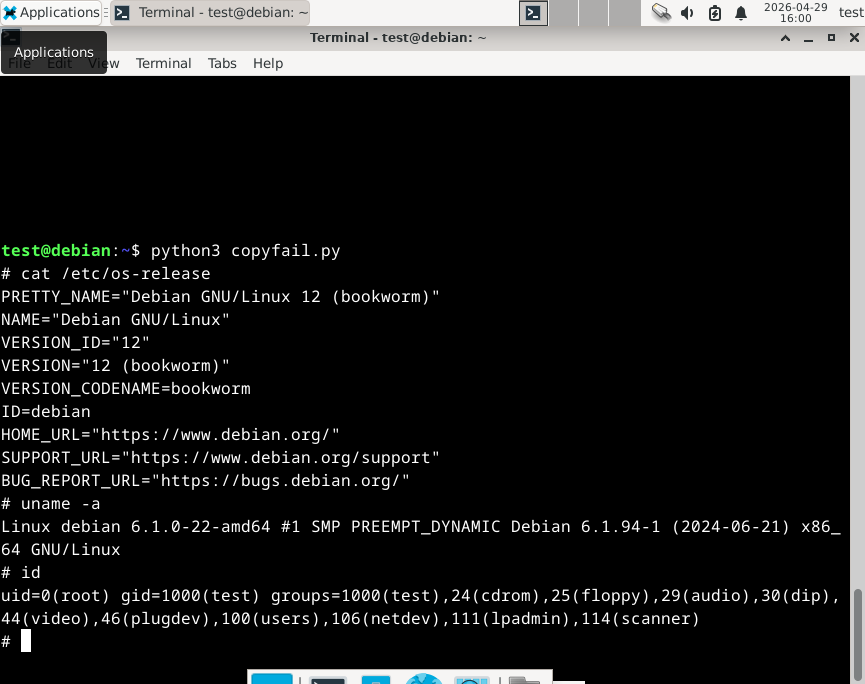
    i have 2 debian 12, kernel 6.1.0-42-amd64 which are not affected.

    1 debian 12 - kernel 6.1.0-38-amd64 affected, event with algif_aead unloaded

    wdormann@infosec.exchangeW This user is from outside of this forum
    wdormann@infosec.exchangeW This user is from outside of this forum
    wdormann@infosec.exchange
    wrote last edited by
    #6

    @randomized
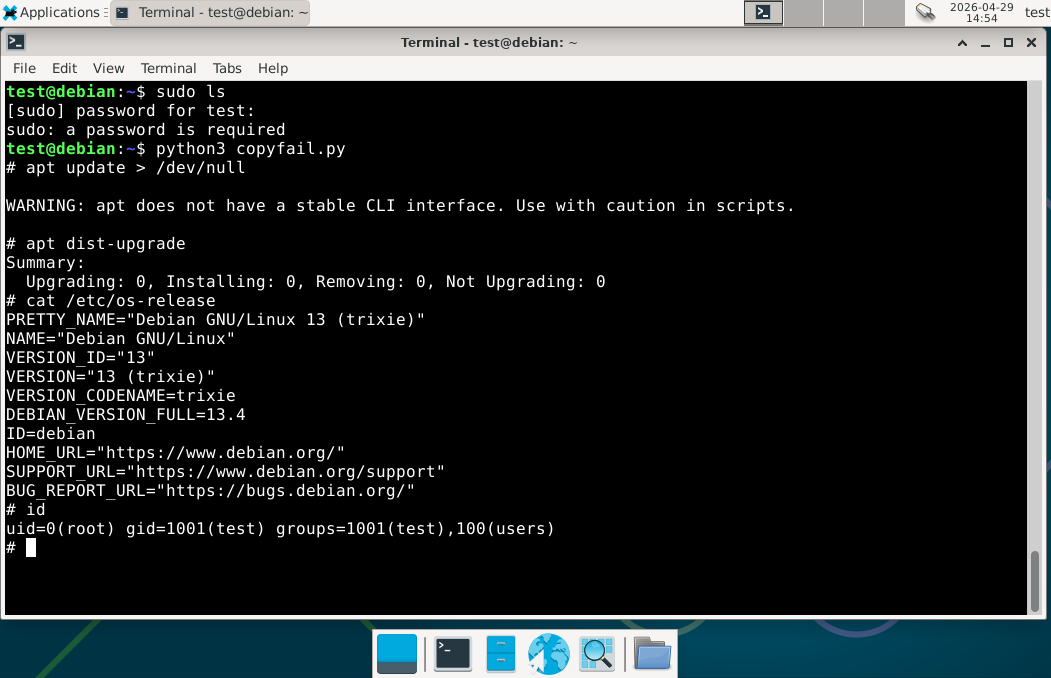
    Interesting that some Debian 12's are not affected, while a fully-patched 13 is affected. πŸ€”
    Link Preview ImageLink Preview Image
    1 Reply Last reply
    0
    • rootwyrm@weird.autosR rootwyrm@weird.autos

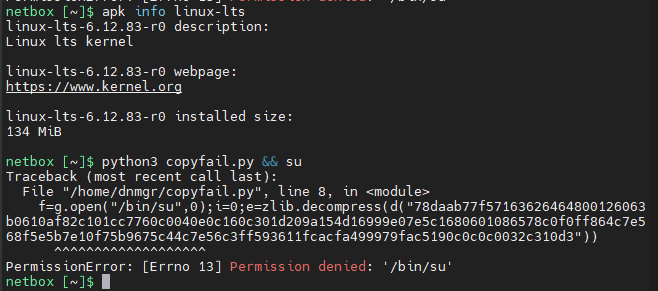
      @wdormann amusingly, it does not appear to be a thing on musl.
      Link Preview Image
      marshray@infosec.exchangeM This user is from outside of this forum
      marshray@infosec.exchangeM This user is from outside of this forum
      marshray@infosec.exchange
      wrote last edited by
      #7

      @rootwyrm @wdormann Likely just a limitation of that particular PoC

      rootwyrm@weird.autosR 1 Reply Last reply
      0
      • wdormann@infosec.exchangeW wdormann@infosec.exchange

        If you're using an obscure distro like "Debian", you may not have a fix available.
        Link Preview Image
        ferrix@mastodon.onlineF This user is from outside of this forum
        ferrix@mastodon.onlineF This user is from outside of this forum
        ferrix@mastodon.online
        wrote last edited by
        #8

        @wdormann inb4 AI agents incorporate this hack as a workaround for not having high enough privs to accomplish their paperclip maxxing

        1 Reply Last reply
        0
        • wdormann@infosec.exchangeW wdormann@infosec.exchange

          If you're using an obscure distro like "Debian", you may not have a fix available.

          Link Preview Image
          wdormann@infosec.exchangeW This user is from outside of this forum
          wdormann@infosec.exchangeW This user is from outside of this forum
          wdormann@infosec.exchange
          wrote last edited by
          #9

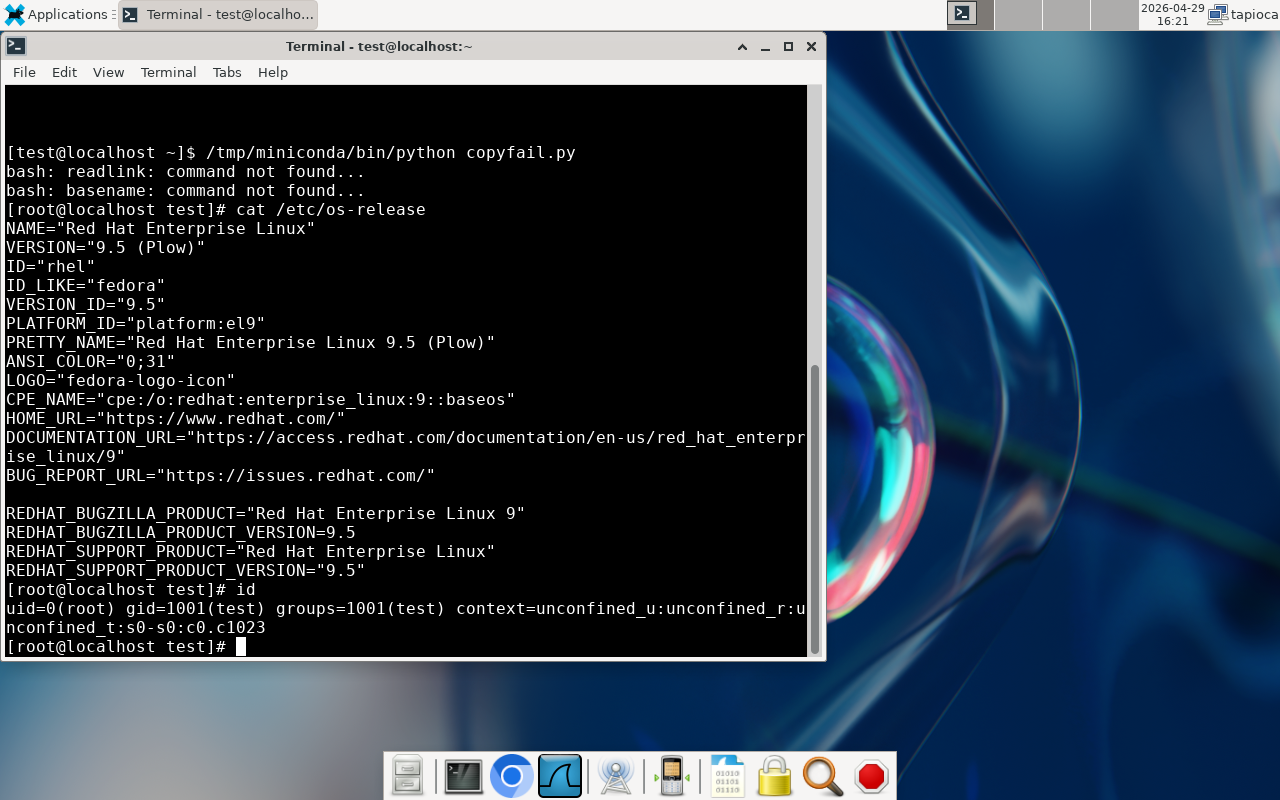
          Or RHEL.
          I suspect that some people use that?
          Link Preview Image
          scorpion8741@infosec.exchangeS wdormann@infosec.exchangeW 2 Replies Last reply
          0
          • wdormann@infosec.exchangeW wdormann@infosec.exchange

            If you're using an obscure distro like "Debian", you may not have a fix available.

            Link Preview Image
            redsakana@infosec.exchangeR This user is from outside of this forum
            redsakana@infosec.exchangeR This user is from outside of this forum
            redsakana@infosec.exchange
            wrote last edited by
            #10

            @wdormann The fix for Debian for users who don't need algif_aead (i.e. most of them): rmmod algif_aead ; find /lib/modules -name algif_aead.ko -exec rm '{}' \;

            1 Reply Last reply
            0
            • marshray@infosec.exchangeM marshray@infosec.exchange

              @rootwyrm @wdormann Likely just a limitation of that particular PoC

              rootwyrm@weird.autosR This user is from outside of this forum
              rootwyrm@weird.autosR This user is from outside of this forum
              rootwyrm@weird.autos
              wrote last edited by
              #11

              @marshray @wdormann the PoC works against the kernel and I already tweaked it as necessary for musl.

              What I'm seeing in musl is that it appears to be failing at step 3 with all suid binaries (I tried several,) possibly because they all set BIND_NOW, or because they don't link against the kernel.

              marshray@infosec.exchangeM 1 Reply Last reply
              0
              • randomized@masto.bikeR This user is from outside of this forum
                randomized@masto.bikeR This user is from outside of this forum
                randomized@masto.bike
                wrote last edited by
                #12

                @wdormann feel free to ask if you need more info on tthose systems

                1 Reply Last reply
                0
                • rootwyrm@weird.autosR rootwyrm@weird.autos

                  @marshray @wdormann the PoC works against the kernel and I already tweaked it as necessary for musl.

                  What I'm seeing in musl is that it appears to be failing at step 3 with all suid binaries (I tried several,) possibly because they all set BIND_NOW, or because they don't link against the kernel.

                  marshray@infosec.exchangeM This user is from outside of this forum
                  marshray@infosec.exchangeM This user is from outside of this forum
                  marshray@infosec.exchange
                  wrote last edited by
                  #13

                  @rootwyrm @wdormann https://hachyderm.io/@dalias/116490206427142497

                  1 Reply Last reply
                  0
                  • wdormann@infosec.exchangeW wdormann@infosec.exchange

                    Or RHEL.
                    I suspect that some people use that?

                    Link Preview Image
                    scorpion8741@infosec.exchangeS This user is from outside of this forum
                    scorpion8741@infosec.exchangeS This user is from outside of this forum
                    scorpion8741@infosec.exchange
                    wrote last edited by
                    #14

                    @wdormann

                    It's even better, the suggested mitigation does not work on RHEL-family systems: https://x.com/grsecurity/status/2049610274840158481?s=20

                    1 Reply Last reply
                    0
                    • wdormann@infosec.exchangeW wdormann@infosec.exchange

                      Or RHEL.
                      I suspect that some people use that?

                      Link Preview Image
                      wdormann@infosec.exchangeW This user is from outside of this forum
                      wdormann@infosec.exchangeW This user is from outside of this forum
                      wdormann@infosec.exchange
                      wrote last edited by
                      #15

                      While this vulnerability seems to be discovered using AI ("Xint Code"), I have to assume that they also let the AI decide how to do the vulnerability coordination as well.

                      • major builds are out as of this writing πŸ˜‚

                        No distros have official updates for CVE-2026-31431. Fedora 42 and newer have updates, but no official advisory or acknowledgement of CVE-2026-31431. So with them it's unclear if it's even intentional. Red Hat, Ubuntu, Amazon Linux, and Suse all have advisories as of now, but NO updates.

                      • disable the algif_aead module as a mitigation. πŸ˜‚

                        Bespoke distros like RHEL don't use a module, it's compiled into the kernel.

                      I can't figure out what the Xint Code angle is with this copyfail stuff. On one hand, yes, it is a true vulnerability that affects a LOT of Linux distros available. And they did submit the bug for fixing to the upstream kernel people.

                      BUT the CVE has only existed for a week. And NONE of the distros IN THEIR ADVISORY had updates available at the time that they pulled the trigger for publication of the shiny copy.fail website.

                      I struggle to think of how this even happens. In all my years of infosec, you're either on board with doing CVD (e.g. coordinating with the former CERT/CC) or you're not (dropping 0day). But this all fits bizarrely in the middle. The publication gives the guise that they did the right thing, (and please use our AI services). But at the same time, they clearly chose to release the vulnerability details and functional exploit before any distro had the ability to properly do anything about it.

                      Either these Xint Code (Theori) people have a hidden agenda or ulterior motive that we aren't aware of yet. Or they're just really bad at coordinated vulnerability disclosure. You pick.

                      wdormann@infosec.exchangeW squaloujenkins@fosstodon.orgS chaz6@ipv6.socialC jtig@infosec.exchangeJ k8ie@toot.mcld.euK 8 Replies Last reply
                      0
                      • wdormann@infosec.exchangeW wdormann@infosec.exchange

                        While this vulnerability seems to be discovered using AI ("Xint Code"), I have to assume that they also let the AI decide how to do the vulnerability coordination as well.

                        • major builds are out as of this writing πŸ˜‚

                          No distros have official updates for CVE-2026-31431. Fedora 42 and newer have updates, but no official advisory or acknowledgement of CVE-2026-31431. So with them it's unclear if it's even intentional. Red Hat, Ubuntu, Amazon Linux, and Suse all have advisories as of now, but NO updates.

                        • disable the algif_aead module as a mitigation. πŸ˜‚

                          Bespoke distros like RHEL don't use a module, it's compiled into the kernel.

                        I can't figure out what the Xint Code angle is with this copyfail stuff. On one hand, yes, it is a true vulnerability that affects a LOT of Linux distros available. And they did submit the bug for fixing to the upstream kernel people.

                        BUT the CVE has only existed for a week. And NONE of the distros IN THEIR ADVISORY had updates available at the time that they pulled the trigger for publication of the shiny copy.fail website.

                        I struggle to think of how this even happens. In all my years of infosec, you're either on board with doing CVD (e.g. coordinating with the former CERT/CC) or you're not (dropping 0day). But this all fits bizarrely in the middle. The publication gives the guise that they did the right thing, (and please use our AI services). But at the same time, they clearly chose to release the vulnerability details and functional exploit before any distro had the ability to properly do anything about it.

                        Either these Xint Code (Theori) people have a hidden agenda or ulterior motive that we aren't aware of yet. Or they're just really bad at coordinated vulnerability disclosure. You pick.

                        wdormann@infosec.exchangeW This user is from outside of this forum
                        wdormann@infosec.exchangeW This user is from outside of this forum
                        wdormann@infosec.exchange
                        wrote last edited by
                        #16

                        If you're curious about IOCs for copyfail, look in syslog for:
                        NET: Registered PF_ALG protocol family
                        for attempts to exploit copyfail on systems that use the vulnerable code as a module. For systems that have the vulnerable code compiled into the kernel, like RHEL, you'll see this line on every boot.
                        And at least for this particular flavor of exploit, a wall-clock nearby:
                        process 'su' launched '/bin/sh with NULL argv: empty string added`
                        is an indication of successful exploitation.

                        But it's worth noting that the "process launched" stuff is merely what this one ITW PoC will leave behind. Other exploitation techniques do not provide the above.

                        As such, perhaps looking for alg: No test for authencesn is perhaps more useful for looking for evidence of the affected endpoint being used.

                        Link Preview Image
                        cliffsesport@mastodon.socialC patpro@social.patpro.netP wdormann@infosec.exchangeW 3 Replies Last reply
                        0
                        • wdormann@infosec.exchangeW wdormann@infosec.exchange

                          If you're curious about IOCs for copyfail, look in syslog for:
                          NET: Registered PF_ALG protocol family
                          for attempts to exploit copyfail on systems that use the vulnerable code as a module. For systems that have the vulnerable code compiled into the kernel, like RHEL, you'll see this line on every boot.
                          And at least for this particular flavor of exploit, a wall-clock nearby:
                          process 'su' launched '/bin/sh with NULL argv: empty string added`
                          is an indication of successful exploitation.

                          But it's worth noting that the "process launched" stuff is merely what this one ITW PoC will leave behind. Other exploitation techniques do not provide the above.

                          As such, perhaps looking for alg: No test for authencesn is perhaps more useful for looking for evidence of the affected endpoint being used.

                          Link Preview Image
                          cliffsesport@mastodon.socialC This user is from outside of this forum
                          cliffsesport@mastodon.socialC This user is from outside of this forum
                          cliffsesport@mastodon.social
                          wrote last edited by
                          #17

                          @wdormann Sigh, as nerd with a homelab working on really understanding stuff this chaos and lack of documentation doesn't help. From what your saying my main 4 distros are all impacted w no patches in sight. My distros, picked in part to mitigate single point of failure of an individual distro: Mint, MX, Kinoite (Fedora immutable), and Manjaro.

                          wdormann@infosec.exchangeW 1 Reply Last reply
                          0
                          • wdormann@infosec.exchangeW wdormann@infosec.exchange

                            If you're curious about IOCs for copyfail, look in syslog for:
                            NET: Registered PF_ALG protocol family
                            for attempts to exploit copyfail on systems that use the vulnerable code as a module. For systems that have the vulnerable code compiled into the kernel, like RHEL, you'll see this line on every boot.
                            And at least for this particular flavor of exploit, a wall-clock nearby:
                            process 'su' launched '/bin/sh with NULL argv: empty string added`
                            is an indication of successful exploitation.

                            But it's worth noting that the "process launched" stuff is merely what this one ITW PoC will leave behind. Other exploitation techniques do not provide the above.

                            As such, perhaps looking for alg: No test for authencesn is perhaps more useful for looking for evidence of the affected endpoint being used.

                            Link Preview Image
                            patpro@social.patpro.netP This user is from outside of this forum
                            patpro@social.patpro.netP This user is from outside of this forum
                            patpro@social.patpro.net
                            wrote last edited by
                            #18

                            @wdormann
                            Ok for Ubuntu, but I can’t find the first one on RHEL 10, instead I have:
                            kernel: alg: No test for authencesn(hmac(sha256),cbc(aes)) (authencesn(hmac(sha256-avx2),cbc-aes-aesni))

                            wdormann@infosec.exchangeW 1 Reply Last reply
                            0
                            • patpro@social.patpro.netP patpro@social.patpro.net

                              @wdormann
                              Ok for Ubuntu, but I can’t find the first one on RHEL 10, instead I have:
                              kernel: alg: No test for authencesn(hmac(sha256),cbc(aes)) (authencesn(hmac(sha256-avx2),cbc-aes-aesni))

                              wdormann@infosec.exchangeW This user is from outside of this forum
                              wdormann@infosec.exchangeW This user is from outside of this forum
                              wdormann@infosec.exchange
                              wrote last edited by
                              #19

                              @patpro
                              RHEL will have NET: Registered PF_ALG protocol family in the log on boot, as it's built into the kernel.
                              Not as a kernel module.

                              patpro@social.patpro.netP 1 Reply Last reply
                              0
                              • wdormann@infosec.exchangeW wdormann@infosec.exchange

                                @patpro
                                RHEL will have NET: Registered PF_ALG protocol family in the log on boot, as it's built into the kernel.
                                Not as a kernel module.

                                patpro@social.patpro.netP This user is from outside of this forum
                                patpro@social.patpro.netP This user is from outside of this forum
                                patpro@social.patpro.net
                                wrote last edited by
                                #20

                                @wdormann OK so in that case it can’t be seen as an IOC on RHEL, is that correct?

                                wdormann@infosec.exchangeW 1 Reply Last reply
                                0
                                • patpro@social.patpro.netP patpro@social.patpro.net

                                  @wdormann OK so in that case it can’t be seen as an IOC on RHEL, is that correct?

                                  wdormann@infosec.exchangeW This user is from outside of this forum
                                  wdormann@infosec.exchangeW This user is from outside of this forum
                                  wdormann@infosec.exchange
                                  wrote last edited by
                                  #21

                                  @patpro
                                  Correct.
                                  That's what I indicated in my post.

                                  for attempts to exploit copyfail on systems that use the vulnerable code as a module

                                  patpro@social.patpro.netP 1 Reply Last reply
                                  0
                                  • wdormann@infosec.exchangeW wdormann@infosec.exchange

                                    @patpro
                                    Correct.
                                    That's what I indicated in my post.

                                    for attempts to exploit copyfail on systems that use the vulnerable code as a module

                                    patpro@social.patpro.netP This user is from outside of this forum
                                    patpro@social.patpro.netP This user is from outside of this forum
                                    patpro@social.patpro.net
                                    wrote last edited by
                                    #22

                                    @wdormann perfect, thank you.

                                    1 Reply Last reply
                                    0
                                    • cliffsesport@mastodon.socialC cliffsesport@mastodon.social

                                      @wdormann Sigh, as nerd with a homelab working on really understanding stuff this chaos and lack of documentation doesn't help. From what your saying my main 4 distros are all impacted w no patches in sight. My distros, picked in part to mitigate single point of failure of an individual distro: Mint, MX, Kinoite (Fedora immutable), and Manjaro.

                                      wdormann@infosec.exchangeW This user is from outside of this forum
                                      wdormann@infosec.exchangeW This user is from outside of this forum
                                      wdormann@infosec.exchange
                                      wrote last edited by
                                      #23

                                      @CliffsEsport
                                      All of those are vulnerable except for Fedora, if it has updates installed.
                                      If you're the only user of these systems, then you have much less to worry about than multi-user systems.

                                      letoams@defcon.socialL cliffsesport@mastodon.socialC 2 Replies Last reply
                                      0
                                      • wdormann@infosec.exchangeW wdormann@infosec.exchange

                                        While this vulnerability seems to be discovered using AI ("Xint Code"), I have to assume that they also let the AI decide how to do the vulnerability coordination as well.

                                        • major builds are out as of this writing πŸ˜‚

                                          No distros have official updates for CVE-2026-31431. Fedora 42 and newer have updates, but no official advisory or acknowledgement of CVE-2026-31431. So with them it's unclear if it's even intentional. Red Hat, Ubuntu, Amazon Linux, and Suse all have advisories as of now, but NO updates.

                                        • disable the algif_aead module as a mitigation. πŸ˜‚

                                          Bespoke distros like RHEL don't use a module, it's compiled into the kernel.

                                        I can't figure out what the Xint Code angle is with this copyfail stuff. On one hand, yes, it is a true vulnerability that affects a LOT of Linux distros available. And they did submit the bug for fixing to the upstream kernel people.

                                        BUT the CVE has only existed for a week. And NONE of the distros IN THEIR ADVISORY had updates available at the time that they pulled the trigger for publication of the shiny copy.fail website.

                                        I struggle to think of how this even happens. In all my years of infosec, you're either on board with doing CVD (e.g. coordinating with the former CERT/CC) or you're not (dropping 0day). But this all fits bizarrely in the middle. The publication gives the guise that they did the right thing, (and please use our AI services). But at the same time, they clearly chose to release the vulnerability details and functional exploit before any distro had the ability to properly do anything about it.

                                        Either these Xint Code (Theori) people have a hidden agenda or ulterior motive that we aren't aware of yet. Or they're just really bad at coordinated vulnerability disclosure. You pick.

                                        squaloujenkins@fosstodon.orgS This user is from outside of this forum
                                        squaloujenkins@fosstodon.orgS This user is from outside of this forum
                                        squaloujenkins@fosstodon.org
                                        wrote last edited by
                                        #24

                                        @wdormann sidenote : I personally tested against several Amazon Linux 2023 (aged a few months to 2 days), all of them are immune to this exploit.
                                        (default 'recommended' image, no tweaks)

                                        wdormann@infosec.exchangeW 1 Reply Last reply
                                        0
                                        • squaloujenkins@fosstodon.orgS squaloujenkins@fosstodon.org

                                          @wdormann sidenote : I personally tested against several Amazon Linux 2023 (aged a few months to 2 days), all of them are immune to this exploit.
                                          (default 'recommended' image, no tweaks)

                                          wdormann@infosec.exchangeW This user is from outside of this forum
                                          wdormann@infosec.exchangeW This user is from outside of this forum
                                          wdormann@infosec.exchange
                                          wrote last edited by
                                          #25

                                          @squalouJenkins
                                          Hmm, that does not jive with what Amazon says

                                          squaloujenkins@fosstodon.orgS 1 Reply Last reply
                                          0
                                          Reply
                                          • Reply as topic
                                          Log in to reply
                                          • Oldest to Newest
                                          • Newest to Oldest
                                          • Most Votes


                                          • Login

                                          • Login or register to search.
                                          • First post
                                            Last post
                                          0
                                          • Categories
                                          • Recent
                                          • Tags
                                          • Popular
                                          • World
                                          • Users
                                          • Groups