Let’s be clear: the US Navy is afraid to escort ships through the Strait of Hormuz because we know now what we knew a decade ago.
-
@mcnado I'm pretty sure if an Arleigh Burke class destroyer planted itself in the middle of the Straight of Hormuz, it would find its vertical launch missile tubes quickly exhausted by all the drones headed it's way and either be forced to retreat or perhaps become open to assault by more sophisticated ship killer missiles.
@Infoseepage @mcnado Not only that, but the fifth fleet just sent its only 4 minesweepers home to Philadelphia for decommissioning. And the LCS classes while _technically_ capable of minesweeping, have never been prooven in any capacity other than sailing from A to B and not catching fire (even that's debatable) . They are literal aluminium tin cans that will be crushed by anything that gets past the close-in weapons. Upside, an Exocet would just fly right through one.
-
@mcnado I'm pretty sure if an Arleigh Burke class destroyer planted itself in the middle of the Straight of Hormuz, it would find its vertical launch missile tubes quickly exhausted by all the drones headed it's way and either be forced to retreat or perhaps become open to assault by more sophisticated ship killer missiles.
@Infoseepage @mcnado curious - can you replenish VLS tubes while at sea? and they don't carry spares do they?
-
Let’s be clear: the US Navy is afraid to escort ships through the Strait of Hormuz because we know now what we knew a decade ago. We know that drone swarms and speedboat swarms are nearly impossible to defeat, and a US warship is a juicy target.
Don’t start shit you can’t finish. And yet, here we are.
@mcnado The concept of consequences is completely foreign to the political "leadership" of this country.
-
R relay@relay.infosec.exchange shared this topic
-
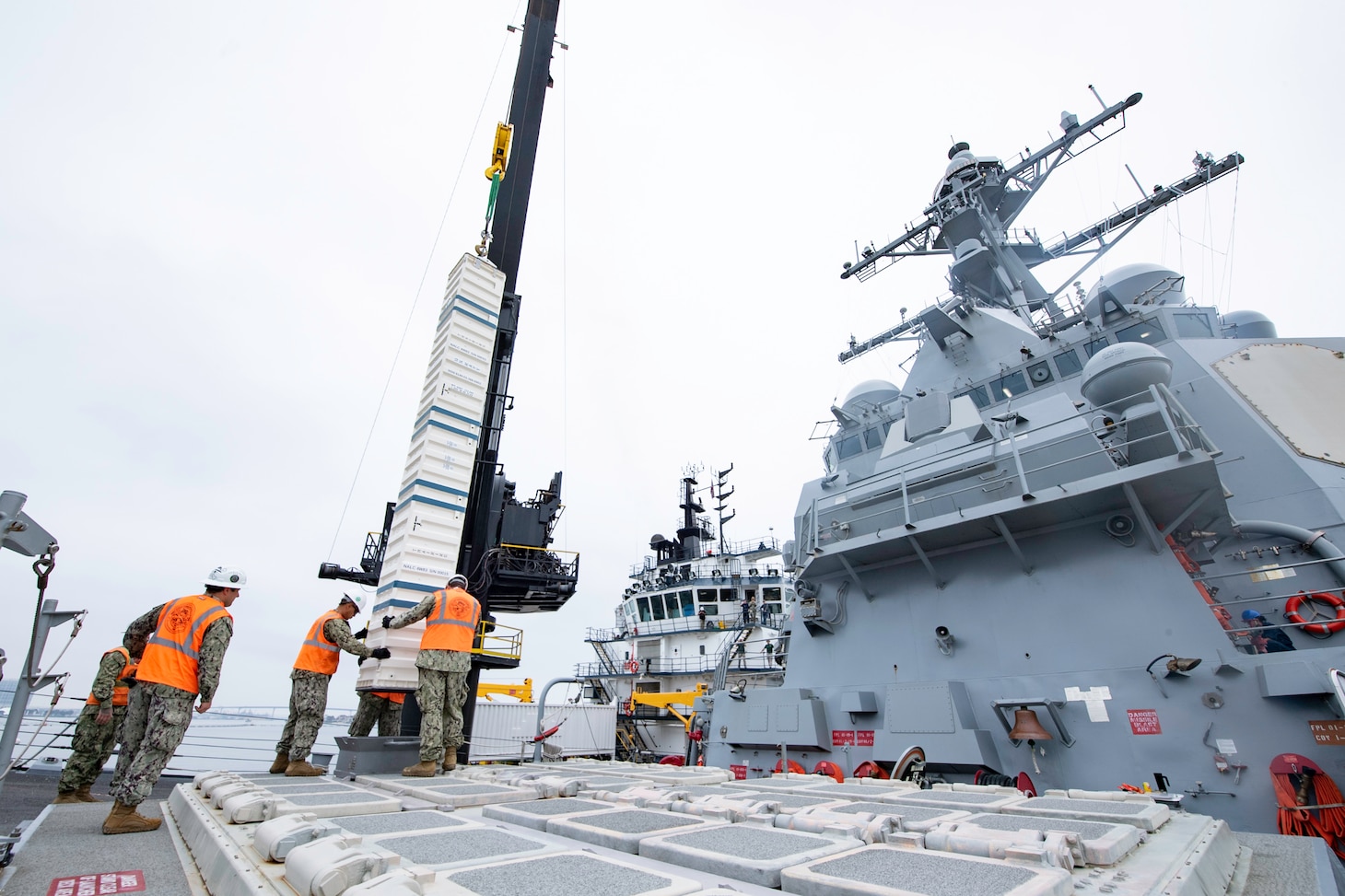
@Infoseepage @mcnado curious - can you replenish VLS tubes while at sea? and they don't carry spares do they?
@tezoatlipoca @mcnado They technically can, but it's a slow process and requires pretty calm seas. They usually just sail out of a theater of conflict into a sheltered harbor where they can be craned in safely.
-
@tezoatlipoca @mcnado They technically can, but it's a slow process and requires pretty calm seas. They usually just sail out of a theater of conflict into a sheltered harbor where they can be craned in safely.
Yeah, I wouldn't want to be doing this in a warzone at any kind of sea-state with actual warheads and possibly even -pre=fuelled missiles.
https://media.defense.gov/2022/Oct/06/2003092795/1460/1280/0/221004-N-UJ411-1429.JPG -
Let’s be clear: the US Navy is afraid to escort ships through the Strait of Hormuz because we know now what we knew a decade ago. We know that drone swarms and speedboat swarms are nearly impossible to defeat, and a US warship is a juicy target.
Don’t start shit you can’t finish. And yet, here we are.
The anthropomorphizing helps no one. The US Navy is not "afraid" to escort ships through the Strait of Hormuz.
It has weighed the risks and benefits, and determined it would be a foolish loss of life and waste of resources, to pursue an unobtainable objective.
-
@mcnado I'm pretty sure if an Arleigh Burke class destroyer planted itself in the middle of the Straight of Hormuz, it would find its vertical launch missile tubes quickly exhausted by all the drones headed it's way and either be forced to retreat or perhaps become open to assault by more sophisticated ship killer missiles.
-
-
R relay@relay.mycrowd.ca shared this topic
-
The anthropomorphizing helps no one. The US Navy is not "afraid" to escort ships through the Strait of Hormuz.
It has weighed the risks and benefits, and determined it would be a foolish loss of life and waste of resources, to pursue an unobtainable objective.
That's pretty hair-splitty. Reasoning your way to a decision to not act is _often_ referred to as fear and doesn't lack clarity. Additionally, suggesting the Navy (or any organization) is experiencing an emotion is a pretty typical way of referring to the leadership and their state.
I don't think anyone thinks the ships themselves are experiencing fear.
Choosing to not send ships into a high-risk zone is succinctly explained as, "Navy afraid to send ships..."
-
The anthropomorphizing helps no one. The US Navy is not "afraid" to escort ships through the Strait of Hormuz.
It has weighed the risks and benefits, and determined it would be a foolish loss of life and waste of resources, to pursue an unobtainable objective.
@huntingdon @mcnado The decision-makers for the US Navy certainly weren't making decisions for the majority of anthropomorphs when they started something with Iran, that much is certain.
-
Let’s be clear: the US Navy is afraid to escort ships through the Strait of Hormuz because we know now what we knew a decade ago. We know that drone swarms and speedboat swarms are nearly impossible to defeat, and a US warship is a juicy target.
Don’t start shit you can’t finish. And yet, here we are.
@mcnado again
-
Let’s be clear: the US Navy is afraid to escort ships through the Strait of Hormuz because we know now what we knew a decade ago. We know that drone swarms and speedboat swarms are nearly impossible to defeat, and a US warship is a juicy target.
Don’t start shit you can’t finish. And yet, here we are.
@mcnado
Let's speak in their language. BABA ( BUY ANYTHING BUT AMERICAN) -
Let’s be clear: the US Navy is afraid to escort ships through the Strait of Hormuz because we know now what we knew a decade ago. We know that drone swarms and speedboat swarms are nearly impossible to defeat, and a US warship is a juicy target.
Don’t start shit you can’t finish. And yet, here we are.
The US Navy has invested heavily in exactly these counter-swarm problems. Systems like CIWS (Phalanx), SeaRAM, and directed energy weapons (the Navy's laser systems are now operationally deployed) are specifically designed for high-volume, low-cost threat saturation. The USS Dewey and other destroyers have demonstrated anti-swarm exercises with real success.
The cost asymmetry argument cuts both ways too — yes, cheap drones are a problem, but laser weapons cost roughly $1 per shot compared to missiles that cost hundreds of thousands.
-
@Infoseepage @mcnado Not only that, but the fifth fleet just sent its only 4 minesweepers home to Philadelphia for decommissioning. And the LCS classes while _technically_ capable of minesweeping, have never been prooven in any capacity other than sailing from A to B and not catching fire (even that's debatable) . They are literal aluminium tin cans that will be crushed by anything that gets past the close-in weapons. Upside, an Exocet would just fly right through one.
@tezoatlipoca @Infoseepage @mcnado
The British Navy discovered during the Falklands War (1982!) that aluminium is not a good material to build warships with.
https://en.wikipedia.org/wiki/RFA_Sir_Galahad_(1966) -
@huntingdon @mcnado The decision-makers for the US Navy certainly weren't making decisions for the majority of anthropomorphs when they started something with Iran, that much is certain.
-
-
The US Navy has invested heavily in exactly these counter-swarm problems. Systems like CIWS (Phalanx), SeaRAM, and directed energy weapons (the Navy's laser systems are now operationally deployed) are specifically designed for high-volume, low-cost threat saturation. The USS Dewey and other destroyers have demonstrated anti-swarm exercises with real success.
The cost asymmetry argument cuts both ways too — yes, cheap drones are a problem, but laser weapons cost roughly $1 per shot compared to missiles that cost hundreds of thousands.
@tuban_muzuru they certainly have, and it may or may not be effective. Of course, we have previously blown open one of our own ships using automated cannon fire for missile defense in the Gulf War, and we had a number of close calls during the recent engagements with the Houthis. I wouldn’t want to be on that tin can if it were moved into the line of fire.
-
Let’s be clear: the US Navy is afraid to escort ships through the Strait of Hormuz because we know now what we knew a decade ago. We know that drone swarms and speedboat swarms are nearly impossible to defeat, and a US warship is a juicy target.
Don’t start shit you can’t finish. And yet, here we are.
@mcnado I was saying at the start of this I'm looking forward to seeing how America reacts to the first sinking of an aircraft carrier. I wonder if someone will bait trumps temper or hubris into sending some ships in
-
@tuban_muzuru they certainly have, and it may or may not be effective. Of course, we have previously blown open one of our own ships using automated cannon fire for missile defense in the Gulf War, and we had a number of close calls during the recent engagements with the Houthis. I wouldn’t want to be on that tin can if it were moved into the line of fire.
The recent embarrassing pratfalls of the Russian Navy are so serious, it calls much of the rationale for a blue water navy into question.