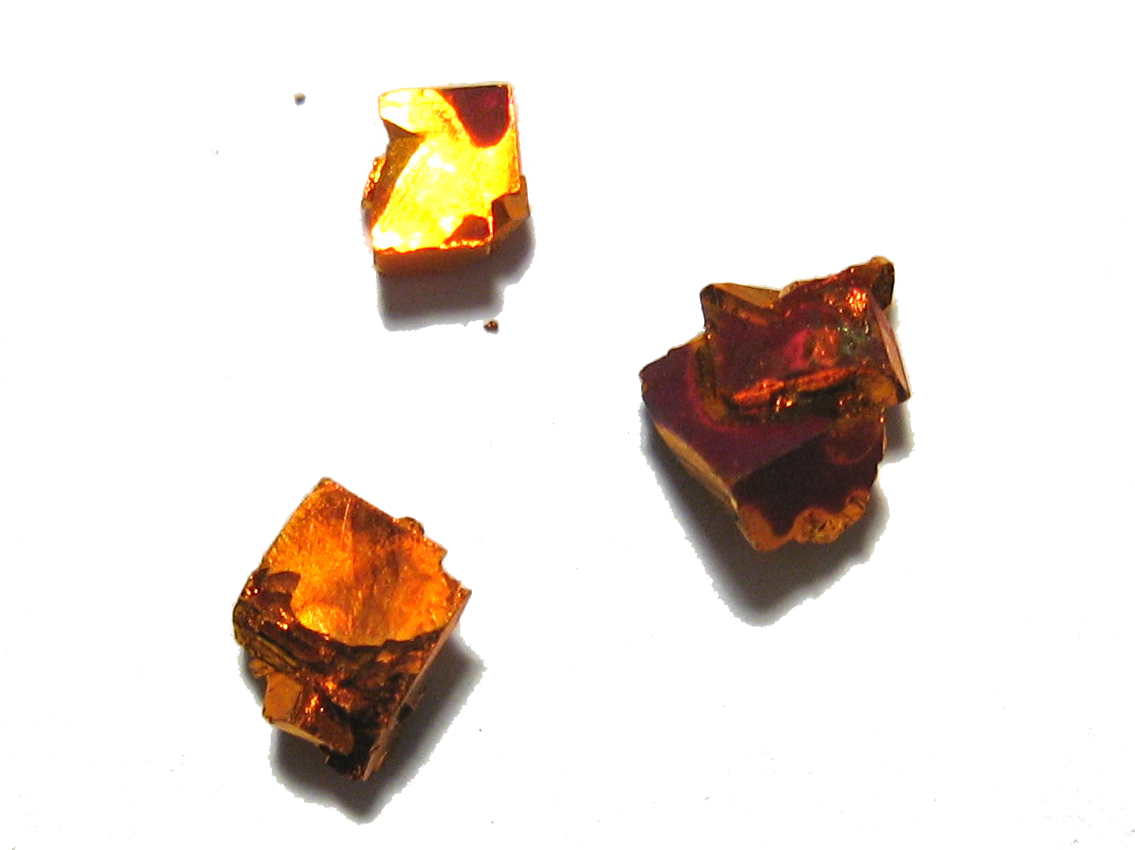
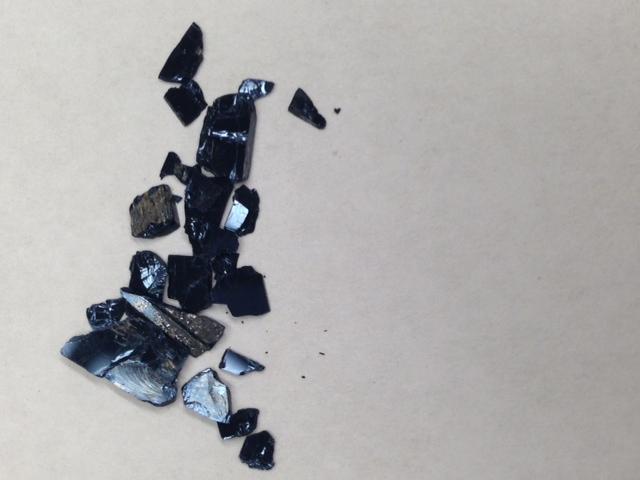
'Blue bronze' is a crystal that can vibrate in two ways: ordinary sound waves, and charge density waves that move faster than sound.
-
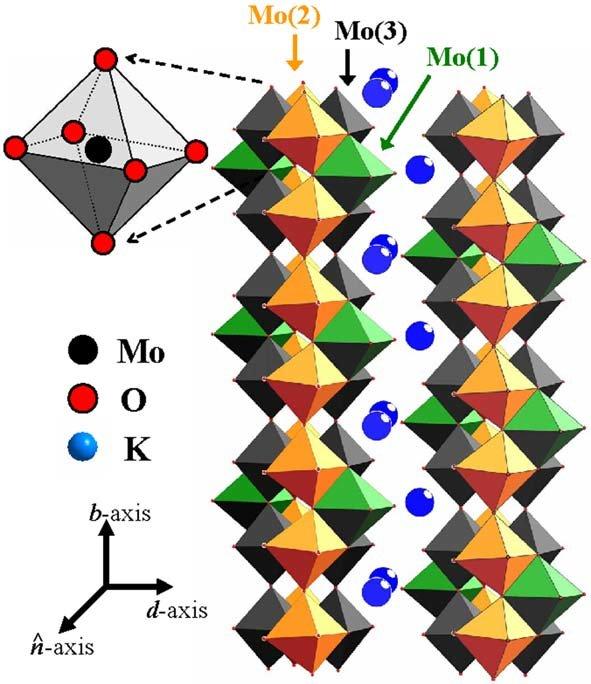
It gets cooler when you look closer. Blue bronze is made of chains of octahedra. Each chain acts like a crystal in 1-dimensional space. Physics in 1d space is weirdly different than in higher dimensions. The electric charge along each chain naturally settles down in a wavy pattern (the 'Peierls instability').
(2/n)
In blue bronze, the wavelength of these charge density ripples is not a rational multiple of the distance between octahedra! As a result [insert math here] it's easy for these ripples to slide back and forth along the octahedra chains.
So we get 'phasons'!
(3/n)
-
In blue bronze, the wavelength of these charge density ripples is not a rational multiple of the distance between octahedra! As a result [insert math here] it's easy for these ripples to slide back and forth along the octahedra chains.
So we get 'phasons'!
(3/n)
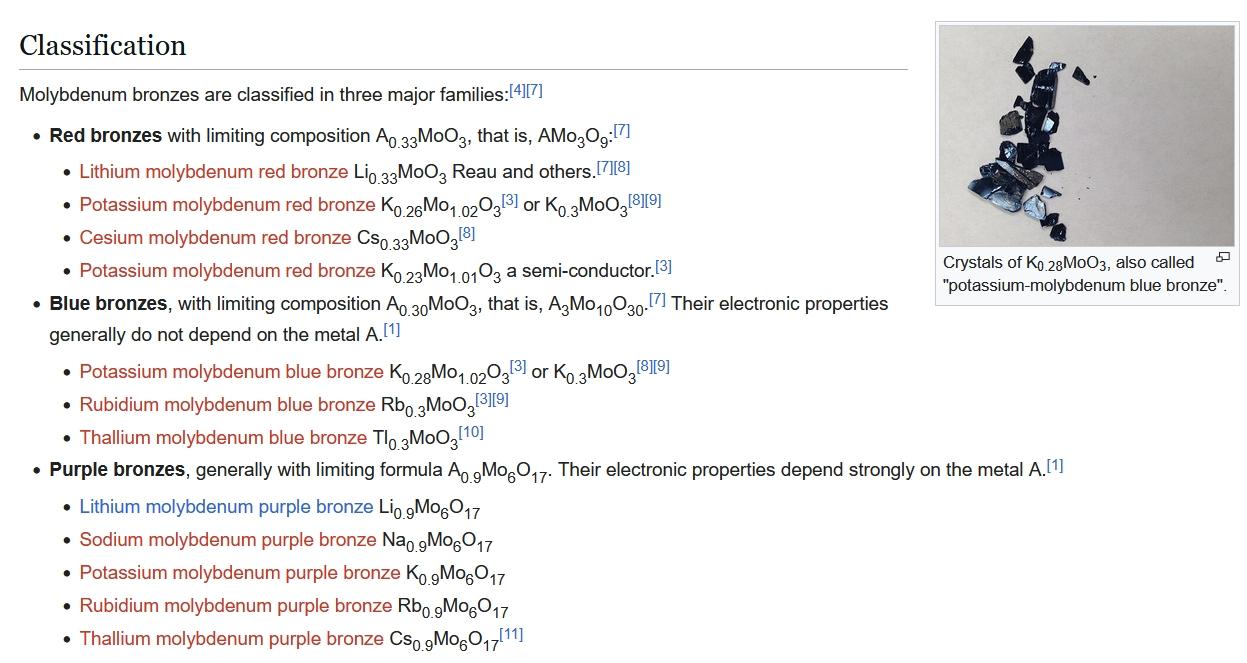
By the way, blue bronzes are just one class of molybenum-oxygen-alkali metal compounds. Boost the amount of alkali a little and you get 'red bronzes'. Boost it a lot more and you get 'purple bronzes'. All these look and act metallic, hence the name.
(4/n)
-
By the way, blue bronzes are just one class of molybenum-oxygen-alkali metal compounds. Boost the amount of alkali a little and you get 'red bronzes'. Boost it a lot more and you get 'purple bronzes'. All these look and act metallic, hence the name.
(4/n)
Here's a longer version:
Blue bronze is K₀.₃MoO₃ — a deep-blue, metallic-looking crystal in the family of alkali molybdenum bronzes first prepared by Wold, Kunnmann, Arnott and Ferretti in 1964. As far as we can tell, these substances don't exist in nature. The name "bronze" is jargon inherited from the sodium tungsten bronzes Wöhler made back in 1825. It refers to the brassy luster of these compounds, not to the copper-tin alloy.
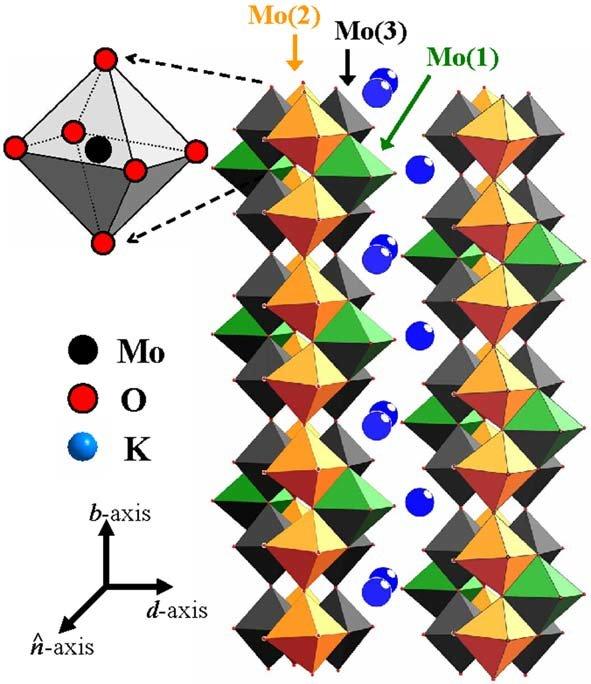
Blue bronze is built from parallel chains of molybdenum and oxygen atoms threading through the crystal, with potassium ions tucked between the layers. The electrons free to carry current are essentially trapped on these chains, like cars on a one-lane highways with no exits. This makes blue bronze a textbook example of a quasi-one-dimensional metal.
This is the setup for a remarkable result Rudolf Peierls established in the 1930s: a one-dimensional metal cannot stay metallic in its ground state! Instead, its atoms spontaneously bunch themselves into pairs, raising a barrier that stops electrons from flowing freely and turning the metal into an insulator. This is the 'Peierls instability'.
Simultaneously, there is a slight periodic rippling in the density of conduction electrons: a 'charge density wave'. But the wavelength of this wave can be an irrational multiple of the spacing between atom pairs! And in blue bronze, this does happen. It's thus an example of an 'aperiodic crystal'.
(5/n)
-
Here's a longer version:
Blue bronze is K₀.₃MoO₃ — a deep-blue, metallic-looking crystal in the family of alkali molybdenum bronzes first prepared by Wold, Kunnmann, Arnott and Ferretti in 1964. As far as we can tell, these substances don't exist in nature. The name "bronze" is jargon inherited from the sodium tungsten bronzes Wöhler made back in 1825. It refers to the brassy luster of these compounds, not to the copper-tin alloy.
Blue bronze is built from parallel chains of molybdenum and oxygen atoms threading through the crystal, with potassium ions tucked between the layers. The electrons free to carry current are essentially trapped on these chains, like cars on a one-lane highways with no exits. This makes blue bronze a textbook example of a quasi-one-dimensional metal.
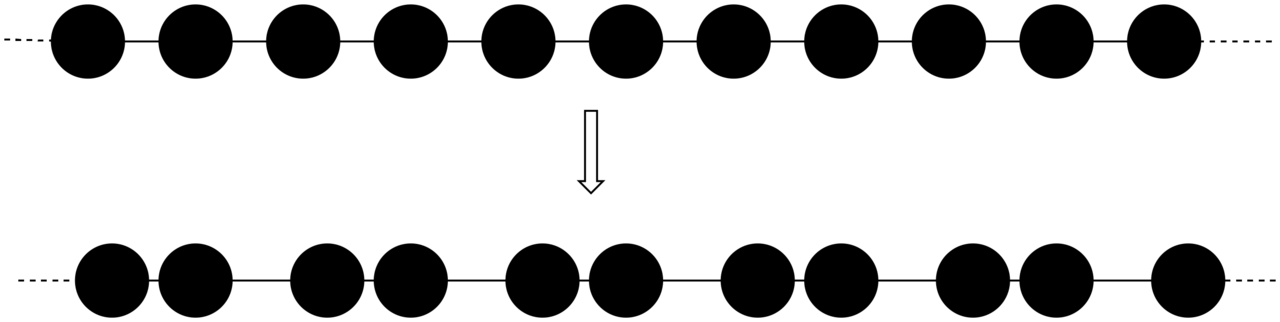
This is the setup for a remarkable result Rudolf Peierls established in the 1930s: a one-dimensional metal cannot stay metallic in its ground state! Instead, its atoms spontaneously bunch themselves into pairs, raising a barrier that stops electrons from flowing freely and turning the metal into an insulator. This is the 'Peierls instability'.
Simultaneously, there is a slight periodic rippling in the density of conduction electrons: a 'charge density wave'. But the wavelength of this wave can be an irrational multiple of the spacing between atom pairs! And in blue bronze, this does happen. It's thus an example of an 'aperiodic crystal'.
(5/n)
In blue bronze the Peierls instability kicks in below about 180 K. The octahedra in the chains bunch into pairs, the crystal abruptly stops conducting, and a charge density wave forms along each chain of octahedra.
Once the charge density wave has formed, it has two natural ways to wiggle:
• its amplitude (how strongly bunched the ripple is) can pulse;
• its phase (where exactly the peaks of the ripple sit along the chain) can shift.Pulsing the amplitude costs real energy. But sliding the phase - pushing the entire density wave bodily along the chains - costs essentially nothing. Why? Because nothing in the crystal cares where the peaks of the ripple happen to land. This is a strange gift of the fact that the charge density waves have a wavelength that's an irrational multiple of the spacing between atom pairs. No position is preferred over any other, so the wave can slip freely!
The resulting slow, almost-free sliding excitation is called a phason, and very gentle, long-stretching versions of it cost vanishingly little energy to excite. There's a deep principle at work here, known as Goldstone's theorem, that says whenever a system spontaneously settles into one of infinitely many equivalent configurations, it must come with a corresponding gentle shimmer mode that explores the alternatives.
So the Peierls instability in blue bronze doesn't just give a static charge density wave: we get phasons too!
(6/n)
-
In blue bronze the Peierls instability kicks in below about 180 K. The octahedra in the chains bunch into pairs, the crystal abruptly stops conducting, and a charge density wave forms along each chain of octahedra.
Once the charge density wave has formed, it has two natural ways to wiggle:
• its amplitude (how strongly bunched the ripple is) can pulse;
• its phase (where exactly the peaks of the ripple sit along the chain) can shift.Pulsing the amplitude costs real energy. But sliding the phase - pushing the entire density wave bodily along the chains - costs essentially nothing. Why? Because nothing in the crystal cares where the peaks of the ripple happen to land. This is a strange gift of the fact that the charge density waves have a wavelength that's an irrational multiple of the spacing between atom pairs. No position is preferred over any other, so the wave can slip freely!
The resulting slow, almost-free sliding excitation is called a phason, and very gentle, long-stretching versions of it cost vanishingly little energy to excite. There's a deep principle at work here, known as Goldstone's theorem, that says whenever a system spontaneously settles into one of infinitely many equivalent configurations, it must come with a corresponding gentle shimmer mode that explores the alternatives.
So the Peierls instability in blue bronze doesn't just give a static charge density wave: we get phasons too!
(6/n)
In clean samples of blue bronze, the phasons can travel faster than sound - indeed, this is the most famous example of a supersonic lattice excitation. It's possible because the restoring force for the sliding mode of charge density waves has nothing to do with the ordinary stiffness of the crystal.
So: confine some electrons to one-dimensional chains, cool the result down, and they organize themselves into rippling waves whose collective motions can outrun sound!
But as we cool blue bronze still further, the density waves lock into step with the underlying atomic lattice, and all these effects go away.
(6/n, n = 6)
-
In clean samples of blue bronze, the phasons can travel faster than sound - indeed, this is the most famous example of a supersonic lattice excitation. It's possible because the restoring force for the sliding mode of charge density waves has nothing to do with the ordinary stiffness of the crystal.
So: confine some electrons to one-dimensional chains, cool the result down, and they organize themselves into rippling waves whose collective motions can outrun sound!
But as we cool blue bronze still further, the density waves lock into step with the underlying atomic lattice, and all these effects go away.
(6/n, n = 6)
@johncarlosbaez Never heard of molybdenum bronzes before. Really interesting. Thanks!
-
@johncarlosbaez Never heard of molybdenum bronzes before. Really interesting. Thanks!
@Thorium - thanks, I just learned about them! While we're at it, we can learn about tungsten bronzes.
-
In clean samples of blue bronze, the phasons can travel faster than sound - indeed, this is the most famous example of a supersonic lattice excitation. It's possible because the restoring force for the sliding mode of charge density waves has nothing to do with the ordinary stiffness of the crystal.
So: confine some electrons to one-dimensional chains, cool the result down, and they organize themselves into rippling waves whose collective motions can outrun sound!
But as we cool blue bronze still further, the density waves lock into step with the underlying atomic lattice, and all these effects go away.
(6/n, n = 6)
-
@johncarlosbaez this is amazing! thank you for taking the time to post it!
@toddsundsted - thanks! Yes, matter does wild stuff!
-
Here's a longer version:
Blue bronze is K₀.₃MoO₃ — a deep-blue, metallic-looking crystal in the family of alkali molybdenum bronzes first prepared by Wold, Kunnmann, Arnott and Ferretti in 1964. As far as we can tell, these substances don't exist in nature. The name "bronze" is jargon inherited from the sodium tungsten bronzes Wöhler made back in 1825. It refers to the brassy luster of these compounds, not to the copper-tin alloy.
Blue bronze is built from parallel chains of molybdenum and oxygen atoms threading through the crystal, with potassium ions tucked between the layers. The electrons free to carry current are essentially trapped on these chains, like cars on a one-lane highways with no exits. This makes blue bronze a textbook example of a quasi-one-dimensional metal.
This is the setup for a remarkable result Rudolf Peierls established in the 1930s: a one-dimensional metal cannot stay metallic in its ground state! Instead, its atoms spontaneously bunch themselves into pairs, raising a barrier that stops electrons from flowing freely and turning the metal into an insulator. This is the 'Peierls instability'.
Simultaneously, there is a slight periodic rippling in the density of conduction electrons: a 'charge density wave'. But the wavelength of this wave can be an irrational multiple of the spacing between atom pairs! And in blue bronze, this does happen. It's thus an example of an 'aperiodic crystal'.
(5/n)
@johncarlosbaez
BTW as a side note, Sir Rudolph Peierls was the author of "Surprises in Theoretical Physics", 1979https://press.princeton.edu/books/paperback/9780691082424/surprises-in-theoretical-physics
"Each chapter focuses on a specific area:
General Quantum Mechanics
Quantum Theory of Atoms
Statistical Mechanics
Condensed Matter
Transport Problems
Many-Body Problems
Nuclear Physics
Relativity"
-
R relay@relay.mycrowd.ca shared this topic