Skip to content
  • Categories
  • Recent
  • Tags
  • Popular
  • World
  • Users
  • Groups
Skins
  • Light
  • Brite
  • Cerulean
  • Cosmo
  • Flatly
  • Journal
  • Litera
  • Lumen
  • Lux
  • Materia
  • Minty
  • Morph
  • Pulse
  • Sandstone
  • Simplex
  • Sketchy
  • Spacelab
  • United
  • Yeti
  • Zephyr
  • Dark
  • Cyborg
  • Darkly
  • Quartz
  • Slate
  • Solar
  • Superhero
  • Vapor

  • Default (Cyborg)
  • No Skin
Collapse
Brand Logo

CIRCLE WITH A DOT

  1. Home
  2. Uncategorized
  3. There's so much I don't understand in Dashlane's disclosure that an attack on its user accounts resulted in the threat actor obtaining 20 encrypted vaults.

There's so much I don't understand in Dashlane's disclosure that an attack on its user accounts resulted in the threat actor obtaining 20 encrypted vaults.

Scheduled Pinned Locked Moved Uncategorized
29 Posts 16 Posters 0 Views
  • Oldest to Newest
  • Newest to Oldest
  • Most Votes
Reply
  • Reply as topic
Log in to reply
This topic has been deleted. Only users with topic management privileges can see it.
  • lauren@mastodon.laurenweinstein.orgL lauren@mastodon.laurenweinstein.org

    @dangoodin Without addressing the specifics of this case (about which I know no more than the public info), some 2fa authentication code implementations can be vulnerable if they are not properly rate limited or otherwise protected against high speed stuffing. Usually of course 2fa follows a successful id/password authentication, though not always.

    dangoodin@infosec.exchangeD This user is from outside of this forum
    dangoodin@infosec.exchangeD This user is from outside of this forum
    dangoodin@infosec.exchange
    wrote last edited by
    #4

    @lauren

    Right, but none of that addresses the questions I'm asking here.

    lauren@mastodon.laurenweinstein.orgL 1 Reply Last reply
    0
    • dangoodin@infosec.exchangeD dangoodin@infosec.exchange

      @lauren

      Right, but none of that addresses the questions I'm asking here.

      lauren@mastodon.laurenweinstein.orgL This user is from outside of this forum
      lauren@mastodon.laurenweinstein.orgL This user is from outside of this forum
      lauren@mastodon.laurenweinstein.org
      wrote last edited by
      #5

      @dangoodin You asked about TOTP. Yes, a broken implementation can be stuffed.

      dangoodin@infosec.exchangeD 1 Reply Last reply
      0
      • dangoodin@infosec.exchangeD dangoodin@infosec.exchange

        There's so much I don't understand in Dashlane's disclosure that an attack on its user accounts resulted in the threat actor obtaining 20 encrypted vaults.

        Just a moment...

        favicon

        (support.dashlane.com)

        What does it mean to brute force 2fa? Are we talking about TOTPs? That doesn't make sense because TOTPs change every 30-90 seconds, so there's no way for an attacker to meaningfully exhaust key space before it resets all over -- unless the attacker has the ability to pump all 7,700 combinations in <90 seconds, and DL doesn't have any sort of rate limiting.

        Also, if the attacker is brute forcing 2fa, doesn't that by necessity mean the attacker already defeated the first factor? How did that occur?

        I don't know if my confusion is the result of me not knowing the how the Dashlane product works or if it's just Dashlane being opaque.

        Can anyone help me read the tea leaves?

        infoseepage@mastodon.socialI This user is from outside of this forum
        infoseepage@mastodon.socialI This user is from outside of this forum
        infoseepage@mastodon.social
        wrote last edited by
        #6

        @dangoodin How many digits is the 2FA code which is sent? It's possible that these users had password, reuse issues and were relying on the 2FA to keep them safe. It's also possible for services to leak information about whether a password is valid or invalid, if it responds differently in some way, when a user enters a valid password, than an invalid one. Maybe the hackers were able to enumerate a list of users of the service in some way and then try passwords from known breaches.

        infoseepage@mastodon.socialI 1 Reply Last reply
        0
        • lauren@mastodon.laurenweinstein.orgL lauren@mastodon.laurenweinstein.org

          @dangoodin You asked about TOTP. Yes, a broken implementation can be stuffed.

          dangoodin@infosec.exchangeD This user is from outside of this forum
          dangoodin@infosec.exchangeD This user is from outside of this forum
          dangoodin@infosec.exchange
          wrote last edited by
          #7

          @lauren

          Yes, with more than 4,000 guesses in 40 seconds to be successful. That sounds possible, but also leaves a large margin for doubt.

          lauren@mastodon.laurenweinstein.orgL guillaumerossolini@infosec.exchangeG 2 Replies Last reply
          0
          • infoseepage@mastodon.socialI infoseepage@mastodon.social

            @dangoodin How many digits is the 2FA code which is sent? It's possible that these users had password, reuse issues and were relying on the 2FA to keep them safe. It's also possible for services to leak information about whether a password is valid or invalid, if it responds differently in some way, when a user enters a valid password, than an invalid one. Maybe the hackers were able to enumerate a list of users of the service in some way and then try passwords from known breaches.

            infoseepage@mastodon.socialI This user is from outside of this forum
            infoseepage@mastodon.socialI This user is from outside of this forum
            infoseepage@mastodon.social
            wrote last edited by
            #8

            @dangoodin Assuming they somehow did manage to hit upon correct username/passwords for a subset of the services users, it's then dependent on the service's implementation of rate limiting and other protection mechanisms in their 2FA to prevent the hacker getting in and stealing the user's info.

            infoseepage@mastodon.socialI 1 Reply Last reply
            0
            • dangoodin@infosec.exchangeD dangoodin@infosec.exchange

              @lauren

              Yes, with more than 4,000 guesses in 40 seconds to be successful. That sounds possible, but also leaves a large margin for doubt.

              lauren@mastodon.laurenweinstein.orgL This user is from outside of this forum
              lauren@mastodon.laurenweinstein.orgL This user is from outside of this forum
              lauren@mastodon.laurenweinstein.org
              wrote last edited by
              #9

              @dangoodin It's doable. And it happens. Set enough automated systems to work at it and it can succeed enough to be profitable, just like spam. Low percentage success doesn't mean they don't do it.

              i@toot.pouyan.netI 1 Reply Last reply
              0
              • infoseepage@mastodon.socialI infoseepage@mastodon.social

                @dangoodin Assuming they somehow did manage to hit upon correct username/passwords for a subset of the services users, it's then dependent on the service's implementation of rate limiting and other protection mechanisms in their 2FA to prevent the hacker getting in and stealing the user's info.

                infoseepage@mastodon.socialI This user is from outside of this forum
                infoseepage@mastodon.socialI This user is from outside of this forum
                infoseepage@mastodon.social
                wrote last edited by
                #10

                @dangoodin Imagine you have large botnet to throw out the problem of cracking the 2FA code. You've got basically got tens or hundreds of thousands of unique IP addresses all attempting logins with the correct username and password. If there's only minimal rate limiting on a per IP basis, maybe each of those IP's gets 10 guesses before being put in slow down mode. Or maybe you simply make the attempts at a fairly slow rate, but because of the size of your botnet, the overall gas rate is high.

                infoseepage@mastodon.socialI 1 Reply Last reply
                0
                • dangoodin@infosec.exchangeD dangoodin@infosec.exchange

                  There's so much I don't understand in Dashlane's disclosure that an attack on its user accounts resulted in the threat actor obtaining 20 encrypted vaults.

                  Just a moment...

                  favicon

                  (support.dashlane.com)

                  What does it mean to brute force 2fa? Are we talking about TOTPs? That doesn't make sense because TOTPs change every 30-90 seconds, so there's no way for an attacker to meaningfully exhaust key space before it resets all over -- unless the attacker has the ability to pump all 7,700 combinations in <90 seconds, and DL doesn't have any sort of rate limiting.

                  Also, if the attacker is brute forcing 2fa, doesn't that by necessity mean the attacker already defeated the first factor? How did that occur?

                  I don't know if my confusion is the result of me not knowing the how the Dashlane product works or if it's just Dashlane being opaque.

                  Can anyone help me read the tea leaves?

                  drs1969@mstdn.socialD This user is from outside of this forum
                  drs1969@mstdn.socialD This user is from outside of this forum
                  drs1969@mstdn.social
                  wrote last edited by
                  #11

                  @dangoodin it may only be 20 encrypted vaults but i reckon a lot more users affected. Because I'm one of them.

                  1 Reply Last reply
                  0
                  • infoseepage@mastodon.socialI infoseepage@mastodon.social

                    @dangoodin Imagine you have large botnet to throw out the problem of cracking the 2FA code. You've got basically got tens or hundreds of thousands of unique IP addresses all attempting logins with the correct username and password. If there's only minimal rate limiting on a per IP basis, maybe each of those IP's gets 10 guesses before being put in slow down mode. Or maybe you simply make the attempts at a fairly slow rate, but because of the size of your botnet, the overall gas rate is high.

                    infoseepage@mastodon.socialI This user is from outside of this forum
                    infoseepage@mastodon.socialI This user is from outside of this forum
                    infoseepage@mastodon.social
                    wrote last edited by
                    #12

                    @dangoodin So, you've got this big botnet slowly grinding away making guesses at a particular user's momentary 2FA code and apparently the service's real-time monitoring and logging isn't active enough to go "Oh, hello. This is weird. We've got 150k failed login attempts on this one username. Maybe we should do something about it."

                    1 Reply Last reply
                    0
                    • cibyr@omg.wtf.shC cibyr@omg.wtf.sh

                      @dangoodin you only need to try every option if you want to guarantee getting into a particular account. If you try a small number of codes against a large number of accounts, statistically some of them will match. And if that locks out the rest of the accounts, so be it...

                      guillaumerossolini@infosec.exchangeG This user is from outside of this forum
                      guillaumerossolini@infosec.exchangeG This user is from outside of this forum
                      guillaumerossolini@infosec.exchange
                      wrote last edited by
                      #13

                      @cibyr and that’s essentially a denial of service, so if you’re trying to hurt the company, job done
                      @dangoodin

                      1 Reply Last reply
                      0
                      • dangoodin@infosec.exchangeD dangoodin@infosec.exchange

                        @lauren

                        Yes, with more than 4,000 guesses in 40 seconds to be successful. That sounds possible, but also leaves a large margin for doubt.

                        guillaumerossolini@infosec.exchangeG This user is from outside of this forum
                        guillaumerossolini@infosec.exchangeG This user is from outside of this forum
                        guillaumerossolini@infosec.exchange
                        wrote last edited by
                        #14

                        @dangoodin the article states that they did automatically protect against high rates

                        @lauren

                        lauren@mastodon.laurenweinstein.orgL 1 Reply Last reply
                        1
                        0
                        • R relay@relay.infosec.exchange shared this topic
                        • guillaumerossolini@infosec.exchangeG guillaumerossolini@infosec.exchange

                          @dangoodin the article states that they did automatically protect against high rates

                          @lauren

                          lauren@mastodon.laurenweinstein.orgL This user is from outside of this forum
                          lauren@mastodon.laurenweinstein.orgL This user is from outside of this forum
                          lauren@mastodon.laurenweinstein.org
                          wrote last edited by
                          #15

                          @GuillaumeRossolini @dangoodin If you can't stuff it, and if it is a TOTP system, the only other likely possibilities involve issues like deeper implementation issues (e.g., more than one response will match, making the search space much smaller, etc.). Or there's something else going on entirely. Not enough info.

                          guillaumerossolini@infosec.exchangeG 1 Reply Last reply
                          0
                          • cibyr@omg.wtf.shC cibyr@omg.wtf.sh

                            @dangoodin you only need to try every option if you want to guarantee getting into a particular account. If you try a small number of codes against a large number of accounts, statistically some of them will match. And if that locks out the rest of the accounts, so be it...

                            dangoodin@infosec.exchangeD This user is from outside of this forum
                            dangoodin@infosec.exchangeD This user is from outside of this forum
                            dangoodin@infosec.exchange
                            wrote last edited by
                            #16

                            @cibyr

                            Right, but to brute force 2FA, don't you first have to break the first authentication factor? That would mean the number of accounts you can brute force is limited to only those you have already compromised.

                            sophieschmieg@infosec.exchangeS 1 Reply Last reply
                            0
                            • lauren@mastodon.laurenweinstein.orgL lauren@mastodon.laurenweinstein.org

                              @GuillaumeRossolini @dangoodin If you can't stuff it, and if it is a TOTP system, the only other likely possibilities involve issues like deeper implementation issues (e.g., more than one response will match, making the search space much smaller, etc.). Or there's something else going on entirely. Not enough info.

                              guillaumerossolini@infosec.exchangeG This user is from outside of this forum
                              guillaumerossolini@infosec.exchangeG This user is from outside of this forum
                              guillaumerossolini@infosec.exchange
                              wrote last edited by
                              #17

                              @lauren oh yes the article is definitely low on details and it reads like they are using words that may bring some empathy

                              I’m guessing there was a combination of a leak somewhere that allowed the attacker to spray passwords, identifying the accounts they could even try to attack further

                              Then the brute force aspect on those, but really, how fast did their automated system catch on? Can it be called a brute force attack if each account saw 5 tries before being put on hold?

                              Or did they consider that because of how many accounts were targeted (which they don’t say), it still counts as brute forcing?

                              And this gem

                              Our team has taken steps to mitigate the risk of future incidents and continue to harden our resiliency

                              @dangoodin

                              1 Reply Last reply
                              0
                              • dangoodin@infosec.exchangeD dangoodin@infosec.exchange

                                There's so much I don't understand in Dashlane's disclosure that an attack on its user accounts resulted in the threat actor obtaining 20 encrypted vaults.

                                Just a moment...

                                favicon

                                (support.dashlane.com)

                                What does it mean to brute force 2fa? Are we talking about TOTPs? That doesn't make sense because TOTPs change every 30-90 seconds, so there's no way for an attacker to meaningfully exhaust key space before it resets all over -- unless the attacker has the ability to pump all 7,700 combinations in <90 seconds, and DL doesn't have any sort of rate limiting.

                                Also, if the attacker is brute forcing 2fa, doesn't that by necessity mean the attacker already defeated the first factor? How did that occur?

                                I don't know if my confusion is the result of me not knowing the how the Dashlane product works or if it's just Dashlane being opaque.

                                Can anyone help me read the tea leaves?

                                bradr@infosec.exchangeB This user is from outside of this forum
                                bradr@infosec.exchangeB This user is from outside of this forum
                                bradr@infosec.exchange
                                wrote last edited by
                                #18

                                @dangoodin

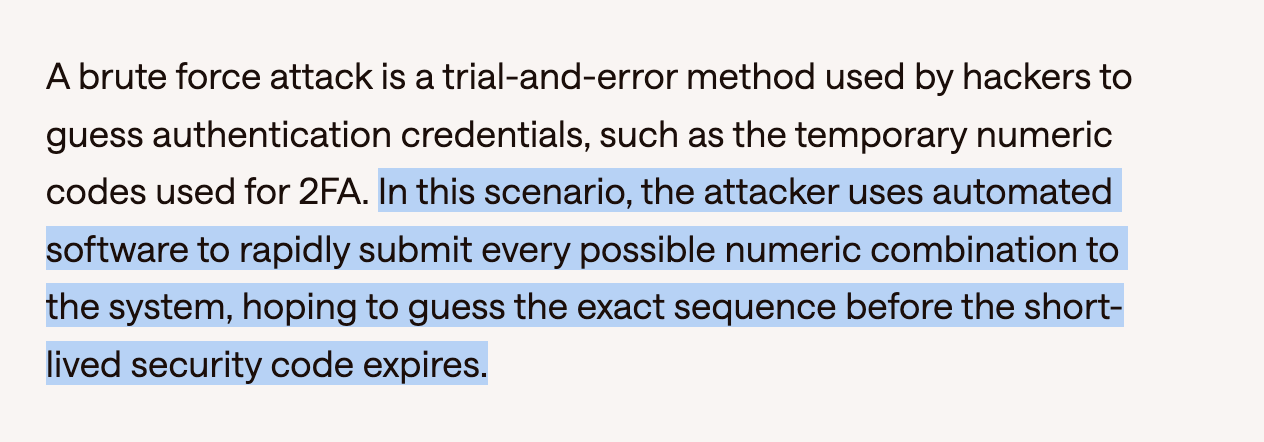
                                No rate limiting? No lockout or cooldown after n failures?

                                Or just let 'em rip at one guess every 30ms?
                                Link Preview Image
                                bob_zim@infosec.exchangeB 1 Reply Last reply
                                0
                                • R relay@relay.mycrowd.ca shared this topic
                                • lauren@mastodon.laurenweinstein.orgL lauren@mastodon.laurenweinstein.org

                                  @dangoodin It's doable. And it happens. Set enough automated systems to work at it and it can succeed enough to be profitable, just like spam. Low percentage success doesn't mean they don't do it.

                                  i@toot.pouyan.netI This user is from outside of this forum
                                  i@toot.pouyan.netI This user is from outside of this forum
                                  i@toot.pouyan.net
                                  wrote last edited by
                                  #19

                                  @lauren@mastodon.laurenweinstein.org it reminds me of AuthQuake:

                                  The vulnerability identified by Oasis, at its core, concerns a lack of rate limit and an extended time interval when providing and validating these one-time codes, thereby allowing a malicious actor to rapidly spawn new sessions and enumerate all possible permutations of the code (i.e., one million) without even alerting the victim about the failed login attempts.

                                  @dangoodin@infosec.exchange

                                  1 Reply Last reply
                                  0
                                  • dangoodin@infosec.exchangeD dangoodin@infosec.exchange

                                    There's so much I don't understand in Dashlane's disclosure that an attack on its user accounts resulted in the threat actor obtaining 20 encrypted vaults.

                                    Just a moment...

                                    favicon

                                    (support.dashlane.com)

                                    What does it mean to brute force 2fa? Are we talking about TOTPs? That doesn't make sense because TOTPs change every 30-90 seconds, so there's no way for an attacker to meaningfully exhaust key space before it resets all over -- unless the attacker has the ability to pump all 7,700 combinations in <90 seconds, and DL doesn't have any sort of rate limiting.

                                    Also, if the attacker is brute forcing 2fa, doesn't that by necessity mean the attacker already defeated the first factor? How did that occur?

                                    I don't know if my confusion is the result of me not knowing the how the Dashlane product works or if it's just Dashlane being opaque.

                                    Can anyone help me read the tea leaves?

                                    spartan_1986@infosec.exchangeS This user is from outside of this forum
                                    spartan_1986@infosec.exchangeS This user is from outside of this forum
                                    spartan_1986@infosec.exchange
                                    wrote last edited by
                                    #20

                                    @dangoodin This assumes TOTP was the method of 2FA, but let’s go with that and assume it was in use. What if this was really a credential stuffing attack where the threat actor already had a password fro another compromised service. So knowing that some people (I’m being kind) use the same password on multiple accounts they start feeding those passwords to another service. When they get an unlock, they can the try a traditional brute force. Or, they can be smart and use email account passwords. Then they could tell Dashlane “nope, don’t have my authenticator app” and ask for verification by another means. Does anyone know if Dashlane’s default account recovery method is email? I hope to god it isn’t SMS.

                                    mkoek@mastodon.nlM 1 Reply Last reply
                                    0
                                    • dangoodin@infosec.exchangeD dangoodin@infosec.exchange

                                      There's so much I don't understand in Dashlane's disclosure that an attack on its user accounts resulted in the threat actor obtaining 20 encrypted vaults.

                                      Just a moment...

                                      favicon

                                      (support.dashlane.com)

                                      What does it mean to brute force 2fa? Are we talking about TOTPs? That doesn't make sense because TOTPs change every 30-90 seconds, so there's no way for an attacker to meaningfully exhaust key space before it resets all over -- unless the attacker has the ability to pump all 7,700 combinations in <90 seconds, and DL doesn't have any sort of rate limiting.

                                      Also, if the attacker is brute forcing 2fa, doesn't that by necessity mean the attacker already defeated the first factor? How did that occur?

                                      I don't know if my confusion is the result of me not knowing the how the Dashlane product works or if it's just Dashlane being opaque.

                                      Can anyone help me read the tea leaves?

                                      nyanbinary@infosec.exchangeN This user is from outside of this forum
                                      nyanbinary@infosec.exchangeN This user is from outside of this forum
                                      nyanbinary@infosec.exchange
                                      wrote last edited by
                                      #21

                                      @dangoodin the "MFA" thing is misleading. Registering a device ONLY requires the email address & a 6-digit numeric "OTP" (e.g. TOTP or OTP via email iirc) which they call "2FA/MFA". Afterwards you can then access the vault "offline", see 4.1.2 here: https://support.dashlane.com/hc/en-us/articles/32877433567634-4-Credential-security-in-detail

                                      Not quite sure what "brute force" means here. For non-TOTP this could be an issue with OTP lifetime? For TOTP this could just be "randomly trying with a 1 in 100000 chance untl you get lucky a few times"?

                                      It's a baffling decision & there is a reason other password managers don't just require an OTP to access the vault. It's also terrible communication imo.

                                      bob_zim@infosec.exchangeB 1 Reply Last reply
                                      0
                                      • bradr@infosec.exchangeB bradr@infosec.exchange

                                        @dangoodin

                                        No rate limiting? No lockout or cooldown after n failures?

                                        Or just let 'em rip at one guess every 30ms?

                                        Link Preview Image
                                        bob_zim@infosec.exchangeB This user is from outside of this forum
                                        bob_zim@infosec.exchangeB This user is from outside of this forum
                                        bob_zim@infosec.exchange
                                        wrote last edited by
                                        #22

                                        @bradr @dangoodin Rate limiting is hard to do well. If you apply it per client IP, then a big botnet can all guess in parallel. If you apply it per account, then an attacker in one place can lock out the legitimate user wherever they are.

                                        1 Reply Last reply
                                        0
                                        • dangoodin@infosec.exchangeD dangoodin@infosec.exchange

                                          @cibyr

                                          Right, but to brute force 2FA, don't you first have to break the first authentication factor? That would mean the number of accounts you can brute force is limited to only those you have already compromised.

                                          sophieschmieg@infosec.exchangeS This user is from outside of this forum
                                          sophieschmieg@infosec.exchangeS This user is from outside of this forum
                                          sophieschmieg@infosec.exchange
                                          wrote last edited by
                                          #23

                                          @dangoodin @cibyr yeah this type of multi user attack doesn't really make much sense, you still only get one try per request. A second factor is usually six decimal digits, meaning the attacker has a one in a million chance of outright guessing it. Usually rate limiting should kick in before anything gets broken.

                                          erikvanstraten@todon.nlE targetdrone@mastodon.socialT 2 Replies Last reply
                                          0
                                          Reply
                                          • Reply as topic
                                          Log in to reply
                                          • Oldest to Newest
                                          • Newest to Oldest
                                          • Most Votes


                                          • Login

                                          • Login or register to search.
                                          • First post
                                            Last post
                                          0
                                          • Categories
                                          • Recent
                                          • Tags
                                          • Popular
                                          • World
                                          • Users
                                          • Groups