Skip to content
  • Categories
  • Recent
  • Tags
  • Popular
  • World
  • Users
  • Groups
Skins
  • Light
  • Brite
  • Cerulean
  • Cosmo
  • Flatly
  • Journal
  • Litera
  • Lumen
  • Lux
  • Materia
  • Minty
  • Morph
  • Pulse
  • Sandstone
  • Simplex
  • Sketchy
  • Spacelab
  • United
  • Yeti
  • Zephyr
  • Dark
  • Cyborg
  • Darkly
  • Quartz
  • Slate
  • Solar
  • Superhero
  • Vapor

  • Default (Cyborg)
  • No Skin
Collapse
Brand Logo

CIRCLE WITH A DOT

  1. Home
  2. Uncategorized
  3. The Windows 95 user interface: a case study in usability engineering

The Windows 95 user interface: a case study in usability engineering

Scheduled Pinned Locked Moved Uncategorized
windows
6 Posts 4 Posters 0 Views
  • Oldest to Newest
  • Newest to Oldest
  • Most Votes
Reply
  • Reply as topic
Log in to reply
This topic has been deleted. Only users with topic management privileges can see it.
  • osnews@mstdn.socialO This user is from outside of this forum
    osnews@mstdn.socialO This user is from outside of this forum
    osnews@mstdn.social
    wrote last edited by
    #1

    The Windows 95 user interface: a case study in usability engineering

    If this isn't catnip to the average OSNews reader, I don't know what is.

    Windows 95 is a comprehensive upgrade to the Windows 3.1 and Windows for Workgroups 3.11 products. Many changes have been made in almost every area of Windows, with the user interface being no exception. This paper discusses

    Link Preview Image
    The Windows 95 user interface: a case study in usability engineering – OSnews

    favicon

    (www.osnews.com)

    #Windows

    julian@fietkau.socialJ 1 Reply Last reply
    2
    0
    • osnews@mstdn.socialO osnews@mstdn.social

      The Windows 95 user interface: a case study in usability engineering

      If this isn't catnip to the average OSNews reader, I don't know what is.

      Windows 95 is a comprehensive upgrade to the Windows 3.1 and Windows for Workgroups 3.11 products. Many changes have been made in almost every area of Windows, with the user interface being no exception. This paper discusses

      Link Preview Image
      The Windows 95 user interface: a case study in usability engineering – OSnews

      favicon

      (www.osnews.com)

      #Windows

      julian@fietkau.socialJ This user is from outside of this forum
      julian@fietkau.socialJ This user is from outside of this forum
      julian@fietkau.social
      wrote last edited by
      #2

      @osnews This is my academic field (as in, I literally have a PhD in it) and I believe you are 100% correct in the last paragraph @thomholwerda.

      We can trace from the 1980s to the 2010s how usability engineering and then UX was assimilated by the bean counters. In the era of usability lab tests, you'd invite people over, watch them use your software, and carefully take note of mistakes and stumbling blocks, mood shifts, things that work but only kinda, etc.

      Holistic work. Difficult to KPI-ify.

      julian@fietkau.socialJ 1 Reply Last reply
      0
      • R relay@relay.infosec.exchange shared this topic
      • julian@fietkau.socialJ julian@fietkau.social

        @osnews This is my academic field (as in, I literally have a PhD in it) and I believe you are 100% correct in the last paragraph @thomholwerda.

        We can trace from the 1980s to the 2010s how usability engineering and then UX was assimilated by the bean counters. In the era of usability lab tests, you'd invite people over, watch them use your software, and carefully take note of mistakes and stumbling blocks, mood shifts, things that work but only kinda, etc.

        Holistic work. Difficult to KPI-ify.

        julian@fietkau.socialJ This user is from outside of this forum
        julian@fietkau.socialJ This user is from outside of this forum
        julian@fietkau.social
        wrote last edited by
        #3

        @osnews @thomholwerda Then with widespread internet and web apps came the reign of analytics. No contact between designers and users allowed. All that's looked at is the numbers. The only feedback channel people have, is leaving.

        Does the added newsletter popup increase subscriptions by 3.8% while only causing 0.9% of people to leave? A rousing success! Do people hate it? Don't know, don't care.

        And this is why ~all websites are shit now: everything inexorably trends towards barely tolerable.

        mahryekuh@hachyderm.ioM 1 Reply Last reply
        0
        • julian@fietkau.socialJ julian@fietkau.social

          @osnews @thomholwerda Then with widespread internet and web apps came the reign of analytics. No contact between designers and users allowed. All that's looked at is the numbers. The only feedback channel people have, is leaving.

          Does the added newsletter popup increase subscriptions by 3.8% while only causing 0.9% of people to leave? A rousing success! Do people hate it? Don't know, don't care.

          And this is why ~all websites are shit now: everything inexorably trends towards barely tolerable.

          mahryekuh@hachyderm.ioM This user is from outside of this forum
          mahryekuh@hachyderm.ioM This user is from outside of this forum
          mahryekuh@hachyderm.io
          wrote last edited by
          #4

          @julian @osnews @thomholwerda I don't like it when science confirms something I hoped was just me being pessimistic. 🥲

          julian@fietkau.socialJ 1 Reply Last reply
          0
          • mahryekuh@hachyderm.ioM mahryekuh@hachyderm.io

            @julian @osnews @thomholwerda I don't like it when science confirms something I hoped was just me being pessimistic. 🥲

            julian@fietkau.socialJ This user is from outside of this forum
            julian@fietkau.socialJ This user is from outside of this forum
            julian@fietkau.social
            wrote last edited by
            #5

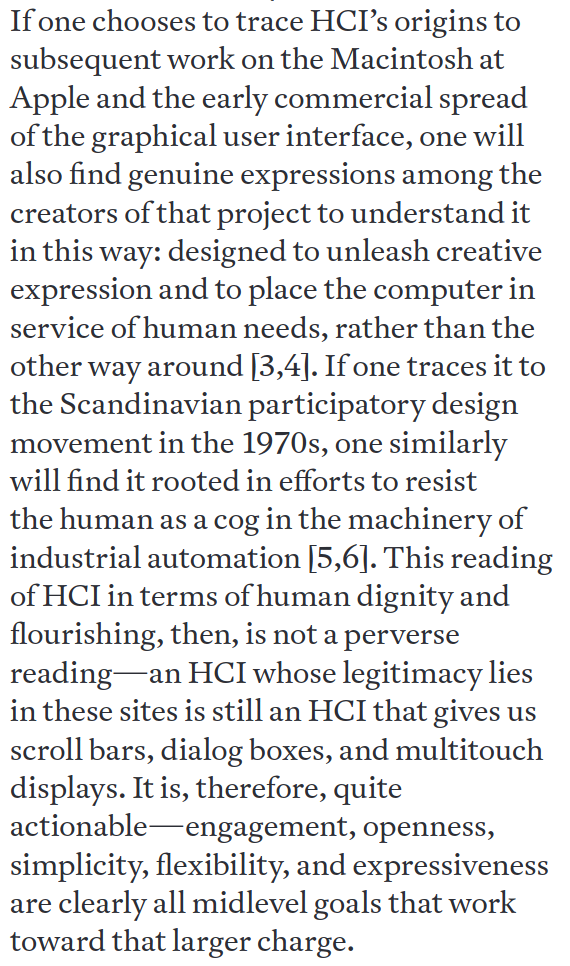
            @mahryekuh Then, in the interest of science communication, let me use this opportunity to provide some further reading for anyone interested. 🙂

            Thanks to the @ACM digital library going open access, Paul Dourish's “User Experience as Legitimacy Trap” from 2019 is now available to the public: https://dl.acm.org/doi/abs/10.1145/3358908

            A good start for a deeper dive!
            @osnews @thomholwerda

            Link Preview ImageLink Preview Image
            1 Reply Last reply
            0
            • tehstu@hachyderm.ioT This user is from outside of this forum
              tehstu@hachyderm.ioT This user is from outside of this forum
              tehstu@hachyderm.io
              wrote last edited by
              #6

              @ellyqw @osnews Those words were written and published in 1996.

              1 Reply Last reply
              0
              • R relay@relay.an.exchange shared this topic

              Reply
              • Reply as topic
              Log in to reply
              • Oldest to Newest
              • Newest to Oldest
              • Most Votes


              • Login

              • Login or register to search.
              • First post
                Last post
              0
              • Categories
              • Recent
              • Tags
              • Popular
              • World
              • Users
              • Groups