Aviation emissions are usually seen as a technological issue; more efficient planes, better (sustainable) aviation fuel etc is the answer..... but what if organisational issues would make a more immediate impact:
-
@clew @ChrisMayLA6 Are there that many empty seats these days? I remember then 1980s when you could expect to sleep across an entire row of empty seats coming back across the Atlantic, but I haven't seen a plane that wasn't at least nearly full for decades.
Apparently, there are still empty legs being flown, and on some routes still half full flights (I haven't flown since before Lockdown so I'm only going on reports, though)
-
Apparently, there are still empty legs being flown, and on some routes still half full flights (I haven't flown since before Lockdown so I'm only going on reports, though)
@ChrisMayLA6 @clew I haven't flown since lockdown either.
-
@iwein @ChrisMayLA6 Yes, this.
Why it has escaped taxation for so long I can only imagine /s
@Fishd I've looked into that extensively. Most of it is public, and rather obvious, and at least as disgusting as you probably expect.
This is a good place to go into that rabbit hole: https://www.nlr.org/newsroom/blog/kerosene-tax-what-exactly-is-the-deal/
What is formulated there very clearly is that the deal isn't nearly as global and binding as the epstein class wants you to believe. What it boils down to imo is a clearly intentional set of smoke and mirrors with the main purpose of protecting privilege 🤮
-
@beemoh @clew @ChrisMayLA6 "Row to myself" seemed normal in the 1980s. The cabin crew would tell us to grab a row and lie down quick "before they start coming back from club class".
-
Aviation emissions are usually seen as a technological issue; more efficient planes, better (sustainable) aviation fuel etc is the answer..... but what if organisational issues would make a more immediate impact:
reduce the number of semi-filled/empty flights (require all flights to be full to at least more fully booked);
reduce or even abolish business class, both expanding passenger numbers per flight (less flights) & putting off business travellers.
#emissions
https://theconversation.com/scrapping-business-class-could-halve-aviation-emissions-new-study-275474Frequent flyer here. A few points:
First, reducing emissions from aviation is a laudable goal, and can be achieved by numerous strategies, such as more efficient aircraft, fewer flights, access to alternatives such as high-speed rail, and so on.
The aviation industry is doing plenty of things such as improving load factors, lightening equipment, and running more point to point flights rather than hub and spoke services. All of that helps.
Part of the calculus of the business class seats ignored by the article is that they are heavy. Those lovely lie-flat pods weigh a significant amount more than an economy seat, and weight means emissions. However, being able to arrive from a 14 hour flight relaxed and well rested has value.
Part of the calculus of business class is that its higher price subsidizes those cheaper economy class tickets. Reducing or eliminating business class would mean an increase in economy class prices. .../
-
Frequent flyer here. A few points:
First, reducing emissions from aviation is a laudable goal, and can be achieved by numerous strategies, such as more efficient aircraft, fewer flights, access to alternatives such as high-speed rail, and so on.
The aviation industry is doing plenty of things such as improving load factors, lightening equipment, and running more point to point flights rather than hub and spoke services. All of that helps.
Part of the calculus of the business class seats ignored by the article is that they are heavy. Those lovely lie-flat pods weigh a significant amount more than an economy seat, and weight means emissions. However, being able to arrive from a 14 hour flight relaxed and well rested has value.
Part of the calculus of business class is that its higher price subsidizes those cheaper economy class tickets. Reducing or eliminating business class would mean an increase in economy class prices. .../
That said, aviation accounts for about 2% of global emissions. So does streaming video. Whilst we can and should reduce those emissions, there is more to be gained from addressing other sources of emissions. I'm not saying it's either/or, but a little perspective is helpful.
Cloud computing and AI are voracious and growing users of (often fossil fuel produced) electricity.
Electricity generation and heating are by far the number 1 sources of emissions.
Transportation is huge.
Manufacturing, building, industry are all big emitters.
Here's a useful chart of emissions by sector:
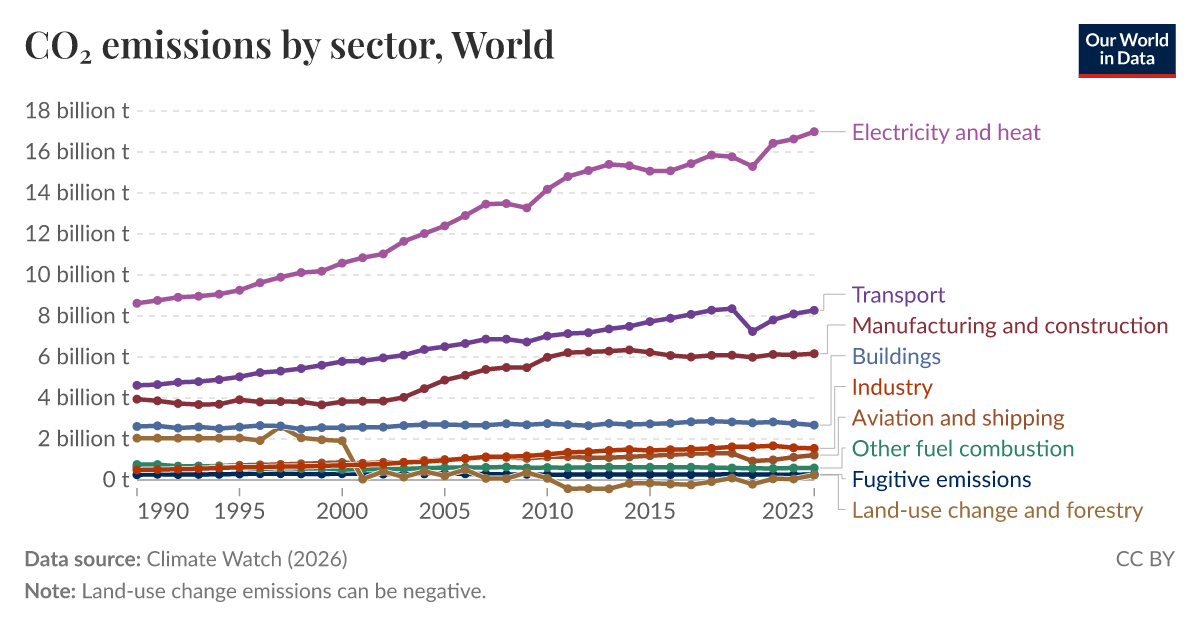
CO₂ emissions by sector
An interactive visualization from Our World in Data.

Our World in Data (ourworldindata.org)
-
That said, aviation accounts for about 2% of global emissions. So does streaming video. Whilst we can and should reduce those emissions, there is more to be gained from addressing other sources of emissions. I'm not saying it's either/or, but a little perspective is helpful.
Cloud computing and AI are voracious and growing users of (often fossil fuel produced) electricity.
Electricity generation and heating are by far the number 1 sources of emissions.
Transportation is huge.
Manufacturing, building, industry are all big emitters.
Here's a useful chart of emissions by sector:
CO₂ emissions by sector
An interactive visualization from Our World in Data.
Our World in Data (ourworldindata.org)
@alantperry @ChrisMayLA6 flying, like driving, will only be reduced when there is a viable alternative. And the reality is, in most of the world there is no viable alternative. It's not like you can do London to Toronto by train... Or Sydney to Tokyo... Even in places where the trains in theory exist, they often aren't viable alternatives. Edinburgh to London, Amsterdam to Lisbon. Sure you can do this by train. But flying is often an order of magnitude cheaper.
-
That said, aviation accounts for about 2% of global emissions. So does streaming video. Whilst we can and should reduce those emissions, there is more to be gained from addressing other sources of emissions. I'm not saying it's either/or, but a little perspective is helpful.
Cloud computing and AI are voracious and growing users of (often fossil fuel produced) electricity.
Electricity generation and heating are by far the number 1 sources of emissions.
Transportation is huge.
Manufacturing, building, industry are all big emitters.
Here's a useful chart of emissions by sector:
CO₂ emissions by sector
An interactive visualization from Our World in Data.
Our World in Data (ourworldindata.org)
@alantperry @ChrisMayLA6
I’m not sure I understand this chart… where is “electricity and heat” used, if not in those other sectors? Or have those sectors had their e&h usage removed, which would be a big distortion of their carbon footprint. It’s either that, or e&h has been double-counted.
What have I missed? -
@alantperry @ChrisMayLA6 flying, like driving, will only be reduced when there is a viable alternative. And the reality is, in most of the world there is no viable alternative. It's not like you can do London to Toronto by train... Or Sydney to Tokyo... Even in places where the trains in theory exist, they often aren't viable alternatives. Edinburgh to London, Amsterdam to Lisbon. Sure you can do this by train. But flying is often an order of magnitude cheaper.
True.
You *can* travel from Toronto to Vancouver by train, but it takes 4-5 days and emits far more carbon than the 4-5 hour flight.
I will be taking TGV in France for the first time this summer. Looking forward to it. Of course, I will have to fly to Paris first.
-
@alantperry @ChrisMayLA6
I’m not sure I understand this chart… where is “electricity and heat” used, if not in those other sectors? Or have those sectors had their e&h usage removed, which would be a big distortion of their carbon footprint. It’s either that, or e&h has been double-counted.
What have I missed?Not questions I can answer, not having done the underlying research. Your guesses sound plausible.
I would say that you have little control over your carbon footprint from electricity use. Your provider has the control in shifting to renewables from fossil fuels.
You *can* reduce your consumption to a degree, and if viable install solar panels on your house, but otherwise are at the mercy of the power generator who supplies you.
That is, many emissions are upstream.
-
R relay@relay.infosec.exchange shared this topic