Skip to content
  • Categories
  • Recent
  • Tags
  • Popular
  • World
  • Users
  • Groups
Skins
  • Light
  • Brite
  • Cerulean
  • Cosmo
  • Flatly
  • Journal
  • Litera
  • Lumen
  • Lux
  • Materia
  • Minty
  • Morph
  • Pulse
  • Sandstone
  • Simplex
  • Sketchy
  • Spacelab
  • United
  • Yeti
  • Zephyr
  • Dark
  • Cyborg
  • Darkly
  • Quartz
  • Slate
  • Solar
  • Superhero
  • Vapor

  • Default (Cyborg)
  • No Skin
Collapse
Brand Logo

CIRCLE WITH A DOT

  1. Home
  2. Uncategorized
  3. how diffie hellman key exchange works

how diffie hellman key exchange works
Scheduled Pinned Locked Moved Uncategorized
34 Posts 20 Posters 0 Views
  • Oldest to Newest
  • Newest to Oldest
  • Most Votes
Reply
  • Reply as topic
Log in to reply
This topic has been deleted. Only users with topic management privileges can see it.
  • b0rk@social.jvns.caB b0rk@social.jvns.ca

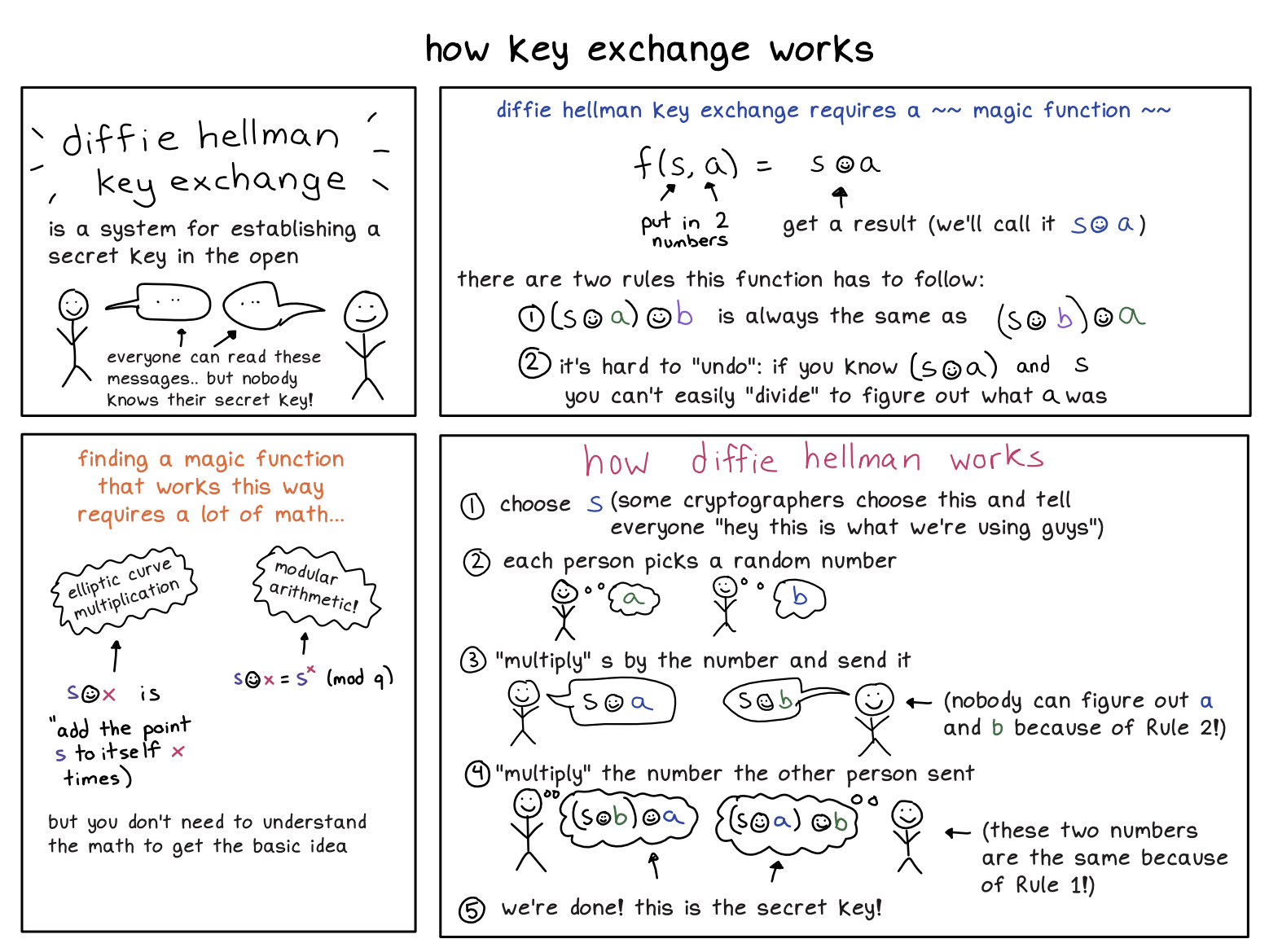
    how diffie hellman key exchange works

    (with as little math as possible)

    counting_is_hard@mathstodon.xyzC This user is from outside of this forum
    counting_is_hard@mathstodon.xyzC This user is from outside of this forum
    counting_is_hard@mathstodon.xyz
    wrote last edited by
    #22

    @b0rk you can do it without maths at all. Say I want to give you my bicycle, but our schedules just will never work out for me to give you it directly. Well, we pick a place both of us can access, say outside the train station. I lock my bike up at a designated spot and go about my day. You come along with your own lock and use it to fasten the bike to the same spot without interfering with my lock, then go about your day. At some point I remove my lock, after which you can remove yours and gain a bicycle.

    As I understand it, such a protocol was the inspiration for DH key exchange. Picking a spot is picking a generator. Locking is exponentiating. Locks not interfering is the commutativity property.

    It's the explanation I always use when TAing cryptography

    1 Reply Last reply
    0
    • b0rk@social.jvns.caB b0rk@social.jvns.ca

      how diffie hellman key exchange works

      (with as little math as possible)

      E This user is from outside of this forum
      E This user is from outside of this forum
      esoteric_programmer@social.stealthy.club
      wrote last edited by
      #23

      @b0rk I would boost it, but the attached image doesn't have any alt text, so I can't. What's the image about? is it showing a mathematical formula or something similar? a diagram?

      b0rk@social.jvns.caB 1 Reply Last reply
      0
      • E esoteric_programmer@social.stealthy.club

        @b0rk I would boost it, but the attached image doesn't have any alt text, so I can't. What's the image about? is it showing a mathematical formula or something similar? a diagram?

        b0rk@social.jvns.caB This user is from outside of this forum
        b0rk@social.jvns.caB This user is from outside of this forum
        b0rk@social.jvns.ca
        wrote last edited by
        #24

        @esoteric_programmer will write some and let you know when it’s added

        1 Reply Last reply
        0
        • b0rk@social.jvns.caB b0rk@social.jvns.ca

          how diffie hellman key exchange works

          (with as little math as possible)

          palvaro@discuss.systemsP This user is from outside of this forum
          palvaro@discuss.systemsP This user is from outside of this forum
          palvaro@discuss.systems
          wrote last edited by
          #25

          @b0rk I love it. when I have taught this material, I have fallen back on the paint mixing analogy, but as a colorblind person this never felt right!

          1 Reply Last reply
          0
          • b0rk@social.jvns.caB b0rk@social.jvns.ca

            how diffie hellman key exchange works

            (with as little math as possible)

            snoopj@hachyderm.ioS This user is from outside of this forum
            snoopj@hachyderm.ioS This user is from outside of this forum
            snoopj@hachyderm.io
            wrote last edited by
            #26

            @b0rk am I missing something or is "add the result s to itself x times) a result of mixed-up puncutation? Did a double-take at that

            snoopj@hachyderm.ioS b0rk@social.jvns.caB 2 Replies Last reply
            0
            • snoopj@hachyderm.ioS snoopj@hachyderm.io

              @b0rk am I missing something or is "add the result s to itself x times) a result of mixed-up puncutation? Did a double-take at that

              snoopj@hachyderm.ioS This user is from outside of this forum
              snoopj@hachyderm.ioS This user is from outside of this forum
              snoopj@hachyderm.io
              wrote last edited by
              #27

              @b0rk fantastic work as usual, thanks for sharing

              1 Reply Last reply
              0
              • b0rk@social.jvns.caB b0rk@social.jvns.ca

                @divVerent ah yeah good point! do you know an example offhand where you can find (S o A) o B given S o A and S o B? (but not find B given S o B)

                divverent@misskey.deD This user is from outside of this forum
                divverent@misskey.deD This user is from outside of this forum
                divverent@misskey.de
                wrote last edited by
                #28
                @b0rk@social.jvns.ca No such groups are known yet. However one can easily prove that discrete log solves CDH, whereas no general reduction from CDH to discrete log exists, which in a way tells that DL is a "harder or equivalent" problem.

                There exists however such a reduction for some elliptic curves (e.g. the NIST curves and Curve25519); these curves are usually preferred, as we then only depend on one problem being hard.
                1 Reply Last reply
                0
                • b0rk@social.jvns.caB b0rk@social.jvns.ca

                  how diffie hellman key exchange works

                  (with as little math as possible)

                  arildsen@mastodon.greenA This user is from outside of this forum
                  arildsen@mastodon.greenA This user is from outside of this forum
                  arildsen@mastodon.green
                  wrote last edited by
                  #29

                  @b0rk that’s a great explainer. You made it straightforward for me to understand how it works without having to know how the functions involved work (I don’t).
                  And the keys are for symmetric encryption, I guess?

                  1 Reply Last reply
                  0
                  • snoopj@hachyderm.ioS snoopj@hachyderm.io

                    @b0rk am I missing something or is "add the result s to itself x times) a result of mixed-up puncutation? Did a double-take at that

                    b0rk@social.jvns.caB This user is from outside of this forum
                    b0rk@social.jvns.caB This user is from outside of this forum
                    b0rk@social.jvns.ca
                    wrote last edited by
                    #30

                    @SnoopJ what do you mean by mixed up punctuation?

                    it’s trying to explain how on an elliptic curve, you start with an initial point s on the elliptic curve, choose a random integer x , and then add that point s to itself x times (using elliptic curve addition) to get the result of the “magic function”

                    1 Reply Last reply
                    0
                    • b0rk@social.jvns.caB This user is from outside of this forum
                      b0rk@social.jvns.caB This user is from outside of this forum
                      b0rk@social.jvns.ca
                      wrote last edited by
                      #31

                      @bmitch @SnoopJ oops yeah thanks

                      1 Reply Last reply
                      0
                      • b0rk@social.jvns.caB b0rk@social.jvns.ca

                        how diffie hellman key exchange works

                        (with as little math as possible)

                        smallsees@social.dropbear.xyzS This user is from outside of this forum
                        smallsees@social.dropbear.xyzS This user is from outside of this forum
                        smallsees@social.dropbear.xyz
                        wrote last edited by
                        #32

                        @b0rk like how you used 'hard to undo'. I used to explain it by saying the inverse is really hard to do but that explanation is simpler.

                        1 Reply Last reply
                        0
                        • b0rk@social.jvns.caB b0rk@social.jvns.ca

                          how diffie hellman key exchange works

                          (with as little math as possible)

                          gerbrand@fosstodon.orgG This user is from outside of this forum
                          gerbrand@fosstodon.orgG This user is from outside of this forum
                          gerbrand@fosstodon.org
                          wrote last edited by
                          #33

                          @b0rk @agturcz Ik love the smiley operator!

                          1 Reply Last reply
                          0
                          • b0rk@social.jvns.caB b0rk@social.jvns.ca

                            how diffie hellman key exchange works

                            (with as little math as possible)

                            lindsey@recurse.socialL This user is from outside of this forum
                            lindsey@recurse.socialL This user is from outside of this forum
                            lindsey@recurse.social
                            wrote last edited by
                            #34

                            @b0rk The Wikipedia article uses a color-mixing analogy that I've always liked. I used to know someone who would do the color-mixing thing live in a class she taught!

                            1 Reply Last reply
                            0
                            Reply
                            • Reply as topic
                            Log in to reply
                            • Oldest to Newest
                            • Newest to Oldest
                            • Most Votes


                            • Login

                            • Login or register to search.
                            • First post
                              Last post
                            0
                            • Categories
                            • Recent
                            • Tags
                            • Popular
                            • World
                            • Users
                            • Groups