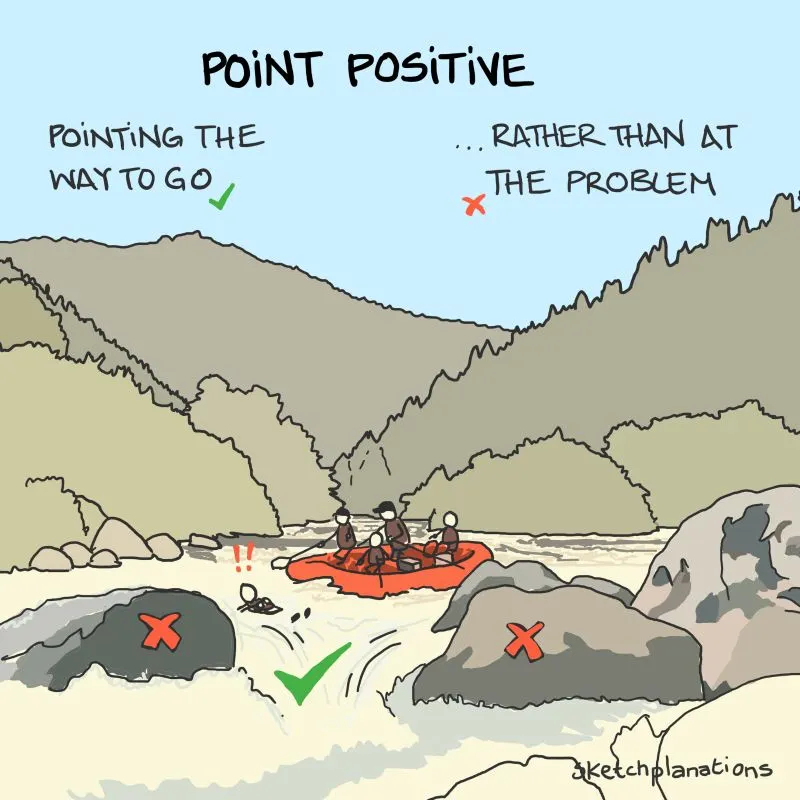
My greatest professional accomplishment of the year: I got my exec & manager teammates saying "point positive," a term from whitewater rafting and kayaking.
-
My greatest professional accomplishment of the year: I got my exec & manager teammates saying "point positive," a term from whitewater rafting and kayaking.
Meaning: when facing hazards, point people toward where to go/what to do, rather than drawing attention to everything to avoid.
@eanakashima now if you could only build on this and get us in the world wide fediverse to "point positive" instead of perma-ranting against all and every hazard, that would be no small feat

-
My greatest professional accomplishment of the year: I got my exec & manager teammates saying "point positive," a term from whitewater rafting and kayaking.
Meaning: when facing hazards, point people toward where to go/what to do, rather than drawing attention to everything to avoid.
@eanakashima The benefits of this are obvious to me when facing immediate threats where there's no time to orient and plan a path to safety. Sharing common language so that you can get to safety with a single glance is huge.
Bringing this to the office, where emergencies are rarely this immediate, seems to be little more than applying the name to preferred behaviour where we want people to do more than just point out problems.
Is that assessment correct, or is there more to this?
-
My greatest professional accomplishment of the year: I got my exec & manager teammates saying "point positive," a term from whitewater rafting and kayaking.
Meaning: when facing hazards, point people toward where to go/what to do, rather than drawing attention to everything to avoid.
@eanakashima Ah, the flipside term to target fixation, nice. TIL!
-
@eanakashima I think I'd heard this phrase but didn't know it came from rafting and kayaking. Thanks for the background!
And I sure do have to keep reminding people “tell people what to do, not just what not to do”…
In the vein of not focusing people's attention in an unwanted direction, I'm reminded of this bit from the 1987 edition of the Apple Human Interface Guidelines (second paragraph):
@boredzo on a tangential note, I like the last section: "Design in black and white" (and add colours later)
Some of the reasoning may seem outdated, as it initially did to me even though I am currently reading this on a black-and-white e-paper monitor

I learnt a similar concept as a drawing style from Hergé who always made sure his illustrations worked in black and white, where it would sometimes stay unless colour was added as a bonus on top. Works wonders for xeroxable art

-
My greatest professional accomplishment of the year: I got my exec & manager teammates saying "point positive," a term from whitewater rafting and kayaking.
Meaning: when facing hazards, point people toward where to go/what to do, rather than drawing attention to everything to avoid.
@eanakashima @praveen society is not immutable. If you just avoid conflict, always take the way of least resistance, never fixing things, never identifying obstacles and problems to address everything will stay bad for everyone forever.
If your job is like a death ride on a wild river reconsider your life choices, if you have enough privilege to do so.
-
@eanakashima Ha, didn't know boating people used that as well - motorcycle people are told "do not look at the tree" (or more generally, look where you want to go, not what you want to avoid).
The Wikipedia page is disappointingly terse, though: https://en.wikipedia.org/wiki/Target_fixation .
@richlv @eanakashima heh, from a boating/sailing perspective I learned to always point at the person who fell off. That way you don't lose track of their position.
I was confused by this image at the start.

-
@eanakashima Works with motorbikes too

@davep @eanakashima And walking also, come to think about it. Very noticeable when your footing is compromised, like an injury or surgery.
-
People just naturally start to go toward where you draw their attention, whether they want to or not.


Might as well pick something good to point at.
This lesson has many applications right now.
@eanakashima Had a CEO once who announced new things by talking about all the ills of whatever necessitated the new thing, then added a "oh, by the way, this is the new thing we will do" - I ended up tuning out whenever he was talking, until he started to sound like he were starting to wind down.
It's an atrocious communication style.
-
My greatest professional accomplishment of the year: I got my exec & manager teammates saying "point positive," a term from whitewater rafting and kayaking.
Meaning: when facing hazards, point people toward where to go/what to do, rather than drawing attention to everything to avoid.
-
My greatest professional accomplishment of the year: I got my exec & manager teammates saying "point positive," a term from whitewater rafting and kayaking.
Meaning: when facing hazards, point people toward where to go/what to do, rather than drawing attention to everything to avoid.
@eanakashima Thank you for sharing this. Didn't know that term and it's great to learn it.
-
My greatest professional accomplishment of the year: I got my exec & manager teammates saying "point positive," a term from whitewater rafting and kayaking.
Meaning: when facing hazards, point people toward where to go/what to do, rather than drawing attention to everything to avoid.
@eanakashima I did a skid course some years ago and the first and foremost thing they tell you is "never look at obstacles, instead look at where you want to go".
It's honestly kind of magical, but if you just keep your eyes focused on where it's safe to be, then you're most likely to end up exactly there.
-
@richlv @tab2space @eanakashima Sounds like something Paul Bunyan would've done, had he skied.
@david42 @tab2space @eanakashima Latvian folk heroes tend to be more on the strong/agile side (Kurbads, Lāčplēsis). The larger one I recall, Lielais (Big) Kristaps, was more into crossing rivers.
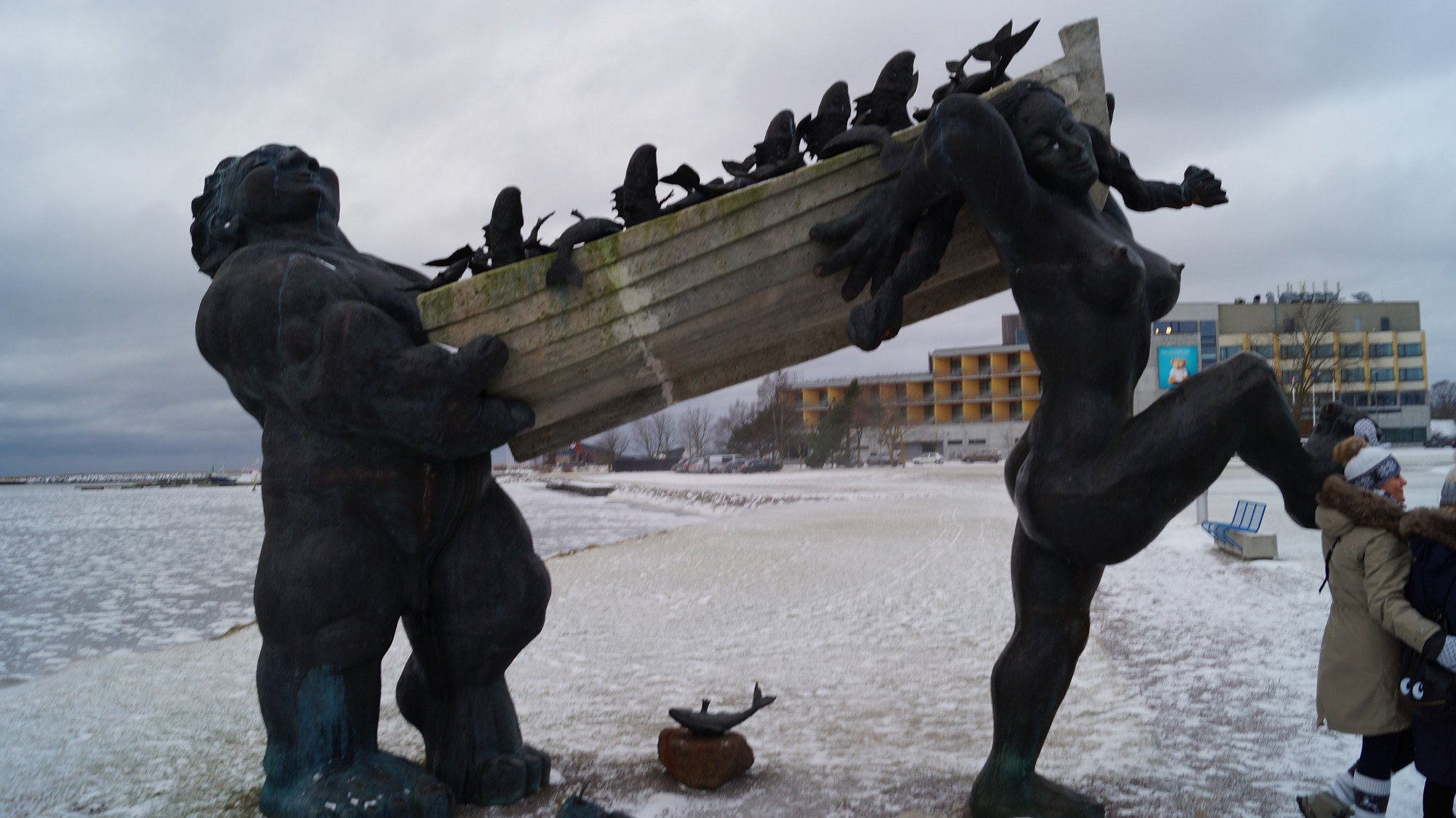
My first association of somebody using trees for skis was with the Estonian Suur Tõll, probably because of the great sculpture they have on Saaremaa (coudn't find my own pictures, though).
-
@boredzo on a tangential note, I like the last section: "Design in black and white" (and add colours later)
Some of the reasoning may seem outdated, as it initially did to me even though I am currently reading this on a black-and-white e-paper monitor
I learnt a similar concept as a drawing style from Hergé who always made sure his illustrations worked in black and white, where it would sometimes stay unless colour was added as a bonus on top. Works wonders for xeroxable art
@badrihippo @eanakashima Yeah, that's another one that's stuck with me (and was actually in the HIG longer—into the 1990s). Still relevant to those of us designing printable zines and flyers! I have a color printer but not everyone does.
-
My greatest professional accomplishment of the year: I got my exec & manager teammates saying "point positive," a term from whitewater rafting and kayaking.
Meaning: when facing hazards, point people toward where to go/what to do, rather than drawing attention to everything to avoid.
I knew the concept from motorcycle (and bicycle) training, but not the term "point positive" which is excellent, thanks, TIL.
-
@eanakashima Ha, didn't know boating people used that as well - motorcycle people are told "do not look at the tree" (or more generally, look where you want to go, not what you want to avoid).
The Wikipedia page is disappointingly terse, though: https://en.wikipedia.org/wiki/Target_fixation .
Interesting to read about the application of this thinking to rafting, kajaking, motorcycling and skiing (in a other replies), wasn't aware of this.
With "Solution-Focused Coaching" there is also a whole school of thought that is based on related ideas. And it originated from a specific form of #psychotherapy (Solution Focused Brief Therapy #SFBT).
-
@eanakashima @praveen society is not immutable. If you just avoid conflict, always take the way of least resistance, never fixing things, never identifying obstacles and problems to address everything will stay bad for everyone forever.
If your job is like a death ride on a wild river reconsider your life choices, if you have enough privilege to do so.
Its a matter of the sequence:
Looking for the bright spot on the horizon first enables us to assess which rocks are worth dealing with, because they're in our pathway.
Looking around for all rocks first, we never have any time for determining what we want more of, or a path leading to it.
The trouble is that you get problems for free, in unlimited numbers. And the time for lifting your head and looking around is available only in small doses.
Hence we become experts in things that we want less of, and we keep struggling with even building a bit of expertise of what we want more of.
-
R relay@relay.infosec.exchange shared this topicR relay@relay.mycrowd.ca shared this topic
-
My greatest professional accomplishment of the year: I got my exec & manager teammates saying "point positive," a term from whitewater rafting and kayaking.
Meaning: when facing hazards, point people toward where to go/what to do, rather than drawing attention to everything to avoid.
@eanakashima This thinking saved my life once when I was riding a motorcycle.
-
@richlv ooh TIL "target fixation"
@eanakashima @richlv I recall dojng a skid pan training session, tremendous fun and genuinely useful for better car control, and we were told “if you stare at the wall you’re worried about hitting, you’re much more likely to hit it”
-
My greatest professional accomplishment of the year: I got my exec & manager teammates saying "point positive," a term from whitewater rafting and kayaking.
Meaning: when facing hazards, point people toward where to go/what to do, rather than drawing attention to everything to avoid.
@eanakashima this relates to my complaint about signs like "low flying aircraft". Should I get a really big butterfly net? Should I dodge? What's the recommended action?
-
People just naturally start to go toward where you draw their attention, whether they want to or not.
Might as well pick something good to point at.
This lesson has many applications right now.
@eanakashima Hey it's like driving target fixation!











 🤩
🤩