Yet another #Artemis II article (from a French press agency, no less) ignoring that propulsion, power, & life support to the Orion capsule are provided by ESA’s European Service Module.
-
@datenwolf It also tends to be a lot more “bitty”, coming in small chunks as experiments are modified & upgraded over time. It’s also often a bit buried in wider studies of which the spaceflight experiments are just part.
Of course, I’m deliberately avoiding saying whether the cost-science benefit ratio is worth it compared to robotic missions, but arguably the two pots of money aren’t really fungible. Science is a by-product of other human spaceflight, not the primary goal.
I'm well aware of the experiments that are done on the ISS (or back in the day on the STS and Mir). Heck, a couple of years ago some hardware for a medical study went up to the ISS what was in part built (or rather modified from the commercial system) by colleagues of me (optical coherence tomography to investigate the eyesight problems astronauts develop in microgravity).
1/
-
I'm well aware of the experiments that are done on the ISS (or back in the day on the STS and Mir). Heck, a couple of years ago some hardware for a medical study went up to the ISS what was in part built (or rather modified from the commercial system) by colleagues of me (optical coherence tomography to investigate the eyesight problems astronauts develop in microgravity).
1/
What's puzzling to me is, that so little of what's done on the ISS ends up being discussed during lunch, or over the post seminar pizza. Whereas so much other research, often in very far removed fields tends to be brought up.
It's a quite remarkable situation: Crewed space flight is a very "popular" topic; almost everyone in the 1st and 2nd world knows about it and that "a lot of science" is happening there.But among my earthbound researcher peers it's discussed very little.
-
To be clear, yes, the article is in a British newspaper, @guardian, but is directly sourced from @AFP.
Not that the articles written by the Guardian’s own journalists are necessarily any better, mind you:
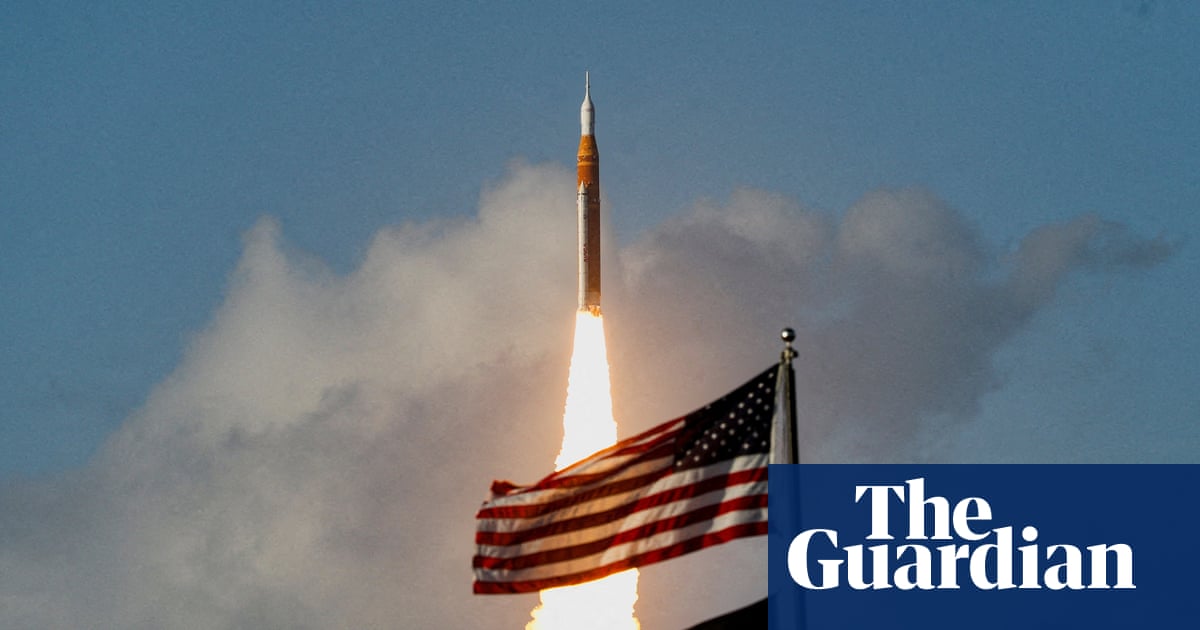
Artemis II marks Nasa’s new moon age, wrapped in patriotism and global promise
The moonshot gave US spectacle a broader face with the first woman, first person of color and first non-American
the Guardian (www.theguardian.com)
And this is no UK anti-Europe bias; same across most Euro-media.
Some are doing better though, & I know the BBC are doing a piece today about the key role being played by the ESM, & ESA themselves are of course talking up the ESM.
@markmccaughrean @guardian @AFP
I haven't read the english AFP article, but I can tell you that BFM (main tv news) invited someone who spoke long about ESA's work on this mission (I can't remember his name but I'll try to find the video).
There's also other articles like the one from RFI (RAdio France Internationale), interview with Philippe Berthe :
Artemis II: «Sans le Module de service européen, la mission est impossible»
https://www.rfi.fr/fr/science/20260331-artemis-ii-sans-le-module-de-service-europ%C3%A9en-la-mission-est-impossible -
What's puzzling to me is, that so little of what's done on the ISS ends up being discussed during lunch, or over the post seminar pizza. Whereas so much other research, often in very far removed fields tends to be brought up.
It's a quite remarkable situation: Crewed space flight is a very "popular" topic; almost everyone in the 1st and 2nd world knows about it and that "a lot of science" is happening there.But among my earthbound researcher peers it's discussed very little.
@datenwolf I agree, & little of the science done there is covered by media either, hence burying it from the public radar screen too. Possibly because in part it’s visually unexciting, just humans & boxes of gear.
There’s also an element of truth in that it’s a bit of an insider club, with the same groups getting experiments approved all the time, partly because they already know the ropes & partly because they then sit on the committees deciding future strategy & experiments.
-
@datenwolf I agree, & little of the science done there is covered by media either, hence burying it from the public radar screen too. Possibly because in part it’s visually unexciting, just humans & boxes of gear.
There’s also an element of truth in that it’s a bit of an insider club, with the same groups getting experiments approved all the time, partly because they already know the ropes & partly because they then sit on the committees deciding future strategy & experiments.
@datenwolf And that you get weird outliers like AMS-02, a hugely expensive piece of kit that made its way to the ISS despite not being highly-ranked in peer review, despite huge technical problems during test which led to the cryomagnet being dumped, making the experiment less sensitive, & despite needing congressional approval for a whole extra shuttle flight to get it there.
The power of a Nobel prize winner very adept at playing politics, to be sure, but good for science?
-
@markmccaughrean @guardian @AFP
I haven't read the english AFP article, but I can tell you that BFM (main tv news) invited someone who spoke long about ESA's work on this mission (I can't remember his name but I'll try to find the video).
There's also other articles like the one from RFI (RAdio France Internationale), interview with Philippe Berthe :
Artemis II: «Sans le Module de service européen, la mission est impossible»
https://www.rfi.fr/fr/science/20260331-artemis-ii-sans-le-module-de-service-europ%C3%A9en-la-mission-est-impossible@hadon Oh, there certainly has been some coverage of the European involvement in Artemis, & I also saw a piece of Dutch TV where the fact that the solar wings were made in Leiden was mentioned.
I’ve been asked to do media around Artemis & have largely turned it down, because I have felt very conflicted about not wanting to give any succour to the current US govt. Missed opportunities to discuss the ESM as a result, of course.
And overall, ESA’s part is just lost in the noise of US flag-waving.
-
@birchbirch The problem with that is that people are often fine with glorious, exciting endeavours when the bill is footed by someone else.
Ask your golf friends whether they’d be willing to pay an extra few percent income tax to fund an independent European human spaceflight programme & a wider boost to education, universities, government R&D, tech incubation, & science needed to support, justify, & benefit from such a programme.
I suspect you know the answer already

@markmccaughrean Golfers are rather used to the imposition of additional levies to be used for "future programmes" - whether the members want them or not! But you're right; a good proportion wouldn't be in favour of additional taxes.
-
@markmccaughrean Quite a lot of people used to be really excited about manned space exploration, myself being one of them, but current events have made us almost indifferent to it. To refer to a professional author's take:
Charlie Stross (@cstross@wandering.shop)
Same for me, too. And Elon Musk took all the joy out of his big rocket launch (and occasional explosion) livestreams when he unmasked as full nazi in public. And the Russian space program? Dead to me. We should just get back in the sea. Our species is done.

The Wandering Shop (wandering.shop)
@Lemmus I have a lot of time for Charlie & his perspective, & suspect that it’s widely shared even among tech & science folk.
Which is a problem for NASA, inasmuch as the association between the tropes of human destiny in space & fascism are probably even stronger now in the public eye than it was in Von Braun’s heyday.
But perhaps even more so for ESA, if the next move is to try to persuade people that an independent human spaceflight programme is the way forward.
-
R relay@relay.mycrowd.ca shared this topic