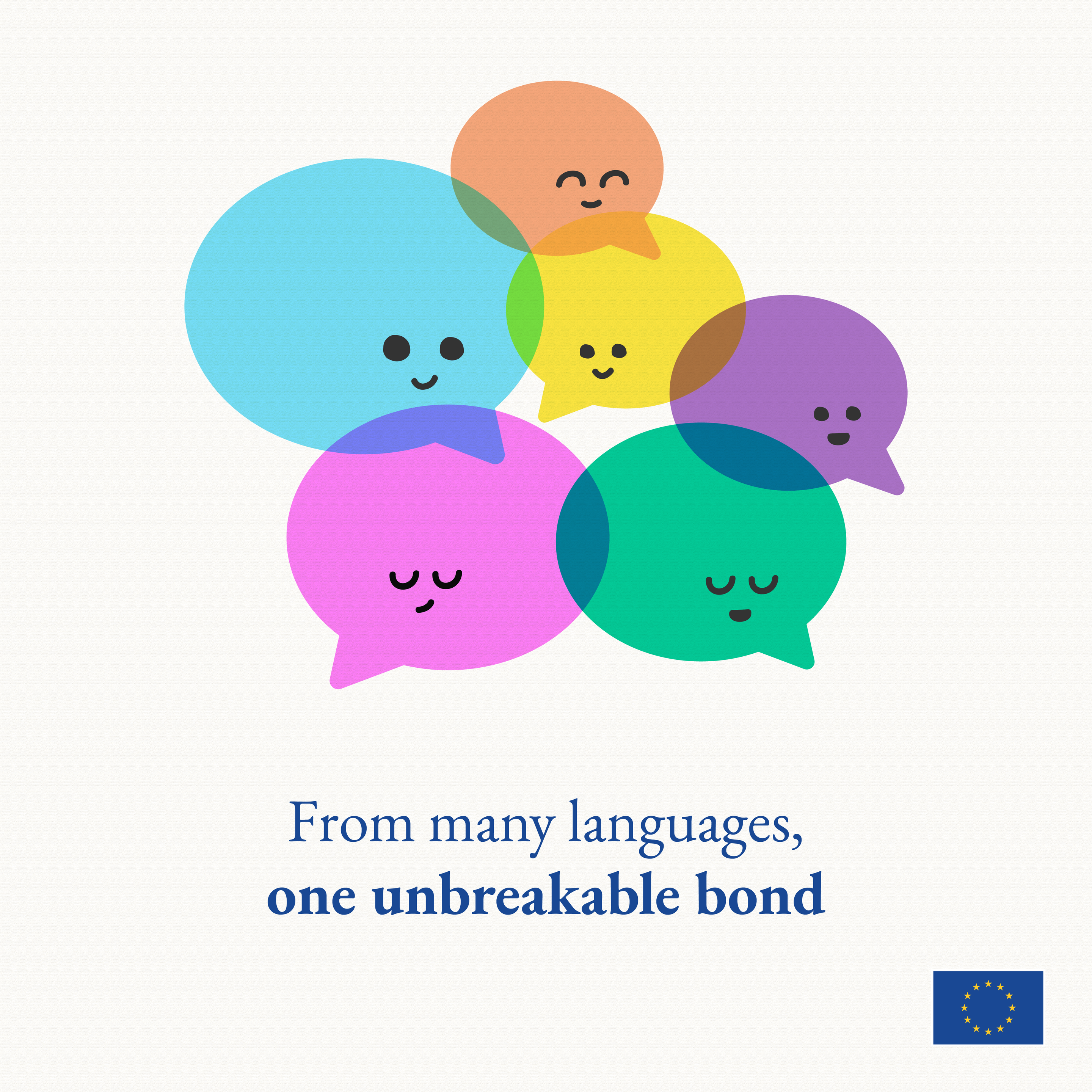
On International Mother Language Day, we celebrate the rich linguistic and cultural diversity that defines our Union, as well as the importance of protecting and promoting mother tongues across Europe.
-
@kinkkong @kubofhromoslav @proedie @Pare @valhalla @EUCommission I'm aware of all that. Still the USA has no official language, they just happen to have a lot of English speakers. Of course Trump is trying to make the lives of Spanish speakers as miserable as possible, after all it's Trump and he "has the best words" and those are English, porque no tiene educación.
-
@benny @proedie @kinkkong @Pare @valhalla @EUCommission, yes! For non-native speakers. By factor of 5-10, depending on the native language.
In about 2 years of mostly self-study of #Esperanto (2 months intensive study, 22 months of mostly using on internet) I get to same level as in English in 15 years of school learning.
Clear difference
 @kubofhromoslav
@benny
I second that:
Esperanto is *by far* easier to learn than English.
You wrote of "a planned language equally hard for everyone to learn".
Or equally (relatively) easy to learn, like Esperanto.
Look up "Paderborner Methode" on Wikipedia:
It's been around 50 years now that in this scientific experiment with different school classes, was found out that pupils who learned Esperanto *first* were mostly able to learn additional (European) languages easier and significantly faster than those who *only* learned the European language, without learning Esperanto.
50 years - and there's still an active recommendation by the UN to offer Esperanto lessons in all schools in Europe - ignored ever since, despite its advantages!
@proedie @kinkkong @Pare @valhalla @EUCommission -
@kubofhromoslav @proedie @kinkkong @Pare @valhalla @EUCommission what I mean is not only from native languages but like having several word stems from several languages that mean the same, which looks to me like you learn all vocabulary from all languages and apply a unified grammar - I'm obviously exaggerating here.
@benny @kubofhromoslav @proedie @kinkkong @valhalla @EUCommission
Do you mean that also in #Esperanto there are some synonyms? Yes of course. Far less than in any other language I'm aware of, but yes, also in Esperanto there are a few of them. -
@kubofhromoslav @proedie @kinkkong @Pare @valhalla @EUCommission maybe my problem is that I did not learn English so much through grammar than through constant repetition. I could hardly explain grammar rules, but most of the time I am close enough. But then again, my mother tongue is German which isn't too far off vocabilary wise.
I "learned" Esperanto about 25 years ago from a small booklet which really was enough, but there was very few vocabulary and the internet didn't have much either.@benny @kubofhromoslav @proedie @kinkkong @Pare @valhalla @EUCommission
Heh, that's basically my Esperanto experience too.
I'm guessing that when you say "constant repetition" for English that means that there was lots of content around, and lots of stuff you wanted access to that required English. (Computer stuff? Entertainment?)
And Esperanto just does not have that vast, high-demand content (at least now). ....
-
@benny @kubofhromoslav @proedie @kinkkong @Pare @valhalla @EUCommission
I was wondering that too. My guess is that it's similar to the difference in English between 'see' and 'look at' respectively. Heck, doesn't French have both 'voir' and 'regarder'?
And my understanding is that even though it's rather informal, German has 'kucken' in addition to 'sehen'?
@jztusk
I'm italian. I'd translate the #Esperanto verb "vidi" with the Italian "vedere", and the Esperanto verb "rigardi" with "guardare".I agree, the English verbs "to see" and "to look (at)" should have the same differences.
@benny @kubofhromoslav @proedie @kinkkong @valhalla @EUCommission -
@benny @kubofhromoslav @proedie @kinkkong @Pare @valhalla @EUCommission
Heh, that's basically my Esperanto experience too.
I'm guessing that when you say "constant repetition" for English that means that there was lots of content around, and lots of stuff you wanted access to that required English. (Computer stuff? Entertainment?)
And Esperanto just does not have that vast, high-demand content (at least now). ....
@benny @kubofhromoslav @proedie @kinkkong @Pare @valhalla @EUCommission
... and that constant exposure is how people really absorb language. So it's definitely true that Esperanto is *much* better structured than English, but as you demonstrate, content beats grammar.
As a native English speaker I've benefited a lot from English languages hegemony, but I can't pretend English isn't an absolute mess.
-
@benny @kubofhromoslav @proedie @kinkkong @Pare @valhalla @EUCommission
I was wondering that too. My guess is that it's similar to the difference in English between 'see' and 'look at' respectively. Heck, doesn't French have both 'voir' and 'regarder'?
And my understanding is that even though it's rather informal, German has 'kucken' in addition to 'sehen'?
@jztusk @kubofhromoslav @proedie @kinkkong @Pare @valhalla @EUCommission you are right. Regarder would be rather betrachten/beobachten than sehen.
-
@benny @kubofhromoslav @proedie @kinkkong @Pare @valhalla @EUCommission
... and that constant exposure is how people really absorb language. So it's definitely true that Esperanto is *much* better structured than English, but as you demonstrate, content beats grammar.
As a native English speaker I've benefited a lot from English languages hegemony, but I can't pretend English isn't an absolute mess.
@jztusk @kubofhromoslav @proedie @kinkkong @Pare @valhalla @EUCommission I never said English was no mess. And sure, there were plenty opportunities to practise English in the early 90s while there were hardly any around 2000 for Esperanto.
I later also gave Na'vi a try, though I never succeeded much. I also had French and Spanish in school and I think I'd get by on a very low level if I was thrown into Spain or France, but zhen they also speak English... -
@jztusk @kubofhromoslav @proedie @kinkkong @Pare @valhalla @EUCommission I never said English was no mess. And sure, there were plenty opportunities to practise English in the early 90s while there were hardly any around 2000 for Esperanto.
I later also gave Na'vi a try, though I never succeeded much. I also had French and Spanish in school and I think I'd get by on a very low level if I was thrown into Spain or France, but zhen they also speak English...@jztusk @kubofhromoslav @proedie @kinkkong @Pare @valhalla @EUCommission the only time I was completely disconnected was in Korea, where people would know English but considered theif English too bad to bother me with it so they tried Korean of which I only knew a few terms.
Then try to buy an overland bus ticket. -
@jztusk @kubofhromoslav @proedie @kinkkong @Pare @valhalla @EUCommission I never said English was no mess. And sure, there were plenty opportunities to practise English in the early 90s while there were hardly any around 2000 for Esperanto.
I later also gave Na'vi a try, though I never succeeded much. I also had French and Spanish in school and I think I'd get by on a very low level if I was thrown into Spain or France, but zhen they also speak English...@benny @kubofhromoslav @proedie @kinkkong @Pare @valhalla @EUCommission
I've said that if you study two out of Spanish, French, and Italian you get the third one almost for free.
I think if you've studied Spanish and English, and are a native German speaker, I think you get Esperanto for free.

-
@benny @kubofhromoslav @proedie @kinkkong @Pare @valhalla @EUCommission
I've said that if you study two out of Spanish, French, and Italian you get the third one almost for free.
I think if you've studied Spanish and English, and are a native German speaker, I think you get Esperanto for free.
@jztusk @kubofhromoslav @proedie @kinkkong @Pare @valhalla @EUCommission might be, but I lack the time to put in the effort plus I see no big use of it. If ever I need to understand a text, I get most anyway, but I wouldn'tbe able to produce something myself...
-
@kubofhromoslav @jztusk @proedie @kinkkong @Pare @valhalla @EUCommission what would be the difference between vide- and rigarde-? Because it looks like just being the same coming from two languages: vedere - Latin and regarder - French
@benny@kirche.social @kubofhromoslav@esperanto.masto.host @jztusk@mastodon.social @proedie@mastodon.green @kinkkong@kinkycats.org @Pare@sociale.network @valhalla@social.gl-como.it @EUCommission@ec.social-network.europa.eu ‘Vid’ means ‘see’ and ‘rigard’ means ‘look’. An invisible person is ‘ne·vid·ebl·a’, since you can’t see them even if you’re looking at them. (Inversely, you could say the sun is ‘vid·ebl·a’ but ‘ne·rigard·ebl·a’, since you can see it but can’t directly look at it. Well, you can, but only once.) <img class="not-responsive emoji" src="https://jam.xwx.moe/emoji/Gutkatoj/gutkato_mojosa.png" title=":gutkato_mojosa:" />
There are countless instances where you could have either few words with very broad meanings to cover many use cases, or a single, more specialised word for each single use case. Both extremes have their advantages and disadvantages, and Esperanto isn’t naturally optimised for one or the other. <img class="not-responsive emoji" src="https://jam.xwx.moe/emoji/Gutkatoj/gutkato_kontenta.png" title=":gutkato_kontenta:" />
-
@Pare @valhalla @EUCommission @kinkkong, it makes more sense. Europe needs a mutual language to unite, and that will not happen using a national language of one of the big members.
Better would be even more neutral language, like #Esperanto, as it belongs to no specific nation (not even some competitor nation, like English does), so it can unite people and nations of Europe.
@kubofhromoslav @Pare @valhalla @EUCommission @kinkkong I say this as someone who isn't a citizen or resident of any EU country. I would love to see #Esperanto adopted as an official language in the EU. No need to make it the only official language. Just give it a foothold and start using and teaching it officially.
Mi diras tion ĉi kiel persono kiu ne estas civitano aŭ loĝanto de iu ajn EU-a lando. Mi amus vidi se la EU adoptus Esperanton kiel oficiala lingvo. Ne estas necesa fari ĝin la sola oficiala lingvo. Nur donu al ĝi piedteno kaj komencu uzi kaj instrui ĝin oficiale.
-
@kubofhromoslav @proedie @kinkkong @Pare @valhalla @EUCommission a truly neutral language would be one that is equally hard for all, which would be some planned language, which would not be used comfortably by the masses, because not many people speak Volapük or Klingon.
English's use is not nationsl communication just like French wasn't national in olden times or Sumerian in even older times.@benny @kubofhromoslav @proedie @kinkkong @Pare @valhalla @EUCommission From what I know of linguistics, I don't believe that it's possible to have a language that is simultaneously comprehensible by the human mind and completely neutral. There are too many linguistic features which are common to some languages and not others. Some, we could probably just dispense with, such as grammatical gender, without putting native speakers of the languages that have them at a disadvantage, but some will remain.
While there is considerable acknowledgement that #Esperanto is easier for native speakers of various European languages from which it draws it's vocabulary, it at least presents less of a disadvantage to people coming from other native languages. And the fact that it is built heavily on vocabulary common to many European languages is actual a reasonable argument for using it for international communication within Europe.
-
@kubofhromoslav @proedie @kinkkong @Pare @valhalla @EUCommission you consider English harder than Esperanto?
@benny @kubofhromoslav @proedie @kinkkong @Pare @valhalla @EUCommission As a native English speaker who also knows #Esperanto, I am completely confident that English is harder than Esperanto. I personally think that Spanish is an easier language to learn than English, and Esperanto is easier than Spanish.
-
@benny @kubofhromoslav @proedie @kinkkong @Pare @valhalla @EUCommission As a native English speaker who also knows #Esperanto, I am completely confident that English is harder than Esperanto. I personally think that Spanish is an easier language to learn than English, and Esperanto is easier than Spanish.
@ddgulledge @kubofhromoslav @proedie @kinkkong @Pare @valhalla @EUCommission I like Spanish, but I would not say it's easier than English. They have a more straightforward spelling system though, butt hoo kairs abowed spelling anyway?
-
@benny @kubofhromoslav @proedie @kinkkong @Pare @valhalla @EUCommission As a native English speaker who also knows #Esperanto, I am completely confident that English is harder than Esperanto. I personally think that Spanish is an easier language to learn than English, and Esperanto is easier than Spanish.
@ddgulledge @benny @kubofhromoslav @proedie @Pare @valhalla @EUCommission As a speaker of #Esperanto I think the language is quite easier to learn than say something like English.
But then the people come around the corner who think that this language is horrible bad, complicated, eurocentric, inexpressive, a language of "spies", a bad jewish language, a language without "culture" and other chauvinistic nonsense come around the corner.
I think this cosmopolitan language, which always was about peace, connection, internationalism, co-existence of languages, hope, etc. is perfectly fine.
-
@ddgulledge @benny @kubofhromoslav @proedie @Pare @valhalla @EUCommission As a speaker of #Esperanto I think the language is quite easier to learn than say something like English.
But then the people come around the corner who think that this language is horrible bad, complicated, eurocentric, inexpressive, a language of "spies", a bad jewish language, a language without "culture" and other chauvinistic nonsense come around the corner.
I think this cosmopolitan language, which always was about peace, connection, internationalism, co-existence of languages, hope, etc. is perfectly fine.
@phantasus @benny @kubofhromoslav @proedie @Pare @valhalla @EUCommission Diri ke Esperanto estas senkultura klare maltrafas kiel homaj grupoj funkcias. Ie kaj iam ajn troviĝas multaj personoj, plurfoje, tiuj grupoj kreas grupajn kulturojn. Komuna lingvo estas perilo de tiuj gruoj kaj iliaj kulturoj. Ne eblas esti alie.
Mi enangliĝos por ne jam samideanoj:
To say that Esperanto is without a culture clearly misses how humans and groups function. Wherever and whenever multiple people are found repeatedly, those groups create a group culture. A common language is a tool for those groups and their cultures. It can't be otherwise.
-
@benny @proedie @kinkkong @Pare @valhalla @EUCommission, there definitely are some occasions when Esperanto speakers translate too directly from their native language and others are wondering what it means. That tends to disappear when speakers have contact from other Esperantists from different language families.
I still hear / read it sometimes, but rarely.
@kubofhromoslav@esperanto.masto.host @benny@kirche.social @proedie@mastodon.green @kinkkong@kinkycats.org @Pare@sociale.network @valhalla@social.gl-como.it @EUCommission@ec.social-network.europa.eu In practice this also results in a different problem, where some people will introduce synonymous words since their either don’t know other words already exist, or they know but think their word brings an important quality or nuance the existing words are missing. Quality or nuance which isn’t always universally agreed on and often gets dropped in the process of adoption. <img class="not-responsive emoji" src="https://jam.xwx.moe/emoji/Gutkatoj/gutkato_malgaja.png" title=":gutkato_malgaja:" />
So quite often Esperanto will have multiple words for the exact same idea, making it unnecessarily tedious to learn the language. I don’t think that’s a flaw of the language, though, more like an inevitable flaw of humanity that any international language would have to deal with once popular enough. <img class="not-responsive emoji" src="https://jam.xwx.moe/emoji/Gutkatoj/gutkato_ŝultrumas.png" title=":gutkato_ŝultrumas:" />