Coursetexts is an open library of advanced course readings.
-
Coursetexts is an open library of advanced course readings.
"A 501(c)(3) non-profit open-sourcing university & graduate-level courses, starting with MIT, Princeton, and Yale. Our goal is to enable anyone to learn deeply, without institutional barriers"

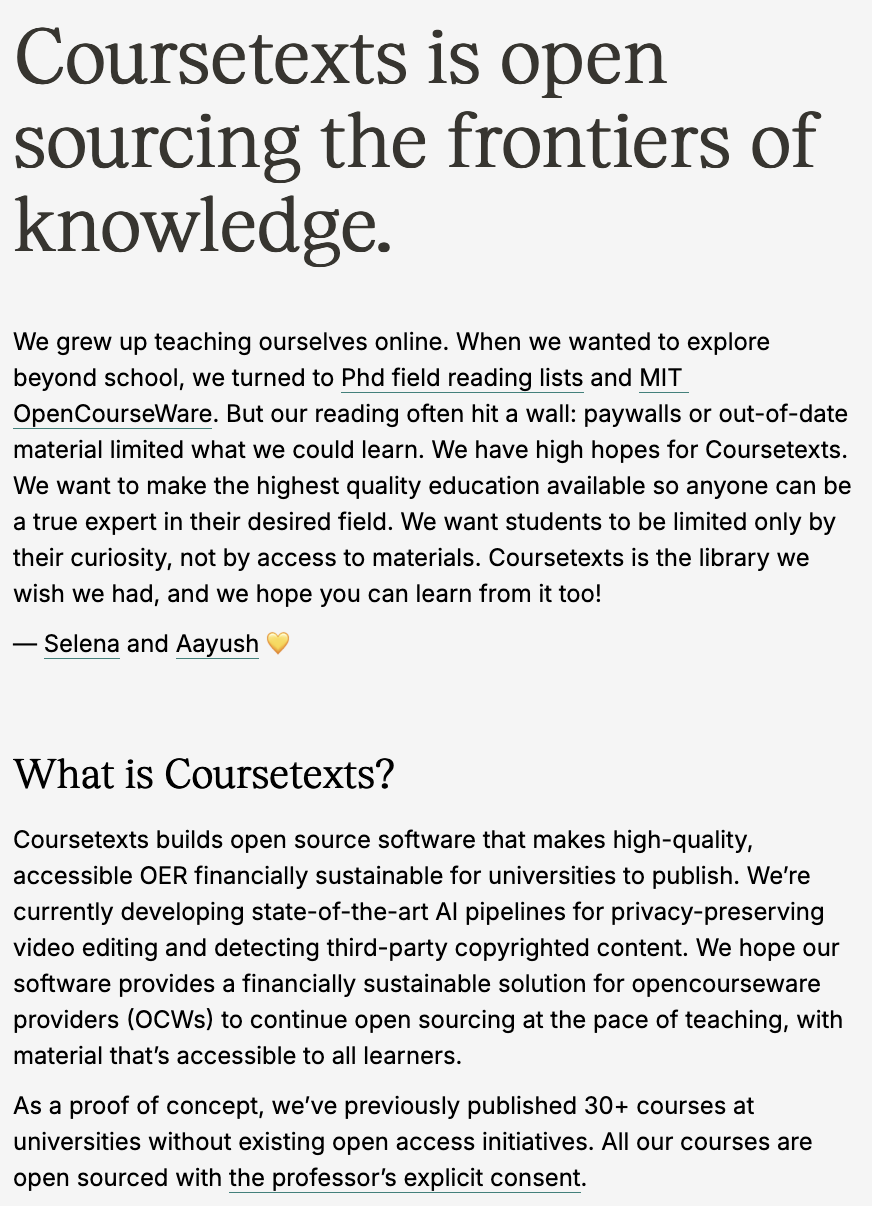
Coursetexts is open sourcing the frontiers of knowledge.
Coursetexts is open library of advanced course notes.
Coursetexts (coursetexts.org)
Introduction to Historiography of Science (HOS/HIS 595)
Coursetexts is open library of advanced course notes.
Coursetexts (coursetexts.org)
This is an extremely useful OER edtech project
-
Coursetexts is an open library of advanced course readings.
"A 501(c)(3) non-profit open-sourcing university & graduate-level courses, starting with MIT, Princeton, and Yale. Our goal is to enable anyone to learn deeply, without institutional barriers"
Coursetexts is open sourcing the frontiers of knowledge.
Coursetexts is open library of advanced course notes.
Coursetexts (coursetexts.org)
Introduction to Historiography of Science (HOS/HIS 595)
Coursetexts is open library of advanced course notes.
Coursetexts (coursetexts.org)
This is an extremely useful OER edtech project
"We grew up teaching ourselves online. When we wanted to explore beyond school, we turned to Phd field reading lists and MIT OpenCourseWare. But our reading often hit a wall: paywalls or out-of-date material limited what we could learn"
"We have high hopes for Coursetexts. We want to make the highest quality education available so anyone can be a true expert in their desired field. We want students to be limited only by their curiosity, not by access to materials"
-
"We grew up teaching ourselves online. When we wanted to explore beyond school, we turned to Phd field reading lists and MIT OpenCourseWare. But our reading often hit a wall: paywalls or out-of-date material limited what we could learn"
"We have high hopes for Coursetexts. We want to make the highest quality education available so anyone can be a true expert in their desired field. We want students to be limited only by their curiosity, not by access to materials"
"We hope our software provides a financially sustainable solution for opencourseware providers (OCWs) to continue open sourcing at the pace of teaching, with material that’s accessible to all learners"
"As a proof of concept, we’ve previously published 30+ courses at universities without existing open access initiatives. All our courses are open sourced with the professor’s explicit consent"
-
"We hope our software provides a financially sustainable solution for opencourseware providers (OCWs) to continue open sourcing at the pace of teaching, with material that’s accessible to all learners"
"As a proof of concept, we’ve previously published 30+ courses at universities without existing open access initiatives. All our courses are open sourced with the professor’s explicit consent"
"By automating onerous workflows but focusing on quick manual review, our software helps publish more courses, more frequently, at a fraction of the cost and time"
Legit use of AI
"Quick publication with minimal effort from professors: Our median time to creating a course preview after receiving professor consent is under 1 week. Compiling and formatting materials can otherwise require months of review"
-
"By automating onerous workflows but focusing on quick manual review, our software helps publish more courses, more frequently, at a fraction of the cost and time"
Legit use of AI
"Quick publication with minimal effort from professors: Our median time to creating a course preview after receiving professor consent is under 1 week. Compiling and formatting materials can otherwise require months of review"
"Low overhead and cost effectivity: We’ve previously published 31 open access courses on a total budget of $11k, for an average cost of $354 per course. Open sourcing with manual auditing costs $3.9M for 132 courses, which is $29.5k per course (including overhead)"
-
Coursetexts is an open library of advanced course readings.
"A 501(c)(3) non-profit open-sourcing university & graduate-level courses, starting with MIT, Princeton, and Yale. Our goal is to enable anyone to learn deeply, without institutional barriers"
Coursetexts is open sourcing the frontiers of knowledge.
Coursetexts is open library of advanced course notes.
Coursetexts (coursetexts.org)
Introduction to Historiography of Science (HOS/HIS 595)
Coursetexts is open library of advanced course notes.
Coursetexts (coursetexts.org)
This is an extremely useful OER edtech project
@impactology But is it slop?
-
@impactology But is it slop?
@androcat Its readings curated by professors
Raghav Agrawal (@impactology@mastodon.social)
"We hope our software provides a financially sustainable solution for opencourseware providers (OCWs) to continue open sourcing at the pace of teaching, with material that’s accessible to all learners" "As a proof of concept, we’ve previously published 30+ courses at universities without existing open access initiatives. All our courses are open sourced with the professor’s explicit consent"

Mastodon (mastodon.social)
-
"Low overhead and cost effectivity: We’ve previously published 31 open access courses on a total budget of $11k, for an average cost of $354 per course. Open sourcing with manual auditing costs $3.9M for 132 courses, which is $29.5k per course (including overhead)"
@impactology As long as someone is responsive to errata reports, this approach to releasing open courseware seems not terrible.
The audit function of a system needs to live somewhere, and if a streamlined process mostly works, that's what gives us industrialized mass abundance.
But automating routine editing and publishing workflow also brings us into the territory of Ironies of Automation -- small errors are corrected, large ones may be amplified.
-
@impactology As long as someone is responsive to errata reports, this approach to releasing open courseware seems not terrible.
The audit function of a system needs to live somewhere, and if a streamlined process mostly works, that's what gives us industrialized mass abundance.
But automating routine editing and publishing workflow also brings us into the territory of Ironies of Automation -- small errors are corrected, large ones may be amplified.
@jmeowmeow Yes! Its just making the process of professors who do want to contribute to OER easier
A good reminder that maybe there are few professors who don't want to gatekeep knowledge and brand it like a luxury product but don't have the means to share it openly
-
R relay@relay.mycrowd.ca shared this topic