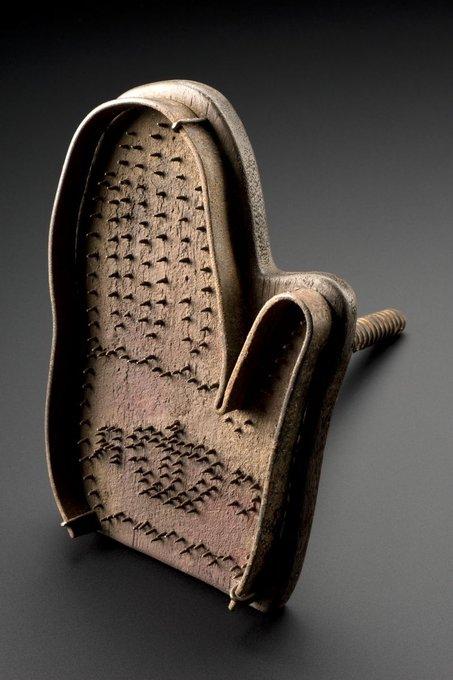
Hand-shaped branding tool for criminals or deserters, 1642–1649.
-
Hand-shaped branding tool for criminals or deserters, 1642–1649. Medium: Wood and steel. Collection: Science Museum Group, London.
Dozens of metal points have been driven into the flat surface. Their arrangement isn't random. If you look closely, you’ll notice a distinct crown figure at the bottom, flanked by the capital letters C and R. These initials likely stood for the Latin Carolus Rex -- King Charles I of England.
-
Hand-shaped branding tool for criminals or deserters, 1642–1649. Medium: Wood and steel. Collection: Science Museum Group, London.
Dozens of metal points have been driven into the flat surface. Their arrangement isn't random. If you look closely, you’ll notice a distinct crown figure at the bottom, flanked by the capital letters C and R. These initials likely stood for the Latin Carolus Rex -- King Charles I of England.
Throughout the English Civil War (1641–1651), the Royalist army used tools like this to permanently brand deserters or serious felons.
But this branding wasn't driven solely by the intent to punish. One reason for the practice -- especially in later periods -- was a specific type of financial fraud the army struggled to control. At the time, new recruits were paid a cash enlistment bounty.
-
Hand-shaped branding tool for criminals or deserters, 1642–1649. Medium: Wood and steel. Collection: Science Museum Group, London.
Dozens of metal points have been driven into the flat surface. Their arrangement isn't random. If you look closely, you’ll notice a distinct crown figure at the bottom, flanked by the capital letters C and R. These initials likely stood for the Latin Carolus Rex -- King Charles I of England.
Many people would enlist just to collect this money, desert at the first opportunity, and then re-enlist in a different regiment in another city under a new identity. To stop this re-enlistment fraud, the military resorted to permanently marking the bodies of deserters.
Branding was largely abolished as a punishment in 1829. The army instead, began tattooing letters onto their skin using special needled instruments and ink or gunpowder
-
R relay@relay.infosec.exchange shared this topic