
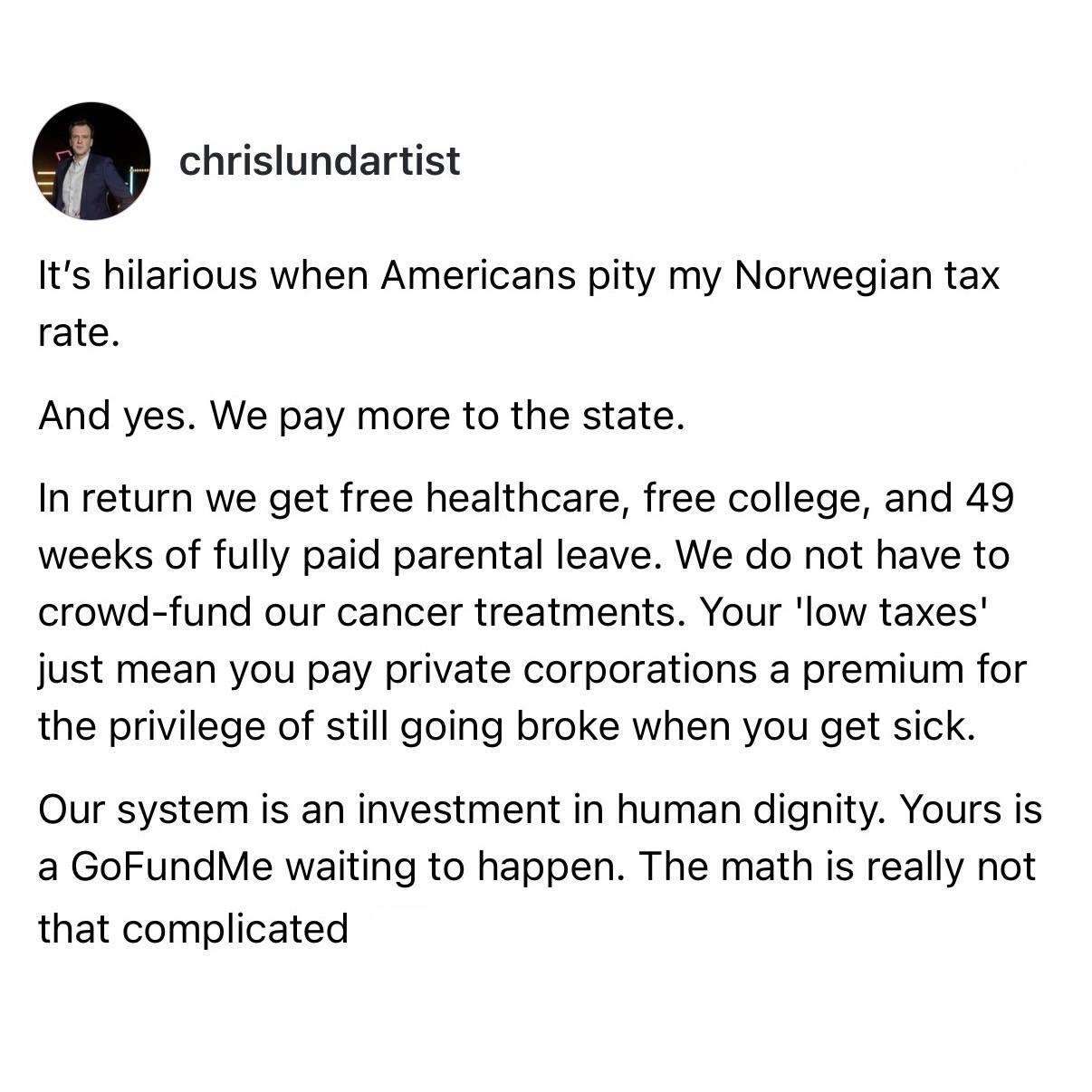
#USpol #Norway #taxes #tax
-
Sure! I'm always curious to hear from other places. Although I'm not so sure that I myself are so impressed with my own skills.

That's the crux not only in your country. People seem to forget what's important, and with the advent of social media, the ways to get yourself lost in meaningless entertainment have exploded. Not that the mechanisms had changed. Even back 2 millennia ago, the Romans knew that "Bread and Games" will keep the poeple from rioting.
Only the media have changed, and maybe the attention span. Hence, a government that has the media in its hand can do bad things with them. Literacy rates are probably only one factor in this.
But I'm curious, what's the primary source of information for those people you are referring to? TV/Radio? Or their mobiles? And if so, how do they use the phones when they are illiterate?
@HarryMutt
It's about fighting hunger in my community, I work with 12 young volunteer farmers to make this a reality by growing food for the needy, educating local farmers with advanced agricultural skills to help them improve on their production as well as equipping beginner farmers with required tools like seeds , fertilisers and organic pestcides to help them produce the best out of their gardens as well combat climate change through tree planting. Do you have such initiatives there? -
Sure! I'm always curious to hear from other places. Although I'm not so sure that I myself are so impressed with my own skills.
That's the crux not only in your country. People seem to forget what's important, and with the advent of social media, the ways to get yourself lost in meaningless entertainment have exploded. Not that the mechanisms had changed. Even back 2 millennia ago, the Romans knew that "Bread and Games" will keep the poeple from rioting.
Only the media have changed, and maybe the attention span. Hence, a government that has the media in its hand can do bad things with them. Literacy rates are probably only one factor in this.
But I'm curious, what's the primary source of information for those people you are referring to? TV/Radio? Or their mobiles? And if so, how do they use the phones when they are illiterate?
@HarryMutt
Learning how to use a phone doesn't require someone to be educated . There are hundreds and thousands of people in my community who who use smart phones although they're not educated. Here we have the UCC which regulates the kind of information showed on TVs, radios and some medias. It becomes easy for them to decide the kind of information to be shown by people more especially the youths and the children. This also plays a big part in keeping people divided and reluctant. -
@HarryMutt
It's about fighting hunger in my community, I work with 12 young volunteer farmers to make this a reality by growing food for the needy, educating local farmers with advanced agricultural skills to help them improve on their production as well as equipping beginner farmers with required tools like seeds , fertilisers and organic pestcides to help them produce the best out of their gardens as well combat climate change through tree planting. Do you have such initiatives there?That sounds a lot like this:
https://de.wikipedia.org/wiki/Raiffeisen
(translate the German page into English, the English page is only about the banks)
During the industrialization, there were many initiatives like this for cooperative associations in Germany, along with social reforms and worker associations, aka unions. Germany is the land of cooperatives anyway. Which the Americans would call "socialist" (which it is not) because they are conditioned that you have to be "better than everybody else and fight alone" and not collaborate to make it better FOR everybody. But what happens there is that the individual is weak and is exploited by corporations who tell them that "SOSHALISM" is bad. Talk about propaganda by the ruling class...For Germany (and, in similar ways, the rest of Europe), this is exactly what brought prosperity to the communities of farmers and also workers. Cooperate, bundle resources, knowledge, and money.
I think it's a great thing you are doing because poverty is best fought together.
-
That sounds a lot like this:
https://de.wikipedia.org/wiki/Raiffeisen
(translate the German page into English, the English page is only about the banks)
During the industrialization, there were many initiatives like this for cooperative associations in Germany, along with social reforms and worker associations, aka unions. Germany is the land of cooperatives anyway. Which the Americans would call "socialist" (which it is not) because they are conditioned that you have to be "better than everybody else and fight alone" and not collaborate to make it better FOR everybody. But what happens there is that the individual is weak and is exploited by corporations who tell them that "SOSHALISM" is bad. Talk about propaganda by the ruling class...For Germany (and, in similar ways, the rest of Europe), this is exactly what brought prosperity to the communities of farmers and also workers. Cooperate, bundle resources, knowledge, and money.
I think it's a great thing you are doing because poverty is best fought together.
@HarryMutt
If people we're not affected by the capitalistic mindsets, the world would be better. Our initiative is currently under a crisis where we have been forced away from the land we have rented for two years to do our activities. We're doing our best tj raise funds and purchase pur own land which would be a big step towards making our dream a reality. Your support via our gofund.me page would make a significant impact towards that goal. -
@HarryMutt
If people we're not affected by the capitalistic mindsets, the world would be better. Our initiative is currently under a crisis where we have been forced away from the land we have rented for two years to do our activities. We're doing our best tj raise funds and purchase pur own land which would be a big step towards making our dream a reality. Your support via our gofund.me page would make a significant impact towards that goal.@HarryMutt
We all would like to form such initiatives and unions to make our countries better places but since people are so divided, it makes it hard for them to join efforts towards a common cause. We have many different tribes, ideologies and the worst of all, we have democratic dictators and oppressors who keep people divided intentionally in order to stay in power. Within such a divided nation, what can make people united? -
@HarryMutt
We all would like to form such initiatives and unions to make our countries better places but since people are so divided, it makes it hard for them to join efforts towards a common cause. We have many different tribes, ideologies and the worst of all, we have democratic dictators and oppressors who keep people divided intentionally in order to stay in power. Within such a divided nation, what can make people united?If I knew the answer to that, I'd earn a Nobel prize.
I can only look back at our own history, and I have to tell you, it took a long time, and also many wars and conflicts. My country alone is the best example. Divided into up to 300 states, from small city states to large ones like Prussia, it was often the place of proxy wars between the big powers. Most notably the war of 30 years where they all fought on German soil, in volatile coalitions, and pretending it was about religion, which, of course, was an excuse to gain power. England, France, Austria, Sweden, and a few others who sent their armies. And as if this hadn't been bad enough, after that war, some of them just took a piece out of the cake and kept it. If that sounds familiar for you, well, I guess, there is a reason for it. Then, the first, nationalist, unification of Germany was a reaction to the Napoleonic occupation which led to nationalism all over Europe, which also fired up the wish for a strong and united Germany. And it was not a peaceful unification. Where this all led to in the 20th century can be read in history books.
Tribalism still exists in Germany, and in the whole of the EU, of course. But at least the latter is not a forced unification, although it was a reaction to the terrible wars before. Sometimes, reason does work.
-
If I knew the answer to that, I'd earn a Nobel prize.
I can only look back at our own history, and I have to tell you, it took a long time, and also many wars and conflicts. My country alone is the best example. Divided into up to 300 states, from small city states to large ones like Prussia, it was often the place of proxy wars between the big powers. Most notably the war of 30 years where they all fought on German soil, in volatile coalitions, and pretending it was about religion, which, of course, was an excuse to gain power. England, France, Austria, Sweden, and a few others who sent their armies. And as if this hadn't been bad enough, after that war, some of them just took a piece out of the cake and kept it. If that sounds familiar for you, well, I guess, there is a reason for it. Then, the first, nationalist, unification of Germany was a reaction to the Napoleonic occupation which led to nationalism all over Europe, which also fired up the wish for a strong and united Germany. And it was not a peaceful unification. Where this all led to in the 20th century can be read in history books.
Tribalism still exists in Germany, and in the whole of the EU, of course. But at least the latter is not a forced unification, although it was a reaction to the terrible wars before. Sometimes, reason does work.
Anyway, I think what you are doing is the right way. Convincing people to work together, that they have common interest to come together and put their stuff together. That the whole is more than the sum of its parts. All too often, this only happens with a negative narrative, "we against the others". But if it happens out of positive sentiments, "we, the people, together", it is a much more stable foundation to build on.
-
If I knew the answer to that, I'd earn a Nobel prize.
I can only look back at our own history, and I have to tell you, it took a long time, and also many wars and conflicts. My country alone is the best example. Divided into up to 300 states, from small city states to large ones like Prussia, it was often the place of proxy wars between the big powers. Most notably the war of 30 years where they all fought on German soil, in volatile coalitions, and pretending it was about religion, which, of course, was an excuse to gain power. England, France, Austria, Sweden, and a few others who sent their armies. And as if this hadn't been bad enough, after that war, some of them just took a piece out of the cake and kept it. If that sounds familiar for you, well, I guess, there is a reason for it. Then, the first, nationalist, unification of Germany was a reaction to the Napoleonic occupation which led to nationalism all over Europe, which also fired up the wish for a strong and united Germany. And it was not a peaceful unification. Where this all led to in the 20th century can be read in history books.
Tribalism still exists in Germany, and in the whole of the EU, of course. But at least the latter is not a forced unification, although it was a reaction to the terrible wars before. Sometimes, reason does work.
@HarryMutt
I read about the European history and studied how the Italy and Germany fought to unify themselves despite the hindrance of Austria, Vienna settlement, Metternich system and other factor. I also learnt how Otto Von Bismarck, Hamilton Cavour, Kaiser William 1 , Victor Emmanuel among others fought hard to create the countries we admire now. This shows that our countries are backwards over 150 years back and we still have a huge battle to fight. -
@HarryMutt
I read about the European history and studied how the Italy and Germany fought to unify themselves despite the hindrance of Austria, Vienna settlement, Metternich system and other factor. I also learnt how Otto Von Bismarck, Hamilton Cavour, Kaiser William 1 , Victor Emmanuel among others fought hard to create the countries we admire now. This shows that our countries are backwards over 150 years back and we still have a huge battle to fight.@HarryMutt
We can't just sit and see our countries drown in disunity that has kept our countries backwards in all aspects of life . We can't wait to see what the government will do for us bug instead work hard to do something for our people and the government. We believe that change starts with us doing something we can no matter how small it is. -
Anyway, I think what you are doing is the right way. Convincing people to work together, that they have common interest to come together and put their stuff together. That the whole is more than the sum of its parts. All too often, this only happens with a negative narrative, "we against the others". But if it happens out of positive sentiments, "we, the people, together", it is a much more stable foundation to build on.
@HarryMutt
Your support matters alot towards us and our community. Sharing and donating to our page makes us motivated and inspired to keep keep going with a strong belief that we're not alone. -
@HarryMutt
I read about the European history and studied how the Italy and Germany fought to unify themselves despite the hindrance of Austria, Vienna settlement, Metternich system and other factor. I also learnt how Otto Von Bismarck, Hamilton Cavour, Kaiser William 1 , Victor Emmanuel among others fought hard to create the countries we admire now. This shows that our countries are backwards over 150 years back and we still have a huge battle to fight.Better don't admire so much what they created. By today's standards, they were war criminals. And what they created was the foundation for colonialism, two world wars, and more than one genocide, also on the African continent.
Today's Germany has not much in common with what they imagined. Democratic, inklusive, pluralistic, not nationalistic like theirs. Not "we against them", or worse, the out-of-context misinterpretation of "Deutschland über alles" (which meant "a united Germany over the fragmented entity that was not a real nation like everybody else had one". Instead a country that is built on human rights, equality, not submission, cooperation, not confrontation. Flawed, and full of people who want back to the old ways of nationalism, racism, and imperialism. But they are a loud minority. The majority has long realized that real prosperity comes from cooperation, not wars. The people you listed would feel were displaced in this country which has values so far from theirs.
But those were the lessons from the unimaginable crimes that were committed in this nation's name.
Don't admire countries or historical people. Stay with being a human being with empathy for others and take from our history what suits your situation best. At least, we can serve as bad example, sometimes even as a good one.:-)
-
@nuwagaba2 @nazokiyoubinbou set up schools to teach social democracy to Americans.
@TheComfortableSpotPodcast @nuwagaba2 @nazokiyoubinbou
That should be Denmarks/the EU's answer to sending a hospital ship to where nobody needs one because the health system is much better than in the states.
Lets fund US schools and universities to teach Americans how people can actually live in a democracy, how "we, the people" actually works when the "we" is not the oligarchs. How their riches can actually benefit PEOPLE, those who have been exploited to accumulate that wealth for the very few.
And I've always been for creating a fund that would finance European student exchange years for American teenagers so that they can see through all that nationalist propaganda. That would easily finance itself by saving hundreds of millions or even billions wasted through silly trade wars because those people would oppose to electing another crazy isolationist. 100,000 students a year. That would have an effect.
It's not America which helps spreading democracy. It's America which needs help building real democracy at home. One that can't be bought so easily.
-
Better don't admire so much what they created. By today's standards, they were war criminals. And what they created was the foundation for colonialism, two world wars, and more than one genocide, also on the African continent.
Today's Germany has not much in common with what they imagined. Democratic, inklusive, pluralistic, not nationalistic like theirs. Not "we against them", or worse, the out-of-context misinterpretation of "Deutschland über alles" (which meant "a united Germany over the fragmented entity that was not a real nation like everybody else had one". Instead a country that is built on human rights, equality, not submission, cooperation, not confrontation. Flawed, and full of people who want back to the old ways of nationalism, racism, and imperialism. But they are a loud minority. The majority has long realized that real prosperity comes from cooperation, not wars. The people you listed would feel were displaced in this country which has values so far from theirs.
But those were the lessons from the unimaginable crimes that were committed in this nation's name.
Don't admire countries or historical people. Stay with being a human being with empathy for others and take from our history what suits your situation best. At least, we can serve as bad example, sometimes even as a good one.:-)
@HarryMutt
That's right, we can copy the good from them amd shape our country into something better. World wars were meant to happen but it's unfortunate that it was these unified countries that made them happen. These individuals saw a better world amd countries than what we see now. They hoped and worked for something better . I know Otto Von Bismarck was the foundation for African colonialism through the Berlin conference which is making our countries to suffer up to now. -
R relay@relay.mycrowd.ca shared this topic

