Remember the "One Laptop Per Child" project, that developed a low-cost computer for children in developing countries?


-
Sounds like you'd want to write a JIT compiler for C tbh...
@agowa338 @blinry what a nightmare that would be! Which AOT compiler would you target compatibility with? How would you handle ISA extensions? Allow specifying compiler options? Well, I might want a C interpreter+JIT for new code targeting that system, but for existing code with an established build process, I’d use the existing distributed machine code, so the language module used is minimal (until it gets run on future hardware with an incompatible ISA)
-
@ShadSterling @raymaccarthy @blinry
Netflix probably. I think they used Silverlight as DRM in the early days or something.
@agowa338 @raymaccarthy @blinry yeah, that sounds right. That was definitely something I had problems with
-
@agowa338 @blinry what a nightmare that would be! Which AOT compiler would you target compatibility with? How would you handle ISA extensions? Allow specifying compiler options? Well, I might want a C interpreter+JIT for new code targeting that system, but for existing code with an established build process, I’d use the existing distributed machine code, so the language module used is minimal (until it gets run on future hardware with an incompatible ISA)
Well it was your idea. I didn't even say it was possible to pull off. Your idea just sounded like JIT compiled C to me...
Also anyone know what magic https://godbolt.org/ is using under the hood? I'd hope they're not actually running each of these compilers on their system each time you put something in there and somehow do it interpreted? Right?
Then something like that may be able to help.
-
Remember the "One Laptop Per Child" project, that developed a low-cost computer for children in developing countries? I was always amazed by a certain feature: The "View Source" button.
When you pressed it, the source code for the currently running application would open. This was supposed to encourage tinkering with the software on your device!

I've been pondering what it would take to build that button on modern machines. Has anyone seen something like that?
(Prototype in next toot.)
It originally ran Sqeak. Sqeak is a modern Smalltalk (though Pharo is positioning itself as a replacement). It was also inspired by the DynaBook, which was another of Alan Kay's projects.
Smalltalk environments all let you inspect both the source code and the state of running objects.
For Étoilé, we built a persistent object model with some common interfaces and the UI framework exposed the same introspection APIs, so you could attach an inspector to any object and see it in a generic way, but then attach an inspector to the UI for the model object, and then to that in turn and have inspectors all the way down (or up, or something).
-
Remember the "One Laptop Per Child" project, that developed a low-cost computer for children in developing countries? I was always amazed by a certain feature: The "View Source" button.
When you pressed it, the source code for the currently running application would open. This was supposed to encourage tinkering with the software on your device!
I've been pondering what it would take to build that button on modern machines. Has anyone seen something like that?
(Prototype in next toot.)
@blinry story time! I was volunteering in Ecuador doing a summer enrichment program in English and math skills for rural students. One summer we rolled up and discovered the school had a whole shelf of these OLPCs. Decided on the spot to include a computer class. Completely made it up as we went along, it was tons of fun. Some of the students had never touched a computer before.
-
@blinry story time! I was volunteering in Ecuador doing a summer enrichment program in English and math skills for rural students. One summer we rolled up and discovered the school had a whole shelf of these OLPCs. Decided on the spot to include a computer class. Completely made it up as we went along, it was tons of fun. Some of the students had never touched a computer before.
@blinry The computers were pretty buggy. They hid the file system and instead stored stuff in a chronological "journal". But a few times the whole journal disappeared leaving students a bit distraught. I had a literal Jurassic Park "wait, it's a Linux system?" moment when I found out there was a terminal and I could go search for the missing files.
-
@blinry The computers were pretty buggy. They hid the file system and instead stored stuff in a chronological "journal". But a few times the whole journal disappeared leaving students a bit distraught. I had a literal Jurassic Park "wait, it's a Linux system?" moment when I found out there was a terminal and I could go search for the missing files.
@blinry but back to the view source button! There was a kid with untreated vision issues, we thought he wasn't paying attention but he couldn't see the board etc etc. In a couple of the apps we use I was able to click that button, go in and increase the font size, and suddenly he could use the computer. He was so grateful for that.
-
@blinry but back to the view source button! There was a kid with untreated vision issues, we thought he wasn't paying attention but he couldn't see the board etc etc. In a couple of the apps we use I was able to click that button, go in and increase the font size, and suddenly he could use the computer. He was so grateful for that.
@aburka Lovely story, thanks for sharing!
-
Well it was your idea. I didn't even say it was possible to pull off. Your idea just sounded like JIT compiled C to me...
Also anyone know what magic https://godbolt.org/ is using under the hood? I'd hope they're not actually running each of these compilers on their system each time you put something in there and somehow do it interpreted? Right?
Then something like that may be able to help.
@agowa338 @blinry I can see how it could sound that way; the mental model I landed on aims to run existing AOT-compiled software unchanged, to maximize compatibility.
godbolt.org gives you a compiler picker and an options field, so each time you put something it actually runs just the compiler you pick - https://xania.org/202506/how-compiler-explorer-works
-
@dwardoric @blinry I was thinking Lisp Machines, but, nevertheless, very cool project! :3
@korenchkin @dwardoric @blinry I mean, this is already pretty easy today if you use Emacs for everything

C-h kgives you hyperlinks straight to the source of any command bound to a keystrokethe main problem is that sometimes your boss makes you use programs that aren't emacs =(
-
@korenchkin @dwardoric @blinry I mean, this is already pretty easy today if you use Emacs for everything
C-h kgives you hyperlinks straight to the source of any command bound to a keystrokethe main problem is that sometimes your boss makes you use programs that aren't emacs =(
@technomancy @dwardoric @blinry I'm lucky, I can use emacs all day :3
-
@blinry @EndlessAccess @wjt @ramcq @chergert I remember seeing this in @ptomato’s talk at GUADEC in 2018 (6:45) https://youtu.be/NF-hZ1aMIl0?t=405
@cassidy @blinry @EndlessAccess @ramcq @chergert @ptomato I wasn't involved in implementing this, but: what makes it conceptually possible is that Flatpak apps (at least the ones on Flathub) can be built offline if you have the dependencies, which you can get from Flathub (org.gnome.Calculator.Sources for example). I think this worked by installing the .Sources extension for the running app, unpacking it and opening it in Builder, then window manager hacks to glue the two together.
-
Remember the "One Laptop Per Child" project, that developed a low-cost computer for children in developing countries? I was always amazed by a certain feature: The "View Source" button.
When you pressed it, the source code for the currently running application would open. This was supposed to encourage tinkering with the software on your device!
I've been pondering what it would take to build that button on modern machines. Has anyone seen something like that?
(Prototype in next toot.)
@blinry I incorporate this feature into my game engine right now. The game editor is built inside the game engine which is built with rust. You will be able to see the object components as well as the source code. And can effectively tinker on the editor as if it's a game that you can build with the engine.
-
Remember the "One Laptop Per Child" project, that developed a low-cost computer for children in developing countries? I was always amazed by a certain feature: The "View Source" button.
When you pressed it, the source code for the currently running application would open. This was supposed to encourage tinkering with the software on your device!
I've been pondering what it would take to build that button on modern machines. Has anyone seen something like that?
(Prototype in next toot.)
@blinry the display technology and the rotation and all... everything looked great!
I'd like to have one to tinker with. -
@blinry in the Old Days, one could attach a debugger to any running process, and step through it … if the debug symbols were where the debugger could find them, you would step though the source, if not, the machine code … I gather GDB and LLDB can do similar today, tho maybe only in text mode; I’d think a distro could package everything with debug symbols and make some of that much more accessible, even adding a version-specific repo link to the debug info
@ShadSterling @blinry With debuginfod it's not even necessary to install the debug symbols anymore on most major Linux distributions, gdb or whatever program needs them can just download them on demand. At least Fedora also automatically downloads the matching source file. See https://sourceware.org/elfutils/Debuginfod.html
-
Remember the "One Laptop Per Child" project, that developed a low-cost computer for children in developing countries? I was always amazed by a certain feature: The "View Source" button.
When you pressed it, the source code for the currently running application would open. This was supposed to encourage tinkering with the software on your device!
I've been pondering what it would take to build that button on modern machines. Has anyone seen something like that?
(Prototype in next toot.)
@blinry dynamicland is an extreme version of this: https://dynamicland.org/
The site and explanations are generally so opaque to newcomers that I think it's significantly limiting things, but I suspect that's partly intentional.
If you haven't seen it before, I'd recommend searching YouTube for videos of people using it. It's pretty clear at a glance, the code printed on the paper *is* the code, interactions between things come from physical arrangement, etc: https://youtube.com/shorts/zsYFX_-J-rk -
@blinry oh oh oh talk to @EndlessAccess folks about this! They hold a defensive patent (which is usable by open source projects) for “Flip to Hack” which was this idea taken to the extreme as far as coolness goes.
I imagine @wjt, @ramcq, and maybe @chergert (because I think it used GNOME Builder?) could share some pointers to the history.
@cassidy @blinry @EndlessAccess @ramcq @chergert Here is the patent: https://patents.google.com/patent/US11355030B2/en
-
Remember the "One Laptop Per Child" project, that developed a low-cost computer for children in developing countries? I was always amazed by a certain feature: The "View Source" button.
When you pressed it, the source code for the currently running application would open. This was supposed to encourage tinkering with the software on your device!
I've been pondering what it would take to build that button on modern machines. Has anyone seen something like that?
(Prototype in next toot.)
@blinry @gvwilson amazing work! the lack of such a thing is one of my primary complaints about the so-called “open” operating systems, and the FLOSS movement generally. if we can’t put the actual control in users’ hands, then what’s the point? seeing an actual modern prototype of this is really encouraging. Particularly because it seems you have a scalable approach which won’t require work from every app? I wish you great luck in making it happen more broadly!
-
Remember the "One Laptop Per Child" project, that developed a low-cost computer for children in developing countries? I was always amazed by a certain feature: The "View Source" button.
When you pressed it, the source code for the currently running application would open. This was supposed to encourage tinkering with the software on your device!
I've been pondering what it would take to build that button on modern machines. Has anyone seen something like that?
(Prototype in next toot.)
@blinry I think the OLPC project failed because they foolishly rejected my implementation suggestion
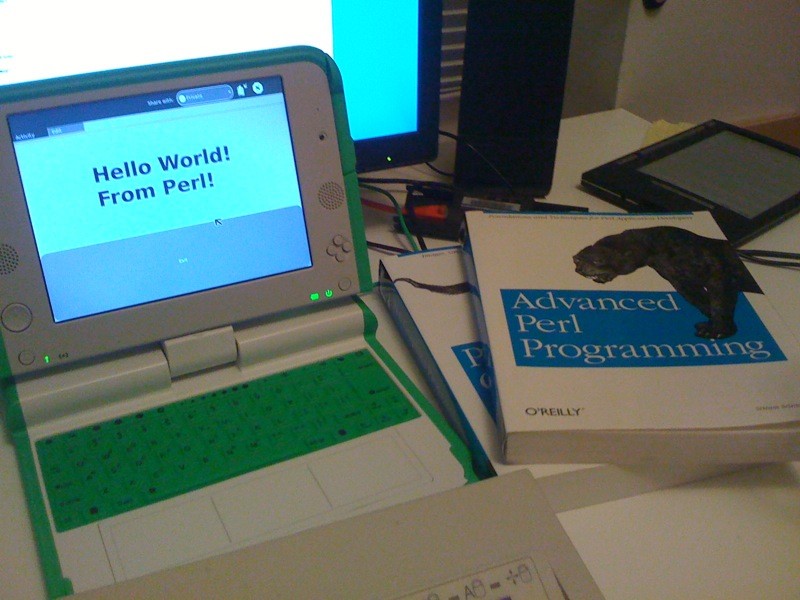
-
You'd roughly need to:
- Figure out which program is currently focused
- Figure out the Git repo of this software
- Clone it into a temporary directory
- Set up the required tools to start hacking on it and compile itAs a quick prototype, I wrote a li'l Bash script that does some of these things. It makes heavy use of #nix and #nixpkgs:
view-source-button
view-source-button - A script that allows you to start tinkering with software

Codeberg.org (codeberg.org)
I enters a "dev shell" with the required tools already in the PATH, and even sets up a Git remote to start contributing.

@blinry would be nicer to bundle the apps with the source itself in some way