Happy Mainframe Day
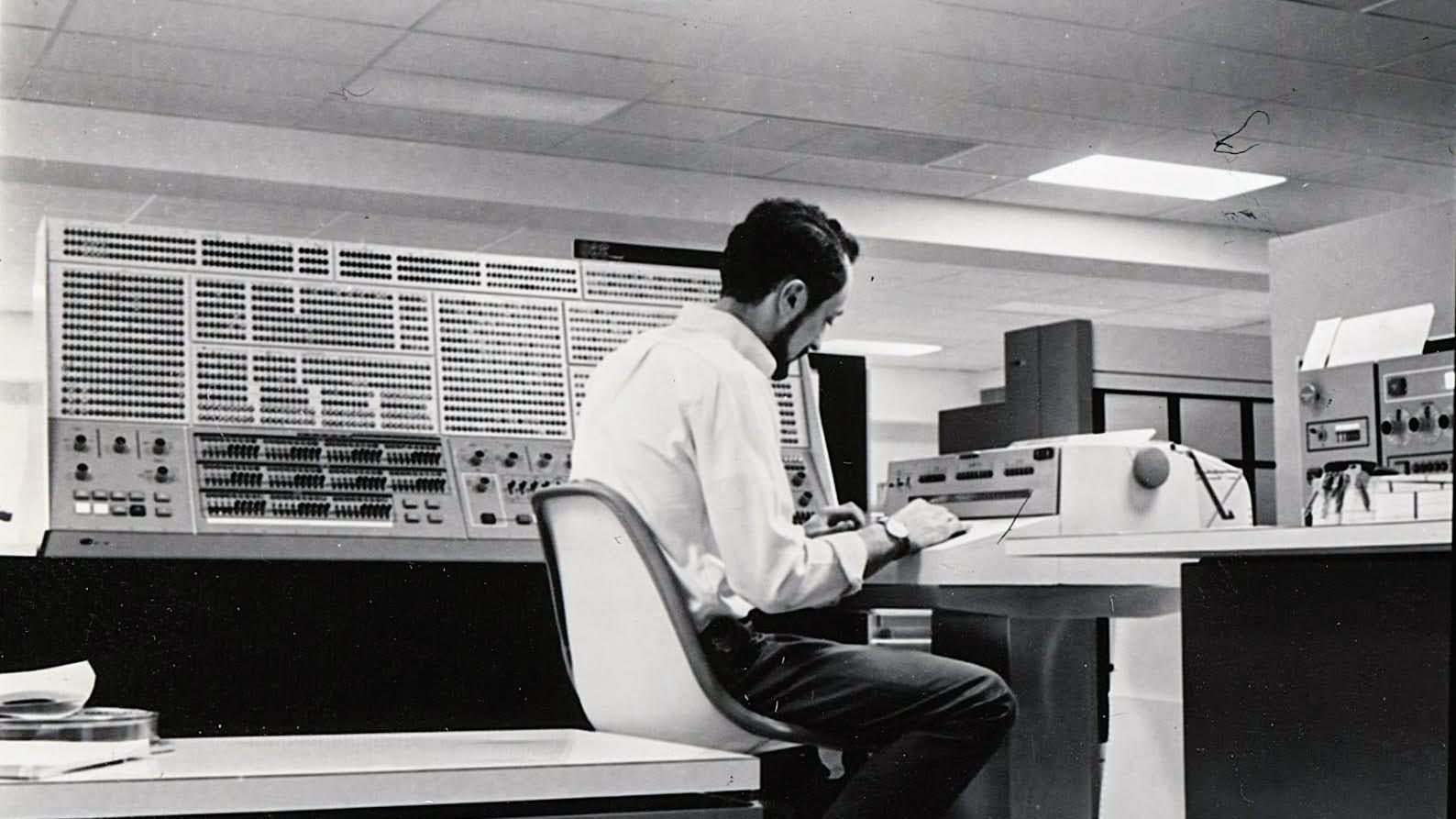
-
@SteveBellovin @markd @stuartmarks @aka_pugs
Agreed. A few more notes:
I always admired Burroughs B5000,etc for software-oriented hardware design… but seemed harder to aggressively pipeline than general-register machines. (After all, 360/44 subset was not too far away from typical RISCs)
Also, simplicity for expression evaluation was rendered less useful by global optimizing compilers with 16+ registers, ie Fortran IV(H), ~1968.
I was impressed by day course in optimization by Cocke & Allen.@JohnMashey @SteveBellovin @markd @aka_pugs Speaking of the 360/44 and (previously) of IBM’s hex floating point, I went down a little rabbit hole I thought I’d share here. The 360/44 had variable-precision FP. Using a knob on the front panel, you could select long precision to have 8, 10, 12, or 14 hex digits, allowing you to trade precision for speed. (1/4)
-
There’s a picture of this on Ken Shirriff’s @kenshirriff site, along with the consoles of the other 360 models. In the 360/44 pic, the knob is the bottom one of the trio of knobs at the center left.
Iconic consoles of the IBM System/360 mainframes, 55 years old
The IBM System/360 was a groundbreaking family of mainframe computers announced on April 7, 1964. Designing the System/360 was an extremely...
(www.righto.com)
There is a general description of this feature on the Wikipedia page:
and fortunately it has a link to original source material on bitsavers:
https://bitsavers.org/pdf/ibm/360/functional_characteristics/A22-6875-5_360-44_funcChar.pdf (2/4)
Page 13 describes how this works. The value always occupied 64 bits, but digits beyond the selected precision were zeroed. It says “Model 44 always performs long-precision arithmetic with 56 bits.” So how were the lower-precision formats faster? The timing table on p. 15 reveals that only multiplication and division operations changed speed depending on the selected precision. Other operations’ timings were unchanged. (3/4)
-
@JohnMashey @SteveBellovin @markd @aka_pugs Speaking of the 360/44 and (previously) of IBM’s hex floating point, I went down a little rabbit hole I thought I’d share here. The 360/44 had variable-precision FP. Using a knob on the front panel, you could select long precision to have 8, 10, 12, or 14 hex digits, allowing you to trade precision for speed. (1/4)
There’s a picture of this on Ken Shirriff’s @kenshirriff site, along with the consoles of the other 360 models. In the 360/44 pic, the knob is the bottom one of the trio of knobs at the center left.
Iconic consoles of the IBM System/360 mainframes, 55 years old
The IBM System/360 was a groundbreaking family of mainframe computers announced on April 7, 1964. Designing the System/360 was an extremely...
(www.righto.com)
There is a general description of this feature on the Wikipedia page:
and fortunately it has a link to original source material on bitsavers:
https://bitsavers.org/pdf/ibm/360/functional_characteristics/A22-6875-5_360-44_funcChar.pdf (2/4)
-
Page 13 describes how this works. The value always occupied 64 bits, but digits beyond the selected precision were zeroed. It says “Model 44 always performs long-precision arithmetic with 56 bits.” So how were the lower-precision formats faster? The timing table on p. 15 reveals that only multiplication and division operations changed speed depending on the selected precision. Other operations’ timings were unchanged. (3/4)
The other operations were much faster than multiplication and division, so it was probably deemed unnecessary to speed them up when shorter precisions were selected.
Multiplication and division, being much slower than the other operations, probably stood to benefit the most from the variable precision. Using 8 digits could be 2.7-3.8x faster than 14 digits. (4/4)
-
There’s a picture of this on Ken Shirriff’s @kenshirriff site, along with the consoles of the other 360 models. In the 360/44 pic, the knob is the bottom one of the trio of knobs at the center left.
Iconic consoles of the IBM System/360 mainframes, 55 years old
The IBM System/360 was a groundbreaking family of mainframe computers announced on April 7, 1964. Designing the System/360 was an extremely...
(www.righto.com)
There is a general description of this feature on the Wikipedia page:
and fortunately it has a link to original source material on bitsavers:
https://bitsavers.org/pdf/ibm/360/functional_characteristics/A22-6875-5_360-44_funcChar.pdf (2/4)
@stuartmarks @kenshirriff Well, in looking at the model 44 functional characteristics, I'm surprised to see the 2315 disk with fixed-block size and addressing. Unlike all the Count-Key-Data drives of the rest of the line. AFAIK, FBA wouldn't should up again until the late 70s with the 3370 line.
-
@stuartmarks @kenshirriff Well, in looking at the model 44 functional characteristics, I'm surprised to see the 2315 disk with fixed-block size and addressing. Unlike all the Count-Key-Data drives of the rest of the line. AFAIK, FBA wouldn't should up again until the late 70s with the 3370 line.
@aka_pugs @stuartmarks @kenshirriff It's the same disk used for the IBM 1130 and 1800: http://ibm1130.org/hw/disk/.