It sounds as if electric trucks are great for long-range land transport.
-
Two reasons why not:
Road vehicles can't share the same rail track as cars;
Double-tracking to allow trains to go in both directions at once gets really expensive.@barbra @david_chisnall Good points, but worth noting that (1) trams exist, so road sharing is possible (if not always practical!), and (2) rather than double tracks all the way, you only need to have passing loops at the points where opposing trains cross, which can reduce the cost greatly (in the right situation).
-
@david_chisnall M hmm... I see where you are going with this. If I could make a note?
You are providing dedicated paths for these electric vehicles already. Why not include one of the "charge as you go" designs, like an electrified rail or overhead cable to reduce the required battery size?
@Epic_Null @david_chisnall Big clockwork spring under the truck and a giant winder in the road you stop at every so often. No cables, no electrical interference, no lithium needed.
-
It sounds as if electric trucks are great for long-range land transport. But they require heavy batteries, so rather than putting them on the road (where they'll damage the road surface), why don't we build special metal tracks for them to go on? And, on long trips, join a bunch of them together so that you only need one motor and driver for a load of them travelling in a convoy? I bet you could make freight transport a lot more efficient if you did that.
In China, those ideas are operating in a port context, with cargo shunts.
On the same principle, we need a massive expansion of rail freight.
-
@david_chisnall can't fix your railways, all the money's going into proprietary CargoRail now!
and make it more efficient by running the cargo through underground/elevated tunnels that are in complete vacuum so they can go 500mph
-
and make it more efficient by running the cargo through underground/elevated tunnels that are in complete vacuum so they can go 500mph
@maya_b @david_chisnall I think that's an actual, real-life brain fart you're recounting here, right?
-
@maya_b @david_chisnall I think that's an actual, real-life brain fart you're recounting here, right?
-
@NMBA @david_chisnall Is Canada like the USA though where the trucks and reefers are owned by different people ? That's always been a problem, as well as the fact many trailers spend most of their time parked so it's a very poor return on investment.
@etchedpixels @david_chisnall
There's some private operators but most are drivers for a trucking company. I'm thinking there would be container depots along major highways at the edges of cities for the EV truck trains to switch loads and charge/rest, and have smaller e-trucks distribute the containers into the cities. -
but if we're making fun of techbros regurgitating ideas it's just a matter of time before it's forgettgn as a dream (just like the old sci-fi stories that dreamt it up previously)
-
@david_chisnall decades ago, was flabbergasted to learn my first coding job’s employer (a grain co) usually got $30/ton rates for rail shipping across 5 states. Trucking was 6-8 times that, and the inefficiencies of small-lot (not full rail car) really soar from there.
… tell me we couldn’t engineer a way to let folks hook into this: little bins in boxes in pallets in railcars. Matrushka, and a dollar plops something weighty like a pile of books or preserves or etc anywhere across the country.
@InkomTech @david_chisnall 19th and early 20th century European railways inc UK did stuff like that with chalkboards on each railway wagon detailing what was in the wagon and where it was going. A train would be assembled from all sorts of wagons then would drop some off at a yard someplace and pick up some more to take somewhere else. There were also Mail Trains that did the same sort of thing with letters and parcels. (More)
-
@InkomTech @david_chisnall 19th and early 20th century European railways inc UK did stuff like that with chalkboards on each railway wagon detailing what was in the wagon and where it was going. A train would be assembled from all sorts of wagons then would drop some off at a yard someplace and pick up some more to take somewhere else. There were also Mail Trains that did the same sort of thing with letters and parcels. (More)
@InkomTech @david_chisnall They had sorting offices on board and could pick and drop off mail bags without even stopping.
-
@etchedpixels @david_chisnall
There's some private operators but most are drivers for a trucking company. I'm thinking there would be container depots along major highways at the edges of cities for the EV truck trains to switch loads and charge/rest, and have smaller e-trucks distribute the containers into the cities.@NMBA @david_chisnall I dream of the day a train pulls up in a station and a pile of delivery robots pile out of the wagons and off down the road
-
@david_chisnall
The underlying problem is that rail freight gets to include all the costs associated with the entire rail network; while trucks get to use roads that are paid for out of our taxes.@ocratato @david_chisnall That and they dont pay externalities, pollution, road deaths.
-
@InkomTech @david_chisnall We used to do that in the UK. Our rail companies had parcels services, as did nationalised rail. Then we got a right wing nut job government under Thatcher and they broke it all.
There have been some attempts at doing smaller scale intermodal at stations ("minimodal" the obvious one) but it flopped.
@etchedpixels @InkomTech @david_chisnall Red Star parcels
-
It sounds as if electric trucks are great for long-range land transport. But they require heavy batteries, so rather than putting them on the road (where they'll damage the road surface), why don't we build special metal tracks for them to go on? And, on long trips, join a bunch of them together so that you only need one motor and driver for a load of them travelling in a convoy? I bet you could make freight transport a lot more efficient if you did that.
@david_chisnall
Nonono, you would kill the jobs of a lot of drivers, and the business of the filling stations and road toll and poor Shell, Total, Esso, MSB, Putin, DJT not beeing able to sell a big pool of gasoline each day.
And tyre companies, and repair shops, and, ... .
The money we would not spend on this would probably just being used to improve the railway systems. What a leftist idea!
You see yourself, this could be a very bad idea (for some) /s
-
It sounds as if electric trucks are great for long-range land transport. But they require heavy batteries, so rather than putting them on the road (where they'll damage the road surface), why don't we build special metal tracks for them to go on? And, on long trips, join a bunch of them together so that you only need one motor and driver for a load of them travelling in a convoy? I bet you could make freight transport a lot more efficient if you did that.
@david_chisnall i mean yeah but at some point we have to talk about how these private roads are largely controlled by a cartel of competing business interests, and if those competing business interests were capable of solving this problem which they've had enormous incentive to solve, they are electing not to do it.
i think batteries are absolutely the answer rn this very instant; i don't think anyone anywhere has forgotten that rail freight is an option. Getting them to use it isn't some simple matter of someone having an epiphany that railroads exist and that green tech can be used to power them.
-
It sounds as if electric trucks are great for long-range land transport. But they require heavy batteries, so rather than putting them on the road (where they'll damage the road surface), why don't we build special metal tracks for them to go on? And, on long trips, join a bunch of them together so that you only need one motor and driver for a load of them travelling in a convoy? I bet you could make freight transport a lot more efficient if you did that.
-
It sounds as if electric trucks are great for long-range land transport. But they require heavy batteries, so rather than putting them on the road (where they'll damage the road surface), why don't we build special metal tracks for them to go on? And, on long trips, join a bunch of them together so that you only need one motor and driver for a load of them travelling in a convoy? I bet you could make freight transport a lot more efficient if you did that.
@david_chisnall And a bonus! Having them on the rails would keep them off roads where cars are. No one else would be killed by the truck smashing into them from behind. Yay, trains.
-
The first time i read a shitpost about that, i thought the same thing as you did, "haha that's a funny and brilliant way to remind us that trains exist and are great".
Then i did some research and reading and i suggest you do too; you'll learn that rail freight is already extremely developed pretty much everywhere; cheaper than road freight; and when trucks are used, it's not because some fucker wanted to burn oil for fun but because rail didn't work for that.
So yes, electric trucks are, in fact, not a dumb idea.
Sure it would be even better to engage less in our ultra consumerist society and buy less random garbage so that eventually results in less trucks on the roads - and less trains on tracks, because in the US, one of the reasons why passenger trains suck so much is because the tracks are saturated with freight trains, whose traffic has a higher priority.
You're welcome!
@jpetazzo @david_chisnall You're right. There's a reason railways aren't already reaching all destinations.
That's why electric trucks are a perfect complement to rail freight.
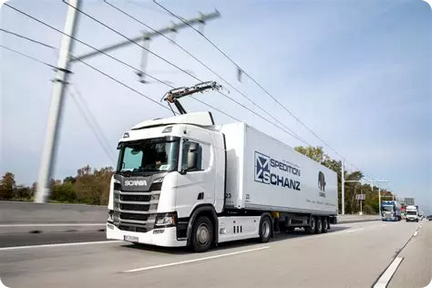
It's even possible to reduce battery size by letting trucks charge with overhead wires.
-
@NMBA @david_chisnall I dream of the day a train pulls up in a station and a pile of delivery robots pile out of the wagons and off down the road
@NMBA @etchedpixels @david_chisnall it’s surprising how long small scale intermodal freight lasted in Germany - into the 1990s! https://bahnwelt.de/neuigkeiten/sanierung-eines-historischen-von-haus-zu-haus-behaelters/
-
It sounds as if electric trucks are great for long-range land transport. But they require heavy batteries, so rather than putting them on the road (where they'll damage the road surface), why don't we build special metal tracks for them to go on? And, on long trips, join a bunch of them together so that you only need one motor and driver for a load of them travelling in a convoy? I bet you could make freight transport a lot more efficient if you did that.
@david_chisnall - Now that is thinking out of the box.