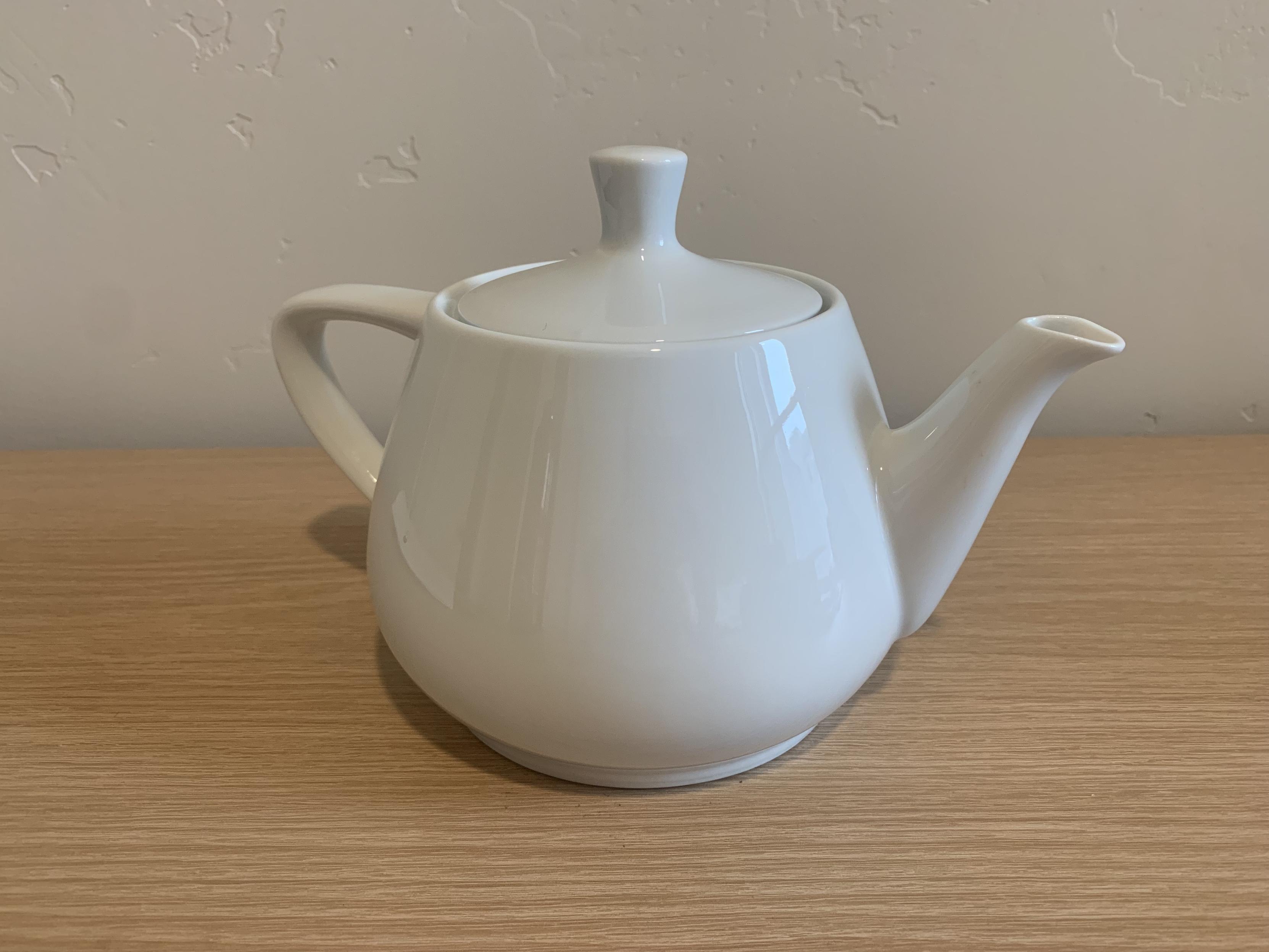
I now have my own Utah teapot!
-
I now have my own Utah teapot!
This ordinary teapot is the "hello world" object of computer graphics and has cameos in countless productions.
A thread on teapots and UNIX… 🧵
Photo: My Melitta teapot, 2026-04-16.
-
I now have my own Utah teapot!
This ordinary teapot is the "hello world" object of computer graphics and has cameos in countless productions.
A thread on teapots and UNIX… 🧵
Photo: My Melitta teapot, 2026-04-16.
While working on his 1975 dissertation on procedural modeling at the University of Utah, Martin Newell needed a good test object and, at the suggestion of his wife, picked their Melitta tea set. He measured it by hand and created a model rendered with Bézier curves, one of the first to be modeled as rules instead of a set of points.
Shortly thereafter, Jim Blinn refined the model. While doing a demo, he shrunk the model vertically by a third, but everyone liked it better that way, so it stuck. His 1977 publication with Martin on texture and reflection applied several fun textures to the teapot and from there its popularity spread.
Photo: UNIX V4 tape with the original Utah teapot at the Computer History Museum, held by Jon Duerig and Thalia Archibald, 2025-12-19.
-
While working on his 1975 dissertation on procedural modeling at the University of Utah, Martin Newell needed a good test object and, at the suggestion of his wife, picked their Melitta tea set. He measured it by hand and created a model rendered with Bézier curves, one of the first to be modeled as rules instead of a set of points.
Shortly thereafter, Jim Blinn refined the model. While doing a demo, he shrunk the model vertically by a third, but everyone liked it better that way, so it stuck. His 1977 publication with Martin on texture and reflection applied several fun textures to the teapot and from there its popularity spread.
Photo: UNIX V4 tape with the original Utah teapot at the Computer History Museum, held by Jon Duerig and Thalia Archibald, 2025-12-19.
At the same time as he modeled the teapot, in 1974, Martin acquired a copy of UNIX V4 for the new computer graphics lab he was managing. It was evidently to serve as the operating system for the lab's PDP-11/45 computer. But UNIX had only been publicly released a few months prior and was still quite flakey, so it went unused, in favor of DEC's more conventional DOS and RSX-11M operating systems.
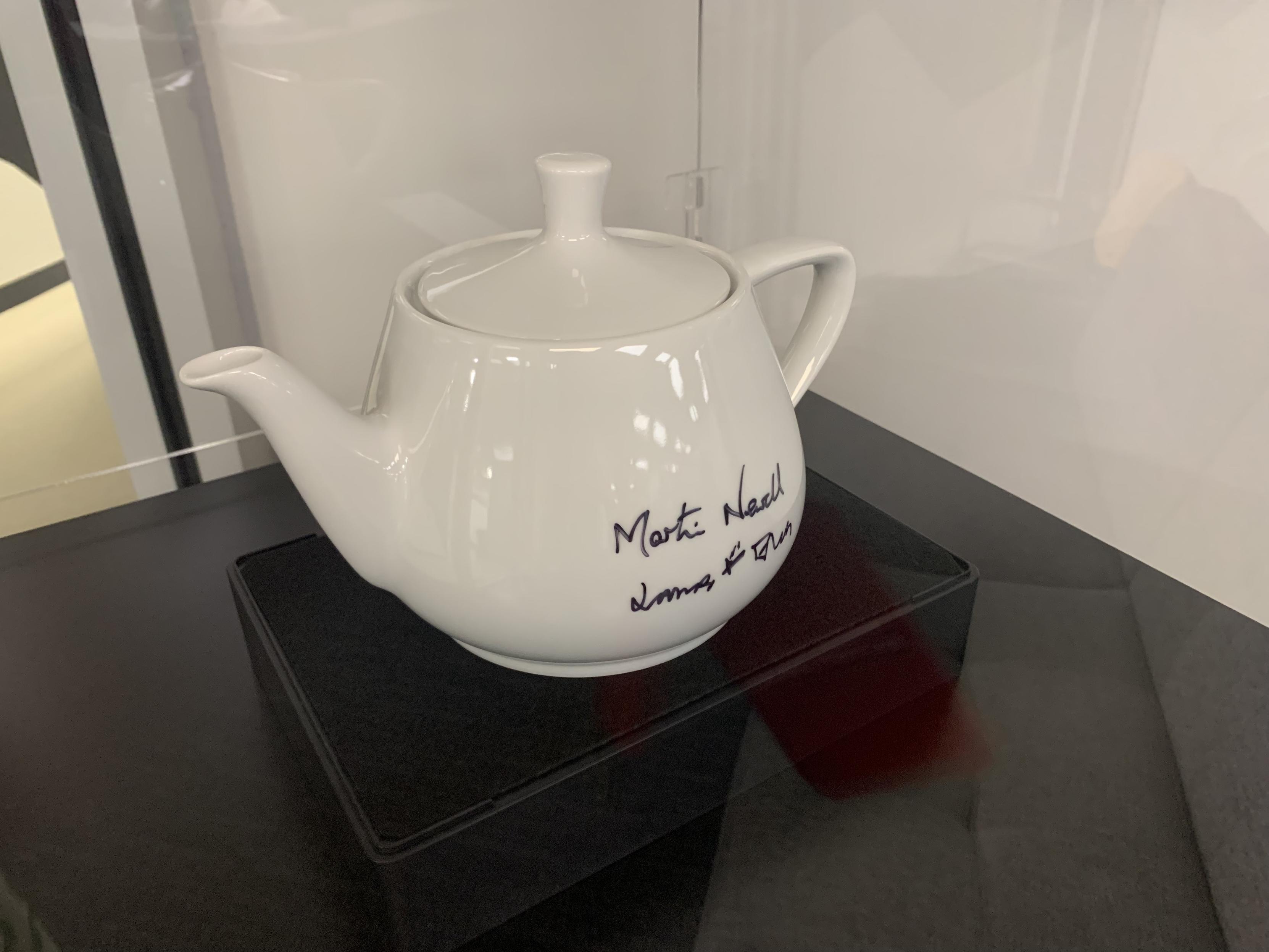
Photo: A Utah teapot in the Kahlert School of Computing office, signed in 2023 by Martin Newell and Jim Blinn, 2025-11-07.
#retrocomputing #vintagecomputing #unix #utah
-
I now have my own Utah teapot!
This ordinary teapot is the "hello world" object of computer graphics and has cameos in countless productions.
A thread on teapots and UNIX… 🧵
Photo: My Melitta teapot, 2026-04-16.
@thalia
> I now have my own Utah teapot!Great collectible!!!
-
At the same time as he modeled the teapot, in 1974, Martin acquired a copy of UNIX V4 for the new computer graphics lab he was managing. It was evidently to serve as the operating system for the lab's PDP-11/45 computer. But UNIX had only been publicly released a few months prior and was still quite flakey, so it went unused, in favor of DEC's more conventional DOS and RSX-11M operating systems.
Photo: A Utah teapot in the Kahlert School of Computing office, signed in 2023 by Martin Newell and Jim Blinn, 2025-11-07.
#retrocomputing #vintagecomputing #unix #utah
After the obsolescence of minicomputers, the UNIX V4 magnetic tape was saved from destruction by Jay Lepreau, an operating systems researcher involved with USENIX conferences. But, without any way to use it, it sat in his office until last July, when Aleks Maricq discovered it while preparing to move the Flux research group to the new building.
I heard the news just after Rob Ricci (@ricci) posted and was soon holding the tape. But without any accompanying documentation, its background was a complete mystery. The University of Utah was not known to have been involved with UNIX, "only" computer graphics and the ARPANET, so I had to go back to primary sources. I tracked down lists of early UNIX users and found Martin's name listed among about 25 sites using UNIX V4. Through numerous hours in online and physical archives, I found that UNIX was not used for research at the U until later, corroborating Martin and Jim's recollections, but being at cutting edge, they followed the latest technologies.
Photo: Researchers holding the UNIX V4 tape in the storage closet it was found, left to right: Thalia Archibald, Aleks Maricq, Jon Duerig, Rob Ricci, and Axel Sorenson, credit: Dan Hixson, 2025-11-12.
-
After the obsolescence of minicomputers, the UNIX V4 magnetic tape was saved from destruction by Jay Lepreau, an operating systems researcher involved with USENIX conferences. But, without any way to use it, it sat in his office until last July, when Aleks Maricq discovered it while preparing to move the Flux research group to the new building.
I heard the news just after Rob Ricci (@ricci) posted and was soon holding the tape. But without any accompanying documentation, its background was a complete mystery. The University of Utah was not known to have been involved with UNIX, "only" computer graphics and the ARPANET, so I had to go back to primary sources. I tracked down lists of early UNIX users and found Martin's name listed among about 25 sites using UNIX V4. Through numerous hours in online and physical archives, I found that UNIX was not used for research at the U until later, corroborating Martin and Jim's recollections, but being at cutting edge, they followed the latest technologies.
Photo: Researchers holding the UNIX V4 tape in the storage closet it was found, left to right: Thalia Archibald, Aleks Maricq, Jon Duerig, Rob Ricci, and Axel Sorenson, credit: Dan Hixson, 2025-11-12.
As the only surviving copy of this version of UNIX, it was vital that it be preserved. Jon Duerig and I brought it to the Computer History Museum's Research Archives, where vintage media recovery has been honed over decades. There, Al Kossow (@bitsavers) recovered the raw analog waveform using his modified tape drive, explaining the process to news and museum film crews as he worked. By recording the low-level waveform, it can be analyzed offline without stressing the tape by reading it again. This was done with Len Shustek's readtape program and, after some debugging with Len, we recovered a complete, flawless dump. Fortunately, the tape was in impeccable condition and did not need to be baked.
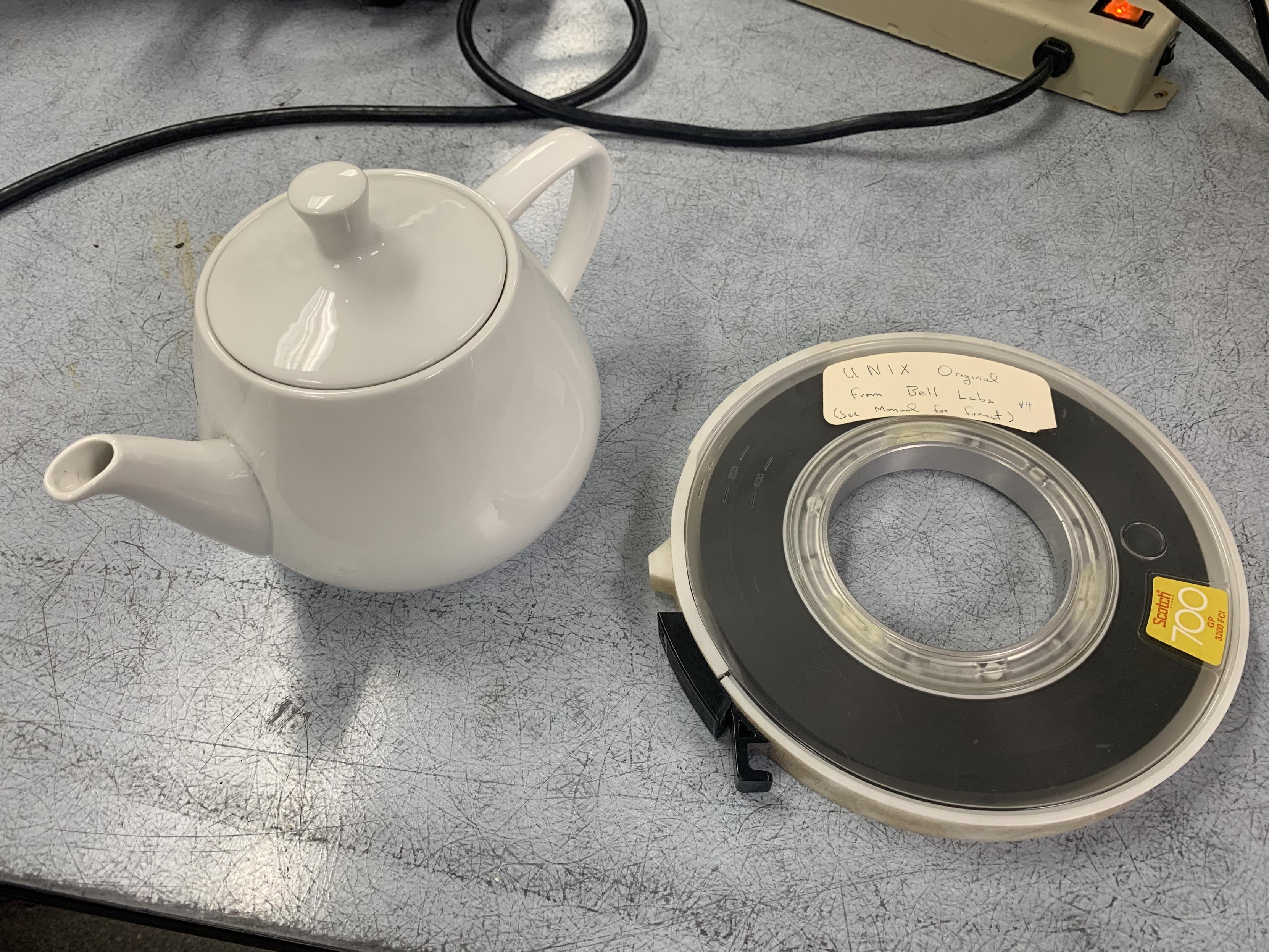
Photo: UNIX V4 tape with Al Kossow's Utah teapot in the CHM Archives lab, 2025-12-19.
#retrocomputing #vintagecomputing #unix #utah
-
As the only surviving copy of this version of UNIX, it was vital that it be preserved. Jon Duerig and I brought it to the Computer History Museum's Research Archives, where vintage media recovery has been honed over decades. There, Al Kossow (@bitsavers) recovered the raw analog waveform using his modified tape drive, explaining the process to news and museum film crews as he worked. By recording the low-level waveform, it can be analyzed offline without stressing the tape by reading it again. This was done with Len Shustek's readtape program and, after some debugging with Len, we recovered a complete, flawless dump. Fortunately, the tape was in impeccable condition and did not need to be baked.
Photo: UNIX V4 tape with Al Kossow's Utah teapot in the CHM Archives lab, 2025-12-19.
#retrocomputing #vintagecomputing #unix #utah
A quick, preliminary analysis of the disk image before sharing showed it was a unique snapshot, earlier than V5. We could see Hunt the Wumpus, SNOBOL, and an older version of cc. Then within hours of my tape image upload to the Internet Archive, Angelo Papenhoff (@aap) produced a working SIMH emulation setup and published instructions. Within days, Jacob Ritorto had booted it on a real PDP-11/45 and Ashlin Inwood on a PDP-11/40, the two officially supported machines. And I visited the Interim Computer Machine to attempt booting on their "misspiggy" PDP-11/70, but more repairs were needed.
As a historical artifact, the UNIX V4 tape fills in a midpoint of a 19-month gap in UNIX source code. It was shortly after the kernel was rewritten from assembly into C and was rapidly growing into a system we recognize today. And at the University of Utah, it adds a connection in a history of pioneering computer science research, and I'm happy to have been involved.
Photo: UNIX V4 tape with a PDP-11/20 and UNIX V1 manual at the Computer History Museum, held by Jon Duerig and Thalia Archibald, 2025-12-19.
-
R relay@relay.infosec.exchange shared this topic
-
A quick, preliminary analysis of the disk image before sharing showed it was a unique snapshot, earlier than V5. We could see Hunt the Wumpus, SNOBOL, and an older version of cc. Then within hours of my tape image upload to the Internet Archive, Angelo Papenhoff (@aap) produced a working SIMH emulation setup and published instructions. Within days, Jacob Ritorto had booted it on a real PDP-11/45 and Ashlin Inwood on a PDP-11/40, the two officially supported machines. And I visited the Interim Computer Machine to attempt booting on their "misspiggy" PDP-11/70, but more repairs were needed.
As a historical artifact, the UNIX V4 tape fills in a midpoint of a 19-month gap in UNIX source code. It was shortly after the kernel was rewritten from assembly into C and was rapidly growing into a system we recognize today. And at the University of Utah, it adds a connection in a history of pioneering computer science research, and I'm happy to have been involved.
Photo: UNIX V4 tape with a PDP-11/20 and UNIX V1 manual at the Computer History Museum, held by Jon Duerig and Thalia Archibald, 2025-12-19.
-
@thalia
> I now have my own Utah teapot!Great collectible!!!
@dougmerritt I'm still looking for a Blinn-ratio Utah teapot, that they produced for a short while!
-
@dougmerritt I'm still looking for a Blinn-ratio Utah teapot, that they produced for a short while!
@thalia
Hmm, I suppose these days a 3D printer could do it. -
I now have my own Utah teapot!
This ordinary teapot is the "hello world" object of computer graphics and has cameos in countless productions.
A thread on teapots and UNIX… 🧵
Photo: My Melitta teapot, 2026-04-16.
@thalia
An Evans and Sutherland vector graphics machine was in lab a math.utah.edu when I got there in 1980. -
@thalia
Hmm, I suppose these days a 3D printer could do it.@dougmerritt I have a 3D printed Blinn-ratio teapot and four tiny teapot halves. They're fun and embody the spirit of the model, but I wanted the real deal too.
https://discuss.systems/@thalia/115919368980584423 -
@thalia
An Evans and Sutherland vector graphics machine was in lab a math.utah.edu when I got there in 1980.@stevewfolds Do you know which model it was?
-
I now have my own Utah teapot!
This ordinary teapot is the "hello world" object of computer graphics and has cameos in countless productions.
A thread on teapots and UNIX… 🧵
Photo: My Melitta teapot, 2026-04-16.
@thalia 418 i'm a teapot 🫖
-
R relay@relay.mycrowd.ca shared this topic
-
@dougmerritt I'm still looking for a Blinn-ratio Utah teapot, that they produced for a short while!
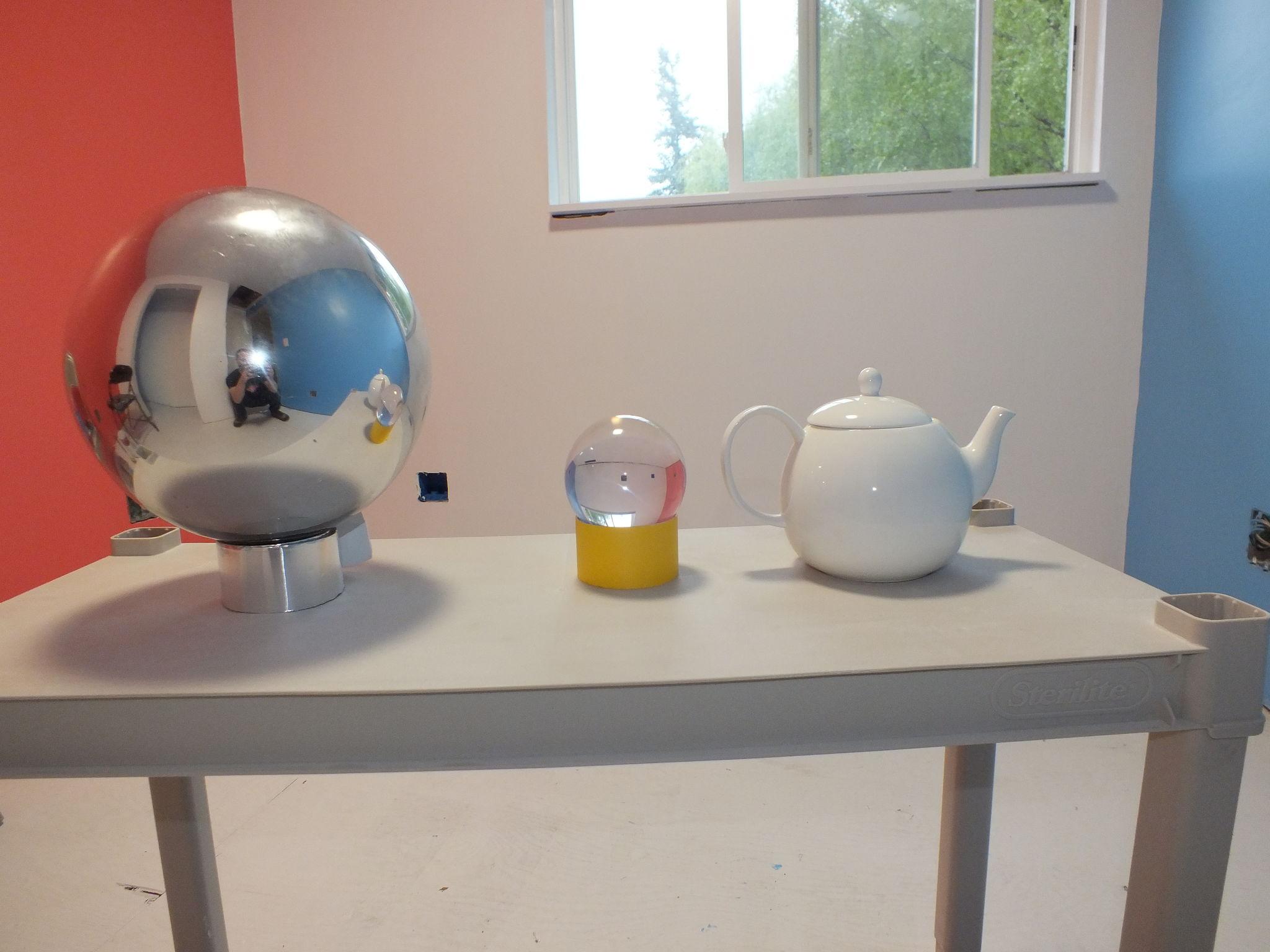
@thalia @dougmerritt That would be cool. I've never got my hands on a *real* one (i.e. correct brand). I wonder if you could 3d print a mold from the data then make a real one out of clay and glaze it?
When I built a life sized Cornell Box (now my 4yo's bedroom but the paint scheme stayed) during my house renovation I used the closest thing I could find at a local store which was recognizably a teapot but not The Teapot.
-
I now have my own Utah teapot!
This ordinary teapot is the "hello world" object of computer graphics and has cameos in countless productions.
A thread on teapots and UNIX… 🧵
Photo: My Melitta teapot, 2026-04-16.
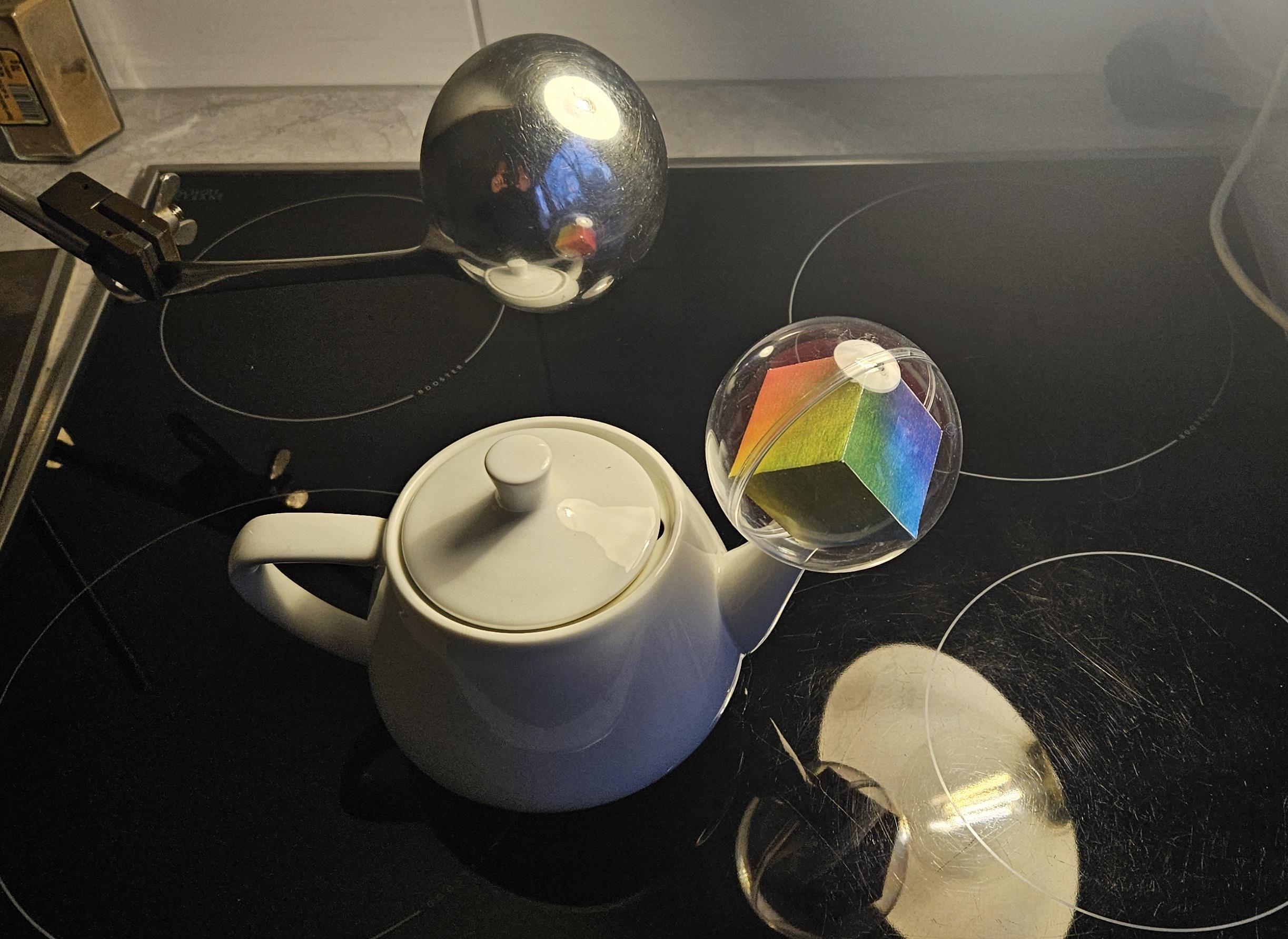
@thalia High five! Honestly, it's a good teapot design, and the fact it's such a prominent artifact in 3D graphics history had me getting one, too

-
@stevewfolds Do you know which model it was?
@thalia The CRT looked like the Picture System 2. A gimbal mount allowed the monitor to tip up and down.
-
I now have my own Utah teapot!
This ordinary teapot is the "hello world" object of computer graphics and has cameos in countless productions.
A thread on teapots and UNIX… 🧵
Photo: My Melitta teapot, 2026-04-16.
@thalia ooh, where did you get it from? aiui those melitta teapots were made by friesland porzellan https://mjg59.dreamwidth.org/47320.html but sadly they had a fire in 2023 which destroyed all their patterns and they can no longer make any more https://friesland-porzellan.de/produkte/information
-
@thalia @dougmerritt That would be cool. I've never got my hands on a *real* one (i.e. correct brand). I wonder if you could 3d print a mold from the data then make a real one out of clay and glaze it?
When I built a life sized Cornell Box (now my 4yo's bedroom but the paint scheme stayed) during my house renovation I used the closest thing I could find at a local store which was recognizably a teapot but not The Teapot.
@azonenberg
A for effort!The next logical step is to upload yourself into...wait, I've lost track of this
-
I now have my own Utah teapot!
This ordinary teapot is the "hello world" object of computer graphics and has cameos in countless productions.
A thread on teapots and UNIX… 🧵
Photo: My Melitta teapot, 2026-04-16.
@thalia Awesome thread. Seems like it would be a neat 50-year journey to 3D print a teapot from those original lines.
I know how to do exactly none of this. So I just have to admire and appreciate the folks who do.