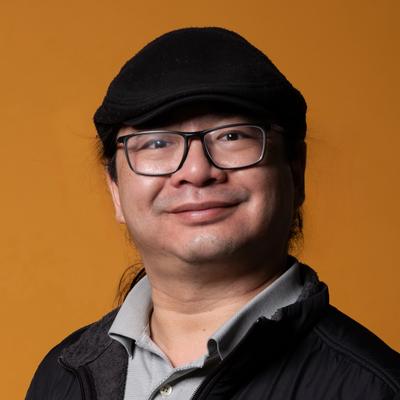
'"Everywhere I looked on social media, it was in my face for like a week," said Paul, who works as the project director for the Indigenous Resurgence Project.
-
'"Everywhere I looked on social media, it was in my face for like a week," said Paul, who works as the project director for the Indigenous Resurgence Project. "I didn’t feel safe here."
She was sure she knew what had sparked it. The day before the torrent of denialism suddenly appeared in her feed, a demonstration had taken place on the Kamloops campus of Thompson Rivers University.
"Even now... there’s not a Facebook post that goes out about Indigenous events in Kamloops where there’s not at least one person in a comment section on a shared post saying something about how our experiences as Indigenous people are fabricated," said Paul.
The Thompson Rivers University event was not an isolated one, nor did it emerge in a vacuum. It was one of a series of events led by Frances Widdowson, a former Mount Royal University professor, on university campuses across Canada.
Widdowson has not been alone in her efforts to generate skepticism about Canada’s residential school history. She is part of a group of roughly two dozen retired academics, lawyers and writers from across the country who collaborate with one another in an email group to construct a more positive version of residential school history.
Collectively, the members of this group are having an outsized impact in sowing doubt about the harms of the residential school system.
They have published over 500 articles about residential schools on various platforms in the last five years and have published three books in the same time span. The books, as well as many of the group’s articles, have been published through the charitable think tanks Frontier Centre for Public Policy and True North Centre for Public Policy.
The two books published by the True North Centre have made bestseller lists in Canada.
A bill that would criminalize condoning, downplaying or justifying the residential school system in Canada is currently being considered in Parliament for the second time and could have implications for the email group and the think tanks they’re associated with.
Leah Gazan, the NDP MP who tabled the bill, said the need to address residential school denialism has become more pressing in recent years.
“Since the discovery of the unmarked graves, it’s increased and it’s become pretty violent,” said Gazan, who represents Winnipeg Centre and is a member of the Wood Mountain Lakota First Nation. “It’s at a level where it’s really unsafe.”
The federal government set a precedent for criminalizing denialism in 2022, when the Criminal Code was amended to include denying or downplaying the Holocaust.'
https://thetyee.ca/News/2026/05/08/Who-Behind-Residential-School-Denialism/
-
R relay@relay.mycrowd.ca shared this topic
-
'"Everywhere I looked on social media, it was in my face for like a week," said Paul, who works as the project director for the Indigenous Resurgence Project. "I didn’t feel safe here."
She was sure she knew what had sparked it. The day before the torrent of denialism suddenly appeared in her feed, a demonstration had taken place on the Kamloops campus of Thompson Rivers University.
"Even now... there’s not a Facebook post that goes out about Indigenous events in Kamloops where there’s not at least one person in a comment section on a shared post saying something about how our experiences as Indigenous people are fabricated," said Paul.
The Thompson Rivers University event was not an isolated one, nor did it emerge in a vacuum. It was one of a series of events led by Frances Widdowson, a former Mount Royal University professor, on university campuses across Canada.
Widdowson has not been alone in her efforts to generate skepticism about Canada’s residential school history. She is part of a group of roughly two dozen retired academics, lawyers and writers from across the country who collaborate with one another in an email group to construct a more positive version of residential school history.
Collectively, the members of this group are having an outsized impact in sowing doubt about the harms of the residential school system.
They have published over 500 articles about residential schools on various platforms in the last five years and have published three books in the same time span. The books, as well as many of the group’s articles, have been published through the charitable think tanks Frontier Centre for Public Policy and True North Centre for Public Policy.
The two books published by the True North Centre have made bestseller lists in Canada.
A bill that would criminalize condoning, downplaying or justifying the residential school system in Canada is currently being considered in Parliament for the second time and could have implications for the email group and the think tanks they’re associated with.
Leah Gazan, the NDP MP who tabled the bill, said the need to address residential school denialism has become more pressing in recent years.
“Since the discovery of the unmarked graves, it’s increased and it’s become pretty violent,” said Gazan, who represents Winnipeg Centre and is a member of the Wood Mountain Lakota First Nation. “It’s at a level where it’s really unsafe.”
The federal government set a precedent for criminalizing denialism in 2022, when the Criminal Code was amended to include denying or downplaying the Holocaust.'
https://thetyee.ca/News/2026/05/08/Who-Behind-Residential-School-Denialism/
@ned I’m not actually sure why we need a new law. This residential school denialism sounds tailor made for a hate crime. We should just start charging them and then let the trials illustrate exactly how much racism sits behind this