I think the #ActivityPub client-to-server API is extremely important and underrated.
-
@smallcircles @steve I know what an "event bus" is but I don't think it applies here. Usually it means a global data structure that attached processes can add events to and read events from. We don't have that in ActivityPub.
I think it's fair to say that activities are like events.
I also like the use cases and primer.
Well, but a part of the specs can certainly be considered a message bus with channels conceptually.
Channel is the name that AsyncAPI uses, which maps to domain aggregates and actor streams.
But considering things purely event-based is stretching it, and may be better to discern between commands and events.
-
Well, but a part of the specs can certainly be considered a message bus with channels conceptually.
Channel is the name that AsyncAPI uses, which maps to domain aggregates and actor streams.
But considering things purely event-based is stretching it, and may be better to discern between commands and events.
Btw, wrt fediverse we really live in a multiverse by all the different perspectives people have towards what the network should or should not provide. All having different physics.
Where ActivityPub is gravity, and fediverse is entropy and chaos, and universes have become inaccessible over time, past stations.
-
Well, but a part of the specs can certainly be considered a message bus with channels conceptually.
Channel is the name that AsyncAPI uses, which maps to domain aggregates and actor streams.
But considering things purely event-based is stretching it, and may be better to discern between commands and events.
@smallcircles @steve maybe? I guess you could consider the `sharedInbox` to be like that.
I think that activities sent to the API by a client are kind of like commands, but they can also be events that happened on a different system.
If I got an achievement in a game, and that was sent as an activity to the API, it's more like an event notification than a command.
-
Btw, wrt fediverse we really live in a multiverse by all the different perspectives people have towards what the network should or should not provide. All having different physics.
Where ActivityPub is gravity, and fediverse is entropy and chaos, and universes have become inaccessible over time, past stations.
@smallcircles @steve I understand that people make their own metaphors for how AP works.
-
@smallcircles @steve maybe? I guess you could consider the `sharedInbox` to be like that.
I think that activities sent to the API by a client are kind of like commands, but they can also be events that happened on a different system.
If I got an achievement in a game, and that was sent as an activity to the API, it's more like an event notification than a command.
Rather than sharedInbox I was more thinking that by implementing the HTTP API and msg exchanges in a well-prescribed manner, these would effectively model an event bus conceptually. After which you can talk about it as a higher abstraction that exists, and not get lost in the reeds of the impl details anymore.
-
Rather than sharedInbox I was more thinking that by implementing the HTTP API and msg exchanges in a well-prescribed manner, these would effectively model an event bus conceptually. After which you can talk about it as a higher abstraction that exists, and not get lost in the reeds of the impl details anymore.
@smallcircles @steve sure. I am not a fan of the idea that AP is a message-passing system; it's a read-write API.
-
@smallcircles @steve sure. I am not a fan of the idea that AP is a message-passing system; it's a read-write API.
It is both, like in that diagram draft.. or at least could be considered such (the notes apply to Protosocial musings).
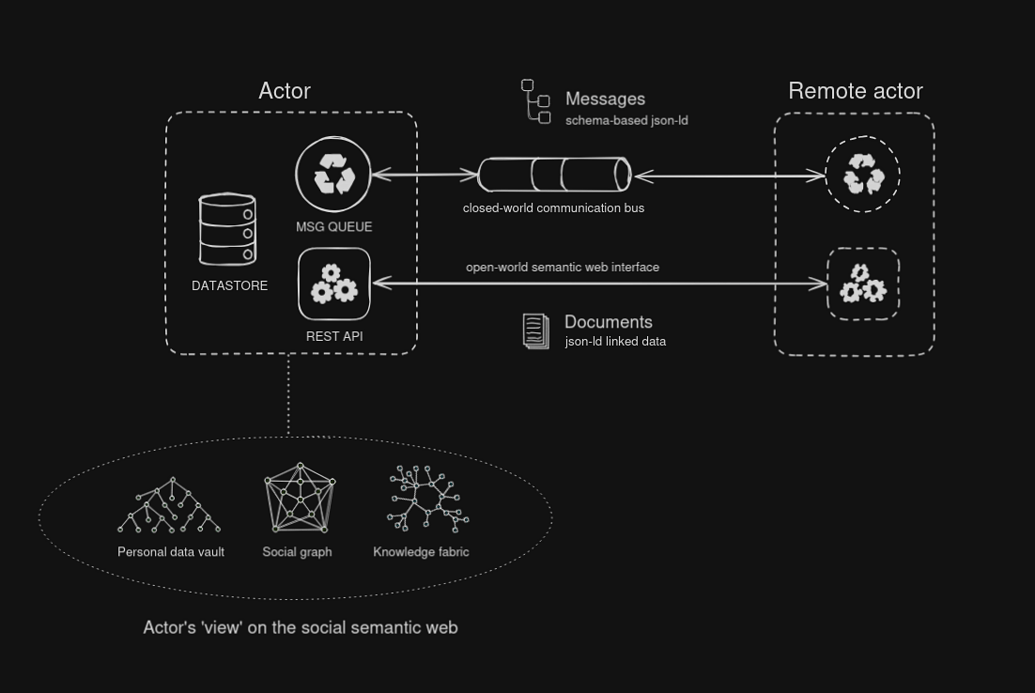
🫧 socialcoding.. (@smallcircles@social.coop)
Attached: 1 image @julian@activitypub.space @evan@cosocial.ca Btw, some time ago in a matrix discussion I sketched how I'd like to conceptually 'see' the social network. Not Mastodon-compliant per se (though it might be via a Profile or Bridge) but back to "promised land". Where the protocol is expressed in familiar architecture patterns and borrows concepts from message queuing, actor model, event-driven architecture, etc. Then as a "Solution designer" I am a stakeholder that wants to be completely shielded from all that jazz. That should all be encapsulated by the protocol libraries and SDK's that are offered in language variants across the ecosystem. #ActivityPub et al is a black box. I can directly start modeling what should be exchanged on the bus, and I can apply domain driven design here. And if I have a semantic web part of my app I'd use linked data modeling best-practices. I would have power tools like #EventCatalog and methods like #EventModeling. https://www.eventcatalog.dev/features/visualization https://eventmodeling.org/

social.coop (social.coop)
-
It is both, like in that diagram draft.. or at least could be considered such (the notes apply to Protosocial musings).
🫧 socialcoding.. (@smallcircles@social.coop)
Attached: 1 image @julian@activitypub.space @evan@cosocial.ca Btw, some time ago in a matrix discussion I sketched how I'd like to conceptually 'see' the social network. Not Mastodon-compliant per se (though it might be via a Profile or Bridge) but back to "promised land". Where the protocol is expressed in familiar architecture patterns and borrows concepts from message queuing, actor model, event-driven architecture, etc. Then as a "Solution designer" I am a stakeholder that wants to be completely shielded from all that jazz. That should all be encapsulated by the protocol libraries and SDK's that are offered in language variants across the ecosystem. #ActivityPub et al is a black box. I can directly start modeling what should be exchanged on the bus, and I can apply domain driven design here. And if I have a semantic web part of my app I'd use linked data modeling best-practices. I would have power tools like #EventCatalog and methods like #EventModeling. https://www.eventcatalog.dev/features/visualization https://eventmodeling.org/
social.coop (social.coop)
Another issue: Unclear protocol layers.
> I am not a fan of the idea that #ActivityPub is a message-passing system; it's a read-write API.
I'm not sure what a "read-write API" is, really. It 's a fuzzy term, whereas message based systems have well-defined architecture patterns and a body of IT knowledge and practice to apply them in robust communication systems. A 'Message API' has a generic, consistent interface.
The overarching goal of AS/AP should be empowerment of the Solution developer so they can directly focus on building use cases for their application or business domain. They should not have to think about any of the intrinsics of the protocol, like particular GETs and POSTs used to model protocol capabilities in the HTTP transport layer.
Solution design then involves:
0. Model the domain
1. Data modeling, msg formats + validation
2. Define actor msg exchange patterns
3. Document design
--
4. Improve these steps. Add native protocol + tool support over time. -
Another issue: Unclear protocol layers.
> I am not a fan of the idea that #ActivityPub is a message-passing system; it's a read-write API.
I'm not sure what a "read-write API" is, really. It 's a fuzzy term, whereas message based systems have well-defined architecture patterns and a body of IT knowledge and practice to apply them in robust communication systems. A 'Message API' has a generic, consistent interface.
The overarching goal of AS/AP should be empowerment of the Solution developer so they can directly focus on building use cases for their application or business domain. They should not have to think about any of the intrinsics of the protocol, like particular GETs and POSTs used to model protocol capabilities in the HTTP transport layer.
Solution design then involves:
0. Model the domain
1. Data modeling, msg formats + validation
2. Define actor msg exchange patterns
3. Document design
--
4. Improve these steps. Add native protocol + tool support over time.@smallcircles @steve it's ok if you haven't heard of a REST API. It's an API that uses HTTP for reading and writing data. Wikipedia has a good
article about it: -
@smallcircles @steve it's ok if you haven't heard of a REST API. It's an API that uses HTTP for reading and writing data. Wikipedia has a good
article about it:@smallcircles @steve one anti-pattern I dislike seeing in ActivityPub discussions is that only one interaction defined in the ActivityPub spec is valid: an HTTP POST to an actor's `inbox` for server-to-server interactions.
We can use HTTP GET to fetch additional data about objects, actors and collections.
-
@smallcircles @steve one anti-pattern I dislike seeing in ActivityPub discussions is that only one interaction defined in the ActivityPub spec is valid: an HTTP POST to an actor's `inbox` for server-to-server interactions.
We can use HTTP GET to fetch additional data about objects, actors and collections.
@smallcircles @steve So, I disagree that we have to exclusively adopt a message-passing paradigm for ActivityPub.
EDIT: note that it's exclusive.
-
@smallcircles @steve So, I disagree that we have to exclusively adopt a message-passing paradigm for ActivityPub.
EDIT: note that it's exclusive.
@evan @smallcircles @steve ActivityPub already is a message passing paradigm
-
@evan @smallcircles @steve ActivityPub already is a message passing paradigm
> it's ok if you haven't heard of a REST API.
Well, you be you. I consider this a 'typical Evan remark' by now, dripping with sarcasm. It is a weird fit for someone who want to lead the #SocialCG efforts, I'd say.
Ah well. What I am talking about is architecture and design, and all the things that allow people to easily form a clear mental picture on how things fit together, wrap their head around the fediverse.
A HTTP interface is a very low-level thing, and clearly but one of the many moving parts that play a role in #ActivityPub based solution development.
Never defining this well, and having the documentation be scattered all across the fediverse in 1,001 random locations doesn't help. Meanwhile the dev talk that is going on for years remains very inefficient due to endless Babylonian speech confusion.
🫧 socialcoding.. (@smallcircles@social.coop)
#ThoughtProvoker :blobhyperthink: The current fediverse is an evolutionary dead-end for 2 reasons: 1. It has painted itself in a small niche of decentralizing typical social media use cases, by means of post-facto interop and the introduction of protocol decay. 2. Lacking a proper grassroots standardization process, and with the primary mechanism for fediverse extension being only post-facto interoperability, there is no way out. Congratulations to the early adopters, who managed to "cross the chasm" with their own app platforms. It took true grit to become deep #ActivityPub experts, and plug holes needed for your app, but you have made it. Post-facto interop works in your favor now. You are unrestrained to productively add more features in your app, and put them on the fedi wire for others to deal with. To avoid fedi to become less and less attractive to newcomers, we must now consider: “Why do we want to grow the open social web, and for whom?” -- @ben@werd.social http://coding.social/blog/shared-ownership/
social.coop (social.coop)
-
> it's ok if you haven't heard of a REST API.
Well, you be you. I consider this a 'typical Evan remark' by now, dripping with sarcasm. It is a weird fit for someone who want to lead the #SocialCG efforts, I'd say.
Ah well. What I am talking about is architecture and design, and all the things that allow people to easily form a clear mental picture on how things fit together, wrap their head around the fediverse.
A HTTP interface is a very low-level thing, and clearly but one of the many moving parts that play a role in #ActivityPub based solution development.
Never defining this well, and having the documentation be scattered all across the fediverse in 1,001 random locations doesn't help. Meanwhile the dev talk that is going on for years remains very inefficient due to endless Babylonian speech confusion.
🫧 socialcoding.. (@smallcircles@social.coop)
#ThoughtProvoker :blobhyperthink: The current fediverse is an evolutionary dead-end for 2 reasons: 1. It has painted itself in a small niche of decentralizing typical social media use cases, by means of post-facto interop and the introduction of protocol decay. 2. Lacking a proper grassroots standardization process, and with the primary mechanism for fediverse extension being only post-facto interoperability, there is no way out. Congratulations to the early adopters, who managed to "cross the chasm" with their own app platforms. It took true grit to become deep #ActivityPub experts, and plug holes needed for your app, but you have made it. Post-facto interop works in your favor now. You are unrestrained to productively add more features in your app, and put them on the fedi wire for others to deal with. To avoid fedi to become less and less attractive to newcomers, we must now consider: “Why do we want to grow the open social web, and for whom?” -- @ben@werd.social http://coding.social/blog/shared-ownership/
social.coop (social.coop)
@smallcircles @cwebber @steve hey, Arnold.
I don't think argument from ignorance is a good way to have a discussion.
I chose to take you at your word that you didn't know what a "read-write API" is, and that you couldn't figure it out from context clues, so I dropped a link to Wikipedia.
What would you have done, if you were me?
-
@evan @smallcircles @steve ActivityPub already is a message passing paradigm
@cwebber @smallcircles @steve thanks for that important clarification.
It does use message-passing, but not exclusively. I'll update my reply.
-
@cwebber @smallcircles @steve thanks for that important clarification.
It does use message-passing, but not exclusively. I'll update my reply.
Which was exactly what I also indicated above, and which aligns to that diagram as well.
-
@smallcircles @cwebber @steve hey, Arnold.
I don't think argument from ignorance is a good way to have a discussion.
I chose to take you at your word that you didn't know what a "read-write API" is, and that you couldn't figure it out from context clues, so I dropped a link to Wikipedia.
What would you have done, if you were me?
So why don't you use the word REST? I never encountered "read-write API". It is an informal term.
But that is not the point. You can have a REST API, fine. But that says nothing in itself. What does it expose? You might say "Duh.. ActivityPub!" but that is not very informative either. There is the notion of message exchange, and of an addressing mechanism, indicating higher level abstractions that conform to well-known architecture patterns, and would allow us to have more productive communication, delve less in implementation details and confusions of protocol behavior with solution design functionality, for starters.
-
@smallcircles @cwebber @steve awesome.
So, would you like me to review your diagram and give comments? I don't know what you're looking for from me in this conversation.
-
@smallcircles @cwebber @steve awesome.
So, would you like me to review your diagram and give comments? I don't know what you're looking for from me in this conversation.
-
@smallcircles @cwebber @steve I would personally really appreciate that. I also think it'd be helpful for the ecosystem. I like that you combine a high-level social and technical approach to discussions of ActivityPub and the Social Web with an almost encyclopedic knowledge of the details. It's a rare combination and extremely valuable.