I think the #ActivityPub client-to-server API is extremely important and underrated.
-
@trwnh The GTS implementation comes with a vocabulary extension, so adding another activity type would be an option.
I guess the reason they didn't do that for this case (I wasn't around for the decision) is that the Accept(Note) thing is itself a backward compatibility hack that they hoped to be able to drop eventually, when more servers would send ReplyRequests (which can be Accept-ed directly), and adding a new type would have felt too much like “enshrining” it.
@julian i think mastodon handles multityping in certain code paths but most other projects don't. it could have been a compatibility thing?
-
@julian i think mastodon handles multityping in certain code paths but most other projects don't. it could have been a compatibility thing?
@trwnh Maybe. I have no idea if GTS itself can handle activities with multiple types.
-
Except when they are called other names instead

A timeline is a different thing than a collection imho. And an AS collection has some very particular functionality, which if I model a timeline in my app may not supported (e.g. reverse ordering).
Collection / 'timeline' is one of those words where sometimes they indicate an app domain, and sometimes a core protocol mechanism. Same is true with 'follow' which is sometimes a user action, sometimes indicates low-level publish/subscribe.
For core capabilities that must be part of the specs, in 'protocol space' it may be better to use terminology that is more common in messaging architectures and all the various architecture patterns that are involved. Perhaps idk we deal with a time-ordered event log or something like that.
@smallcircles @evan An AS2 Collection cannot be a timeline (in general). It’s not even ordered. An AS2 OrderedCollection (a subtype of Collection) might be ordered by time or not, so it’s also not a timeline (in general). When they are ordered by some time value (unspecified in AP) they are often called “streams” in the spec. The Mastodon content timelines are not the same as AP activity streams although a filtered AP stream can be transformed to a content timeline.
-
@smallcircles @evan An AS2 Collection cannot be a timeline (in general). It’s not even ordered. An AS2 OrderedCollection (a subtype of Collection) might be ordered by time or not, so it’s also not a timeline (in general). When they are ordered by some time value (unspecified in AP) they are often called “streams” in the spec. The Mastodon content timelines are not the same as AP activity streams although a filtered AP stream can be transformed to a content timeline.
@steve I think
we need to emphasize that timelines can be built from regular collections, even unordered ones, by using some intermediate representations specific to the type of timeline that a client wants to render.The fact that the specification does not directly support a mapping between a collection and a responsive timeline, *DOES NOT MEAN* one can't be built from it, only that it requires a little more effort on the client side.
My goto example is how rich mail clients allow responsive mailbox representations on top of a much less expressive collection method that IMAP provides compared to ActivityPub.
-
@smallcircles @evan An AS2 Collection cannot be a timeline (in general). It’s not even ordered. An AS2 OrderedCollection (a subtype of Collection) might be ordered by time or not, so it’s also not a timeline (in general). When they are ordered by some time value (unspecified in AP) they are often called “streams” in the spec. The Mastodon content timelines are not the same as AP activity streams although a filtered AP stream can be transformed to a content timeline.
@steve @smallcircles The `inbox` and `outbox` are both sequences ordered by time. I think that should meet your requirements for a 'timeline'?
I think it's fair to call the outbox the actor's 'feed'? It is a feed of all their activities.
-
@steve @smallcircles The `inbox` and `outbox` are both sequences ordered by time. I think that should meet your requirements for a 'timeline'?
I think it's fair to call the outbox the actor's 'feed'? It is a feed of all their activities.
@steve @smallcircles I also agree that activities are more primary than content objects like notes and images in ActivityPub. That is by design and reflected in the name of the data format, API and federation protocol.
-
@steve @smallcircles I also agree that activities are more primary than content objects like notes and images in ActivityPub. That is by design and reflected in the name of the data format, API and federation protocol.
> I think it's fair to call the outbox the actor's 'feed'?
The actor's event bus in a pure event based approach.

Does that break AP? Current fediverse?
Can AP be considered an event-driven architecture of sorts (or restrained as such in a solution design)?I really like the Motivating use cases section of the AS specs, and the primer that sits on the W3C wiki to that. Those might be further formalized so they are applied consistently.
-
@steve @smallcircles I also agree that activities are more primary than content objects like notes and images in ActivityPub. That is by design and reflected in the name of the data format, API and federation protocol.
That said, I think it would be great to have reverse chronological ordered collections of objects created by the actor.
It would be nice to use `streams` like `endpoints`, as an object, and define properties like `notes`, `images`, `places` and so on off of it.
Unfortunately the loose definition and lack of examples for `streams` makes it hard to use. It's probably better just to define them as top-level properties of the actor.
-
That said, I think it would be great to have reverse chronological ordered collections of objects created by the actor.
It would be nice to use `streams` like `endpoints`, as an object, and define properties like `notes`, `images`, `places` and so on off of it.
Unfortunately the loose definition and lack of examples for `streams` makes it hard to use. It's probably better just to define them as top-level properties of the actor.
@steve @smallcircles I also agree that having a separate "home timeline" and "notifications timeline" makes sense. There's an open user story for that:
Separate notifications and home feed · Issue #21 · swicg/activitypub-api
"As an ActivityPub API client developer, I want a 'home feed' collection for content-oriented incoming activities like Create, Question and Announce, so that I can show my users the most important content from their networks." "As an Act...

GitHub (github.com)
-
@steve @smallcircles I also agree that having a separate "home timeline" and "notifications timeline" makes sense. There's an open user story for that:
Separate notifications and home feed · Issue #21 · swicg/activitypub-api
"As an ActivityPub API client developer, I want a 'home feed' collection for content-oriented incoming activities like Create, Question and Announce, so that I can show my users the most important content from their networks." "As an Act...
GitHub (github.com)
The way I see it, this has the wrong stakeholder name of "ActivityPub API client developer" i.e. spec implementer, and a Home Feed is something I may want as a "Solution developer" stakeholder. In other words that library or SDK that offers me the Social API should allow me to model that.
The user story was also brought up by Mastodon, a Microblogging solution built on top of AP (ideally).
-
> I think it's fair to call the outbox the actor's 'feed'?
The actor's event bus in a pure event based approach.
Does that break AP? Current fediverse?
Can AP be considered an event-driven architecture of sorts (or restrained as such in a solution design)?I really like the Motivating use cases section of the AS specs, and the primer that sits on the W3C wiki to that. Those might be further formalized so they are applied consistently.
@smallcircles @steve I know what an "event bus" is but I don't think it applies here. Usually it means a global data structure that attached processes can add events to and read events from. We don't have that in ActivityPub.
I think it's fair to say that activities are like events.
I also like the use cases and primer.
-
The way I see it, this has the wrong stakeholder name of "ActivityPub API client developer" i.e. spec implementer, and a Home Feed is something I may want as a "Solution developer" stakeholder. In other words that library or SDK that offers me the Social API should allow me to model that.
The user story was also brought up by Mastodon, a Microblogging solution built on top of AP (ideally).
@smallcircles @steve please comment on the issue!
-
@smallcircles @steve I know what an "event bus" is but I don't think it applies here. Usually it means a global data structure that attached processes can add events to and read events from. We don't have that in ActivityPub.
I think it's fair to say that activities are like events.
I also like the use cases and primer.
Well, but a part of the specs can certainly be considered a message bus with channels conceptually.
Channel is the name that AsyncAPI uses, which maps to domain aggregates and actor streams.
But considering things purely event-based is stretching it, and may be better to discern between commands and events.
-
Well, but a part of the specs can certainly be considered a message bus with channels conceptually.
Channel is the name that AsyncAPI uses, which maps to domain aggregates and actor streams.
But considering things purely event-based is stretching it, and may be better to discern between commands and events.
Btw, wrt fediverse we really live in a multiverse by all the different perspectives people have towards what the network should or should not provide. All having different physics.
Where ActivityPub is gravity, and fediverse is entropy and chaos, and universes have become inaccessible over time, past stations.
-
Well, but a part of the specs can certainly be considered a message bus with channels conceptually.
Channel is the name that AsyncAPI uses, which maps to domain aggregates and actor streams.
But considering things purely event-based is stretching it, and may be better to discern between commands and events.
@smallcircles @steve maybe? I guess you could consider the `sharedInbox` to be like that.
I think that activities sent to the API by a client are kind of like commands, but they can also be events that happened on a different system.
If I got an achievement in a game, and that was sent as an activity to the API, it's more like an event notification than a command.
-
Btw, wrt fediverse we really live in a multiverse by all the different perspectives people have towards what the network should or should not provide. All having different physics.
Where ActivityPub is gravity, and fediverse is entropy and chaos, and universes have become inaccessible over time, past stations.
@smallcircles @steve I understand that people make their own metaphors for how AP works.
-
@smallcircles @steve maybe? I guess you could consider the `sharedInbox` to be like that.
I think that activities sent to the API by a client are kind of like commands, but they can also be events that happened on a different system.
If I got an achievement in a game, and that was sent as an activity to the API, it's more like an event notification than a command.
Rather than sharedInbox I was more thinking that by implementing the HTTP API and msg exchanges in a well-prescribed manner, these would effectively model an event bus conceptually. After which you can talk about it as a higher abstraction that exists, and not get lost in the reeds of the impl details anymore.
-
Rather than sharedInbox I was more thinking that by implementing the HTTP API and msg exchanges in a well-prescribed manner, these would effectively model an event bus conceptually. After which you can talk about it as a higher abstraction that exists, and not get lost in the reeds of the impl details anymore.
@smallcircles @steve sure. I am not a fan of the idea that AP is a message-passing system; it's a read-write API.
-
@smallcircles @steve sure. I am not a fan of the idea that AP is a message-passing system; it's a read-write API.
It is both, like in that diagram draft.. or at least could be considered such (the notes apply to Protosocial musings).
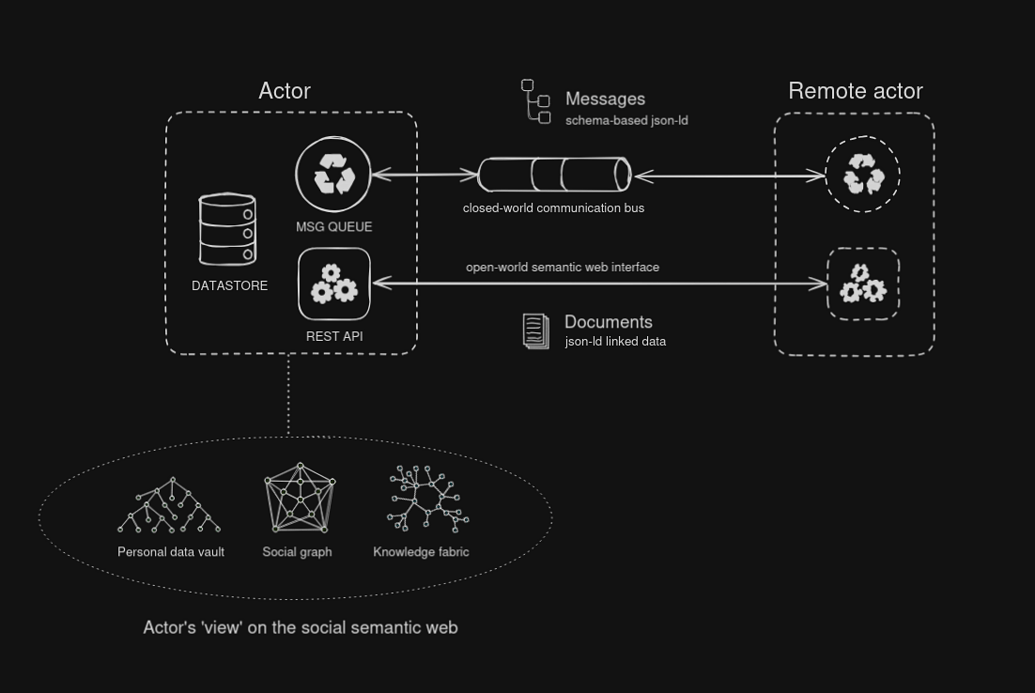
🫧 socialcoding.. (@smallcircles@social.coop)
Attached: 1 image @julian@activitypub.space @evan@cosocial.ca Btw, some time ago in a matrix discussion I sketched how I'd like to conceptually 'see' the social network. Not Mastodon-compliant per se (though it might be via a Profile or Bridge) but back to "promised land". Where the protocol is expressed in familiar architecture patterns and borrows concepts from message queuing, actor model, event-driven architecture, etc. Then as a "Solution designer" I am a stakeholder that wants to be completely shielded from all that jazz. That should all be encapsulated by the protocol libraries and SDK's that are offered in language variants across the ecosystem. #ActivityPub et al is a black box. I can directly start modeling what should be exchanged on the bus, and I can apply domain driven design here. And if I have a semantic web part of my app I'd use linked data modeling best-practices. I would have power tools like #EventCatalog and methods like #EventModeling. https://www.eventcatalog.dev/features/visualization https://eventmodeling.org/

social.coop (social.coop)
-
It is both, like in that diagram draft.. or at least could be considered such (the notes apply to Protosocial musings).
🫧 socialcoding.. (@smallcircles@social.coop)
Attached: 1 image @julian@activitypub.space @evan@cosocial.ca Btw, some time ago in a matrix discussion I sketched how I'd like to conceptually 'see' the social network. Not Mastodon-compliant per se (though it might be via a Profile or Bridge) but back to "promised land". Where the protocol is expressed in familiar architecture patterns and borrows concepts from message queuing, actor model, event-driven architecture, etc. Then as a "Solution designer" I am a stakeholder that wants to be completely shielded from all that jazz. That should all be encapsulated by the protocol libraries and SDK's that are offered in language variants across the ecosystem. #ActivityPub et al is a black box. I can directly start modeling what should be exchanged on the bus, and I can apply domain driven design here. And if I have a semantic web part of my app I'd use linked data modeling best-practices. I would have power tools like #EventCatalog and methods like #EventModeling. https://www.eventcatalog.dev/features/visualization https://eventmodeling.org/
social.coop (social.coop)
Another issue: Unclear protocol layers.
> I am not a fan of the idea that #ActivityPub is a message-passing system; it's a read-write API.
I'm not sure what a "read-write API" is, really. It 's a fuzzy term, whereas message based systems have well-defined architecture patterns and a body of IT knowledge and practice to apply them in robust communication systems. A 'Message API' has a generic, consistent interface.
The overarching goal of AS/AP should be empowerment of the Solution developer so they can directly focus on building use cases for their application or business domain. They should not have to think about any of the intrinsics of the protocol, like particular GETs and POSTs used to model protocol capabilities in the HTTP transport layer.
Solution design then involves:
0. Model the domain
1. Data modeling, msg formats + validation
2. Define actor msg exchange patterns
3. Document design
--
4. Improve these steps. Add native protocol + tool support over time.