Skip to content
  • Categories
  • Recent
  • Tags
  • Popular
  • World
  • Users
  • Groups
Skins
  • Light
  • Brite
  • Cerulean
  • Cosmo
  • Flatly
  • Journal
  • Litera
  • Lumen
  • Lux
  • Materia
  • Minty
  • Morph
  • Pulse
  • Sandstone
  • Simplex
  • Sketchy
  • Spacelab
  • United
  • Yeti
  • Zephyr
  • Dark
  • Cyborg
  • Darkly
  • Quartz
  • Slate
  • Solar
  • Superhero
  • Vapor

  • Default (Cyborg)
  • No Skin
Collapse
Brand Logo

CIRCLE WITH A DOT

  1. Home
  2. Uncategorized
  3. The Long Wispy Tail of Comet R3 (PanSTARRS)Image Credit & Copyright: Haythem Hamdi

The Long Wispy Tail of Comet R3 (PanSTARRS)Image Credit & Copyright: Haythem Hamdi

Scheduled Pinned Locked Moved Uncategorized
apod
1 Posts 1 Posters 0 Views
  • Oldest to Newest
  • Newest to Oldest
  • Most Votes
Reply
  • Reply as topic
Log in to reply
This topic has been deleted. Only users with topic management privileges can see it.
  • apod@reentry.codl.frA This user is from outside of this forum
    apod@reentry.codl.frA This user is from outside of this forum
    apod@reentry.codl.fr
    wrote last edited by
    #1

    The Long Wispy Tail of Comet R3 (PanSTARRS)
    Image Credit & Copyright: Haythem Hamdi

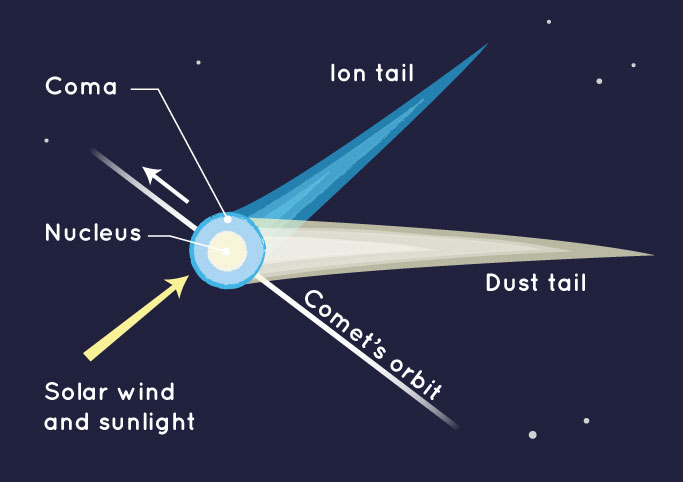
    Explanation: Why does Comet R3 (PanSTARRS) have a wispy tail? The newest bright member of the inner Solar System, Comet C/2025 R3 (PanSTARRS) is already extending an impressive stream of glowing gas. This tail starts from an unseen central nucleus of dirty ice that is likely a few kilometers across. The nucleus is warmed by the Sun and emits a cloud of neutral gas into a coma that glows light green. Nuclear gas ionized by energetic sunlight is pushed away from the Sun by the solar wind into an ion tail that glows light blue. The wispy nature of the ion tail is caused by the constantly changing structure of the solar wind. Pictured from Rhode Island, USA two days ago, Comet R3 (PanSTARRS) shows off a many-degree ion tail. Comet R3 (PanSTARRS) is best seen before dawn from northern skies for another 10 days, after which it will be best visible from southern skies.

    https://apod.nasa.gov/apod/ap260414.html #apod

    Link Preview Image
    1 Reply Last reply
    1
    0
    • R relay@relay.infosec.exchange shared this topic
    Reply
    • Reply as topic
    Log in to reply
    • Oldest to Newest
    • Newest to Oldest
    • Most Votes


    • Login

    • Login or register to search.
    • First post
      Last post
    0
    • Categories
    • Recent
    • Tags
    • Popular
    • World
    • Users
    • Groups