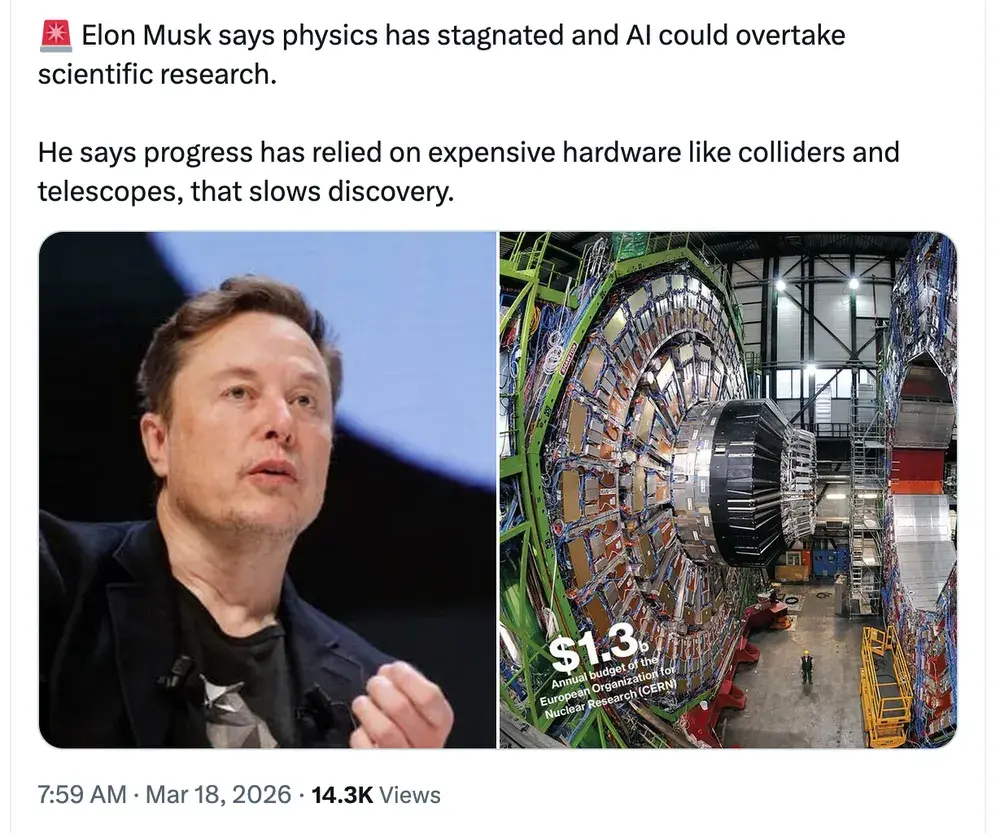
I keep seeing versions of this post, which imply a bizarre misunderstanding of how we know the world.
-
I keep seeing versions of this post, which imply a bizarre misunderstanding of how we know the world.
Do people imagine that if we'd never observed galaxies or neutrinos or exoplanets or the cosmic microwave background, we could have *imagined* these things & that would be just as real?
Or that we've magically reached the point, just now, where we no longer need to observe the world?
@coreyspowell Just imagine what Ptolemy could have done with AI. So much more epicycles and equants could have been combined and progress would have been made so much faster. Telescopes would have been, rightly, dismissed as unreliable and slowing discovery.
-
@SamanthaJaneSmith @coreyspowell well, I don't generally want to argue. I am not really scientist, partly for dumb reasons, which I regret now, partly simply because the required decisions would be needed at age, when I was not ready for it, may it was about the era our country was going through... I was too much hypnotized by "informatics" taking over everything. It was the mindset, which finally resulted in current LLM bubble, RAMageddon, etc. But I did not have enough concentration and focus anyway. Who knows, what could I focus on, if there was no programming around.
But I am fan of basic research and scientific knowledge. The "manned spaceflight vs. science funding" is mostly artificial political dilemma, and it could be compared to competitive sports vs. availability of some sport activity for public. There can be synergies on many levels.
You could argue, that particle colliders suck funding from other fields of basic research. Sometimes you just bet on certain direction of research and sometimes you spend money finding nothing. Eg. manned spaceflight, while basically just publicity stunt, would be probably better investment, than some attempts on dark matter detection. Maybe better publicity stunt, than "please give us money, so we can find nothing and prove it". I mean, there are worse scams, but sometimes, finding nothing with high level of signifixanxe is not the best message for general public, while cool space selfie may be much better message

I don't want to join the general speticism about physics, which may be even somehow encouraged by climate change deniers. There are some parts of physics, which can be locally tested and are well known and probably won't be disproved any time soon. But at the same time, I would definitely invest into fine tuning of technologies for storing energy, instead of building larger collider. Sorry. There are real technological needs with political consequences...
@xChaos @coreyspowell Oh I don't necessarily disagree I would rather spend money on social care for example. I was simply talking about space and particle physics. It is in the end as you say political, as is everything.
The problem is we never know where a breakthrough will come... And that means some kind of balance in the program both in science and technology. Sadly that is not how it works.
-
@SamanthaJaneSmith @coreyspowell as for the string theory... I really understand just the very basic idea (and maybe not even enough) but it somehow reminds me of the original idea of "asking AI about how the world works and not really needing empirical data".
But of course... eg. atomic bomb was basically pure theory, gone "boom" when implemented. This was also the moment, when science started to be somewhat suspicious activity...
There were many attempts on trying to fugure out "how the things must work". Theory of knots in the 19th century turned out to be dead end... and yet they were quite sure, that they will predict properties of atoms! (The knots theory and string theories seem to be distant cousins).
You know, I am maybe more informed about the history of science ("wikipedia syndrome"), than recent developments
I am basically very anti-LLM, because we can expect lot of people "educated" by talking with chatbots... and they would believe crazy things. But sometimes, there really may be occasional "nobody told them, that it can't work" effect.
Sometimes, you really need certain (but not too high) level of ignorance, that something is generally considered impossible (but not too much and not as repeated attempts and not when people's life are in danger...).
But also, scientific discoveries and technological inventions are not the same thing... but public likes to confuse them and it is also often misused as reason for funding... which is really oversimplification... like, lack if understanding, how society works...
@xChaos @coreyspowell I don't think that is true what you say about string theory. It may well be wrong but it was an attempt to solve some issues in the strong force. I don't think it's like LLMs at all.
Science works on dead end theories! There are millions of them and always will be. That is the way science works.
Science is not suspicious, its use is. The theories about nuclear reactions were not about bombs to start with.
I also disagree about ignorance, being ignorant doesn't help. What does is asking questions...
Yes, people confuse science and technology but all technology comes from science. The main problem today is the gap between science and technology. Science is generally government funded while technology is generally private so the gap is in the transfer between the two.
-
@xChaos @coreyspowell Oh I don't necessarily disagree I would rather spend money on social care for example. I was simply talking about space and particle physics. It is in the end as you say political, as is everything.
The problem is we never know where a breakthrough will come... And that means some kind of balance in the program both in science and technology. Sadly that is not how it works.
@SamanthaJaneSmith @coreyspowell I believe some great discoveries were made ... by mistake.
The very birth of modern science from alchemy was series of mistakes... they were following some prescribed rituals, thought to be magical, but they messed up and invented stuff like eg, phosphorus. Also, mandragora was maybe ginseng and it really kind of prolongs life... but doesn't always grow on gallows hill..
So, if some next generation of science emerges, it may very well be results of mistake, done by current AI alchemy crowd. At least, the face similar problem: they spent whole lot of funding to deliver some promised miracle, sometimes even literally same, as alchemists did... and in the process, they invent and share various tricks, and even made the mistake of inventing chemistry....
So it seems to me to do something with a chance of new discovery by mistake, which can happen even by trying manned spaceflight. On the other hand, investing into basic research, which can be trusted to really not even predict anything, is kind of strange game...
Eg., from the point of view of military technology, it is absolutely safe to fund string theorists, because they are not likely to produce any terrible "string bomb" or something like that
 You don't even risk creating another universe by mistake, or so: only lot of very nice papers and diagrams and equations are going to be published, with no dangerous real world consequences (which is not such a bad societal outcome... kind of art, maybe...)
So you can choose to do something, which is guaranteed to NOT give you any breakthrough, not even if you do it wrong (think about preserving some sacred texts in monastery) ... or you can do something, where the results can be random and poorly understood. (like eg. Podkletnov or so...)
Anyway: if something doesn't work, I don't think it is because "they are hiding it from us", but rather because not enough mistakes were made... yet
-
@SamanthaJaneSmith @coreyspowell I believe some great discoveries were made ... by mistake.
The very birth of modern science from alchemy was series of mistakes... they were following some prescribed rituals, thought to be magical, but they messed up and invented stuff like eg, phosphorus. Also, mandragora was maybe ginseng and it really kind of prolongs life... but doesn't always grow on gallows hill..
So, if some next generation of science emerges, it may very well be results of mistake, done by current AI alchemy crowd. At least, the face similar problem: they spent whole lot of funding to deliver some promised miracle, sometimes even literally same, as alchemists did... and in the process, they invent and share various tricks, and even made the mistake of inventing chemistry....
So it seems to me to do something with a chance of new discovery by mistake, which can happen even by trying manned spaceflight. On the other hand, investing into basic research, which can be trusted to really not even predict anything, is kind of strange game...
Eg., from the point of view of military technology, it is absolutely safe to fund string theorists, because they are not likely to produce any terrible "string bomb" or something like that
You don't even risk creating another universe by mistake, or so: only lot of very nice papers and diagrams and equations are going to be published, with no dangerous real world consequences (which is not such a bad societal outcome... kind of art, maybe...)So you can choose to do something, which is guaranteed to NOT give you any breakthrough, not even if you do it wrong (think about preserving some sacred texts in monastery) ... or you can do something, where the results can be random and poorly understood. (like eg. Podkletnov or so...)
Anyway: if something doesn't work, I don't think it is because "they are hiding it from us", but rather because not enough mistakes were made... yet
@xChaos @coreyspowell Yes mistakes do lead to new things but they were doing what we call experiments. That is part of science. Yes doing anything may lead to a mistake which might benefit humanity. But if that is the approach then just do random stuff doesn't matter what. Which I guarantee will not really get places.
I don't know where you get your ideas that basic science can be trusted not to predict anything.... Everything, every technology is based on basic science.
Do you not think the first work on nuclear fusion was a load of equations.... Nobody knew it would lead to a bomb...
I have no idea where LLMs go, it's not AI of course. But they by their very nature do not seem to add knowledge but then again they are not my field.
I can't make any sense of your statement about choosing to do things.
Oh and it's not clear whether the Podkletnov effect is real or not as, at least from my cursory look, it's not been replicated. But again it's not my field.
Anyway thanks for the discussion. I think this has run it's course
-
I've also seen smart people tie themselves into knots trying to defend the original claim.
"He just means big science is expensive."
"He just means that AI can help with data analysis."
"He just means that string theory is a dead end."But that is not the claim, and the efforts to justify it only make the argument even stranger.
@coreyspowell everything #Elon Musk ever says is Class Warfare. There's no point in wondering what his point is, ever.
-
@xChaos @coreyspowell Yes mistakes do lead to new things but they were doing what we call experiments. That is part of science. Yes doing anything may lead to a mistake which might benefit humanity. But if that is the approach then just do random stuff doesn't matter what. Which I guarantee will not really get places.
I don't know where you get your ideas that basic science can be trusted not to predict anything.... Everything, every technology is based on basic science.
Do you not think the first work on nuclear fusion was a load of equations.... Nobody knew it would lead to a bomb...
I have no idea where LLMs go, it's not AI of course. But they by their very nature do not seem to add knowledge but then again they are not my field.
I can't make any sense of your statement about choosing to do things.
Oh and it's not clear whether the Podkletnov effect is real or not as, at least from my cursory look, it's not been replicated. But again it's not my field.
Anyway thanks for the discussion. I think this has run it's course
@SamanthaJaneSmith @coreyspowell
This is complicated. I did not say "basic science can be trusted not to predict anything".
I just believe, that there are certain fields of research, which are generally not expected to turn into applied research and technology.
Fusion technology is special example, one of my favorites. I am 52 years old. But since my 12 years or so, fusion was available in 30 years. The basic principle works... somehow. For some time. There was tremendous amount of both theoretical and practical work done. Except... it does not seem to be scalable anytime soon. It is like trying to power steam locomotive with Heron steam engine: in theory, it should work. It is even kind of steam turbine! But in fact, the actual steam engine was built quite differently. So you can have knowledge, which is basically right, even known for centuries, but still get no practical results.
The popular summary, that inside fusion reaction, there would be "environment like inside Sun" is oversimplification: Sun is huge, but the average density of fusion reactions inside is just fraction of what would be required inside tokamaks. So the required environment would be actually much more extreme. It works in theory, but the engineering might never be sufficiently advanced - who knows. But the popular belief is, that it may be the only possible future.
So the society is just giving away certain constant, but probably not sufficient, amount of resources to fusion research, always not enough, so the they slowly crawl towards better and better results, which definitely prove, that it works... but at the same time, practical application is always 30 years in the future. You would also activate spent reactor vessels with neutrons, while turning them into heat... not really long life nuclear waste, but still...
So fusion is good question: if we put more money into fusion, than manned spaceflight or let's say, particle accelerators, would we finally get it working?
-
@SamanthaJaneSmith @coreyspowell
This is complicated. I did not say "basic science can be trusted not to predict anything".
I just believe, that there are certain fields of research, which are generally not expected to turn into applied research and technology.
Fusion technology is special example, one of my favorites. I am 52 years old. But since my 12 years or so, fusion was available in 30 years. The basic principle works... somehow. For some time. There was tremendous amount of both theoretical and practical work done. Except... it does not seem to be scalable anytime soon. It is like trying to power steam locomotive with Heron steam engine: in theory, it should work. It is even kind of steam turbine! But in fact, the actual steam engine was built quite differently. So you can have knowledge, which is basically right, even known for centuries, but still get no practical results.
The popular summary, that inside fusion reaction, there would be "environment like inside Sun" is oversimplification: Sun is huge, but the average density of fusion reactions inside is just fraction of what would be required inside tokamaks. So the required environment would be actually much more extreme. It works in theory, but the engineering might never be sufficiently advanced - who knows. But the popular belief is, that it may be the only possible future.
So the society is just giving away certain constant, but probably not sufficient, amount of resources to fusion research, always not enough, so the they slowly crawl towards better and better results, which definitely prove, that it works... but at the same time, practical application is always 30 years in the future. You would also activate spent reactor vessels with neutrons, while turning them into heat... not really long life nuclear waste, but still...
So fusion is good question: if we put more money into fusion, than manned spaceflight or let's say, particle accelerators, would we finally get it working?
@SamanthaJaneSmith @coreyspowell also: can we except some breakthrough in nuclear physics, thanks to large colliders, which would help us to finally get fusion right? I seriously doubt so, but again, I am not expert... just maybe hard science fiction fan, or something like that. But there is still this "theory of mistakes", that when you are trying something, you can discover something completely different...
But the problem with fusion is mostly engineering... and perhaps few other problems, which are not just engineering, but rather extremely complex math, which you probably won't figure out without trying. So you iterate and try to make it slightly larger and different... so perhaps more teams in the world should be doing this, and not something else, but while it is applied research, you are still not guaranteed to achieve useful results.
So the activity kind of reminds me of ancient temple building. It does not automatically mean, that it is bad, because centuries ago, building temples was simply the way to organize society around some common activity, not directly practical (I am definitely not the first one, who has this feeling). Probably better, than fighting!
Do I want our everyday lives to rely on something as complex, as fusion energy? (or LLMs, by the way?). I am really not sure. I would rather trust something more simple, maybe. Solar panels and batteries are relatively straightforward and seem easy to understand. But they are not enough during the winter.... and of course, general computing seemed simple to me. But people wanted something more, than general computing could offer....
So perhaps: the basic research, which really does not threat to become the new key technology, on which everything relies, is not such a bad idea... I never said, that I am against basic research (even if myself I live and work outside of science and academia...)
-
@coreyspowell @dahukanna I'm just thinking about all the discoveries that came from observing using those telescopes and then someone thought "hmm, that's weird".
And now we know about pulsars, that light has a speed, quantum mechanics, and whole bunch of other apps for which there was no precedent for LLMs to autocorrect on.
@craignicol @coreyspowell @dahukanna
Anyone who claims that autocorrect can drive science doesn't understand how science actually works.
-
@craignicol @coreyspowell @dahukanna
Anyone who claims that autocorrect can drive science doesn't understand how science actually works.
@adredish @craignicol @coreyspowell @dahukanna
Replace aurocorrect with autofabricate and the point becomes even more poignant… -
@adredish @craignicol @coreyspowell @dahukanna
Replace aurocorrect with autofabricate and the point becomes even more poignant…@adredish @craignicol @coreyspowell @dahukanna
…but these are the same minds who assumed you could cull research funding with large language models… -
@adredish @craignicol @coreyspowell @dahukanna
…but these are the same minds who assumed you could cull research funding with large language models…@adredish @craignicol @coreyspowell @dahukanna
…indeed one could make the opposite point that more Nobel Prizes have been awarded for advances in instrumentation than advances in theory… -
I keep seeing versions of this post, which imply a bizarre misunderstanding of how we know the world.
Do people imagine that if we'd never observed galaxies or neutrinos or exoplanets or the cosmic microwave background, we could have *imagined* these things & that would be just as real?
Or that we've magically reached the point, just now, where we no longer need to observe the world?
@coreyspowell @dyckron Observing reality is a fool’s errand, allegedly.
-
@coreyspowell @dyckron Observing reality is a fool’s errand, allegedly.
@FeloniousPunk @coreyspowell isn't it though! Well said!
-
R relay@relay.infosec.exchange shared this topic