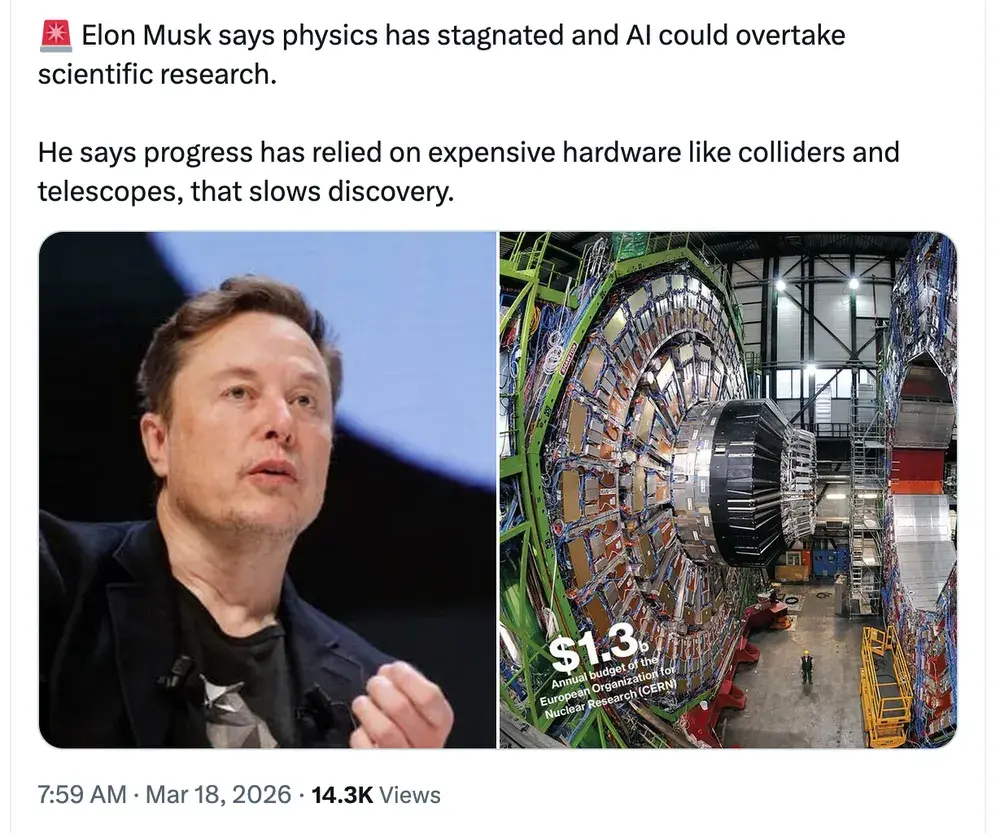
I keep seeing versions of this post, which imply a bizarre misunderstanding of how we know the world.
-
@SamanthaJaneSmith @coreyspowell I am fan of manned spaceflight, but maybe, the funding should be different from science. Manned spaceflight is more or less extrapolation of great voyages, mountain climbing, polar expeditions, and such. I would compare it rather with great sport events... excepts is too ambient (most of the time) and the risks are of different type then risks undertaken in sports, so the funding model of great sport events would not work. It attracts attention of few people and in different way.
The TV show paradigm is definitely more worth replacing, than science.
But when talking about understanding universe, both large and small... you know, I am not scientist, just huge fan of science and history of science, but on amateur basis. It is exciting to invent concepts about how the universe works and be able to do something new, based on these new concepts. Sometimes, save lives.
The intuition, that there may be more to learn when looking at night sky at higher and higher resolutions and more frequency bands, than by smashing particles together at higher and higher frequencies is maybe wrong, who knows.
Definitely, trying to guess things without any input data means doing pure math. You can construct mathematical objects without input data... but why?
There was this strange case of string theory in physics, which thrived even without predicting any observation or suggesting any experiment. No future collider would prove or disprove this. Some theories are too far off....
I feel like there are two major approaches in natural sciences: one is this belief, that if mathematical object is possible, it simply exists somewhere in nature (so we see all this spirals and ornaments in plants, and so on) and the second approach is statistical analysis of gathered data.
Human language is not mathematical object, but LLM AIs somehow treat it as if it was. I seriously doubt, that searching through "all possible conversations" can replace science...
@xChaos @coreyspowell Hi again. The problem with manned spaceflight is that it sucks out the funding from the science program and tbh it is not good value for money. It may be "adventurous" but is that what taxpayer money should be spent on? I think not.
So theories in science are only theories if they are testable otherwise you have beliefs. (this is why the existence of a "god" is a belief - it can't be proved). So progress in science relies on (a) theories that can predict observable data you can observe either now or in the future (b) data to test these theories on or develop new ones from. These go hand-in-hand. Either data or theory may start a new field of research.
So lots of people do construct theories based on mathematical constructs only. Some may become useful some may not. Not all mathematically possible objects can exist or do.
No, you intuition about looking in more detail or different bands is correct which I why I believe they will build more colliders.
Not sure you are right about string theory tbh. It was a candidate for the strong force but it didn't work - however, it did seem to open possibilities for gravity. So it was actually trying to explain a physical phenomena. It is still very much in the - not sure phase of whether this works - but do remember that it is trying to explain the fundamental nature of the world which is observable..... it did however seem to provide some help in some very esoteric ideas that have implications in the real world. But these are way beyond my understanding as I am not a particle physicist or string theorist.
Sammi
-
I also have to point out that the most expensive space telescope (JWST) cost about $500 million/year. We spent 1000x that much on AI development in 2025.
Data collection is essential for discovery...and it's remarkably cheap compared to many other things we do routinely.
@coreyspowell please don’t point it out as it’s super depressing to think what could’ve been achieved in general with all the dollars squandered by big tech on shite.
-
I keep seeing versions of this post, which imply a bizarre misunderstanding of how we know the world.
Do people imagine that if we'd never observed galaxies or neutrinos or exoplanets or the cosmic microwave background, we could have *imagined* these things & that would be just as real?
Or that we've magically reached the point, just now, where we no longer need to observe the world?
@coreyspowell https://youtu.be/GmJI6qIqURA?is=53J7iAt50wu_tU6u @acollierastro puts it nicely - these guys could easily take time out to go get a PhD in Physics but they’d rather spout uninformed nonsense.
-
I keep seeing versions of this post, which imply a bizarre misunderstanding of how we know the world.
Do people imagine that if we'd never observed galaxies or neutrinos or exoplanets or the cosmic microwave background, we could have *imagined* these things & that would be just as real?
Or that we've magically reached the point, just now, where we no longer need to observe the world?
@coreyspowell he's tripping his tits off again.
-
I keep seeing versions of this post, which imply a bizarre misunderstanding of how we know the world.
Do people imagine that if we'd never observed galaxies or neutrinos or exoplanets or the cosmic microwave background, we could have *imagined* these things & that would be just as real?
Or that we've magically reached the point, just now, where we no longer need to observe the world?
@coreyspowell He clearly has no idea how science works. We need all this "expensive" hardware because theories need to be verified by experiments and observations. New theories are useful to shape new experiments, but are useless if they cannot be verified. AI cannot substitute experiments, particularly in its current shape. And it is not even cheaper than colliders and telescopes.
-
@coreyspowell He clearly has no idea how science works. We need all this "expensive" hardware because theories need to be verified by experiments and observations. New theories are useful to shape new experiments, but are useless if they cannot be verified. AI cannot substitute experiments, particularly in its current shape. And it is not even cheaper than colliders and telescopes.
@coreyspowell And physics is hardly stagnant; there have been many important discoveries in the last few years. And that is happening despite efforts from people like Elon Musk to destroy funding of anything that is not benefiting them personally.
-
@coreyspowell I mean, he's the guy who, despite being head dude of the largest satellite operator in the world, argued satellites couldn't be a problem for astronomy because they'd be in darkness at night… so yeah, I'd agree there's a much more straightforward explanation for his apparently nonsensical statements https://mastodon.social/@reedmideke/113817738470795433
@reedmideke @coreyspowell he says everything to support his own ideas and science (facts) is dangerous for him. That's why he's making these statements.
-
I keep seeing versions of this post, which imply a bizarre misunderstanding of how we know the world.
Do people imagine that if we'd never observed galaxies or neutrinos or exoplanets or the cosmic microwave background, we could have *imagined* these things & that would be just as real?
Or that we've magically reached the point, just now, where we no longer need to observe the world?
@coreyspowell when will he test real world physics and fuck off to mars?
-
I keep seeing versions of this post, which imply a bizarre misunderstanding of how we know the world.
Do people imagine that if we'd never observed galaxies or neutrinos or exoplanets or the cosmic microwave background, we could have *imagined* these things & that would be just as real?
Or that we've magically reached the point, just now, where we no longer need to observe the world?
@coreyspowell @PatrickWirth Corey, he’s not the genius everyone makes him out to be. He’s a fraud, a used car salesman, a grifter who knows how to separate people from their money. He’s smart to be sure but he’s also full of shit.
-
I keep seeing versions of this post, which imply a bizarre misunderstanding of how we know the world.
Do people imagine that if we'd never observed galaxies or neutrinos or exoplanets or the cosmic microwave background, we could have *imagined* these things & that would be just as real?
Or that we've magically reached the point, just now, where we no longer need to observe the world?
Musk should not be let near any important development as we have seen in recent years…
-
@xChaos @coreyspowell Hi again. The problem with manned spaceflight is that it sucks out the funding from the science program and tbh it is not good value for money. It may be "adventurous" but is that what taxpayer money should be spent on? I think not.
So theories in science are only theories if they are testable otherwise you have beliefs. (this is why the existence of a "god" is a belief - it can't be proved). So progress in science relies on (a) theories that can predict observable data you can observe either now or in the future (b) data to test these theories on or develop new ones from. These go hand-in-hand. Either data or theory may start a new field of research.
So lots of people do construct theories based on mathematical constructs only. Some may become useful some may not. Not all mathematically possible objects can exist or do.
No, you intuition about looking in more detail or different bands is correct which I why I believe they will build more colliders.
Not sure you are right about string theory tbh. It was a candidate for the strong force but it didn't work - however, it did seem to open possibilities for gravity. So it was actually trying to explain a physical phenomena. It is still very much in the - not sure phase of whether this works - but do remember that it is trying to explain the fundamental nature of the world which is observable..... it did however seem to provide some help in some very esoteric ideas that have implications in the real world. But these are way beyond my understanding as I am not a particle physicist or string theorist.
Sammi
@SamanthaJaneSmith @coreyspowell well, I don't generally want to argue. I am not really scientist, partly for dumb reasons, which I regret now, partly simply because the required decisions would be needed at age, when I was not ready for it, may it was about the era our country was going through... I was too much hypnotized by "informatics" taking over everything. It was the mindset, which finally resulted in current LLM bubble, RAMageddon, etc. But I did not have enough concentration and focus anyway. Who knows, what could I focus on, if there was no programming around.
But I am fan of basic research and scientific knowledge. The "manned spaceflight vs. science funding" is mostly artificial political dilemma, and it could be compared to competitive sports vs. availability of some sport activity for public. There can be synergies on many levels.
You could argue, that particle colliders suck funding from other fields of basic research. Sometimes you just bet on certain direction of research and sometimes you spend money finding nothing. Eg. manned spaceflight, while basically just publicity stunt, would be probably better investment, than some attempts on dark matter detection. Maybe better publicity stunt, than "please give us money, so we can find nothing and prove it". I mean, there are worse scams, but sometimes, finding nothing with high level of signifixanxe is not the best message for general public, while cool space selfie may be much better message

I don't want to join the general speticism about physics, which may be even somehow encouraged by climate change deniers. There are some parts of physics, which can be locally tested and are well known and probably won't be disproved any time soon. But at the same time, I would definitely invest into fine tuning of technologies for storing energy, instead of building larger collider. Sorry. There are real technological needs with political consequences...
-
I keep seeing versions of this post, which imply a bizarre misunderstanding of how we know the world.
Do people imagine that if we'd never observed galaxies or neutrinos or exoplanets or the cosmic microwave background, we could have *imagined* these things & that would be just as real?
Or that we've magically reached the point, just now, where we no longer need to observe the world?
@coreyspowell I guess he thinks all we know is definitely true and thus AI can derive the rest from first principles?
The most glaring flaw with that is that we know we’ll eventually run into data that proves something wrong we thought was true. Just like we’ve found galaxies that were too advanced for their age with Webb, for example.
-
I keep seeing versions of this post, which imply a bizarre misunderstanding of how we know the world.
Do people imagine that if we'd never observed galaxies or neutrinos or exoplanets or the cosmic microwave background, we could have *imagined* these things & that would be just as real?
Or that we've magically reached the point, just now, where we no longer need to observe the world?
Ketamine hallucinations.
-
I keep seeing versions of this post, which imply a bizarre misunderstanding of how we know the world.
Do people imagine that if we'd never observed galaxies or neutrinos or exoplanets or the cosmic microwave background, we could have *imagined* these things & that would be just as real?
Or that we've magically reached the point, just now, where we no longer need to observe the world?
Uhm! Why do you repost a dumbfuck idiocy containing a circular logic error from a stupid fraud?
I find it extremely annoying that Musk is sold as an intelligent man who invents stuff, when in reality he is scamming investors with unrealistic promises and saves his companies from bankruptcy by exploiting government programs. And his companies go bankrupt eventually anyhow unless he is sacked before this happens.
-
@SamanthaJaneSmith @coreyspowell well, I don't generally want to argue. I am not really scientist, partly for dumb reasons, which I regret now, partly simply because the required decisions would be needed at age, when I was not ready for it, may it was about the era our country was going through... I was too much hypnotized by "informatics" taking over everything. It was the mindset, which finally resulted in current LLM bubble, RAMageddon, etc. But I did not have enough concentration and focus anyway. Who knows, what could I focus on, if there was no programming around.
But I am fan of basic research and scientific knowledge. The "manned spaceflight vs. science funding" is mostly artificial political dilemma, and it could be compared to competitive sports vs. availability of some sport activity for public. There can be synergies on many levels.
You could argue, that particle colliders suck funding from other fields of basic research. Sometimes you just bet on certain direction of research and sometimes you spend money finding nothing. Eg. manned spaceflight, while basically just publicity stunt, would be probably better investment, than some attempts on dark matter detection. Maybe better publicity stunt, than "please give us money, so we can find nothing and prove it". I mean, there are worse scams, but sometimes, finding nothing with high level of signifixanxe is not the best message for general public, while cool space selfie may be much better message
I don't want to join the general speticism about physics, which may be even somehow encouraged by climate change deniers. There are some parts of physics, which can be locally tested and are well known and probably won't be disproved any time soon. But at the same time, I would definitely invest into fine tuning of technologies for storing energy, instead of building larger collider. Sorry. There are real technological needs with political consequences...
@SamanthaJaneSmith @coreyspowell as for the string theory... I really understand just the very basic idea (and maybe not even enough) but it somehow reminds me of the original idea of "asking AI about how the world works and not really needing empirical data".
But of course... eg. atomic bomb was basically pure theory, gone "boom" when implemented. This was also the moment, when science started to be somewhat suspicious activity...
There were many attempts on trying to fugure out "how the things must work". Theory of knots in the 19th century turned out to be dead end... and yet they were quite sure, that they will predict properties of atoms! (The knots theory and string theories seem to be distant cousins).
You know, I am maybe more informed about the history of science ("wikipedia syndrome"), than recent developments
I am basically very anti-LLM, because we can expect lot of people "educated" by talking with chatbots... and they would believe crazy things. But sometimes, there really may be occasional "nobody told them, that it can't work" effect.
Sometimes, you really need certain (but not too high) level of ignorance, that something is generally considered impossible (but not too much and not as repeated attempts and not when people's life are in danger...).
But also, scientific discoveries and technological inventions are not the same thing... but public likes to confuse them and it is also often misused as reason for funding... which is really oversimplification... like, lack if understanding, how society works...
-
I keep seeing versions of this post, which imply a bizarre misunderstanding of how we know the world.
Do people imagine that if we'd never observed galaxies or neutrinos or exoplanets or the cosmic microwave background, we could have *imagined* these things & that would be just as real?
Or that we've magically reached the point, just now, where we no longer need to observe the world?
@coreyspowell Just imagine what Ptolemy could have done with AI. So much more epicycles and equants could have been combined and progress would have been made so much faster. Telescopes would have been, rightly, dismissed as unreliable and slowing discovery.
-
@SamanthaJaneSmith @coreyspowell well, I don't generally want to argue. I am not really scientist, partly for dumb reasons, which I regret now, partly simply because the required decisions would be needed at age, when I was not ready for it, may it was about the era our country was going through... I was too much hypnotized by "informatics" taking over everything. It was the mindset, which finally resulted in current LLM bubble, RAMageddon, etc. But I did not have enough concentration and focus anyway. Who knows, what could I focus on, if there was no programming around.
But I am fan of basic research and scientific knowledge. The "manned spaceflight vs. science funding" is mostly artificial political dilemma, and it could be compared to competitive sports vs. availability of some sport activity for public. There can be synergies on many levels.
You could argue, that particle colliders suck funding from other fields of basic research. Sometimes you just bet on certain direction of research and sometimes you spend money finding nothing. Eg. manned spaceflight, while basically just publicity stunt, would be probably better investment, than some attempts on dark matter detection. Maybe better publicity stunt, than "please give us money, so we can find nothing and prove it". I mean, there are worse scams, but sometimes, finding nothing with high level of signifixanxe is not the best message for general public, while cool space selfie may be much better message
I don't want to join the general speticism about physics, which may be even somehow encouraged by climate change deniers. There are some parts of physics, which can be locally tested and are well known and probably won't be disproved any time soon. But at the same time, I would definitely invest into fine tuning of technologies for storing energy, instead of building larger collider. Sorry. There are real technological needs with political consequences...
@xChaos @coreyspowell Oh I don't necessarily disagree I would rather spend money on social care for example. I was simply talking about space and particle physics. It is in the end as you say political, as is everything.
The problem is we never know where a breakthrough will come... And that means some kind of balance in the program both in science and technology. Sadly that is not how it works.
-
@SamanthaJaneSmith @coreyspowell as for the string theory... I really understand just the very basic idea (and maybe not even enough) but it somehow reminds me of the original idea of "asking AI about how the world works and not really needing empirical data".
But of course... eg. atomic bomb was basically pure theory, gone "boom" when implemented. This was also the moment, when science started to be somewhat suspicious activity...
There were many attempts on trying to fugure out "how the things must work". Theory of knots in the 19th century turned out to be dead end... and yet they were quite sure, that they will predict properties of atoms! (The knots theory and string theories seem to be distant cousins).
You know, I am maybe more informed about the history of science ("wikipedia syndrome"), than recent developments
I am basically very anti-LLM, because we can expect lot of people "educated" by talking with chatbots... and they would believe crazy things. But sometimes, there really may be occasional "nobody told them, that it can't work" effect.
Sometimes, you really need certain (but not too high) level of ignorance, that something is generally considered impossible (but not too much and not as repeated attempts and not when people's life are in danger...).
But also, scientific discoveries and technological inventions are not the same thing... but public likes to confuse them and it is also often misused as reason for funding... which is really oversimplification... like, lack if understanding, how society works...
@xChaos @coreyspowell I don't think that is true what you say about string theory. It may well be wrong but it was an attempt to solve some issues in the strong force. I don't think it's like LLMs at all.
Science works on dead end theories! There are millions of them and always will be. That is the way science works.
Science is not suspicious, its use is. The theories about nuclear reactions were not about bombs to start with.
I also disagree about ignorance, being ignorant doesn't help. What does is asking questions...
Yes, people confuse science and technology but all technology comes from science. The main problem today is the gap between science and technology. Science is generally government funded while technology is generally private so the gap is in the transfer between the two.
-
@xChaos @coreyspowell Oh I don't necessarily disagree I would rather spend money on social care for example. I was simply talking about space and particle physics. It is in the end as you say political, as is everything.
The problem is we never know where a breakthrough will come... And that means some kind of balance in the program both in science and technology. Sadly that is not how it works.
@SamanthaJaneSmith @coreyspowell I believe some great discoveries were made ... by mistake.
The very birth of modern science from alchemy was series of mistakes... they were following some prescribed rituals, thought to be magical, but they messed up and invented stuff like eg, phosphorus. Also, mandragora was maybe ginseng and it really kind of prolongs life... but doesn't always grow on gallows hill..
So, if some next generation of science emerges, it may very well be results of mistake, done by current AI alchemy crowd. At least, the face similar problem: they spent whole lot of funding to deliver some promised miracle, sometimes even literally same, as alchemists did... and in the process, they invent and share various tricks, and even made the mistake of inventing chemistry....
So it seems to me to do something with a chance of new discovery by mistake, which can happen even by trying manned spaceflight. On the other hand, investing into basic research, which can be trusted to really not even predict anything, is kind of strange game...
Eg., from the point of view of military technology, it is absolutely safe to fund string theorists, because they are not likely to produce any terrible "string bomb" or something like that
 You don't even risk creating another universe by mistake, or so: only lot of very nice papers and diagrams and equations are going to be published, with no dangerous real world consequences (which is not such a bad societal outcome... kind of art, maybe...)
So you can choose to do something, which is guaranteed to NOT give you any breakthrough, not even if you do it wrong (think about preserving some sacred texts in monastery) ... or you can do something, where the results can be random and poorly understood. (like eg. Podkletnov or so...)
Anyway: if something doesn't work, I don't think it is because "they are hiding it from us", but rather because not enough mistakes were made... yet
-
@SamanthaJaneSmith @coreyspowell I believe some great discoveries were made ... by mistake.
The very birth of modern science from alchemy was series of mistakes... they were following some prescribed rituals, thought to be magical, but they messed up and invented stuff like eg, phosphorus. Also, mandragora was maybe ginseng and it really kind of prolongs life... but doesn't always grow on gallows hill..
So, if some next generation of science emerges, it may very well be results of mistake, done by current AI alchemy crowd. At least, the face similar problem: they spent whole lot of funding to deliver some promised miracle, sometimes even literally same, as alchemists did... and in the process, they invent and share various tricks, and even made the mistake of inventing chemistry....
So it seems to me to do something with a chance of new discovery by mistake, which can happen even by trying manned spaceflight. On the other hand, investing into basic research, which can be trusted to really not even predict anything, is kind of strange game...
Eg., from the point of view of military technology, it is absolutely safe to fund string theorists, because they are not likely to produce any terrible "string bomb" or something like that
You don't even risk creating another universe by mistake, or so: only lot of very nice papers and diagrams and equations are going to be published, with no dangerous real world consequences (which is not such a bad societal outcome... kind of art, maybe...)So you can choose to do something, which is guaranteed to NOT give you any breakthrough, not even if you do it wrong (think about preserving some sacred texts in monastery) ... or you can do something, where the results can be random and poorly understood. (like eg. Podkletnov or so...)
Anyway: if something doesn't work, I don't think it is because "they are hiding it from us", but rather because not enough mistakes were made... yet
@xChaos @coreyspowell Yes mistakes do lead to new things but they were doing what we call experiments. That is part of science. Yes doing anything may lead to a mistake which might benefit humanity. But if that is the approach then just do random stuff doesn't matter what. Which I guarantee will not really get places.
I don't know where you get your ideas that basic science can be trusted not to predict anything.... Everything, every technology is based on basic science.
Do you not think the first work on nuclear fusion was a load of equations.... Nobody knew it would lead to a bomb...
I have no idea where LLMs go, it's not AI of course. But they by their very nature do not seem to add knowledge but then again they are not my field.
I can't make any sense of your statement about choosing to do things.
Oh and it's not clear whether the Podkletnov effect is real or not as, at least from my cursory look, it's not been replicated. But again it's not my field.
Anyway thanks for the discussion. I think this has run it's course