We had a spirited debate in recent weeks regarding the right way to refer to modern networking devices, particularly those found in datacenters.
-
We had a spirited debate in recent weeks regarding the right way to refer to modern networking devices, particularly those found in datacenters. One of us (Bruce) argued that, if it forwards IP packets, it's a router. Larry pushed back: shouldn't a router interconnect heterogeneous networks, or sit on the border between different autonomous systems?
Further confounding the discussion is conflicting usage by industry players: most networking devices in datacenters, even those forwarding IP packets, are called switches. Put a similar device inside a service provider's backbone? Most people call those things routers—so what's the rule for when to use each term?
This might seem like a trivial thing, but when writing a textbook, it's important that we use terminology precisely and consistently if we want our readers to understand the technology fully. Being inconsistent with standard industry practice would help no-one, even if we believe our stance to be "correct". The good news is that we resolved the issue to our satisfaction, and along the way we gained some insights into how much the Internet has changed since we wrote our first edition in 1995. More in this week's newsletter:
https://systemsapproach.org/2026/04/20/not-your-fathers-internet/
🧵 1/n
-
We had a spirited debate in recent weeks regarding the right way to refer to modern networking devices, particularly those found in datacenters. One of us (Bruce) argued that, if it forwards IP packets, it's a router. Larry pushed back: shouldn't a router interconnect heterogeneous networks, or sit on the border between different autonomous systems?
Further confounding the discussion is conflicting usage by industry players: most networking devices in datacenters, even those forwarding IP packets, are called switches. Put a similar device inside a service provider's backbone? Most people call those things routers—so what's the rule for when to use each term?
This might seem like a trivial thing, but when writing a textbook, it's important that we use terminology precisely and consistently if we want our readers to understand the technology fully. Being inconsistent with standard industry practice would help no-one, even if we believe our stance to be "correct". The good news is that we resolved the issue to our satisfaction, and along the way we gained some insights into how much the Internet has changed since we wrote our first edition in 1995. More in this week's newsletter:
https://systemsapproach.org/2026/04/20/not-your-fathers-internet/
🧵 1/n
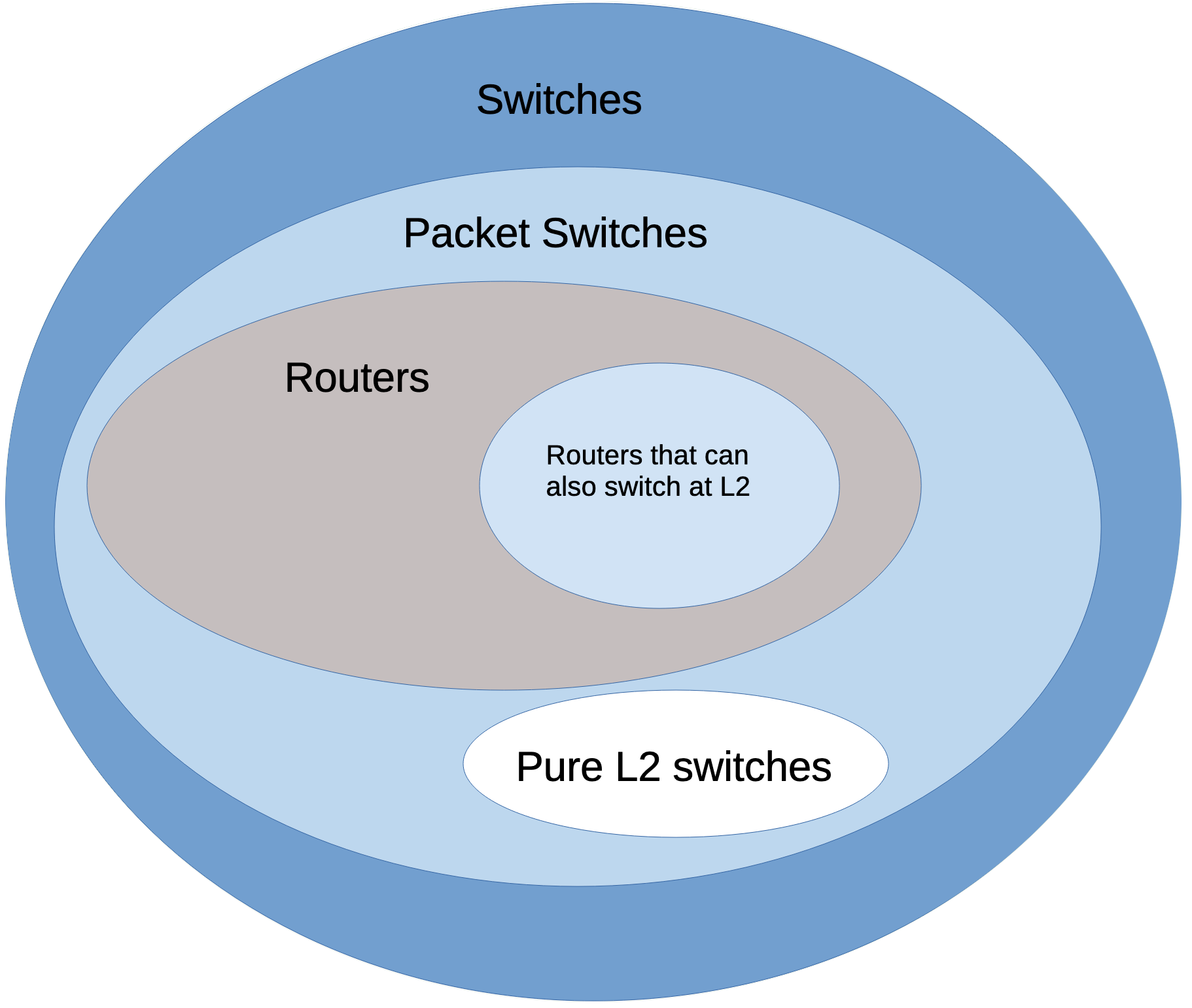
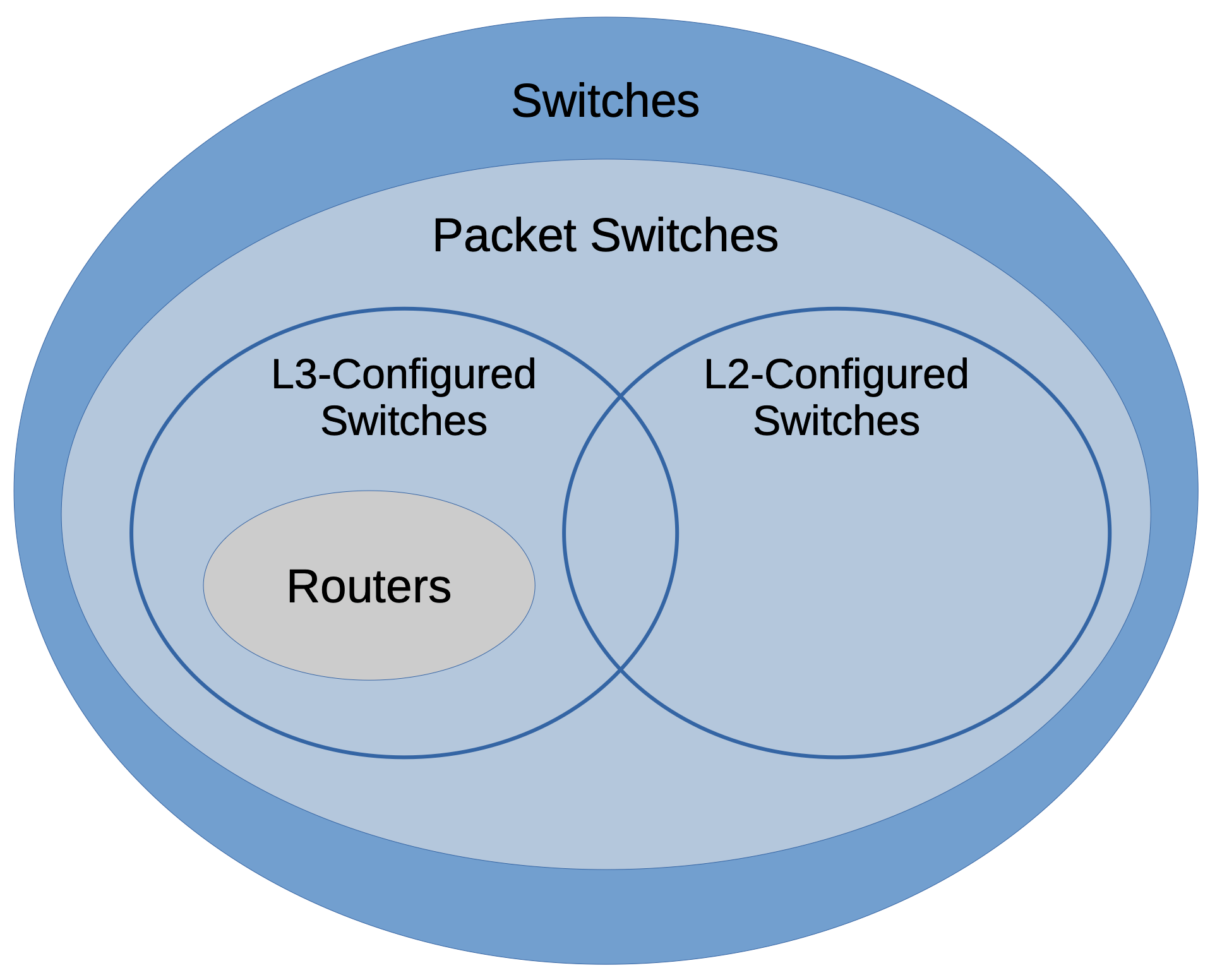
Here are two images by the two authors representing different views of the naming issues:
2/n
-
Here are two images by the two authors representing different views of the naming issues:
2/n
This exposed two issues: first, is there a difference between an L3 switch and a router? And second, when modern switches can be configured to forward on either the Ethernet header or the IP header, how do we best talk about them?
On the first question, we ultimately decided to let context be the determining factor. Even while there is no technical difference between an L3 switch and a router, the most common usage in the datacenter context favors "switch". For ISPs, router is still the preferred term.
The configurability of modern devices, especially those based on programmable forwarding silicon, means we have to be clear in our discussions to separate what a device is capable of doing versus what it is configured to do.
3/n
-
This exposed two issues: first, is there a difference between an L3 switch and a router? And second, when modern switches can be configured to forward on either the Ethernet header or the IP header, how do we best talk about them?
On the first question, we ultimately decided to let context be the determining factor. Even while there is no technical difference between an L3 switch and a router, the most common usage in the datacenter context favors "switch". For ISPs, router is still the preferred term.
The configurability of modern devices, especially those based on programmable forwarding silicon, means we have to be clear in our discussions to separate what a device is capable of doing versus what it is configured to do.
3/n
The more important issue here is that the Internet has changed a lot since our first edition. While the Internet Protocol was invented to allow interconnection of different network technologies and the networks of different organizations, its success has meant that IP is often just used to forward packets among homogeneous links inside a single organization. That doesn't change the meaning of "router", it just illustrates one of many ways the Internet has changed.
The adoption of BGP for routing inside datacenters is another example of how different the Internet and its protocols are today.
This is the challenge we face in writing this new edition: to be correct and precise in our descriptions of technology while admitting that the Internet of today is different than the one we described in our first edition. And to do that in a way that leaves the reader understanding the technology without being overwhelmed by the complexity of today's networks.
More in the newsletter:
https://systemsapproach.org/2026/04/20/not-your-fathers-internet/
4/4 -
We had a spirited debate in recent weeks regarding the right way to refer to modern networking devices, particularly those found in datacenters. One of us (Bruce) argued that, if it forwards IP packets, it's a router. Larry pushed back: shouldn't a router interconnect heterogeneous networks, or sit on the border between different autonomous systems?
Further confounding the discussion is conflicting usage by industry players: most networking devices in datacenters, even those forwarding IP packets, are called switches. Put a similar device inside a service provider's backbone? Most people call those things routers—so what's the rule for when to use each term?
This might seem like a trivial thing, but when writing a textbook, it's important that we use terminology precisely and consistently if we want our readers to understand the technology fully. Being inconsistent with standard industry practice would help no-one, even if we believe our stance to be "correct". The good news is that we resolved the issue to our satisfaction, and along the way we gained some insights into how much the Internet has changed since we wrote our first edition in 1995. More in this week's newsletter:
https://systemsapproach.org/2026/04/20/not-your-fathers-internet/
🧵 1/n
@SystemsAppr I'm probably more aligned with Bruce by the sound of it.
I used to explain to students that even their Windows laptops do IP routing, and they have routing tables! But cautioned, I wouldn't call them routers, even though they might have a really elaborate set of routes from their VPN.
All hosts make forwarding decisions by examining the destination address and at least decide to deliver 1) locally, 2) to a directly attached host, or 3) a gateway.
But deprecating the TTL/hop-limit is a basic requirement, as is updating the checksum in v4.
I call a router connecting autonomous systems a "border" router. Even if it is pointing default and not doing BGP.
I think @jeroen is essentially right, the original usage of terms is still fundamentally precise and correct. The evolution of terms in the "market" has just confused things considerably. I often need more context to understand what people are talking about because a router to them is often not what I think of as a router.
-
We had a spirited debate in recent weeks regarding the right way to refer to modern networking devices, particularly those found in datacenters. One of us (Bruce) argued that, if it forwards IP packets, it's a router. Larry pushed back: shouldn't a router interconnect heterogeneous networks, or sit on the border between different autonomous systems?
Further confounding the discussion is conflicting usage by industry players: most networking devices in datacenters, even those forwarding IP packets, are called switches. Put a similar device inside a service provider's backbone? Most people call those things routers—so what's the rule for when to use each term?
This might seem like a trivial thing, but when writing a textbook, it's important that we use terminology precisely and consistently if we want our readers to understand the technology fully. Being inconsistent with standard industry practice would help no-one, even if we believe our stance to be "correct". The good news is that we resolved the issue to our satisfaction, and along the way we gained some insights into how much the Internet has changed since we wrote our first edition in 1995. More in this week's newsletter:
https://systemsapproach.org/2026/04/20/not-your-fathers-internet/
🧵 1/n
@SystemsAppr
It seems pretty simple to say a router is a computer connected to more than one network which forwards packets between the networks based on routing tables and IP addresses.A switch is a device that determines which ports to send a packet out based on MAC or hardware addresses. An L3 switch is a switch that can also be configured as a router.
-
This exposed two issues: first, is there a difference between an L3 switch and a router? And second, when modern switches can be configured to forward on either the Ethernet header or the IP header, how do we best talk about them?
On the first question, we ultimately decided to let context be the determining factor. Even while there is no technical difference between an L3 switch and a router, the most common usage in the datacenter context favors "switch". For ISPs, router is still the preferred term.
The configurability of modern devices, especially those based on programmable forwarding silicon, means we have to be clear in our discussions to separate what a device is capable of doing versus what it is configured to do.
3/n
@SystemsAppr one of the definitions I’ve seen for routers is not to separate networks but act as a responsibility barrier. Everything in an L3 switched domain belongs to “us” but everything on the other side of the router is “them”.
A bit more social/political than technical
-
R relay@relay.mycrowd.ca shared this topic