AMOC?
-
AMOC?
More certain than previously thought https://www.science.org/doi/10.1126/sciadv.adx4298
And Guardian article https://www.theguardian.com/environment/2026/apr/15/critical-atlantic-current-significantly-more-likely-to-collapse-than-thoughtOkay. Or not. But what does it mean, regionally, on the way to the OFF state?
Do we, us alive today experience any changes in our lifetime?I would say yes.
Disclaimer: it's conjecture. and I am no expert in anything.So. From tipping to OFF, it takes 100 to 150 years.
What happens during this slowdown phase?
I read in another paper that because AMOC slowdown intensifies the #ColdBlob, it also changes how the Lows and Highs over the Atlantic are distributed, which changes the jetstream, which in turn causes more extreme heat events in Europe.More #ExtremeHeat events?
How do those affect our biosphere in Europe?
Well, I don't know exactly. But IPCC AR6 WG2 has mapped the impact on European plants, insects and mammals if we let global 3.2C become reality.
As you can see, 3.2C spells extinction level for European insects – due to heat events and related processes that come with 3.2C.And I believe, a slow-ING #AMOC mimics heat events of such high-emission scenarios.
So we, us alive today, will watch our European insects AND soil…! die right in front of our eyes. I think.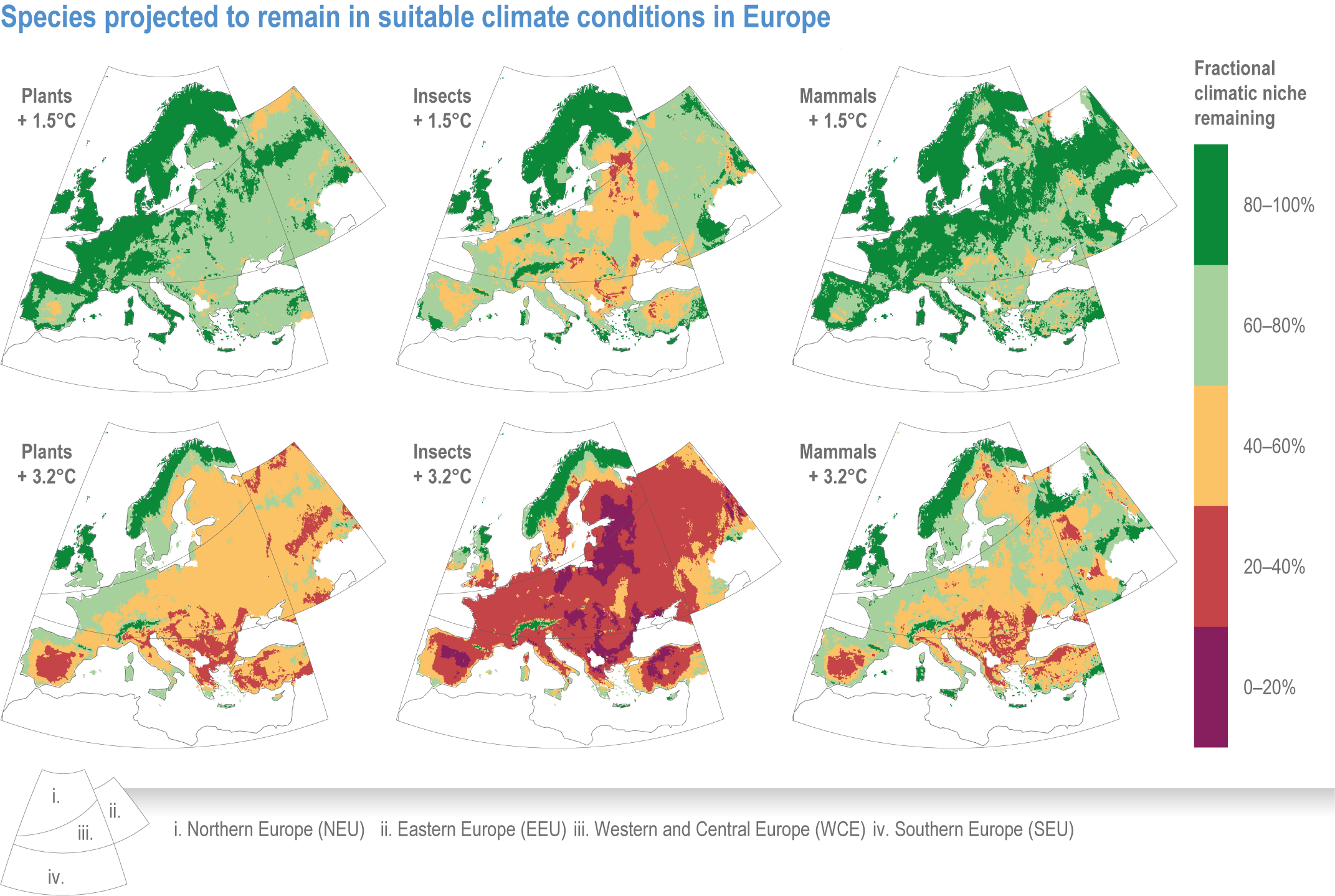
-
R relay@relay.infosec.exchange shared this topic
-
AMOC?
More certain than previously thought https://www.science.org/doi/10.1126/sciadv.adx4298
And Guardian article https://www.theguardian.com/environment/2026/apr/15/critical-atlantic-current-significantly-more-likely-to-collapse-than-thoughtOkay. Or not. But what does it mean, regionally, on the way to the OFF state?
Do we, us alive today experience any changes in our lifetime?I would say yes.
Disclaimer: it's conjecture. and I am no expert in anything.So. From tipping to OFF, it takes 100 to 150 years.
What happens during this slowdown phase?
I read in another paper that because AMOC slowdown intensifies the #ColdBlob, it also changes how the Lows and Highs over the Atlantic are distributed, which changes the jetstream, which in turn causes more extreme heat events in Europe.More #ExtremeHeat events?
How do those affect our biosphere in Europe?
Well, I don't know exactly. But IPCC AR6 WG2 has mapped the impact on European plants, insects and mammals if we let global 3.2C become reality.
As you can see, 3.2C spells extinction level for European insects – due to heat events and related processes that come with 3.2C.And I believe, a slow-ING #AMOC mimics heat events of such high-emission scenarios.
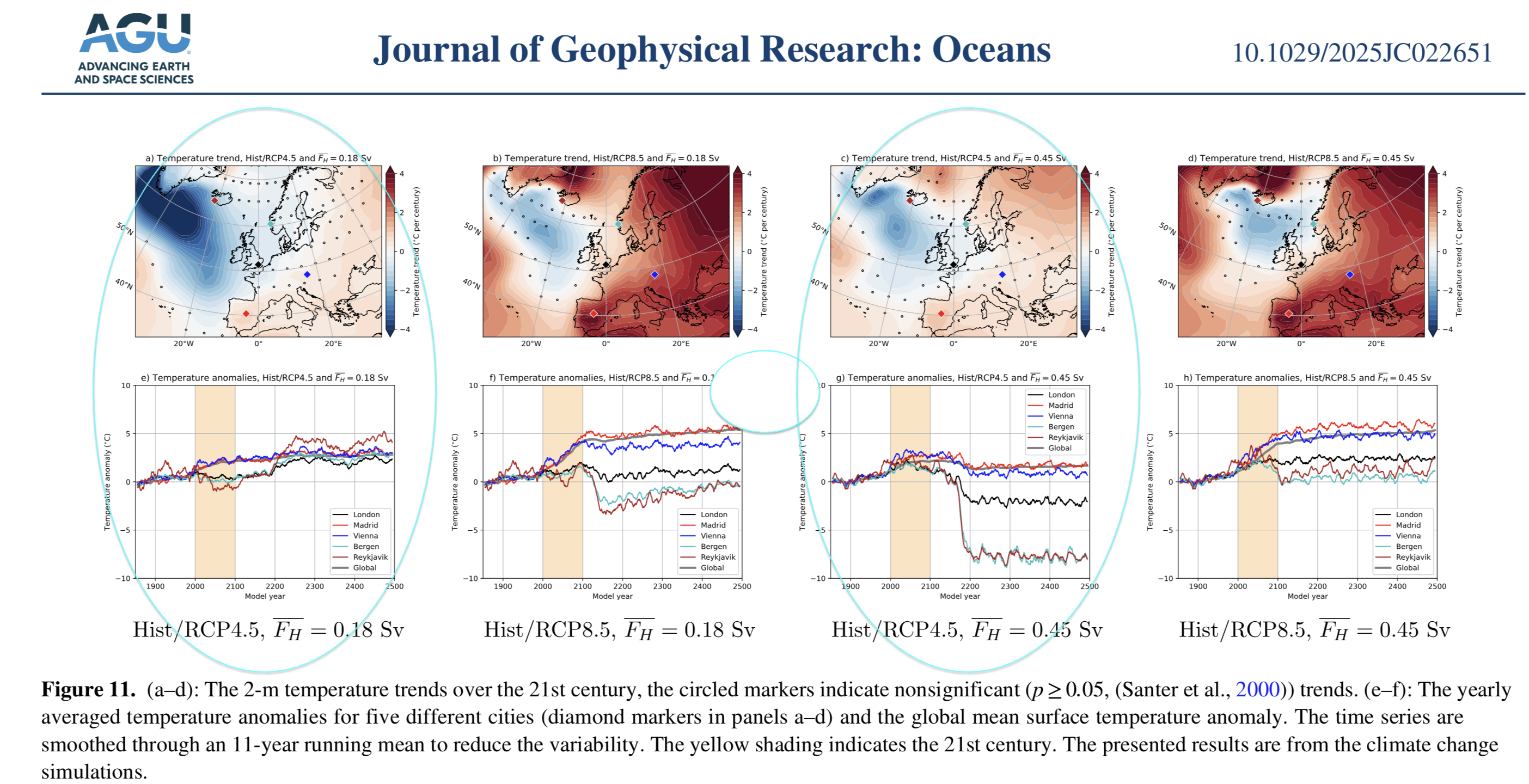
So we, us alive today, will watch our European insects AND soil…! die right in front of our eyes. I think.In their most famous AMOC paper, the vanWesten team in Utrecht were not stingy with printer ink cartridges to illustrate their findings with maps and line charts, also in the Supplementary. https://onlinelibrary.wiley.com/doi/abs/10.1029/2025JC022651
The line charts in particular are of interest as they tell the story of the slow-ing AMOC during our lifetime.
Unfortunately, they're in annual means. So the really expected increased number of heat events (due to the atmosphere re-arranging itself around the #ColdBlob) are smoothed over by whatever the winters will be like.
What I read into it: during the slowdown, the extreme summer heat (that in my opinion kills the insects in Europe, and mammals and plants in large swathes of Southern Europe)
is balanced by extreme cold events in winter. That's why the lines are plateauing until the OFF state is reached in the emission-scenario RCP4.5 (I circled them).
A plateau – despite more extreme heat events happening – must mean a balance from the cold season.
A plateau in annual anomalies does not mean zero change.I wrote more in the ALTtext.
Note: RCP4.5 without #AMOC collapse should produce local annual anomalies of about 6C over pre-industrial, more than double the global outcome of 2.5C.
Note also: the experiments included a return to no freshwater hosing. And that indeed undid the collapsing.
All is not lost. we CAN still act. But we must do that today, like. Not in 5 years. Today. That's how close it is.
-
AMOC?
More certain than previously thought https://www.science.org/doi/10.1126/sciadv.adx4298
And Guardian article https://www.theguardian.com/environment/2026/apr/15/critical-atlantic-current-significantly-more-likely-to-collapse-than-thoughtOkay. Or not. But what does it mean, regionally, on the way to the OFF state?
Do we, us alive today experience any changes in our lifetime?I would say yes.
Disclaimer: it's conjecture. and I am no expert in anything.So. From tipping to OFF, it takes 100 to 150 years.
What happens during this slowdown phase?
I read in another paper that because AMOC slowdown intensifies the #ColdBlob, it also changes how the Lows and Highs over the Atlantic are distributed, which changes the jetstream, which in turn causes more extreme heat events in Europe.More #ExtremeHeat events?
How do those affect our biosphere in Europe?
Well, I don't know exactly. But IPCC AR6 WG2 has mapped the impact on European plants, insects and mammals if we let global 3.2C become reality.
As you can see, 3.2C spells extinction level for European insects – due to heat events and related processes that come with 3.2C.And I believe, a slow-ING #AMOC mimics heat events of such high-emission scenarios.
So we, us alive today, will watch our European insects AND soil…! die right in front of our eyes. I think.@anlomedad
Thanks for posting the link to the article because the Guardian appears to have a default policy of not linking to the reports it covers. They don't want people to click away, obviously. -
@anlomedad
Thanks for posting the link to the article because the Guardian appears to have a default policy of not linking to the reports it covers. They don't want people to click away, obviously.@markhburton
Thanks. But the Guardian article does provide a direct link to the paper too. Somewhere in the middle where it says "The new research, published in the journal Science Advances, explored four different ways .." , the link is highlighted.