Skip to content
  • Categories
  • Recent
  • Tags
  • Popular
  • World
  • Users
  • Groups
Skins
  • Light
  • Brite
  • Cerulean
  • Cosmo
  • Flatly
  • Journal
  • Litera
  • Lumen
  • Lux
  • Materia
  • Minty
  • Morph
  • Pulse
  • Sandstone
  • Simplex
  • Sketchy
  • Spacelab
  • United
  • Yeti
  • Zephyr
  • Dark
  • Cyborg
  • Darkly
  • Quartz
  • Slate
  • Solar
  • Superhero
  • Vapor

  • Default (Cyborg)
  • No Skin
Collapse
Brand Logo

CIRCLE WITH A DOT

  1. Home
  2. Uncategorized
  3. Sigh.

Sigh.

Scheduled Pinned Locked Moved Uncategorized
87 Posts 54 Posters 16 Views
  • Oldest to Newest
  • Newest to Oldest
  • Most Votes
Reply
  • Reply as topic
Log in to reply
This topic has been deleted. Only users with topic management privileges can see it.
  • cstross@wandering.shopC cstross@wandering.shop

    Sigh.

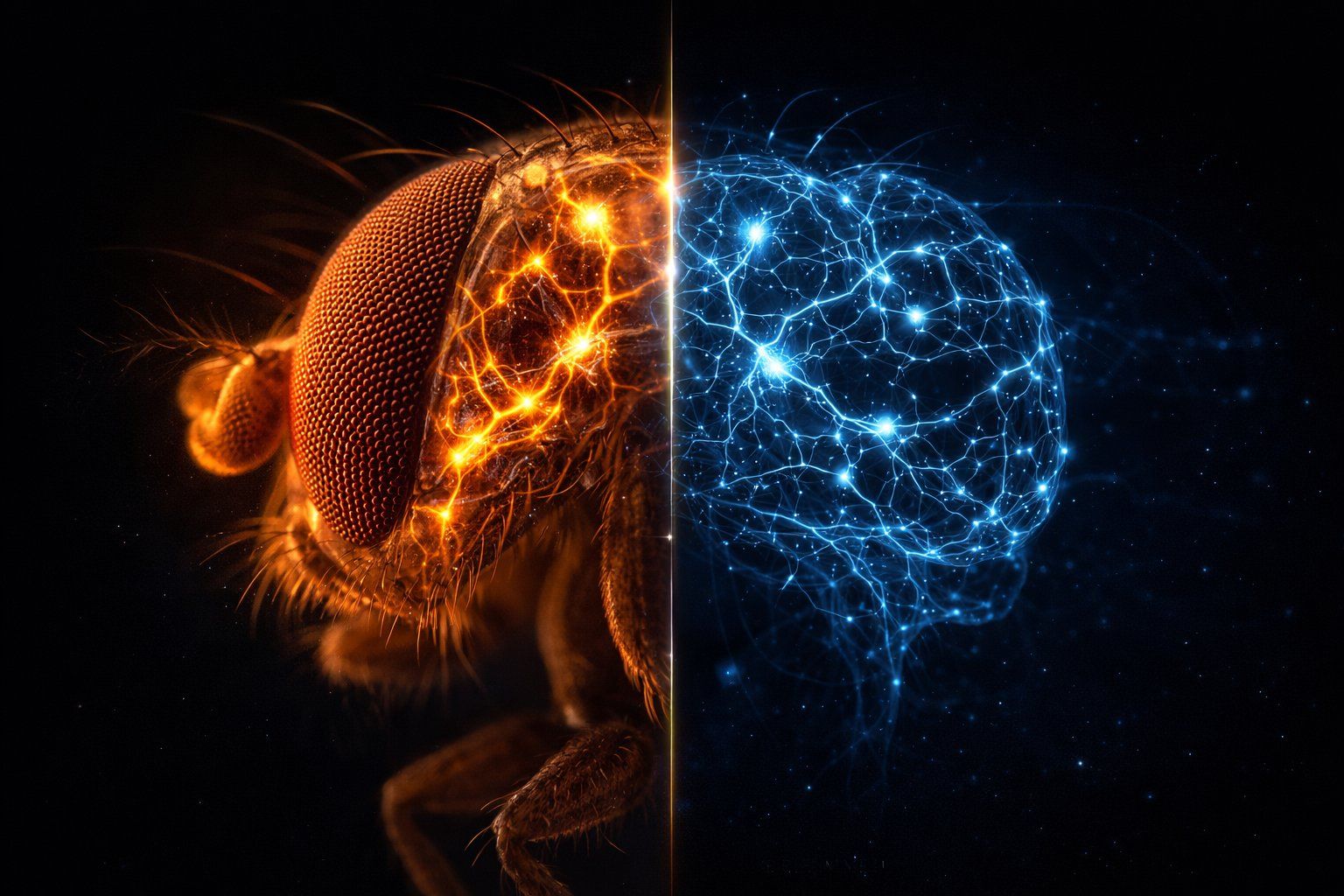
    So it turns out we've mapped the neural connectome of Drosophila *and simulated it in silico*.

    Link Preview Image
    FlyWire

    favicon

    (flywire.ai)

    Pop-sci explainer here:

    Link Preview Image
    Whole Brain Emulation Achieved: Scientists Run a Fruit Fly Brain in Simulation | RathBiotaClan

    Scientists ran a real fruit fly brain in simulation using the FlyWire connectome, achieving the first working whole brain emulation.

    favicon

    RathBiotaClan (www.rathbiotaclan.com)

    Key quote: "The step from a complete connectome to a working computational brain model is not trivial." And there's an even more important finding in this screenshot (alt text via OCR):

    "The wiring is the computation".

    /1

    illuminatus@mstdn.socialI This user is from outside of this forum
    illuminatus@mstdn.socialI This user is from outside of this forum
    illuminatus@mstdn.social
    wrote last edited by
    #2

    @cstross Kick a neuron out of place in the "Brain Scanning Transfer" and your Elon Musk digital clone becomes somebody else. Which, I mean, it could get you a worse person, but not a lot worse.

    1 Reply Last reply
    0
    • cstross@wandering.shopC cstross@wandering.shop

      Sigh.

      So it turns out we've mapped the neural connectome of Drosophila *and simulated it in silico*.

      Link Preview Image
      FlyWire

      favicon

      (flywire.ai)

      Pop-sci explainer here:

      Link Preview Image
      Whole Brain Emulation Achieved: Scientists Run a Fruit Fly Brain in Simulation | RathBiotaClan

      Scientists ran a real fruit fly brain in simulation using the FlyWire connectome, achieving the first working whole brain emulation.

      favicon

      RathBiotaClan (www.rathbiotaclan.com)

      Key quote: "The step from a complete connectome to a working computational brain model is not trivial." And there's an even more important finding in this screenshot (alt text via OCR):

      "The wiring is the computation".

      /1

      P This user is from outside of this forum
      P This user is from outside of this forum
      phosphenes@mastodon.social
      wrote last edited by
      #3

      @cstross

      Someone commented that now we've uploaded a fly brain it can eat virtual shit long after the rest of us are a distant memory.

      P 1 Reply Last reply
      0
      • cstross@wandering.shopC cstross@wandering.shop

        Sigh.

        So it turns out we've mapped the neural connectome of Drosophila *and simulated it in silico*.

        Link Preview Image
        FlyWire

        favicon

        (flywire.ai)

        Pop-sci explainer here:

        Link Preview Image
        Whole Brain Emulation Achieved: Scientists Run a Fruit Fly Brain in Simulation | RathBiotaClan

        Scientists ran a real fruit fly brain in simulation using the FlyWire connectome, achieving the first working whole brain emulation.

        favicon

        RathBiotaClan (www.rathbiotaclan.com)

        Key quote: "The step from a complete connectome to a working computational brain model is not trivial." And there's an even more important finding in this screenshot (alt text via OCR):

        "The wiring is the computation".

        /1

        cstross@wandering.shopC This user is from outside of this forum
        cstross@wandering.shopC This user is from outside of this forum
        cstross@wandering.shop
        wrote last edited by
        #4

        The experimenters then went on to hook up their Drosophila connectome to an anatomically detailed Drosophila body model within an open-source physics engine that "uses generalized coordinates and constraint-based contact dynamics to simulate rigid-body systems with high fidelity" including joint and antennae modeling and accurate modeling of surface adhesion—and compound eye simulation.

        Lots of *really* interesting insights here.

        /2

        cstross@wandering.shopC robcornelius@climatejustice.socialR 2 Replies Last reply
        0
        • R relay@relay.infosec.exchange shared this topic
        • cstross@wandering.shopC cstross@wandering.shop

          The experimenters then went on to hook up their Drosophila connectome to an anatomically detailed Drosophila body model within an open-source physics engine that "uses generalized coordinates and constraint-based contact dynamics to simulate rigid-body systems with high fidelity" including joint and antennae modeling and accurate modeling of surface adhesion—and compound eye simulation.

          Lots of *really* interesting insights here.

          /2

          cstross@wandering.shopC This user is from outside of this forum
          cstross@wandering.shopC This user is from outside of this forum
          cstross@wandering.shop
          wrote last edited by
          #5

          They managed to run a feedback loop between the full 127,400 neuron network in the biological connectome to the physical simulation, with feedback from proprioceptive signals received by the model "fly" in the simulation producing feedback spile trains in the simulation, and THEY GOT RESULTS (again, see alt text of screencap: it's too verbose for a toot):

          /3

          cstross@wandering.shopC 1 Reply Last reply
          0
          • cstross@wandering.shopC cstross@wandering.shop

            Sigh.

            So it turns out we've mapped the neural connectome of Drosophila *and simulated it in silico*.

            Link Preview Image
            FlyWire

            favicon

            (flywire.ai)

            Pop-sci explainer here:

            Link Preview Image
            Whole Brain Emulation Achieved: Scientists Run a Fruit Fly Brain in Simulation | RathBiotaClan

            Scientists ran a real fruit fly brain in simulation using the FlyWire connectome, achieving the first working whole brain emulation.

            favicon

            RathBiotaClan (www.rathbiotaclan.com)

            Key quote: "The step from a complete connectome to a working computational brain model is not trivial." And there's an even more important finding in this screenshot (alt text via OCR):

            "The wiring is the computation".

            /1

            ehproque@neopaquita.esE This user is from outside of this forum
            ehproque@neopaquita.esE This user is from outside of this forum
            ehproque@neopaquita.es
            wrote last edited by
            #6

            @cstross I think I'm going to have to read that a few times to understand if

            1 Reply Last reply
            0
            • cstross@wandering.shopC cstross@wandering.shop

              The experimenters then went on to hook up their Drosophila connectome to an anatomically detailed Drosophila body model within an open-source physics engine that "uses generalized coordinates and constraint-based contact dynamics to simulate rigid-body systems with high fidelity" including joint and antennae modeling and accurate modeling of surface adhesion—and compound eye simulation.

              Lots of *really* interesting insights here.

              /2

              robcornelius@climatejustice.socialR This user is from outside of this forum
              robcornelius@climatejustice.socialR This user is from outside of this forum
              robcornelius@climatejustice.social
              wrote last edited by
              #7

              @cstross not lobsters then....

              cstross@wandering.shopC 1 Reply Last reply
              0
              • cstross@wandering.shopC cstross@wandering.shop

                Sigh.

                So it turns out we've mapped the neural connectome of Drosophila *and simulated it in silico*.

                Link Preview Image
                FlyWire

                favicon

                (flywire.ai)

                Pop-sci explainer here:

                Link Preview Image
                Whole Brain Emulation Achieved: Scientists Run a Fruit Fly Brain in Simulation | RathBiotaClan

                Scientists ran a real fruit fly brain in simulation using the FlyWire connectome, achieving the first working whole brain emulation.

                favicon

                RathBiotaClan (www.rathbiotaclan.com)

                Key quote: "The step from a complete connectome to a working computational brain model is not trivial." And there's an even more important finding in this screenshot (alt text via OCR):

                "The wiring is the computation".

                /1

                meyerweb@mastodon.socialM This user is from outside of this forum
                meyerweb@mastodon.socialM This user is from outside of this forum
                meyerweb@mastodon.social
                wrote last edited by
                #8

                @cstross Oh gods, Peter Watts was right.

                1 Reply Last reply
                0
                • cstross@wandering.shopC cstross@wandering.shop

                  They managed to run a feedback loop between the full 127,400 neuron network in the biological connectome to the physical simulation, with feedback from proprioceptive signals received by the model "fly" in the simulation producing feedback spile trains in the simulation, and THEY GOT RESULTS (again, see alt text of screencap: it's too verbose for a toot):

                  /3

                  cstross@wandering.shopC This user is from outside of this forum
                  cstross@wandering.shopC This user is from outside of this forum
                  cstross@wandering.shop
                  wrote last edited by
                  #9

                  There is stuff missing, of course (alt text for screencap contains about 3 toots' worth of text explaining this): information about how the motor neurons connect to physical features of the body like the muscles, information on morphologically divergent neurons and fine detail on dendritic branching and synaptic inputs across dendritic compartments:

                  /4

                  Link Preview Image
                  cstross@wandering.shopC raymaccarthy@mastodon.ieR 2 Replies Last reply
                  0
                  • cstross@wandering.shopC cstross@wandering.shop

                    There is stuff missing, of course (alt text for screencap contains about 3 toots' worth of text explaining this): information about how the motor neurons connect to physical features of the body like the muscles, information on morphologically divergent neurons and fine detail on dendritic branching and synaptic inputs across dendritic compartments:

                    /4

                    Link Preview Image
                    cstross@wandering.shopC This user is from outside of this forum
                    cstross@wandering.shopC This user is from outside of this forum
                    cstross@wandering.shop
                    wrote last edited by
                    #10

                    ... The next step on from Drosophila, the mouse brain, is 560 times larger—never mind a vastly more complex human brain. And to get the murine connectome we'll have to chop up *a lot* of brains: a human upload won't pass any kind of medical ethics review at this point!

                    But near-term, it's expected to yield "fundamentally new architectural principles for AI systems that are more sample-efficient, more robust, and more capable of behavioral generalization than current approaches"

                    /5

                    cstross@wandering.shopC uilebheist@polyglot.cityU nilz@norden.socialN boydstephensmithjr@hachyderm.ioB mikestok@mstdn.caM 5 Replies Last reply
                    0
                    • cstross@wandering.shopC cstross@wandering.shop

                      ... The next step on from Drosophila, the mouse brain, is 560 times larger—never mind a vastly more complex human brain. And to get the murine connectome we'll have to chop up *a lot* of brains: a human upload won't pass any kind of medical ethics review at this point!

                      But near-term, it's expected to yield "fundamentally new architectural principles for AI systems that are more sample-efficient, more robust, and more capable of behavioral generalization than current approaches"

                      /5

                      cstross@wandering.shopC This user is from outside of this forum
                      cstross@wandering.shopC This user is from outside of this forum
                      cstross@wandering.shop
                      wrote last edited by
                      #11

                      But I'm REALLY HAPPY right now because this kinda-sorta validates the key premise of the SF novel I just handed in last month (which involves serial reincarnation via destructive brain-slicing-and-imaging then imprinting onto an immature cortex, and then explores its disastrous societal failure modes).

                      ... And it also hints that artificial consciousness might, eventually, be possible, if only via the hard path of doing it the same way we do it, only in simulation in silico.

                      /6 (ends)

                      mwl@io.mwl.ioM future_upbeat@mastodon.socialF jsl@hachyderm.ioJ raymaccarthy@mastodon.ieR antiqueight@mastodon.ieA 14 Replies Last reply
                      0
                      • cstross@wandering.shopC cstross@wandering.shop

                        But I'm REALLY HAPPY right now because this kinda-sorta validates the key premise of the SF novel I just handed in last month (which involves serial reincarnation via destructive brain-slicing-and-imaging then imprinting onto an immature cortex, and then explores its disastrous societal failure modes).

                        ... And it also hints that artificial consciousness might, eventually, be possible, if only via the hard path of doing it the same way we do it, only in simulation in silico.

                        /6 (ends)

                        mwl@io.mwl.ioM This user is from outside of this forum
                        mwl@io.mwl.ioM This user is from outside of this forum
                        mwl@io.mwl.io
                        wrote last edited by
                        #12

                        @cstross very cool, thanks for sharing!

                        cstross@wandering.shopC 1 Reply Last reply
                        0
                        • cstross@wandering.shopC cstross@wandering.shop

                          Sigh.

                          So it turns out we've mapped the neural connectome of Drosophila *and simulated it in silico*.

                          Link Preview Image
                          FlyWire

                          favicon

                          (flywire.ai)

                          Pop-sci explainer here:

                          Link Preview Image
                          Whole Brain Emulation Achieved: Scientists Run a Fruit Fly Brain in Simulation | RathBiotaClan

                          Scientists ran a real fruit fly brain in simulation using the FlyWire connectome, achieving the first working whole brain emulation.

                          favicon

                          RathBiotaClan (www.rathbiotaclan.com)

                          Key quote: "The step from a complete connectome to a working computational brain model is not trivial." And there's an even more important finding in this screenshot (alt text via OCR):

                          "The wiring is the computation".

                          /1

                          fromboliere@mastodon.unoF This user is from outside of this forum
                          fromboliere@mastodon.unoF This user is from outside of this forum
                          fromboliere@mastodon.uno
                          wrote last edited by
                          #13

                          @cstross apparently Aristotle was right about substance and essence

                          1 Reply Last reply
                          0
                          • cstross@wandering.shopC cstross@wandering.shop

                            But I'm REALLY HAPPY right now because this kinda-sorta validates the key premise of the SF novel I just handed in last month (which involves serial reincarnation via destructive brain-slicing-and-imaging then imprinting onto an immature cortex, and then explores its disastrous societal failure modes).

                            ... And it also hints that artificial consciousness might, eventually, be possible, if only via the hard path of doing it the same way we do it, only in simulation in silico.

                            /6 (ends)

                            future_upbeat@mastodon.socialF This user is from outside of this forum
                            future_upbeat@mastodon.socialF This user is from outside of this forum
                            future_upbeat@mastodon.social
                            wrote last edited by
                            #14

                            @cstross Agreed that artificial consciousness might be possible from the bottom up, starting with agency and a complete model.

                            I don't believe for a picosecond that current LLMs (or other AI) are conscious.

                            cstross@wandering.shopC 1 Reply Last reply
                            0
                            • robcornelius@climatejustice.socialR robcornelius@climatejustice.social

                              @cstross not lobsters then....

                              cstross@wandering.shopC This user is from outside of this forum
                              cstross@wandering.shopC This user is from outside of this forum
                              cstross@wandering.shop
                              wrote last edited by
                              #15

                              @robcornelius The Lobster stomatogastric ganglion sim happened in the 1990s. That's where I got the idea for "Lobsters" (written 1997/98) from.

                              1 Reply Last reply
                              0
                              • mwl@io.mwl.ioM mwl@io.mwl.io

                                @cstross very cool, thanks for sharing!

                                cstross@wandering.shopC This user is from outside of this forum
                                cstross@wandering.shopC This user is from outside of this forum
                                cstross@wandering.shop
                                wrote last edited by
                                #16

                                @mwl Also very cool, the Indian sci/tech news website that ran that feature! (From the writing style I initially thought it might be AI slop, but no: Indian English is just a bit different.)

                                pwassonchat@eldritch.cafeP solitha@mastodon.socialS 2 Replies Last reply
                                0
                                • cstross@wandering.shopC cstross@wandering.shop

                                  There is stuff missing, of course (alt text for screencap contains about 3 toots' worth of text explaining this): information about how the motor neurons connect to physical features of the body like the muscles, information on morphologically divergent neurons and fine detail on dendritic branching and synaptic inputs across dendritic compartments:

                                  /4

                                  Link Preview Image
                                  raymaccarthy@mastodon.ieR This user is from outside of this forum
                                  raymaccarthy@mastodon.ieR This user is from outside of this forum
                                  raymaccarthy@mastodon.ie
                                  wrote last edited by
                                  #17

                                  @cstross
                                  Also shows that much "AI" terminology is marketing, not science. Computer "AI" doesn't have Neural Networks (it's a distributed dataflow database) nor "learning".

                                  I've suspected this result for decades.

                                  "Uploading" human consciousness is still SF based on Transhumanism, which is a religion, not science.

                                  I doubt it will yield anything for computer AI. Except current LLM based AI is a dead end.

                                  1 Reply Last reply
                                  0
                                  • future_upbeat@mastodon.socialF future_upbeat@mastodon.social

                                    @cstross Agreed that artificial consciousness might be possible from the bottom up, starting with agency and a complete model.

                                    I don't believe for a picosecond that current LLMs (or other AI) are conscious.

                                    cstross@wandering.shopC This user is from outside of this forum
                                    cstross@wandering.shopC This user is from outside of this forum
                                    cstross@wandering.shop
                                    wrote last edited by
                                    #18

                                    @future_upbeat

                                    I absolutely agree.

                                    At best, what current LLMs are is evidence that linguistic processing follows statistically modelable rules.

                                    raymaccarthy@mastodon.ieR weekend_editor@mathstodon.xyzW 2 Replies Last reply
                                    0
                                    • cstross@wandering.shopC cstross@wandering.shop

                                      But I'm REALLY HAPPY right now because this kinda-sorta validates the key premise of the SF novel I just handed in last month (which involves serial reincarnation via destructive brain-slicing-and-imaging then imprinting onto an immature cortex, and then explores its disastrous societal failure modes).

                                      ... And it also hints that artificial consciousness might, eventually, be possible, if only via the hard path of doing it the same way we do it, only in simulation in silico.

                                      /6 (ends)

                                      jsl@hachyderm.ioJ This user is from outside of this forum
                                      jsl@hachyderm.ioJ This user is from outside of this forum
                                      jsl@hachyderm.io
                                      wrote last edited by
                                      #19

                                      @cstross Does that make your work Science Fact-ion instead of Science Fiction?

                                      1 Reply Last reply
                                      0
                                      • cstross@wandering.shopC cstross@wandering.shop

                                        Sigh.

                                        So it turns out we've mapped the neural connectome of Drosophila *and simulated it in silico*.

                                        Link Preview Image
                                        FlyWire

                                        favicon

                                        (flywire.ai)

                                        Pop-sci explainer here:

                                        Link Preview Image
                                        Whole Brain Emulation Achieved: Scientists Run a Fruit Fly Brain in Simulation | RathBiotaClan

                                        Scientists ran a real fruit fly brain in simulation using the FlyWire connectome, achieving the first working whole brain emulation.

                                        favicon

                                        RathBiotaClan (www.rathbiotaclan.com)

                                        Key quote: "The step from a complete connectome to a working computational brain model is not trivial." And there's an even more important finding in this screenshot (alt text via OCR):

                                        "The wiring is the computation".

                                        /1

                                        dr2chase@ohai.socialD This user is from outside of this forum
                                        dr2chase@ohai.socialD This user is from outside of this forum
                                        dr2chase@ohai.social
                                        wrote last edited by
                                        #20

                                        @cstross "the wiring is the computer" is not too surprising. Years ago playing w/ algorithms for FPGA, needed to invent a bit-string perfect hash table. One way of doing a perfect hash function/table involves a matrix and offset, H = Mx + v, but our math needed to be boolean (AND, XOR), a "1" coefficient was a wire, and if we wanted a one-cycle hash index, then we needed no more 1's in a row than maximum inputs to an FPGA XOR. So, a sparse boolean matrix. The wiring was the computation..

                                        flippac@types.plF 1 Reply Last reply
                                        0
                                        • cstross@wandering.shopC cstross@wandering.shop

                                          But I'm REALLY HAPPY right now because this kinda-sorta validates the key premise of the SF novel I just handed in last month (which involves serial reincarnation via destructive brain-slicing-and-imaging then imprinting onto an immature cortex, and then explores its disastrous societal failure modes).

                                          ... And it also hints that artificial consciousness might, eventually, be possible, if only via the hard path of doing it the same way we do it, only in simulation in silico.

                                          /6 (ends)

                                          raymaccarthy@mastodon.ieR This user is from outside of this forum
                                          raymaccarthy@mastodon.ieR This user is from outside of this forum
                                          raymaccarthy@mastodon.ie
                                          wrote last edited by
                                          #21

                                          @cstross
                                          Also since cryogenic freezing a brain destroys the structure of an already dead brain (basically deteriotated), the folk paying for that are being scammed.

                                          I agree it's nice info for SF world building.

                                          Presumably they'd have to replace the blood of a living mouse with a special fluid to preserve the structure?


                                          cstross@wandering.shopC 1 Reply Last reply
                                          0
                                          Reply
                                          • Reply as topic
                                          Log in to reply
                                          • Oldest to Newest
                                          • Newest to Oldest
                                          • Most Votes


                                          • Login

                                          • Login or register to search.
                                          • First post
                                            Last post
                                          0
                                          • Categories
                                          • Recent
                                          • Tags
                                          • Popular
                                          • World
                                          • Users
                                          • Groups