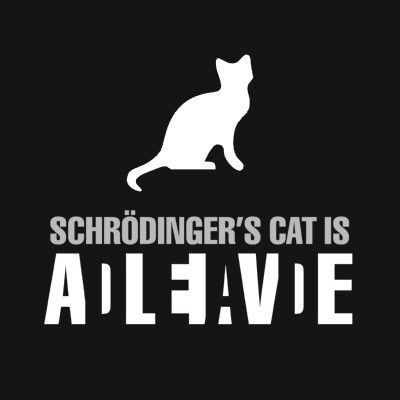
The notion of a broken clock being sometimes right is based on a gross misunderstanding of what information is.
-
@larsmb I'm not entirely sure I understand your point (I might if you fleshed it out some more), but I suspect that a relevant counterpoint you might not have properly considered is, the uncertainty space doesn't have to be flat. It can have an extra axis of plausibility, allowing for fuzzy exclusion of points on it, not just a black-and-white excluded/included binary.
@riley I blame my undercaffeination, you *did* imclude that via the "if you can't tell" part.
My apologies for a redundant reply.
-
The notion of a broken clock being sometimes right is based on a gross misunderstanding of what information is.
A clock that always shows the same time is never right, even in the moments of the day when the time happens to be what it shows, because you don't gain any information about what time it is by looking at the clock.
This reasoning also applies to chatbots. If you can't tell whether what you have been given is useful information unless you alreay know the information, then you haven't been given useful information.
@riley
I love this post, very thought provoking.As a native English speaker I have never once conceived of the idiom about broken clocks meaning what you say though, regarding gaining knowledge.
In my experience it is used to mean someone/thing is sometimes right, but not from any action they took, rather through luck, error, whatever. They are the broken clock.
I love your take though and the point as a whole.
-
@riley That is such a brilliantly clear analogy.
@MissConstrue @riley What Miss Construe said.
-
The notion of a broken clock being sometimes right is based on a gross misunderstanding of what information is.
A clock that always shows the same time is never right, even in the moments of the day when the time happens to be what it shows, because you don't gain any information about what time it is by looking at the clock.
This reasoning also applies to chatbots. If you can't tell whether what you have been given is useful information unless you alreay know the information, then you haven't been given useful information.
@riley That's a very useful angle on it. Where I think this gets interesting is that there's information which is, so to speak, self-certifying. Consider a proof, written in a form that's subject to a deterministic mechanised check. In many ways, it doesn't matter where you got it from: a Ouija board, a demon whispering, hard work, or an LLM. If the proof correctly typechecks, the theorem is true. Now if we consider programs are proofs...
-
@riley That's a very useful angle on it. Where I think this gets interesting is that there's information which is, so to speak, self-certifying. Consider a proof, written in a form that's subject to a deterministic mechanised check. In many ways, it doesn't matter where you got it from: a Ouija board, a demon whispering, hard work, or an LLM. If the proof correctly typechecks, the theorem is true. Now if we consider programs are proofs...
@modulux A proof is not information in a strict sense, and largery exactly because of this reason: it's self-contained (or, well, can be, with sufficient formalism available).
In a broad sense, there's some very interesting philosophy that can be done about the notion of information content of Teh Book. But it's mostly the kind of philosophy that requires a larger mug of beer than would be conducive to my upcoming meetings[1], so, as the old Orcish saying goes, nar udautas.
As a general rule, I tend to prefer the interpretation that a proof is a series of "I'd now like to bring your attention to ..." kind of steps: they don't add anything (directly) to your mental map; they suggest where you should look at to find interesting things that are already on the map.
[1] A children's book I once read included a character, one mathematics professor, who argued that it is pointless to ask questions, because there's two possibilities: the answer either is known or is not known. If it's known, what's the point of asking it again? If it's not known, what's the point of asking if there won't be an answer?
And, well, while it's silly in an obvious way, this kind of reasoning actually comes up in the context of proofs-as-information.
-
@MissConstrue Are you a chatbot sycophanting me up?

These days, one can never be too cautious.
@riley @MissConstrue I am not a bot. Please don't look at my name.
-
The notion of a broken clock being sometimes right is based on a gross misunderstanding of what information is.
A clock that always shows the same time is never right, even in the moments of the day when the time happens to be what it shows, because you don't gain any information about what time it is by looking at the clock.
This reasoning also applies to chatbots. If you can't tell whether what you have been given is useful information unless you alreay know the information, then you haven't been given useful information.
@riley I am sorry, this is not correct analogy
The bot not giving you correct information 100% of the time doesn't make them useless
A Search engine doesn't give you the correct answer all the time.
Chatbots are incredibly helpful. Don't take the answer as 100% correct, review and research accuracy after you get the answer but they save you immense amount of time from searching yourself
Think of them as hiring a jr employee or assistant. They are helpful but you must review their work -
The notion of a broken clock being sometimes right is based on a gross misunderstanding of what information is.
A clock that always shows the same time is never right, even in the moments of the day when the time happens to be what it shows, because you don't gain any information about what time it is by looking at the clock.
This reasoning also applies to chatbots. If you can't tell whether what you have been given is useful information unless you alreay know the information, then you haven't been given useful information.
@riley "This compass doesn't have a needle, I just painted one on."
What good is that?
"If I hold it right, it points North."
So it's a sign, not an instrument.
-
The notion of a broken clock being sometimes right is based on a gross misunderstanding of what information is.
A clock that always shows the same time is never right, even in the moments of the day when the time happens to be what it shows, because you don't gain any information about what time it is by looking at the clock.
This reasoning also applies to chatbots. If you can't tell whether what you have been given is useful information unless you alreay know the information, then you haven't been given useful information.
@riley The idea of that quote is accurate to its phrasing. Much like how you can't look at that clock to get an accurate reading of the time, you can't use the person or source of comparison for accurate information either.
What's the result of both? Don't bother looking or listening to clock or the person being compared to a broken clock.
It's the equivalent of saying "Trump lies so much that if he said the sky was blue, I'd have to go to a window to double check."
-
The notion of a broken clock being sometimes right is based on a gross misunderstanding of what information is.
A clock that always shows the same time is never right, even in the moments of the day when the time happens to be what it shows, because you don't gain any information about what time it is by looking at the clock.
This reasoning also applies to chatbots. If you can't tell whether what you have been given is useful information unless you alreay know the information, then you haven't been given useful information.
@riley ooh, this is good. Totally gonna add this to my list of arguments!
-
@proedie No, that's not how information works. Information is about reducing your uncertainty space. Every time you can exclude half of the uncertainty space, you will have gained one bit of information. If you exclude less than half of the uncertainty space, you will have gained less than a bit of information. Just ask Claude[1].
Looking at broken clock[2] does not reduce your uncertainty space at all, therefore you gain zero bits of information. The classic formula Claude Shannon is famous for involves dividing the volume of the uncertainty space after gaining information with the volume of the uncertainty space before gaining information, and then taking a base-2 logarithm of the ratio and negating it. If you don't care a minus one bit about negative amounts of data, you can turn the ratio on its top; then, negation won't be necessary. But there's didactic reasons for presenting it in the classic way.
[1] Claude Shannon, an overall smart human and a measurer of the enthropy of information. Who were you thinking about?
[2] Well, there's the minor issue of knowing that the clock is broken, lest you erroneously throw out parts of your uncertainty space that might actually be valid. But the problem of information-resembling text is also an issue that applies to chatbots. -
The notion of a broken clock being sometimes right is based on a gross misunderstanding of what information is.
A clock that always shows the same time is never right, even in the moments of the day when the time happens to be what it shows, because you don't gain any information about what time it is by looking at the clock.
This reasoning also applies to chatbots. If you can't tell whether what you have been given is useful information unless you alreay know the information, then you haven't been given useful information.
@riley Could you elaborate more on the notion of "uncertainty volume" you speak of? How do you measure these volumes or the changes in them without a well defined space of information (we don't know what we don't know nor how much we don't know to begin with)?
-
The notion of a broken clock being sometimes right is based on a gross misunderstanding of what information is.
A clock that always shows the same time is never right, even in the moments of the day when the time happens to be what it shows, because you don't gain any information about what time it is by looking at the clock.
This reasoning also applies to chatbots. If you can't tell whether what you have been given is useful information unless you alreay know the information, then you haven't been given useful information.
@riley Also, you mentioned that it would be too complicated to describe how information is different from mathematical proofs even though these usually reveal both the statement it's trying to prove but some of its connections to other concepts. If anything, aren't proof jammed packed with information? What is the definition of information for these calculations?
-
The notion of a broken clock being sometimes right is based on a gross misunderstanding of what information is.
A clock that always shows the same time is never right, even in the moments of the day when the time happens to be what it shows, because you don't gain any information about what time it is by looking at the clock.
This reasoning also applies to chatbots. If you can't tell whether what you have been given is useful information unless you alreay know the information, then you haven't been given useful information.
@riley While your argument seems complex it also seems to contradict my little experience using AI. While generally it is not very useful, it has proven helpful to me by giving me key terms I can then search for while trying to learn about concepts I have no idea about to begin with. I believe these key terms and connections that I can later "verify or disprove" are useful pieces of information.
-
The notion of a broken clock being sometimes right is based on a gross misunderstanding of what information is.
A clock that always shows the same time is never right, even in the moments of the day when the time happens to be what it shows, because you don't gain any information about what time it is by looking at the clock.
This reasoning also applies to chatbots. If you can't tell whether what you have been given is useful information unless you alreay know the information, then you haven't been given useful information.
@riley I agree here, and it is an important point. Yes, a broken clock is right twice a day, but you have no idea which points it happens to be right. So it just reverses its usual function - it doesn't tell you the time, it just tells you a time that exists.
-
The notion of a broken clock being sometimes right is based on a gross misunderstanding of what information is.
A clock that always shows the same time is never right, even in the moments of the day when the time happens to be what it shows, because you don't gain any information about what time it is by looking at the clock.
This reasoning also applies to chatbots. If you can't tell whether what you have been given is useful information unless you alreay know the information, then you haven't been given useful information.
@riley I miss when chatbots only existed in IRC and everyone knew they were just for the memes.
-
The notion of a broken clock being sometimes right is based on a gross misunderstanding of what information is.
A clock that always shows the same time is never right, even in the moments of the day when the time happens to be what it shows, because you don't gain any information about what time it is by looking at the clock.
This reasoning also applies to chatbots. If you can't tell whether what you have been given is useful information unless you alreay know the information, then you haven't been given useful information.
@riley Precisely the acid test I've given to various LLMs, and precisely how I discovered what I suspected about them is true. They're simply big bull shitters. Ask them something you know, and watch the blatantly false answers come back.
-
The notion of a broken clock being sometimes right is based on a gross misunderstanding of what information is.
A clock that always shows the same time is never right, even in the moments of the day when the time happens to be what it shows, because you don't gain any information about what time it is by looking at the clock.
This reasoning also applies to chatbots. If you can't tell whether what you have been given is useful information unless you alreay know the information, then you haven't been given useful information.
@riley I was thinking about this and realized that a clock that shows a fully random time every time you check it gives you the same info as a stopped clock.
-
The notion of a broken clock being sometimes right is based on a gross misunderstanding of what information is.
A clock that always shows the same time is never right, even in the moments of the day when the time happens to be what it shows, because you don't gain any information about what time it is by looking at the clock.
This reasoning also applies to chatbots. If you can't tell whether what you have been given is useful information unless you alreay know the information, then you haven't been given useful information.
@riley That actually really clears up how I feel when I very occasionally test an LLM. It gives me an answer but I just cannot trust that answer unless I already know.
-
The notion of a broken clock being sometimes right is based on a gross misunderstanding of what information is.
A clock that always shows the same time is never right, even in the moments of the day when the time happens to be what it shows, because you don't gain any information about what time it is by looking at the clock.
This reasoning also applies to chatbots. If you can't tell whether what you have been given is useful information unless you alreay know the information, then you haven't been given useful information.
@riley It seems like the step of error checking has been missed off and left to the user. It’s as if you sent the time as beeps down a really noisy phone line - you’d need some form of checkbit for each package of information to have any assurance of veracity. We do this with people automatically - if someone tells you something, you’ll place less weight on it being right if that person also says verifiably false things. You might ask more questions to check against known info.