If you use AI-generated code, you currently cannot claim copyright on it in the US.
-
@blogdiva @fsinn @jamie not a lawyer but deciding to weigh in regardless for some reason: the legal existence of trade secrets does not seem to be directly threatened by the legal methodology being advanced by these corporations in the same way as it directly opposes the basis of copyright infringement (also see hachette vs IA for an attempt to develop new precedent which also failed). however precisely as you say it may as a practical matter become more difficult to lay claim to the actions of a particular employee for breaching contract terms regarding trade secrets if the employer also subscribes to espionage as a service
-
@jamie I *am* an IP lawyer and I (along with many others) have been saying it for a while, that if the position the “AI” co’s are taking with respect to the legality of scraping “publicly available” materials were true (that all “publicly available” materials are “public domain” free to be used as raw materials without consent required), then copyright ceases to exist and all their own materials will be free for everyone else to use the very first time they’re leaked. That’ll be fun for the co.
@fsinn @jamie My understanding was that training an AI model on copyrighted work was fair use, because the actual "distribution"--when the AI generates something from a prompt--uses a diminimus amount of copyrighted content from an individual work, except if the user explicitly prompted something like, "Give me Homer Simpson surfing a space orca," at which point the AI company would throw the user all the way under the bus.
-
@atax1a This is the most incredible clapback I've seen all day. Flawless. No notes.

-
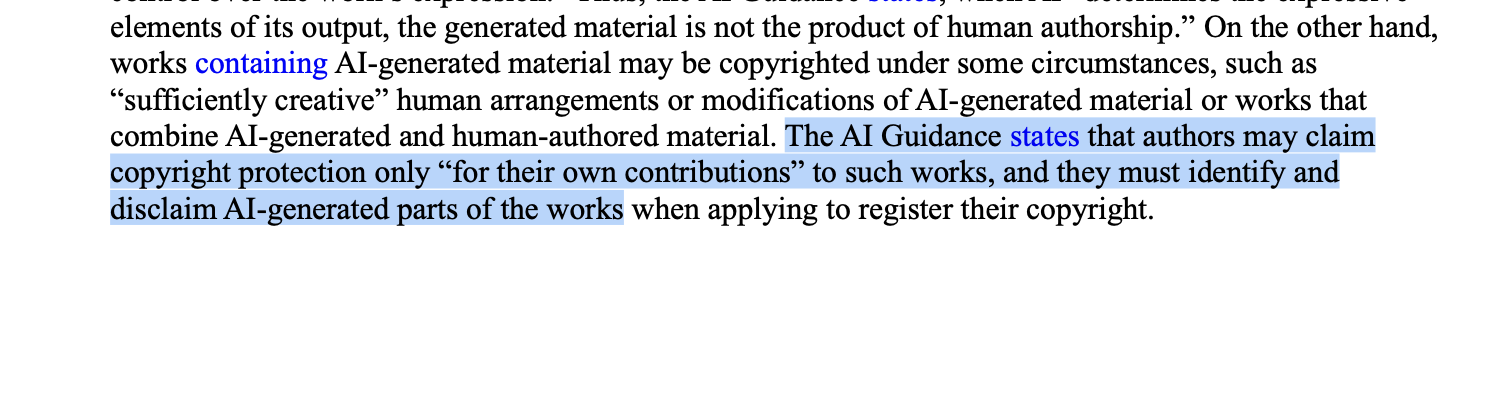
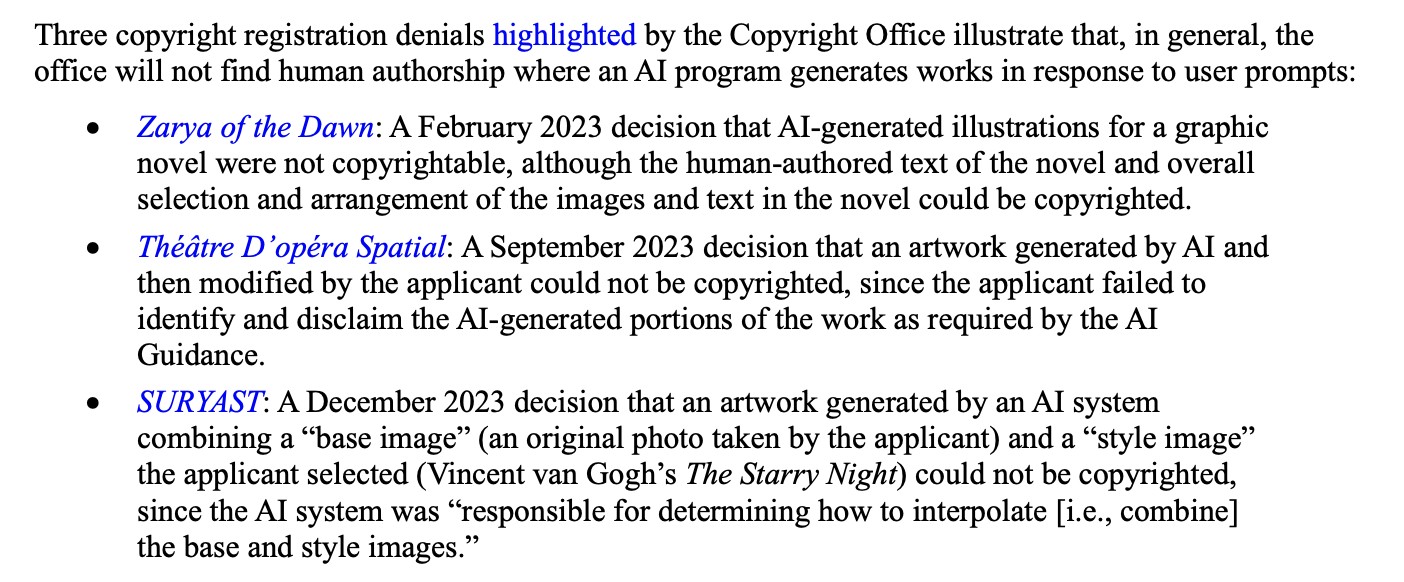
If you use AI-generated code, you currently cannot claim copyright on it in the US. If you fail to disclose/disclaim exactly which parts were not written by a human, you forfeit your copyright claim on *the entire codebase*.
This means copyright notices and even licenses folks are putting on their vibe-coded GitHub repos are unenforceable. The AI-generated code, and possibly the whole project, becomes public domain.
Source: https://www.congress.gov/crs_external_products/LSB/PDF/LSB10922/LSB10922.8.pdf
@jamie@zomglol.wtf this means a lot of windows 11 is public domain right?
-
@starr Sorry, it occurred to me that that could come across as sarcastic. I mean that law is not cut and dry, and opinions of specific people factor into every legal decision.
@jamie no worries, it didn’t come across that way. Your sibling could easily know something I don’t. I just suspect it’s more complicated than the presence of ai code canceling out any copyright claims on adjacent code. Now that I think about it, do companies even register copyright for their code? I’ve personally never seen it done. It would mean that anyone could go to the library of congress and see it I believe. I’ve only done books but I had to send them a pdf.
-
@fsinn @jamie My understanding was that training an AI model on copyrighted work was fair use, because the actual "distribution"--when the AI generates something from a prompt--uses a diminimus amount of copyrighted content from an individual work, except if the user explicitly prompted something like, "Give me Homer Simpson surfing a space orca," at which point the AI company would throw the user all the way under the bus.
@Azuaron @fsinn The argument has been that the model doesn't contain the copyrighted works directly. Like, you can't grep the model file on disk for a passage from a book it can still somehow reproduce.
It's a ridiculous argument, though, because the models deal in numbers, not text. Those numbers are converted to text for human consumption only, so of course it won't contain the raw text anywhere in the model.
-
If you use AI-generated code, you currently cannot claim copyright on it in the US. If you fail to disclose/disclaim exactly which parts were not written by a human, you forfeit your copyright claim on *the entire codebase*.
This means copyright notices and even licenses folks are putting on their vibe-coded GitHub repos are unenforceable. The AI-generated code, and possibly the whole project, becomes public domain.
Source: https://www.congress.gov/crs_external_products/LSB/PDF/LSB10922/LSB10922.8.pdf
@jamie well that's certainly an imaginative way to disarm GPL
-
If you use AI-generated code, you currently cannot claim copyright on it in the US. If you fail to disclose/disclaim exactly which parts were not written by a human, you forfeit your copyright claim on *the entire codebase*.
This means copyright notices and even licenses folks are putting on their vibe-coded GitHub repos are unenforceable. The AI-generated code, and possibly the whole project, becomes public domain.
Source: https://www.congress.gov/crs_external_products/LSB/PDF/LSB10922/LSB10922.8.pdf
@jamie this is kind of funny.
-
@jamie no worries, it didn’t come across that way. Your sibling could easily know something I don’t. I just suspect it’s more complicated than the presence of ai code canceling out any copyright claims on adjacent code. Now that I think about it, do companies even register copyright for their code? I’ve personally never seen it done. It would mean that anyone could go to the library of congress and see it I believe. I’ve only done books but I had to send them a pdf.
@starr I'll have to ask. We didn't get into these kinds of details when we talked about it.
It's definitely more complicated than AI-generated code infecting copyright GPL-style. More that you can't claim copyright on the AI-generated code, so if you don't disclaim the AI-generated code, your copyright won't be recognized. There may also be a lot more dirty details to it that could sway a decision one way or another.
-
@starr I'll have to ask. We didn't get into these kinds of details when we talked about it.
It's definitely more complicated than AI-generated code infecting copyright GPL-style. More that you can't claim copyright on the AI-generated code, so if you don't disclaim the AI-generated code, your copyright won't be recognized. There may also be a lot more dirty details to it that could sway a decision one way or another.
@starr Also, are the full contents of all registered copyrights visible at the Library of Congress? I assumed that was patents only but I used to get copyright and patents confused a lot and this may be one of those things I've been carrying incorrectly in my mind.
-
If you use AI-generated code, you currently cannot claim copyright on it in the US. If you fail to disclose/disclaim exactly which parts were not written by a human, you forfeit your copyright claim on *the entire codebase*.
This means copyright notices and even licenses folks are putting on their vibe-coded GitHub repos are unenforceable. The AI-generated code, and possibly the whole project, becomes public domain.
Source: https://www.congress.gov/crs_external_products/LSB/PDF/LSB10922/LSB10922.8.pdf
@jamie The same goes in Finland. Machine is not a natural person (obviously) and copyright can be granted only to a natural human being - not to an organisation, not to a system. This is by law.
Anything coming out of LLMs’ is free for any use by anyone. It is merely a matter of access to this content.
-
Hi @tuban_muzuru , totally with you that this is a deeply wrong, misguided "sky is falling" take; purely speculative, since there are no court rulings related to *code* anywhere in the vicinity of:
"used AI, therefore, *poof* it's legal to open source it!"
edit: at the same time, absolutely, LLMs were not ethically trained. But ethics != judicial systems.
But hey, @jamie , enjoy your popcorn regardless
@dusk @tuban_muzuru @jamie 2nded. I certainly appreciated it. I considered Tuban's perspective from a big tech position. Google would be contributing to their own IP risk. Since their legal team hasn't been lit on fire, I agree there might be nuance.
-
If you use AI-generated code, you currently cannot claim copyright on it in the US. If you fail to disclose/disclaim exactly which parts were not written by a human, you forfeit your copyright claim on *the entire codebase*.
This means copyright notices and even licenses folks are putting on their vibe-coded GitHub repos are unenforceable. The AI-generated code, and possibly the whole project, becomes public domain.
Source: https://www.congress.gov/crs_external_products/LSB/PDF/LSB10922/LSB10922.8.pdf
I'm surprised this isn't obvious. No, no, I'm not.
-
FWIW I'm not a lawyer and I'm not recommending that you do this.
 Even if companies have no legal standing on copyright, their legal team will try it. It *will* cost you money.
But man, oh man, I'm gonna have popcorn ready for when someone inevitably pulls this move.
Can’t wait!!
-
It'll be interesting to see what happens when a company pisses off an employee to the point where that person creates a public repo containing all the company's AI-generated code. I guarantee what's AI-generated and what's human-written isn't called out anywhere in the code, meaning the entire codebase becomes public domain.
While the company may have recourse based on the employment agreement (which varies in enforceability by state), I doubt there'd be any on the basis of copyright.
@jamie It may not be copyrightable but it can still count as one of the other forms of IP, such as trade secrets, which as a former employee you can very easily be prosecuted for divulging. And there are usually NDAs on top of that. (sorry, replied to wrong post before)
-
@tuban_muzuru Buddy, you're the only one that's been whining this whole time. Whining about what I said, whining about "get a Claude subscription".
I was literally talking about "I'm gonna have popcorn ready". I don't know how you read fear from that.
It seems more like you feel attacked because someone criticized AI. You've been the only one alarmed in this whole thread.
@jamie The funny thing about this whole thread is apparently I'd already blocked that guy some time ago, so I'm only seeing your side of the conversation. And…that's all I need to know anyway.

-
@starr I did notice it specifically mentions registration, but I thought copyright registration is necessary to enforce your copyright. Is that not correct?
Like, it needs to be confirmed that you indeed own the copyright before infringement of that copyright can be determined. Registration of the copyright is probably the single best way to do that and, if you don’t register it, my first line of questioning would be why you didn’t.
@jamie @starr Registration is required to sue to enforce a copyright, yes. The copyright exists without registration, but as soon as you want to sue, you have to provide the registration number or a copy of the Register of Copyright's formal denial (which you can then litigate).
What registration gives you is "statutory damages": for infringement that occurs prior to registration, you can only receive *actual* damages, not the act's fixed penalty plus treble damages and costs.
-
@jamie @starr Registration is required to sue to enforce a copyright, yes. The copyright exists without registration, but as soon as you want to sue, you have to provide the registration number or a copy of the Register of Copyright's formal denial (which you can then litigate).
What registration gives you is "statutory damages": for infringement that occurs prior to registration, you can only receive *actual* damages, not the act's fixed penalty plus treble damages and costs.
@jamie @starr This was a big deal for authors in the Anthropic suit: those whose works had not been registered for whatever reason prior to the infringement were excluded from the settlement because they would only have been entitled to at most a few dollars in lost royalties, a fact-bound question not conducive to class action and for which they could not be awarded fees. (Foreign authors are understandably angry about this.)
-
@starr Also, are the full contents of all registered copyrights visible at the Library of Congress? I assumed that was patents only but I used to get copyright and patents confused a lot and this may be one of those things I've been carrying incorrectly in my mind.
@jamie @starr No. You must deposit the work with the Copyright Office but the rules vary depending on the kind of work and the nature of the claim. For very voluminous non-literary works, the Office has long allowed deposit of a representative sample. While the Copyright Office is part of the Library of Congress, copyright deposits do not become part of the Library's public collections. (The Librarian can require publishers to deposit copies of specific works for public access.)
-
@jamie It may not be copyrightable but it can still count as one of the other forms of IP, such as trade secrets, which as a former employee you can very easily be prosecuted for divulging. And there are usually NDAs on top of that. (sorry, replied to wrong post before)
@dwineman Yeah, there are a few approaches to IP law that they'd still have available. But even then, the discovery process would probably require them to air out some of their laundry, too.
IIRC one of the AI platforms was sued recently and settled out of court. Someone on here pointed out that they likely did that to avoid discovery, which would enter a lot of internal data into public record. I'm fuzzy on the details, but the gist was companies generally don't like to go to court over this.