If you use AI-generated code, you currently cannot claim copyright on it in the US.
-
@jamie so… Windows is now fair game?
@bougiewonderland It would be some poetic justice for a company that stole the whole idea of a GUI and talked down about OSS for decades to lose their copyright and for that GUI to become public domain explicitly because they couldn't come up with a way to comply with copyright law.
-
@jamie in the US, outside of the US exist, and when i don't like AI, until other country rules AI code is not copyrightable ... it remain copyrightable on the whole world BUT US.
so not it does not automatically become public domain
(And again i'm against AI).
@lexinova Yeah, my take is very much US-centric because it's the only jurisdiction I'm familiar with.
-
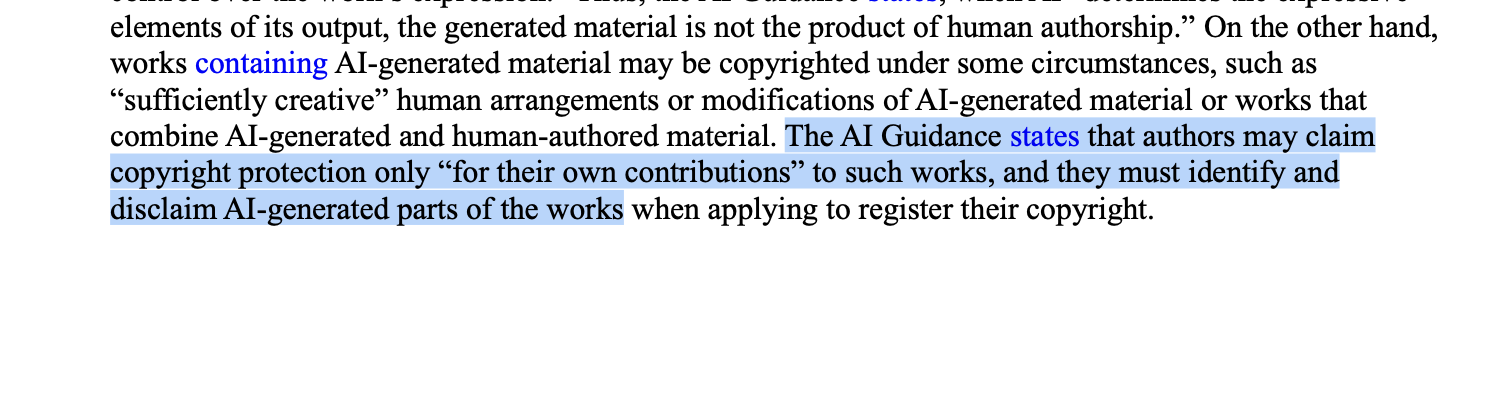
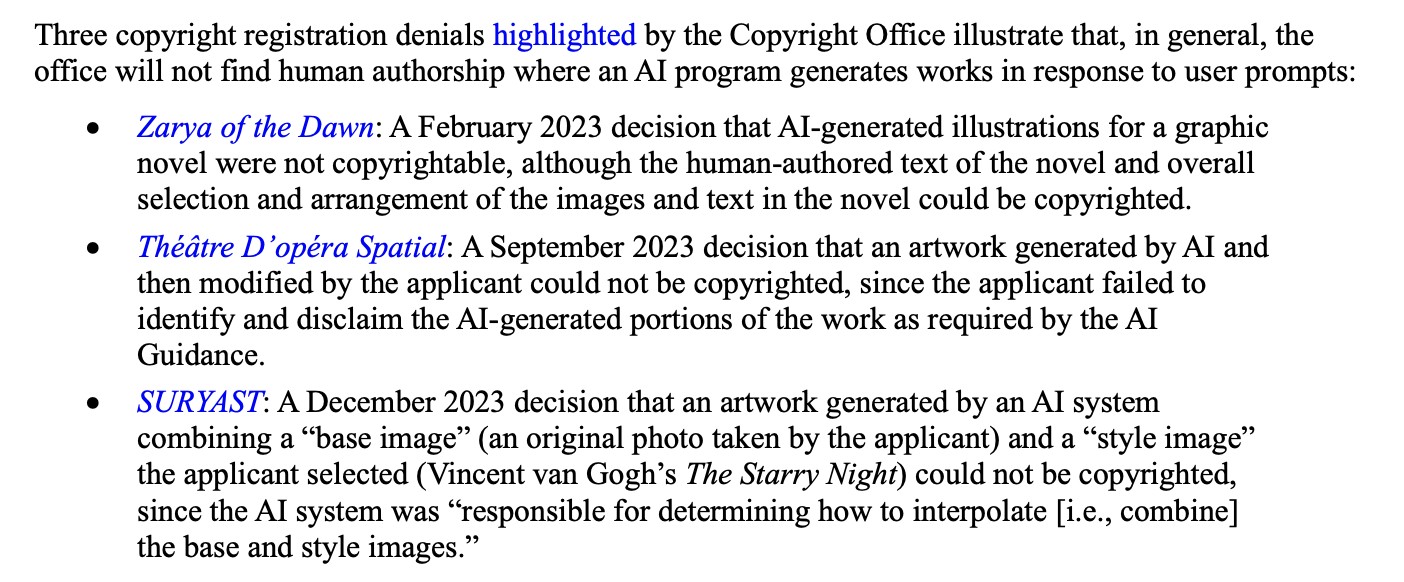
If you use AI-generated code, you currently cannot claim copyright on it in the US. If you fail to disclose/disclaim exactly which parts were not written by a human, you forfeit your copyright claim on *the entire codebase*.
This means copyright notices and even licenses folks are putting on their vibe-coded GitHub repos are unenforceable. The AI-generated code, and possibly the whole project, becomes public domain.
Source: https://www.congress.gov/crs_external_products/LSB/PDF/LSB10922/LSB10922.8.pdf
@jamie that's interesting. So I guess #Windows11 will be public domain soon.
-
@jamie where does it say "the entire codebase"?
I reas it exactly opposite.Copyright on own contributions
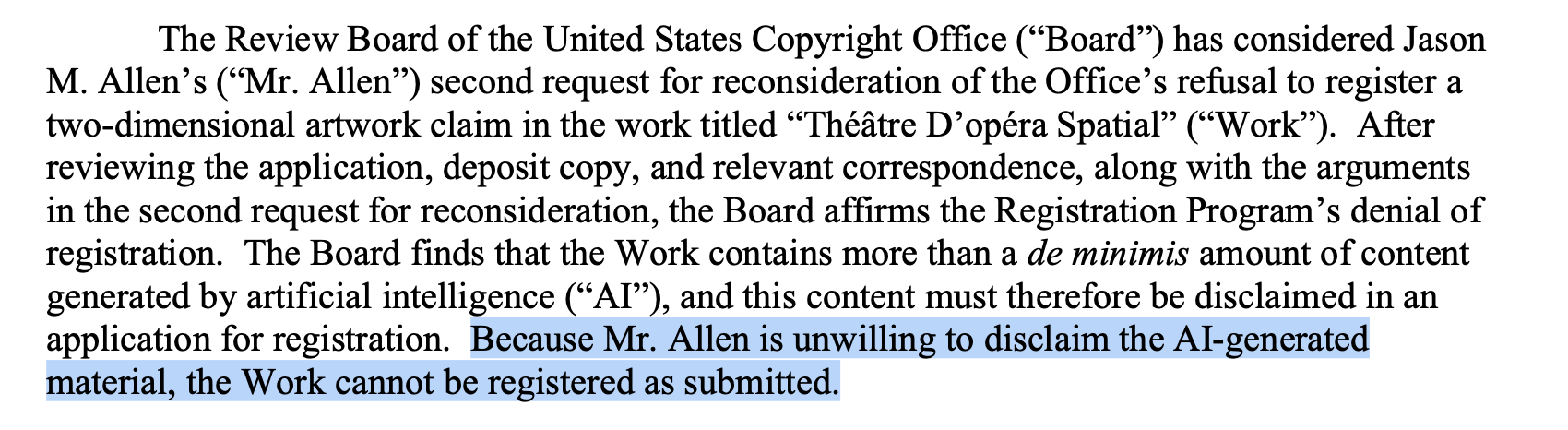
@saxnot In the second screenshot, second bullet point. AFAICT, if you don't disclaim the parts of the work generated by AI, copyright cannot be assigned for the entire work.
The link in that bullet point goes here: https://www.copyright.gov/rulings-filings/review-board/docs/Theatre-Dopera-Spatial.pdf
-
@tuban_muzuru i hope you write a program some day
@atax1a This is the most incredible clapback I've seen all day. Flawless. No notes.

-
@c0dec0dec0de I'm honestly surprised that startups take on this risk.
@jamie wait, the dates on these are 2023. I feel like I should forward to our legal department.
-
@jamie I *am* an IP lawyer and I (along with many others) have been saying it for a while, that if the position the “AI” co’s are taking with respect to the legality of scraping “publicly available” materials were true (that all “publicly available” materials are “public domain” free to be used as raw materials without consent required), then copyright ceases to exist and all their own materials will be free for everyone else to use the very first time they’re leaked. That’ll be fun for the co.
@fsinn This is amazing
-
If you use AI-generated code, you currently cannot claim copyright on it in the US. If you fail to disclose/disclaim exactly which parts were not written by a human, you forfeit your copyright claim on *the entire codebase*.
This means copyright notices and even licenses folks are putting on their vibe-coded GitHub repos are unenforceable. The AI-generated code, and possibly the whole project, becomes public domain.
Source: https://www.congress.gov/crs_external_products/LSB/PDF/LSB10922/LSB10922.8.pdf
@jamie wouldn’t that apply to all of AI companies now?
-
@jamie wouldn’t that apply to all of AI companies now?
@JoBlakely Very possible
-
If you use AI-generated code, you currently cannot claim copyright on it in the US. If you fail to disclose/disclaim exactly which parts were not written by a human, you forfeit your copyright claim on *the entire codebase*.
This means copyright notices and even licenses folks are putting on their vibe-coded GitHub repos are unenforceable. The AI-generated code, and possibly the whole project, becomes public domain.
Source: https://www.congress.gov/crs_external_products/LSB/PDF/LSB10922/LSB10922.8.pdf
@jamie this just exhibit number 9285028204 on how law is entirely vibes based
-
If you use AI-generated code, you currently cannot claim copyright on it in the US. If you fail to disclose/disclaim exactly which parts were not written by a human, you forfeit your copyright claim on *the entire codebase*.
This means copyright notices and even licenses folks are putting on their vibe-coded GitHub repos are unenforceable. The AI-generated code, and possibly the whole project, becomes public domain.
Source: https://www.congress.gov/crs_external_products/LSB/PDF/LSB10922/LSB10922.8.pdf
@jamie Oh, nice. Microsoft... lol
-
If you use AI-generated code, you currently cannot claim copyright on it in the US. If you fail to disclose/disclaim exactly which parts were not written by a human, you forfeit your copyright claim on *the entire codebase*.
This means copyright notices and even licenses folks are putting on their vibe-coded GitHub repos are unenforceable. The AI-generated code, and possibly the whole project, becomes public domain.
Source: https://www.congress.gov/crs_external_products/LSB/PDF/LSB10922/LSB10922.8.pdf
@jamie gad that guy's chicken little comments really annoyed me (easily annoyed)
I'm thinking that it's more a "which side are you on". Chicken Little said Oh Noes! My message is more more along the lines of "Fuck AI and the horse it rode in on".
(Also an engineer but not LLM user)
-
Shrug. Here's a tip - when you put up a para like this one: "It'll be interesting to see what happens when a company pisses off an employee to the point where that person creates a public repo containing all the company's AI-generated code. I guarantee what's AI-generated and what's human-written isn't called out anywhere in the code, meaning the entire codebase becomes public domain."
- I can make the observation you're being a Chicken Little. You guaranteed it.
Hi @tuban_muzuru , totally with you that this is a deeply wrong, misguided "sky is falling" take; purely speculative, since there are no court rulings related to *code* anywhere in the vicinity of:
"used AI, therefore, *poof* it's legal to open source it!"
edit: at the same time, absolutely, LLMs were not ethically trained. But ethics != judicial systems.
But hey, @jamie , enjoy your popcorn regardless
-
If you use AI-generated code, you currently cannot claim copyright on it in the US. If you fail to disclose/disclaim exactly which parts were not written by a human, you forfeit your copyright claim on *the entire codebase*.
This means copyright notices and even licenses folks are putting on their vibe-coded GitHub repos are unenforceable. The AI-generated code, and possibly the whole project, becomes public domain.
Source: https://www.congress.gov/crs_external_products/LSB/PDF/LSB10922/LSB10922.8.pdf
@jamie this is good news! Open source all over the place and justice for all !
-
Stop whining. You and about seventy zillion terrified sheep running around here bleating about the Terrible AI monster under the bed.
-
It'll be interesting to see what happens when a company pisses off an employee to the point where that person creates a public repo containing all the company's AI-generated code. I guarantee what's AI-generated and what's human-written isn't called out anywhere in the code, meaning the entire codebase becomes public domain.
While the company may have recourse based on the employment agreement (which varies in enforceability by state), I doubt there'd be any on the basis of copyright.
@jamie not sure this is right based on my understanding. The things you quoted are about copyright registration, not copyright ownership. If I write a book, I own the copyright to that even if I never register it. If it was subsequently published with an ai generated appendix, I can’t see it invalidating the copyright on the non ai work. I’m not a lawyer either so I could be wrong.
-
@jamie I *am* an IP lawyer and I (along with many others) have been saying it for a while, that if the position the “AI” co’s are taking with respect to the legality of scraping “publicly available” materials were true (that all “publicly available” materials are “public domain” free to be used as raw materials without consent required), then copyright ceases to exist and all their own materials will be free for everyone else to use the very first time they’re leaked. That’ll be fun for the co.
-
If you use AI-generated code, you currently cannot claim copyright on it in the US. If you fail to disclose/disclaim exactly which parts were not written by a human, you forfeit your copyright claim on *the entire codebase*.
This means copyright notices and even licenses folks are putting on their vibe-coded GitHub repos are unenforceable. The AI-generated code, and possibly the whole project, becomes public domain.
Source: https://www.congress.gov/crs_external_products/LSB/PDF/LSB10922/LSB10922.8.pdf
@jamie@zomglol.wtf I hope this doesn't change. I hope that AI-generated works are never eligible for copyright protection.
-
If you use AI-generated code, you currently cannot claim copyright on it in the US. If you fail to disclose/disclaim exactly which parts were not written by a human, you forfeit your copyright claim on *the entire codebase*.
This means copyright notices and even licenses folks are putting on their vibe-coded GitHub repos are unenforceable. The AI-generated code, and possibly the whole project, becomes public domain.
Source: https://www.congress.gov/crs_external_products/LSB/PDF/LSB10922/LSB10922.8.pdf
@jamie@zomglol.wtf Microsoft admitted at least 30% of Windows 11 is coded by Copilot. Curious if they are eligible to be open source now, b/c that would be hilarious.
-
If you use AI-generated code, you currently cannot claim copyright on it in the US. If you fail to disclose/disclaim exactly which parts were not written by a human, you forfeit your copyright claim on *the entire codebase*.
This means copyright notices and even licenses folks are putting on their vibe-coded GitHub repos are unenforceable. The AI-generated code, and possibly the whole project, becomes public domain.
Source: https://www.congress.gov/crs_external_products/LSB/PDF/LSB10922/LSB10922.8.pdf