I first saw the word “aphantasia” about a decade ago, and it was clear to me that it’s one of my mental traits, though I did still have questions about some things I can do.
-
@gannet I don't see what's happening when I read a book.

So now I'm trying to learn what people mean when they "visualize". Like, they actually _see_ something? When I "picture" a horse, for instance, I see nothing... I have something that's like a mathematical "concept" of what a horse is. I can imagine it galloping, I can imagine it being a color if I think about it, but I don't _see_ anything. It's like a ghostly presence I sense.
I’m told there’s actual pictures that they see. I don’t know either!
-
I’m told there’s actual pictures that they see. I don’t know either!
@gannet That's just so weird. My visualization is ... strange. It's like an extra sense. Like, the thing I'm "visualizing" is behind a curtain, and I can tell you all about it, but I don't actually _see_ anything. Not even a hint or a ghost of a thing. But I can "hold up" gears and mesh them together, revolve mechanical objects in my mind.
-
@gannet That's just so weird. My visualization is ... strange. It's like an extra sense. Like, the thing I'm "visualizing" is behind a curtain, and I can tell you all about it, but I don't actually _see_ anything. Not even a hint or a ghost of a thing. But I can "hold up" gears and mesh them together, revolve mechanical objects in my mind.
@gannet I found a site that has a picture of a horse and a bunch of sliders and instruction to "adjust the sliders until the image matches what you see in your mind." And really? I see absolutely nothing. Not blurry, not faded, not black and white. Just a _sense_ of that thing that isn't visual. And my reaction is... people see something like these sample images?
I didn't realize I had aphantasia.
-
I think aphantasia has an effect on how I read books. I have real difficulty understanding what’s happening in fight scenes, for instance, and I automatically skim them until I get to something I comprehend.
Edit: there’s a reply from someone who definitely doesn’t have aphantasia but also has trouble visualizing fight scenes from books. So much for that guess on my part!
Sorry, authors, I know you worked hard on those descriptions, but they mean nothing to me. I do read visual descriptions of things I know more about, though even then I don’t really know what they look like unless I try drawing them.
3/4 (I know I said 2 earlier, but)
@gannet you and I seem to be very similar in this regard!
-
@gannet I found a site that has a picture of a horse and a bunch of sliders and instruction to "adjust the sliders until the image matches what you see in your mind." And really? I see absolutely nothing. Not blurry, not faded, not black and white. Just a _sense_ of that thing that isn't visual. And my reaction is... people see something like these sample images?
I didn't realize I had aphantasia.
I think it’s pretty common for aphantasic people to think that other people talking about imagining a picture are speaking metaphorically.
I sometimes vague colorless outlines, but yeah, it’s mostly a sense of things for me, more kinesthetic than visual.
-
I think aphantasia has an effect on how I read books. I have real difficulty understanding what’s happening in fight scenes, for instance, and I automatically skim them until I get to something I comprehend.
Edit: there’s a reply from someone who definitely doesn’t have aphantasia but also has trouble visualizing fight scenes from books. So much for that guess on my part!
Sorry, authors, I know you worked hard on those descriptions, but they mean nothing to me. I do read visual descriptions of things I know more about, though even then I don’t really know what they look like unless I try drawing them.
3/4 (I know I said 2 earlier, but)
Also, reading the article above helped me make a connection about how I prefer to get news about unpleasant subjects. I don’t know how specific this is to people with aphantasia, but when there’s something violent in the news, I am extremely horrified by video, very horrified by audio, and horrified by text descriptions.
This is the bit from the article that made me wonder if that has any connection to my aphantasia (though I wouldn’t be surprised if everyone had some difference of intensity):
> A person’s emotional reaction to scary stories, measured by how much they sweat, can be a good proxy for how vividly they imagine what’s happening in the story.
4/4
-
I think it’s pretty common for aphantasic people to think that other people talking about imagining a picture are speaking metaphorically.
I sometimes vague colorless outlines, but yeah, it’s mostly a sense of things for me, more kinesthetic than visual.
@gannet So doing more research, it seems I'm not aphantasic, but am on the "spatial imagery" side. I don't _see_ things, but I _sense_ them in great detail. I don't sense color or lighting unless I specifically think about it. And this kind of "mind's eye" is more common in technical people.
It's like the thing I'm "visualizing" is a ghost I'm sensing in detail with a sixth-sense.
-
I think it’s pretty common for aphantasic people to think that other people talking about imagining a picture are speaking metaphorically.
I sometimes vague colorless outlines, but yeah, it’s mostly a sense of things for me, more kinesthetic than visual.
@gannet Kinesthetic is a good description... It's not that I _feel_ where my limbs are so much as I just _know_ where they are. And my visualizations are like that... I just _know_ what the thing I'm thinking about looks like beyond just a list of attributes.
-
I think aphantasia has an effect on how I read books. I have real difficulty understanding what’s happening in fight scenes, for instance, and I automatically skim them until I get to something I comprehend.
Edit: there’s a reply from someone who definitely doesn’t have aphantasia but also has trouble visualizing fight scenes from books. So much for that guess on my part!
Sorry, authors, I know you worked hard on those descriptions, but they mean nothing to me. I do read visual descriptions of things I know more about, though even then I don’t really know what they look like unless I try drawing them.
3/4 (I know I said 2 earlier, but)
@gannet OMG THIS!
I regularly skip descriptions because I cannot translate that into an image in my mind. So writers like Tolkien bore the snot out of me. I often go from one bit of dialog to the next because the stuff in between--I really don't care that she has a freckle on her nose--is just a string of words.
As a writer, I have to force myself to describe things. I often do this in a specific draft, where I -try- to check each scene for the appropriate description. (It bores me.)
-
I think aphantasia has an effect on how I read books. I have real difficulty understanding what’s happening in fight scenes, for instance, and I automatically skim them until I get to something I comprehend.
Edit: there’s a reply from someone who definitely doesn’t have aphantasia but also has trouble visualizing fight scenes from books. So much for that guess on my part!
Sorry, authors, I know you worked hard on those descriptions, but they mean nothing to me. I do read visual descriptions of things I know more about, though even then I don’t really know what they look like unless I try drawing them.
3/4 (I know I said 2 earlier, but)
@gannet I struggle to parse fight scenes too, and I have the most vivid and detailed mind's eye of anyone I know
Trying to come up with some generalization about writing fight scenes, but I think I need breakfast first
-
@gannet I struggle to parse fight scenes too, and I have the most vivid and detailed mind's eye of anyone I know
Trying to come up with some generalization about writing fight scenes, but I think I need breakfast first
huh, interesting! So much for that correlation
-
I think aphantasia has an effect on how I read books. I have real difficulty understanding what’s happening in fight scenes, for instance, and I automatically skim them until I get to something I comprehend.
Edit: there’s a reply from someone who definitely doesn’t have aphantasia but also has trouble visualizing fight scenes from books. So much for that guess on my part!
Sorry, authors, I know you worked hard on those descriptions, but they mean nothing to me. I do read visual descriptions of things I know more about, though even then I don’t really know what they look like unless I try drawing them.
3/4 (I know I said 2 earlier, but)
@gannet This is interesting -- because B also has aphantasia, but he seems to really get into fight scenes. Then again, maybe that's because his fight scenes tend to be more about D&D-like scoring systems and less about physical action/location.
-
huh, interesting! So much for that correlation
@gannet I mean, it's a sample size of two, but yeah
I just don't think prose is a good medium for combat
-
@gannet This is interesting -- because B also has aphantasia, but he seems to really get into fight scenes. Then again, maybe that's because his fight scenes tend to be more about D&D-like scoring systems and less about physical action/location.
@woozle I have someone else replying that they have good mental imagery but still has trouble with visualizing fight scenes, so it seems to be unrelated.
-
I first saw the word “aphantasia” about a decade ago, and it was clear to me that it’s one of my mental traits, though I did still have questions about some things I can do. This new article sums up the current research and has more specifics about the variations.
1/2
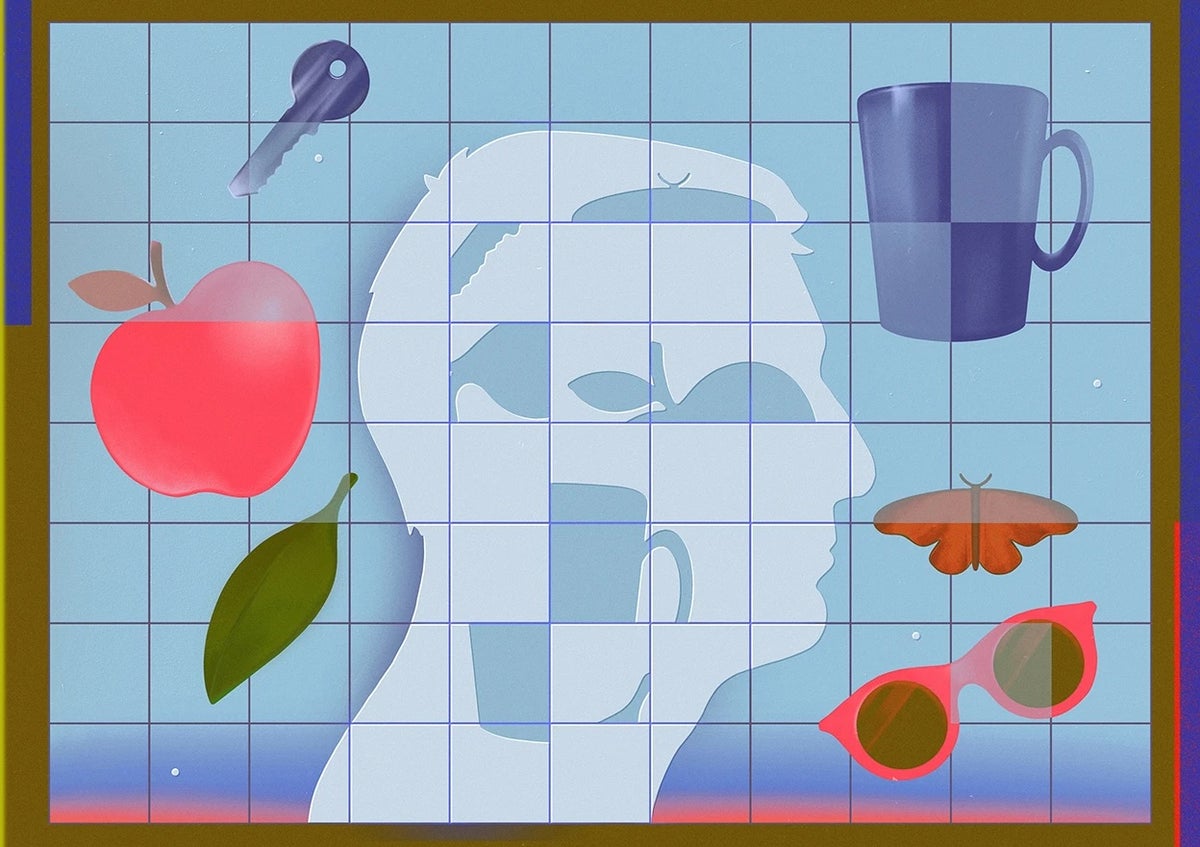
Many people don’t see mental images. The reason offers clues to consciousness
People with aphantasia have no mental imagery—and they’re offering brain scientists a window into consciousness
Scientific American (www.scientificamerican.com)
@gannet Thanks for a great thread. I admit to irritation, at times, at the assumption that visual imagery is the sum total of imagination that seems to underlie some discussions I've been part of. My mental world is incredibly rich in sensory and spatial terms. To suggest, even by inference, that I lack imagination because I simply don't visualize is... pretty ignorant.
As for reading: I notice that some writers over-rely on visual description. It flattens the reading experience for me.
-
For me, it’s not that I have no mental imagery, but that it’s extremely vague when it exists. It is clear that images are stored somewhere in my brain, since I do recognize things and people on sight.
I am baffled that I dream in pictures at least some of the time. Maybe because my brain isn’t processing actual visual input?
I do have a strong “mind’s ear”, to the point where, if I’ve heard an author’s voice, I might hear them narrating the words when I read one of their books.
Anyway, it pleases me to learn that having a “mind’s ear” and visual dreams are things shared by some other aphantasics.
Also:
> A decade of work has left researchers convinced that aphantasia is a real phenomenon, but many are puzzled by how little it seems to affect behaviour. Behavioural tasks that are thought to depend on mental imagery don’t seem to be a problem for people with aphantasia. They perform relatively well on standard memory assessments and they seem to be able to rotate objects in their mind, to determine whether an object in one picture matches another presented from a different angle.
Yep! My feeling is that my brain knows what things look like; it’s just not projecting it in that mysterious location where other people see mental imagery. I mean, what the heck, how can some people both read a book and “see” what’s happening. Where does the imagery appear?
2/2
@gannet My mental imagery is kind of similar. I can picture things in my head if I try, but as soon as I try to change them, examine a specific part or turn them over it's like the image is made of smoke and it vanishes.
-
Also, reading the article above helped me make a connection about how I prefer to get news about unpleasant subjects. I don’t know how specific this is to people with aphantasia, but when there’s something violent in the news, I am extremely horrified by video, very horrified by audio, and horrified by text descriptions.
This is the bit from the article that made me wonder if that has any connection to my aphantasia (though I wouldn’t be surprised if everyone had some difference of intensity):
> A person’s emotional reaction to scary stories, measured by how much they sweat, can be a good proxy for how vividly they imagine what’s happening in the story.
4/4
Oh and I’ve always hated the kind of guided meditation that’s all about visualizing soothing imagery. I can remember sitting cross-legged in Girl Scouts with my eyes closed and being told to imagine flying over a green forest under a blue sky. I’m still irritated when I think of that!

-
Also, reading the article above helped me make a connection about how I prefer to get news about unpleasant subjects. I don’t know how specific this is to people with aphantasia, but when there’s something violent in the news, I am extremely horrified by video, very horrified by audio, and horrified by text descriptions.
This is the bit from the article that made me wonder if that has any connection to my aphantasia (though I wouldn’t be surprised if everyone had some difference of intensity):
> A person’s emotional reaction to scary stories, measured by how much they sweat, can be a good proxy for how vividly they imagine what’s happening in the story.
4/4
@gannet I'm on the other end of whatever spectrum aphantasia is one end of, extremely vivid imagination, and I can't with most books. I am extremely grateful for the Celia Lake recommendation from you about four or five years ago, they rarely make me tense up. I'm also quick thinking and can imagine all the ways something can go wrong, so for instance breaking in to the villain's house/room always terrifies me. Don't doooo iiiiiit
-
Oh and I’ve always hated the kind of guided meditation that’s all about visualizing soothing imagery. I can remember sitting cross-legged in Girl Scouts with my eyes closed and being told to imagine flying over a green forest under a blue sky. I’m still irritated when I think of that!
Ditto! I always thought that was just a bunch of hooey... I didn't know that people could actually do that.
-
I think aphantasia has an effect on how I read books. I have real difficulty understanding what’s happening in fight scenes, for instance, and I automatically skim them until I get to something I comprehend.
Edit: there’s a reply from someone who definitely doesn’t have aphantasia but also has trouble visualizing fight scenes from books. So much for that guess on my part!
Sorry, authors, I know you worked hard on those descriptions, but they mean nothing to me. I do read visual descriptions of things I know more about, though even then I don’t really know what they look like unless I try drawing them.
3/4 (I know I said 2 earlier, but)
@gannet I also skip fight scenes in books cuz I can't really follow what is happening. Don't think I have aphantasia