Some people claim thar the 6502 is a RISC processor.
-
The DG Nova was the first RISC, and anybody who wants to argue otherwise must bring an architecture with less than 18 instructions to the debate.
-
@brouhaha @phloggen I read somewhere that when designing the ARM, one of the things that had impressed Acorn about the 6502 was the low interrupt latency, which had given the BBC micro features like background print buffering. They gave the ARM the FIQ mode with 7 private registers, although AFAICT this seems to rarely get used on modern devices.
@simonzerafa@kbm0 @brouhaha @phloggen @simonzerafa FIQ type functionality was not new by then. 6809 has it for example. A lot of ARM is borrowed. Its how they mixed the ingredients.
-
@kbm0 @brouhaha @phloggen @simonzerafa FIQ type functionality was not new by then. 6809 has it for example. A lot of ARM is borrowed. Its how they mixed the ingredients.
@etchedpixels @kbm0 @brouhaha @phloggen
The 6809 is somewhat a better CPU than the 6502 in many ways and yet it's still impressive what the less capable 6502 can do.
-
@etchedpixels @kbm0 @brouhaha @phloggen
The 6809 is somewhat a better CPU than the 6502 in many ways and yet it's still impressive what the less capable 6502 can do.
@simonzerafa @etchedpixels @kbm0 @brouhaha @phloggen I learned Z80 first but prefer 6502. On one occasion I had to code the same thing for both, which was, interesting.
-
@simonzerafa @etchedpixels @kbm0 @brouhaha @phloggen I learned Z80 first but prefer 6502. On one occasion I had to code the same thing for both, which was, interesting.
@revk @etchedpixels @kbm0 @brouhaha @phloggen
I've since learned that the Z80 was a very capable CPU but somewhat hamstring by the platforms that used it

No such issues with 6502 based CPU platforms

-
@revk @etchedpixels @kbm0 @brouhaha @phloggen
I've since learned that the Z80 was a very capable CPU but somewhat hamstring by the platforms that used it
No such issues with 6502 based CPU platforms
@revk @etchedpixels @kbm0 @brouhaha @phloggen
It's been possible through, dark arts and necromancy, to add a protected mode to the Z80, which would have been very cool in 1989

GitHub - Andy18650/HEC-Model-Z1: A Z80 computer with protected mode support
A Z80 computer with protected mode support. Contribute to Andy18650/HEC-Model-Z1 development by creating an account on GitHub.

GitHub (github.com)
-
@revk @etchedpixels @kbm0 @brouhaha @phloggen
It's been possible through, dark arts and necromancy, to add a protected mode to the Z80, which would have been very cool in 1989
GitHub - Andy18650/HEC-Model-Z1: A Z80 computer with protected mode support
A Z80 computer with protected mode support. Contribute to Andy18650/HEC-Model-Z1 development by creating an account on GitHub.
GitHub (github.com)
@simonzerafa @revk @kbm0 @brouhaha @phloggen it was done in the 1980s by Morrow
-
@revk @etchedpixels @kbm0 @brouhaha @phloggen
I've since learned that the Z80 was a very capable CPU but somewhat hamstring by the platforms that used it
No such issues with 6502 based CPU platforms
@simonzerafa @etchedpixels @kbm0 @brouhaha @phloggen 6502 BRK was uses creatively by BBC Micro as I recall.
-
@simonzerafa @etchedpixels @kbm0 @brouhaha @phloggen 6502 BRK was uses creatively by BBC Micro as I recall.
@revk @simonzerafa @kbm0 @brouhaha @phloggen BBC uses JSR vectors in top of memory BRK on classic 6502 is buggy and cannot be combined reliably with interrupts so it's not really used for anything serious
-
@revk @simonzerafa @kbm0 @brouhaha @phloggen BBC uses JSR vectors in top of memory BRK on classic 6502 is buggy and cannot be combined reliably with interrupts so it's not really used for anything serious
@etchedpixels @simonzerafa @kbm0 @brouhaha @phloggen Yeh I may be misremembering, to be honest, long time ago.
-
R relay@relay.infosec.exchange shared this topic
-
@etchedpixels @simonzerafa @kbm0 @brouhaha @phloggen Yeh I may be misremembering, to be honest, long time ago.
@revk @simonzerafa @kbm0 @brouhaha @phloggen some 680x machines use SWI this way (equivalent of BRK) but BRK is really limited to dropping into the debugger until 65C02 annoyingly as I did want to use BRK for Fuzix syscalls on 6502
-
@simonzerafa @etchedpixels @kbm0 @brouhaha @phloggen I learned Z80 first but prefer 6502. On one occasion I had to code the same thing for both, which was, interesting.
@revk @simonzerafa @kbm0 @brouhaha @phloggen carry flag always gets me on 6502 when switching the CPU I am working with 6800 series, 8080 series and most others it's the other way around on subtract
-
@etchedpixels @simonzerafa @kbm0 @brouhaha @phloggen Yeh I may be misremembering, to be honest, long time ago.
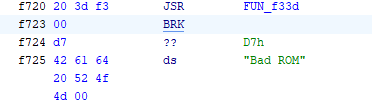
@revk @etchedpixels @simonzerafa @kbm0 @brouhaha @phloggen By default on the Acorn 8-bit OS, the IRQ/BRK vector (0xfffe) redirects into ROM, which then splits it depending on the I flag.
If it is a BRK, then it will pull the calling address from stack and store the following address in 0x00ED and 0x00FE and then jump to the code pointed to by 0x0202. By default this will print the null terminated ASCII message after the BRK.
For example:
-
@revk @etchedpixels @simonzerafa @kbm0 @brouhaha @phloggen By default on the Acorn 8-bit OS, the IRQ/BRK vector (0xfffe) redirects into ROM, which then splits it depending on the I flag.
If it is a BRK, then it will pull the calling address from stack and store the following address in 0x00ED and 0x00FE and then jump to the code pointed to by 0x0202. By default this will print the null terminated ASCII message after the BRK.
For example:
@revk @etchedpixels @simonzerafa @kbm0 @brouhaha @phloggen
There is a warning in the Advanced User guide about using this for anything complex:
"Note that although a fully prepared exit from a BRK instruction
is possible, neither the operating system or BASIC expect a
return from this vector. Possibly fatal results may occur if such
a return is made as paged ROM software typically stores the
BRK, error number and message in page one below the stack,
returning there is very hazardous. The exception to this is when
using the BRK instruction as a breakpoint in user supplied
machine code, and is not used as a standard error generating
mechanism." -
@revk @etchedpixels @simonzerafa @kbm0 @brouhaha @phloggen By default on the Acorn 8-bit OS, the IRQ/BRK vector (0xfffe) redirects into ROM, which then splits it depending on the I flag.
If it is a BRK, then it will pull the calling address from stack and store the following address in 0x00ED and 0x00FE and then jump to the code pointed to by 0x0202. By default this will print the null terminated ASCII message after the BRK.
For example:
@tautology @revk @etchedpixels @simonzerafa @brouhaha @phloggen What causes a "Bad ROM"? Is that what you get if you pull the BASIC ROM out?
-
The DG Nova was the first RISC, and anybody who wants to argue otherwise must bring an architecture with less than 18 instructions to the debate.
@phloggen @brouhaha Hmm less than 18; Manchester Baby 1948 - 7 instructions; https://en.wikipedia.org/wiki/Manchester_Baby#Programming
-
@revk @etchedpixels @simonzerafa @kbm0 @brouhaha @phloggen
There is a warning in the Advanced User guide about using this for anything complex:
"Note that although a fully prepared exit from a BRK instruction
is possible, neither the operating system or BASIC expect a
return from this vector. Possibly fatal results may occur if such
a return is made as paged ROM software typically stores the
BRK, error number and message in page one below the stack,
returning there is very hazardous. The exception to this is when
using the BRK instruction as a breakpoint in user supplied
machine code, and is not used as a standard error generating
mechanism."@tautology @etchedpixels @simonzerafa @kbm0 @brouhaha @phloggen The paged ROMs were fun. I have one application that actually took up two slots with calls between them - all good fun.
-
@tautology @etchedpixels @simonzerafa @kbm0 @brouhaha @phloggen The paged ROMs were fun. I have one application that actually took up two slots with calls between them - all good fun.
@revk @tautology @etchedpixels @simonzerafa @brouhaha @phloggen You could make a cheap "sideways RAM" board with static RAM mapped into the ROM slots.
-
@revk @tautology @etchedpixels @simonzerafa @brouhaha @phloggen You could make a cheap "sideways RAM" board with static RAM mapped into the ROM slots.
@revk @tautology @etchedpixels @simonzerafa @brouhaha @phloggen I seem to remember there was a romsel header on the BBC B that could address up to 16 ROMs. You had to steal the R/W line from somewhere else on the board.
-
The DG Nova was the first RISC, and anybody who wants to argue otherwise must bring an architecture with less than 18 instructions to the debate.