Well-documented list of free software projects and their use of genAI:https://codeberg.org/small-hack/open-slopware
-
Well-documented list of free software projects and their use of genAI:
https://codeberg.org/small-hack/open-slopwareIt’s already a long list that shows what looks like uncritical adoption, both by high-profile projects (systemd, VLC, etc.) and by niche projects (GNU Mach is a prime example).
-
Well-documented list of free software projects and their use of genAI:
https://codeberg.org/small-hack/open-slopwareIt’s already a long list that shows what looks like uncritical adoption, both by high-profile projects (systemd, VLC, etc.) and by niche projects (GNU Mach is a prime example).
@civodul Hugo is in the list? Fuuuuuck...

-
Well-documented list of free software projects and their use of genAI:
https://codeberg.org/small-hack/open-slopwareIt’s already a long list that shows what looks like uncritical adoption, both by high-profile projects (systemd, VLC, etc.) and by niche projects (GNU Mach is a prime example).
@civodul vlc and mach are not correct. mach has not accepted generated source code, vlc appears to have nothing at all but the absent "creator" who doesn't contribute talking on a podcast. "use of genAI" is defined extremely broadly here in a way i find intended to harm
-
@civodul vlc and mach are not correct. mach has not accepted generated source code, vlc appears to have nothing at all but the absent "creator" who doesn't contribute talking on a podcast. "use of genAI" is defined extremely broadly here in a way i find intended to harm
@civodul "what looks like uncritical adoption" is kind of irresponsible to say without perusing the very projects you mention by name at least
-
Well-documented list of free software projects and their use of genAI:
https://codeberg.org/small-hack/open-slopwareIt’s already a long list that shows what looks like uncritical adoption, both by high-profile projects (systemd, VLC, etc.) and by niche projects (GNU Mach is a prime example).
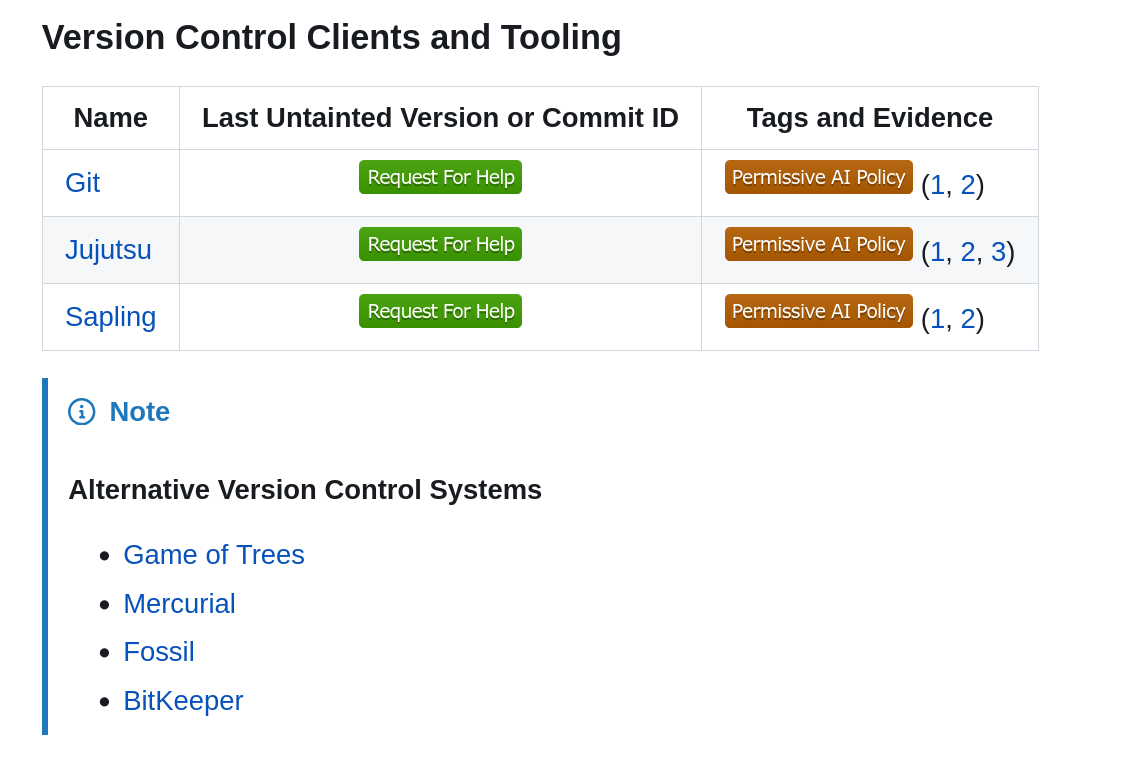
@civodul > A policy that permits the use of AI/LLMs in any capacity or is declared to be vibecoded. Both vibecoding and opening the door for people to vibecode count as a permissive AI policy.
What a big huge dumb pile of bollocks this is
-
@civodul > A policy that permits the use of AI/LLMs in any capacity or is declared to be vibecoded. Both vibecoding and opening the door for people to vibecode count as a permissive AI policy.
What a big huge dumb pile of bollocks this is
@civodul Reminds me of the time everybody had to change their branch from `master` to `main`, otherwise a big crowd of holier-than-thou warriors would descend upon your project to shame it
-
@civodul Reminds me of the time everybody had to change their branch from `master` to `main`, otherwise a big crowd of holier-than-thou warriors would descend upon your project to shame it
@civodul Oh yeah, and marking something as “tainted” is very nice & cool & good & mentally stable behaviour
-
@civodul Oh yeah, and marking something as “tainted” is very nice & cool & good & mentally stable behaviour
@civodul Very funny though
-
Well-documented list of free software projects and their use of genAI:
https://codeberg.org/small-hack/open-slopwareIt’s already a long list that shows what looks like uncritical adoption, both by high-profile projects (systemd, VLC, etc.) and by niche projects (GNU Mach is a prime example).
The most surprising for me is Anubis.
-
Well-documented list of free software projects and their use of genAI:
https://codeberg.org/small-hack/open-slopwareIt’s already a long list that shows what looks like uncritical adoption, both by high-profile projects (systemd, VLC, etc.) and by niche projects (GNU Mach is a prime example).
@civodul
AFAIK are for Hurd projects like GNU Mach LLMs "only" used to point out possible problems. Code should always be written by humans. -
@civodul "what looks like uncritical adoption" is kind of irresponsible to say without perusing the very projects you mention by name at least
@hipsterelectron I agree that the categorization is a bit too extremist. But the list is a good starting point for doing one's own explorations.
-
The most surprising for me is Anubis.
@khinsen they haven't accepted LLM contributions which is a really significant distinction
-
Well-documented list of free software projects and their use of genAI:
https://codeberg.org/small-hack/open-slopwareIt’s already a long list that shows what looks like uncritical adoption, both by high-profile projects (systemd, VLC, etc.) and by niche projects (GNU Mach is a prime example).
Meanwhile, @civodul@toot.aquilenet.fr, at Oracle:
Contributions in the OpenJDK Community must not include content generated, in part or in full, by large language models, diffusion models, or similar deep-learning systems. Content, in this context, includes but is not limited to source code, text, and images in OpenJDK Git repositories, GitHub pull requests, e-mail messages, wiki pages, and JBS issues.
I want this so bad for Guix <img class="not-responsive emoji" src="https://awkward.place/emoji/stolen/blobsadfrown.png" title=":blobsadfrown:" />
-
@hipsterelectron I agree that the categorization is a bit too extremist. But the list is a good starting point for doing one's own explorations.
@khinsen @civodul i'm glad to see they provide citations now. the first version of this i saw a few weeks ago didn't. i had to delete my initial reply which failed to examine it before responding and it seems like a good change. their labels are not remotely helpful and seem intended to obfuscate. i really do not respect the categorization they employ but do not contest that the projects they include are all worth listing (including the ones @civodul mentioned in OP). i just have a strong aversion to the failure to make distinctions which i feel harms the ability to help the users of this list to extend the analysis beyond LLMs to e.g. surveillance and other harmful influences
-
Meanwhile, @civodul@toot.aquilenet.fr, at Oracle:
Contributions in the OpenJDK Community must not include content generated, in part or in full, by large language models, diffusion models, or similar deep-learning systems. Content, in this context, includes but is not limited to source code, text, and images in OpenJDK Git repositories, GitHub pull requests, e-mail messages, wiki pages, and JBS issues.
I want this so bad for Guix <img class="not-responsive emoji" src="https://awkward.place/emoji/stolen/blobsadfrown.png" title=":blobsadfrown:" />
-
@khinsen @civodul i'm glad to see they provide citations now. the first version of this i saw a few weeks ago didn't. i had to delete my initial reply which failed to examine it before responding and it seems like a good change. their labels are not remotely helpful and seem intended to obfuscate. i really do not respect the categorization they employ but do not contest that the projects they include are all worth listing (including the ones @civodul mentioned in OP). i just have a strong aversion to the failure to make distinctions which i feel harms the ability to help the users of this list to extend the analysis beyond LLMs to e.g. surveillance and other harmful influences
@khinsen @civodul come to think of it, maybe i could be my own change and make such a table for surveillance of different varieties. i'm sorry @civodul for my initial response since i fully believe you to be aware of and thoughtful about this. i was clearly being defensive and that's extremely unhelpful here. i will try very hard to avoid this and i admire your ability to accept hard truths
-
Well-documented list of free software projects and their use of genAI:
https://codeberg.org/small-hack/open-slopwareIt’s already a long list that shows what looks like uncritical adoption, both by high-profile projects (systemd, VLC, etc.) and by niche projects (GNU Mach is a prime example).
@civodul This list is so devastating. KOReader, Hugo, AntennaPod were great projects…
-
Well-documented list of free software projects and their use of genAI:
https://codeberg.org/small-hack/open-slopwareIt’s already a long list that shows what looks like uncritical adoption, both by high-profile projects (systemd, VLC, etc.) and by niche projects (GNU Mach is a prime example).
@civodul This list is poorly curated. FreeBSD was included with a link to a commit I authored (without LLM use) as "evidence", because a report submitted to the security team made use of an LLM. It currently links to https://github.com/freebsd/freebsd-src?tab=contributing-ov-file#quality-expectations as evidence of a permissive AI policy.
-
@civodul This list is poorly curated. FreeBSD was included with a link to a commit I authored (without LLM use) as "evidence", because a report submitted to the security team made use of an LLM. It currently links to https://github.com/freebsd/freebsd-src?tab=contributing-ov-file#quality-expectations as evidence of a permissive AI policy.
@emaste I guess they consider “permissive” anything that doesn’t explicitly forbid genAI-assisted contributions.
I don’t see a commit link for FreeBSD, but maybe that’s because you reported it before?
-
@emaste I guess they consider “permissive” anything that doesn’t explicitly forbid genAI-assisted contributions.
I don’t see a commit link for FreeBSD, but maybe that’s because you reported it before?
@civodul Yeah, I submitted a ticket about misleading information for FreeBSD and they subsequently removed the commit links.