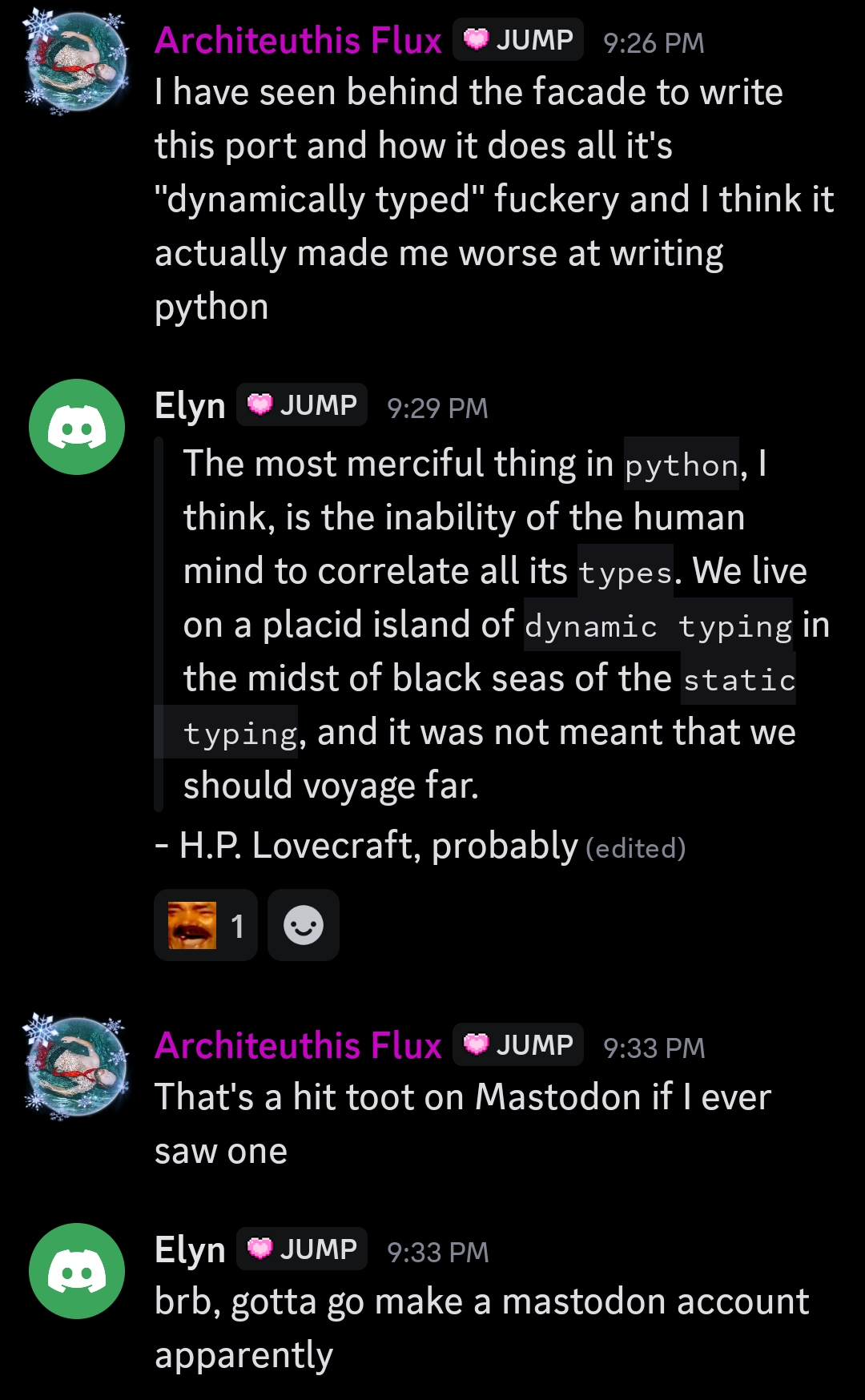
And that's how I ended up on mastodon
-
@elyn @ancoghlan a lot of the python internal type machinery was added before python had spellable types, which now shows up as those strange breaks in the type math.
there's a similar case where `float` actually means `float | int`, so there's now no way of saying just float, no int, even though `isinstance(1, float) == False`.
@konstin @ancoghlan Maybe they should just change it, surely there's no historical precedent indicating that changing foundational design details would ever stifle adoption or fracture a community!
-
@elyn @ancoghlan a lot of the python internal type machinery was added before python had spellable types, which now shows up as those strange breaks in the type math.
there's a similar case where `float` actually means `float | int`, so there's now no way of saying just float, no int, even though `isinstance(1, float) == False`.
@konstin @ancoghlan That's genuinely really cool to know tho, thank u

-
And that's how I ended up on mastodon
@elyn I was about to ask you for a link to the original Mastodon post, to be able to boost that one and to give the author credit. Luckily I read the last post just before posting myself :D.
Edit: And hi and welcome
-
@elyn I was about to ask you for a link to the original Mastodon post, to be able to boost that one and to give the author credit. Luckily I read the last post just before posting myself :D.
Edit: And hi and welcome@T_X thank you!! And hey, if you're looking for anyone else to give some credit to, check out @ArchiteuthisFlux , the post wouldn't exist without him telling me it'd be well received here!
-
And that's how I ended up on mastodon
@elyn Welcome!
-
@elyn @ancoghlan a lot of the python internal type machinery was added before python had spellable types, which now shows up as those strange breaks in the type math.
there's a similar case where `float` actually means `float | int`, so there's now no way of saying just float, no int, even though `isinstance(1, float) == False`.
@konstin @elyn Oof, I had managed to forget how much worse it all was before the classic class emulation bits were dropped, but that observation reminded me. I shudder to think how much harder it would have been to start defining type forms if those were still around (as you say, it's hard enough retrofitting a comprehensive description language to the status quo).
-
@elyn Yeah, I advise folks to steer clear of the core type machinery implementation unless they actually *want* to stretch their brains into weird shapes in order to understand it. Lots of "this isn't quite true yet, but it will be true before it needs to be true, just trust us on that, computer".
I also love the fact that it is all completely *un*necessary knowledge for folks that just want to use Python without worrying about the fiddly details of how it works.
@ancoghlan @elyn I didn't mean to, but I have been in the past couple days, and I am not even working in anything conceptually complex

-
And that's how I ended up on mastodon
@elyn Welcome!
I'd say I hope you'll like it here, but I have a feeling that you will!
-
@elyn Welcome!
I'd say I hope you'll like it here, but I have a feeling that you will!
@stefan and you're so right!
-
@ArchiteuthisFlux @csolisr the alchemical formula for mastodon catnip has thus been revealed
-
And that's how I ended up on mastodon
@elyn I mean, they were right
-
@elyn I mean, they were right
@kinsale42 YEAH
-
@elyn so, how do you like it here?
@EnigmaVoice it's great!
-
And that's how I ended up on mastodon
@elyn The paradox is that Python is good because it sucks. You can't make good stuff in the language so the only possible role of the language is to be thin layers of glue. And that makes it good. Example: a researcher who only knows Python has to use a module implemented by someone else (who knows what they're doing) in an efficient language. It's not even possible implement a crappy algorithm or logic in Python because then the simulation will never finish because of how slow the language is.
-
@elyn The paradox is that Python is good because it sucks. You can't make good stuff in the language so the only possible role of the language is to be thin layers of glue. And that makes it good. Example: a researcher who only knows Python has to use a module implemented by someone else (who knows what they're doing) in an efficient language. It's not even possible implement a crappy algorithm or logic in Python because then the simulation will never finish because of how slow the language is.
@elyn There are of course many exceptions to this shower thought...
-
And that's how I ended up on mastodon
-
@ancoghlan that's insane
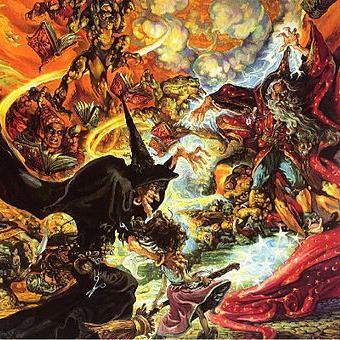
@elyn @ancoghlan well you started with the Lovecraftian scenery. Welcome to cosmic horror of comp...oh god
The̸̖̕ya̸͕͆̈́̈̀͘r̶͎̀̏̾ė̷̥̣͙̰̭͜͝ ̵̙̖̫̦͉̊͒̍͑͗͐ͅc̸͕̮̱̖̒̀ǒ̶̙̬͔̿̉̾m̵̉̓̏̑i̵̟̬͕̥̠̐͋ng̸̽̌͘.̸̧̳̜͇̓̽̇.̵̻̽̌̋̿̄.̶̝̫̮̻͆͌͊̓̔͑͝͠
-
And that's how I ended up on mastodon
@elyn@tech.lgbt XD A hit post indeed! ^^
Welcome to the fediverse! I hope you have a great time here! -
Welcome Elyn
Feel free to ask if you want help using this place, and there's also lots of help for new people on the website at https://fedi.tips
-
And that's how I ended up on mastodon
@elyn @ShaulaEvans welcome