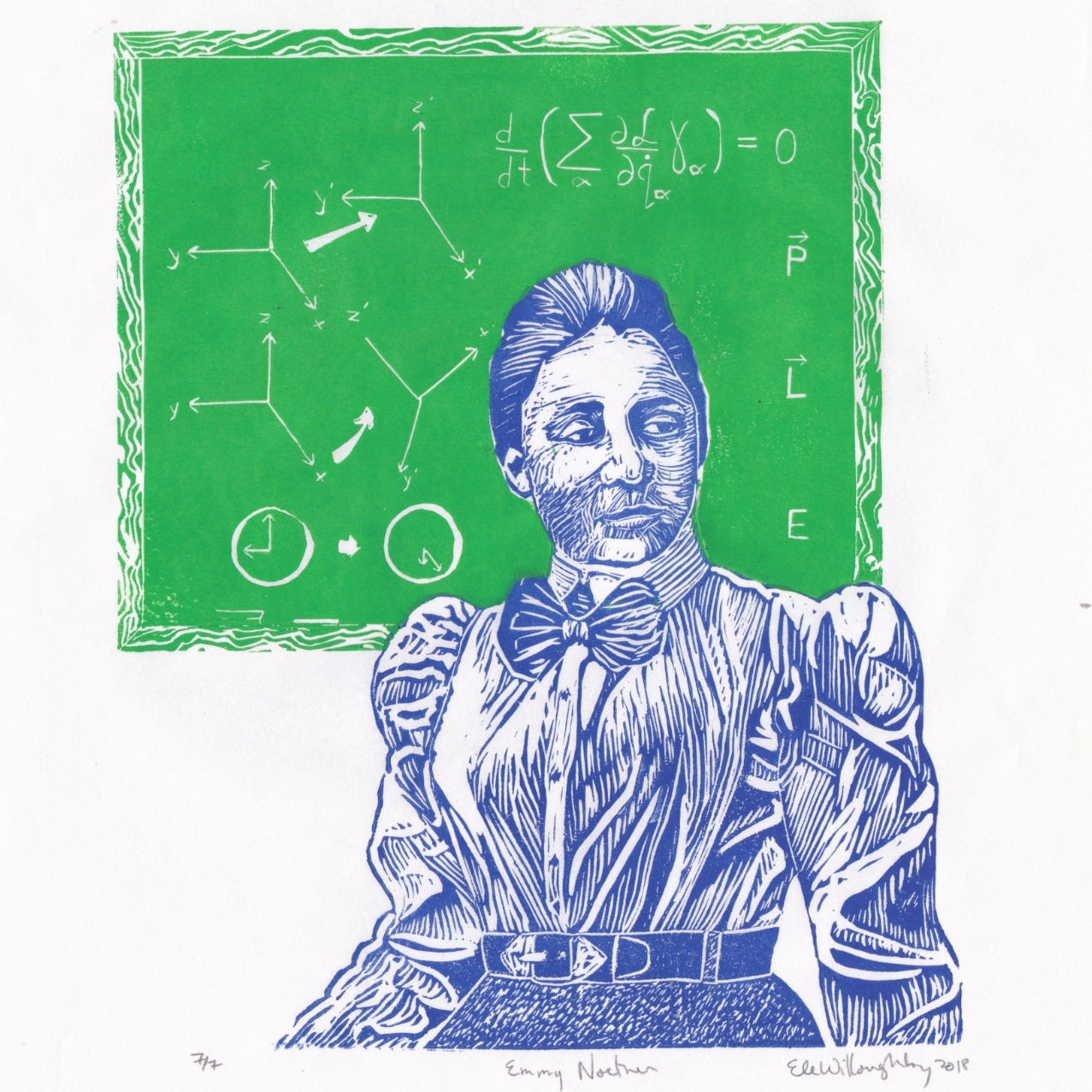
Happy birthday to one of greatest mathematicians of all time Emmy Noether (1882-1935), here with her eponymous theorem, the backbone of modern physics.
-
Happy birthday to one of greatest mathematicians of all time Emmy Noether (1882-1935), here with her eponymous theorem, the backbone of modern physics. Noether’s theorem links any symmetry of a system with a conservation law. In my portrait, I chose to depict a young Emmy in front of a blackboard with a more simple formulation of her theorem and three specific applications of it, shown schematically, using pictures and 🧵
#linocut #printmaking #physics #mathematics #WomenInSTEM #mastoArt
-
Happy birthday to one of greatest mathematicians of all time Emmy Noether (1882-1935), here with her eponymous theorem, the backbone of modern physics. Noether’s theorem links any symmetry of a system with a conservation law. In my portrait, I chose to depict a young Emmy in front of a blackboard with a more simple formulation of her theorem and three specific applications of it, shown schematically, using pictures and 🧵
#linocut #printmaking #physics #mathematics #WomenInSTEM #mastoArt
geometry. Noether’s Theorem shows that if you get the same result in two reference frames which are shifted from one another, your system conserves momentum (p). Similarly, if your system doesn’t care if you rotate it or how it’s oriented in space, the conserved quantity is angular momentum (L). If it’s irrelevant to results whether you do your experiment at 3:00 or 6:25 then your system has a time symmetry and conserves energy (E). 🧵2/
-
geometry. Noether’s Theorem shows that if you get the same result in two reference frames which are shifted from one another, your system conserves momentum (p). Similarly, if your system doesn’t care if you rotate it or how it’s oriented in space, the conserved quantity is angular momentum (L). If it’s irrelevant to results whether you do your experiment at 3:00 or 6:25 then your system has a time symmetry and conserves energy (E). 🧵2/
This method of using observed symmetries of something and then finding things which are invariant allows us to easily solve all sorts of problems in physics. Further, using observed symmetries of the Universe allows us to know which things are invariant, know more about the nature of reality and assess any new theories by checking whether they also produce the same conserved quantities.
While her incredible contribution to physics had already occurred in 1918, mathematicians remember her for 🧵3
-
This method of using observed symmetries of something and then finding things which are invariant allows us to easily solve all sorts of problems in physics. Further, using observed symmetries of the Universe allows us to know which things are invariant, know more about the nature of reality and assess any new theories by checking whether they also produce the same conserved quantities.
While her incredible contribution to physics had already occurred in 1918, mathematicians remember her for 🧵3
her central role in the 20th century revolution in mathematics, the development of abstract algebra, and her prolific work including Ring Theory from 1920 to 1926, as well as Noetherian rings, Noether groups, Noether equations, Noether modules and more. Her revolutionary 1921 paper Theory of Ideals in Ring Domains is considered a classic and objects which satisfy the ascending chain condition are named Noetherian, in her honour. 🧵4/5
-
her central role in the 20th century revolution in mathematics, the development of abstract algebra, and her prolific work including Ring Theory from 1920 to 1926, as well as Noetherian rings, Noether groups, Noether equations, Noether modules and more. Her revolutionary 1921 paper Theory of Ideals in Ring Domains is considered a classic and objects which satisfy the ascending chain condition are named Noetherian, in her honour. 🧵4/5
In the final stage of her career, she focused on noncommutative algebras and hypercomplex numbers and united the representation theory of groups with the theory of modules and ideals.
🧵5/5 -
R relay@relay.an.exchange shared this topic