Happy birthday to chemist William Henry Perkin (1838-1907)!
-
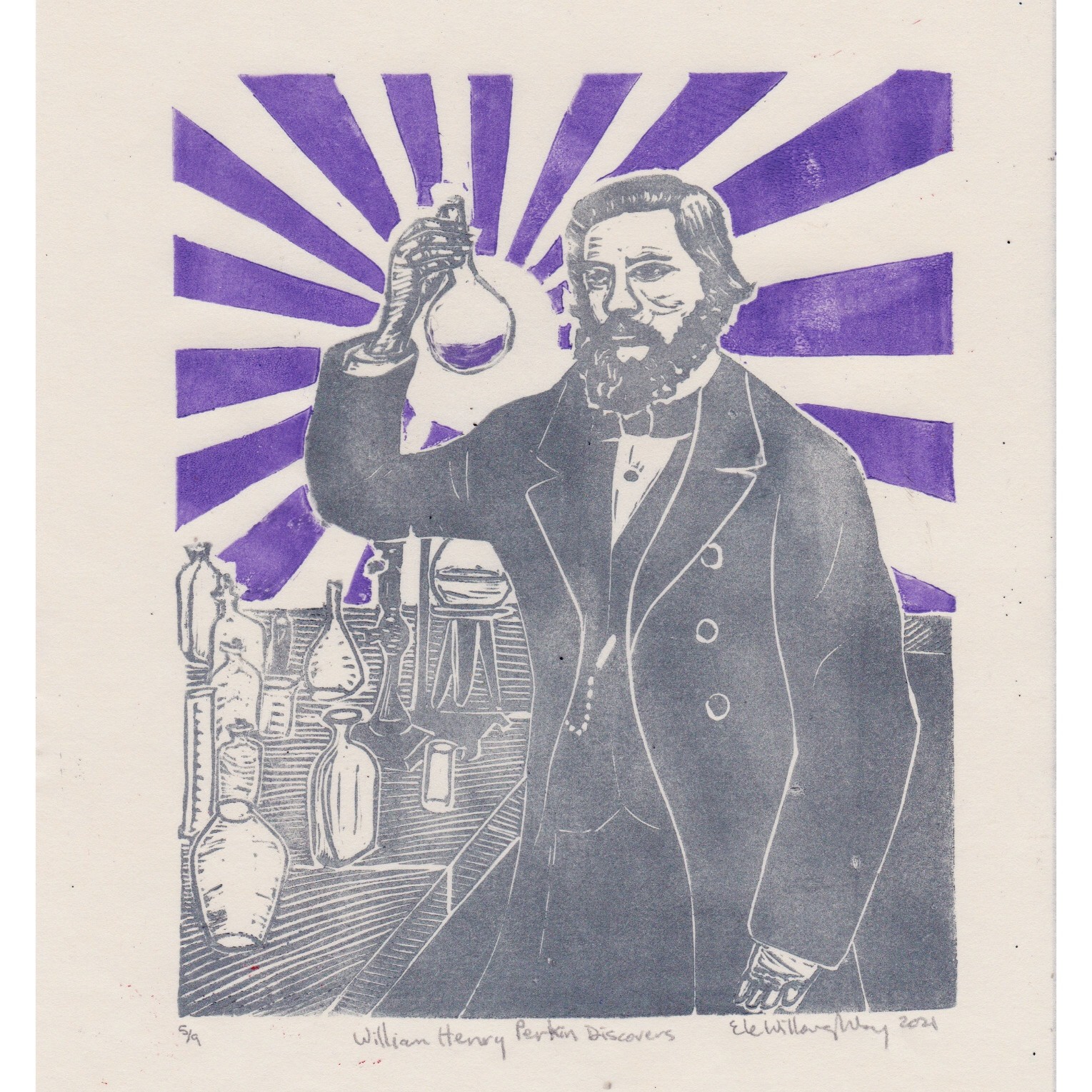
Happy birthday to chemist William Henry Perkin (1838-1907)! This lino block print ‘William Henry Perkin Discovers Mauve’ is about how the British chemist & entrepreneur made the serendipitous discovery of the 1st synthetic organic dye: mauveine.
Perkins entered the Royal College of Chemistry in London in 1853 when he was only 15, studying with August Wilhelm von Hofmann. 🧵1/https://minouette.etsy.com/listing/955324548
#linocut #printmaking #sciart #chemistry #histsci #mastoArt
-
Happy birthday to chemist William Henry Perkin (1838-1907)! This lino block print ‘William Henry Perkin Discovers Mauve’ is about how the British chemist & entrepreneur made the serendipitous discovery of the 1st synthetic organic dye: mauveine.
Perkins entered the Royal College of Chemistry in London in 1853 when he was only 15, studying with August Wilhelm von Hofmann. 🧵1/https://minouette.etsy.com/listing/955324548
#linocut #printmaking #sciart #chemistry #histsci #mastoArt
Hofmann hired him as his assistant in 1855 & had Perkin working on a series of experiments to try to synthesize quinine, used to treat malaria. During his Easter break in 1856, Perkin was performing some experiments, in his makeshift lab in his own apartment. Perkin tried to oxidize a coal tar product, aniline, with potassium bichromate which failed to produce quinine. It produced a black sludge.... but left purple stains on the lab bench when he cleaned up with alcohol. 🧵2/
-
Hofmann hired him as his assistant in 1855 & had Perkin working on a series of experiments to try to synthesize quinine, used to treat malaria. During his Easter break in 1856, Perkin was performing some experiments, in his makeshift lab in his own apartment. Perkin tried to oxidize a coal tar product, aniline, with potassium bichromate which failed to produce quinine. It produced a black sludge.... but left purple stains on the lab bench when he cleaned up with alcohol. 🧵2/
Perkin was interested in painting & photography & had already been thinking about dyestuffs with his friend Arthur Church & his brother Thomas. They did not tell Hofmann. Perkin used a purified extract of the black sludge to colour samples of silk & sent them to a Scottish textile manufacturer. The results were so promising he decided to quit college, file for a patent & set up dye factory in Greenford Green, Middlesex. They named the dye mauveine & marketed ‘Perkin’s mauve’.
🧵3/ -
Perkin was interested in painting & photography & had already been thinking about dyestuffs with his friend Arthur Church & his brother Thomas. They did not tell Hofmann. Perkin used a purified extract of the black sludge to colour samples of silk & sent them to a Scottish textile manufacturer. The results were so promising he decided to quit college, file for a patent & set up dye factory in Greenford Green, Middlesex. They named the dye mauveine & marketed ‘Perkin’s mauve’.
🧵3/His timing was perfect. Purple was a challenging colour to produce with natural pigments, many of which tended to fade. Considered a sign of royalty for centuries, ‘Tyrian purple’ was made from glandular mucus of certain molluscs; it was expensive & complicated to produce. Aided by Empress Eugénie & Queen Victoria’s fashion choices, Perkin’s mauve, the 1st mass-produced synthetic dye, became all the rage. In England they joked about ‘mauve measles’ & ‘mauve mania’. 🧵4/5
-
His timing was perfect. Purple was a challenging colour to produce with natural pigments, many of which tended to fade. Considered a sign of royalty for centuries, ‘Tyrian purple’ was made from glandular mucus of certain molluscs; it was expensive & complicated to produce. Aided by Empress Eugénie & Queen Victoria’s fashion choices, Perkin’s mauve, the 1st mass-produced synthetic dye, became all the rage. In England they joked about ‘mauve measles’ & ‘mauve mania’. 🧵4/5
Several of Hofmann’s other students discovered other colours of synthetic dyes & an industry was born. Perkin was able to sell his business & retire from manufacturing at 36! 🧵5/5
-
Happy birthday to chemist William Henry Perkin (1838-1907)! This lino block print ‘William Henry Perkin Discovers Mauve’ is about how the British chemist & entrepreneur made the serendipitous discovery of the 1st synthetic organic dye: mauveine.
Perkins entered the Royal College of Chemistry in London in 1853 when he was only 15, studying with August Wilhelm von Hofmann. 🧵1/https://minouette.etsy.com/listing/955324548
#linocut #printmaking #sciart #chemistry #histsci #mastoArt
@minouette oh man, I remember reading about his discovery in a Horrible Science book as a kid.
-
R relay@relay.infosec.exchange shared this topic