You shouldn't expect centralised organisations, be it companies or governments, to be good at implementing or even supporting decentralised solutions.
-
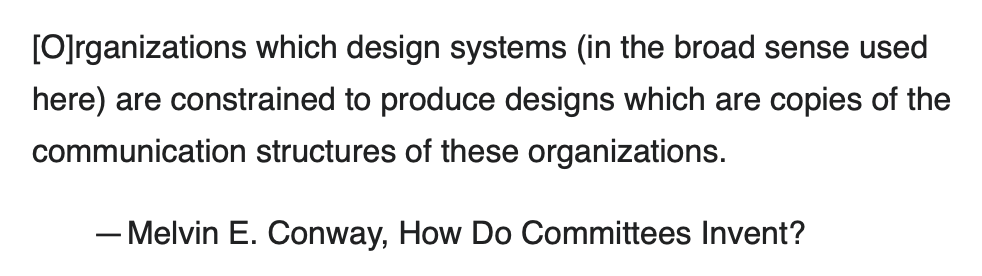
You shouldn't expect centralised organisations, be it companies or governments, to be good at implementing or even supporting decentralised solutions. That's just Conway's law [1] at work.
That's why decentralised solutions are shared, implemented bottom-up by communities of practice.
This is also why decentralised solutions are hard to monetise.
TL;DR: Decentralised solutions work best when they are open source, open hardware, run in cooperative ways.
[1] https://en.wikipedia.org/wiki/Conway%27s_law
-
You shouldn't expect centralised organisations, be it companies or governments, to be good at implementing or even supporting decentralised solutions. That's just Conway's law [1] at work.
That's why decentralised solutions are shared, implemented bottom-up by communities of practice.
This is also why decentralised solutions are hard to monetise.
TL;DR: Decentralised solutions work best when they are open source, open hardware, run in cooperative ways.
[1] https://en.wikipedia.org/wiki/Conway%27s_law
@jwildeboer See also: the Web, RSS and other early-ish community-made protocols.
-
R relay@relay.mycrowd.ca shared this topic
-
You shouldn't expect centralised organisations, be it companies or governments, to be good at implementing or even supporting decentralised solutions. That's just Conway's law [1] at work.
That's why decentralised solutions are shared, implemented bottom-up by communities of practice.
This is also why decentralised solutions are hard to monetise.
TL;DR: Decentralised solutions work best when they are open source, open hardware, run in cooperative ways.
[1] https://en.wikipedia.org/wiki/Conway%27s_law
The impact of Conway's law is often underestimated. It's a dilemma. On the one hand you want organisation, authority because it seems to be a good thing. But that always leads to centralisation.
But embracing the chaos, infighting and ego fights that unavoidably comes with decentralised, leaderless approaches feels unnatural. But trust me on this. In the end chaotic systems work better.
I know. It feels weird. Take your time. Let it sink in. Don't "yes, but" immediately, just this one time

-
The impact of Conway's law is often underestimated. It's a dilemma. On the one hand you want organisation, authority because it seems to be a good thing. But that always leads to centralisation.
But embracing the chaos, infighting and ego fights that unavoidably comes with decentralised, leaderless approaches feels unnatural. But trust me on this. In the end chaotic systems work better.
I know. It feels weird. Take your time. Let it sink in. Don't "yes, but" immediately, just this one time
@jwildeboer Anarchism is inevitable. Messy, unordered, and difficult, but inevitable.
-
The impact of Conway's law is often underestimated. It's a dilemma. On the one hand you want organisation, authority because it seems to be a good thing. But that always leads to centralisation.
But embracing the chaos, infighting and ego fights that unavoidably comes with decentralised, leaderless approaches feels unnatural. But trust me on this. In the end chaotic systems work better.
I know. It feels weird. Take your time. Let it sink in. Don't "yes, but" immediately, just this one time
So if you wonder why (centralised) electricity grids don't seem to be able to cope with (decentralised) solar and wind electricity, here's an important factor.
And that's just one example. You'll start to see the pattern at a lot of places.
And here's the real task. How do we find ways to productive coexistence? Where are the translators between these two very different worlds? Because cooperation beats confrontation. That was always my hope for the Open Source movement. To be that translator.
-
You shouldn't expect centralised organisations, be it companies or governments, to be good at implementing or even supporting decentralised solutions. That's just Conway's law [1] at work.
That's why decentralised solutions are shared, implemented bottom-up by communities of practice.
This is also why decentralised solutions are hard to monetise.
TL;DR: Decentralised solutions work best when they are open source, open hardware, run in cooperative ways.
[1] https://en.wikipedia.org/wiki/Conway%27s_law
@jwildeboer like ubisoft trying to sell nfts
-
You shouldn't expect centralised organisations, be it companies or governments, to be good at implementing or even supporting decentralised solutions. That's just Conway's law [1] at work.
That's why decentralised solutions are shared, implemented bottom-up by communities of practice.
This is also why decentralised solutions are hard to monetise.
TL;DR: Decentralised solutions work best when they are open source, open hardware, run in cooperative ways.
[1] https://en.wikipedia.org/wiki/Conway%27s_law
@jwildeboer The comment on the wiki page about Conway's observation being being originally a sociological one has a "citation needed" mark against it, but I think that's right on the money. I think it extends beyond tech and what we normally think of when we think of "organisations." For example, we wouldn't think of LinkedIn users as being an organisation as such, yet there are definitely the outlines of organising mechanics, and these are most definitely and obviously coded into the language used.
-
So if you wonder why (centralised) electricity grids don't seem to be able to cope with (decentralised) solar and wind electricity, here's an important factor.
And that's just one example. You'll start to see the pattern at a lot of places.
And here's the real task. How do we find ways to productive coexistence? Where are the translators between these two very different worlds? Because cooperation beats confrontation. That was always my hope for the Open Source movement. To be that translator.
I think one skill we need to (re)learn is that we don't have to perfectly align to collaborate.
It is OK to have different but overlapping goals, it is OK to have different interests and priorities, And we can still collaborate with all that.
The wide open Internet gave us the opportunity to reach to many like-minded people, which is really cool. But it also gave us the way to too easily escape the need to cooperate with people who are not as like-minded.
-
The impact of Conway's law is often underestimated. It's a dilemma. On the one hand you want organisation, authority because it seems to be a good thing. But that always leads to centralisation.
But embracing the chaos, infighting and ego fights that unavoidably comes with decentralised, leaderless approaches feels unnatural. But trust me on this. In the end chaotic systems work better.
I know. It feels weird. Take your time. Let it sink in. Don't "yes, but" immediately, just this one time
@jwildeboer If you're familiar withbit - what are your thoughts on Arthur #Koestler and the concept of #holarchy?
I've had the opportunity to work with an enterprise that was organized based on this principle (as opposed to a hierarchical structure) and have been fascinated ever since.
-
The impact of Conway's law is often underestimated. It's a dilemma. On the one hand you want organisation, authority because it seems to be a good thing. But that always leads to centralisation.
But embracing the chaos, infighting and ego fights that unavoidably comes with decentralised, leaderless approaches feels unnatural. But trust me on this. In the end chaotic systems work better.
I know. It feels weird. Take your time. Let it sink in. Don't "yes, but" immediately, just this one time
@jwildeboer @akosma I think you have to lean in to decentralisation if you want it to work. Especially when it seems the worst. I keep getting hit by planks when the mode is mixed.
-
R relay@relay.publicsquare.global shared this topic