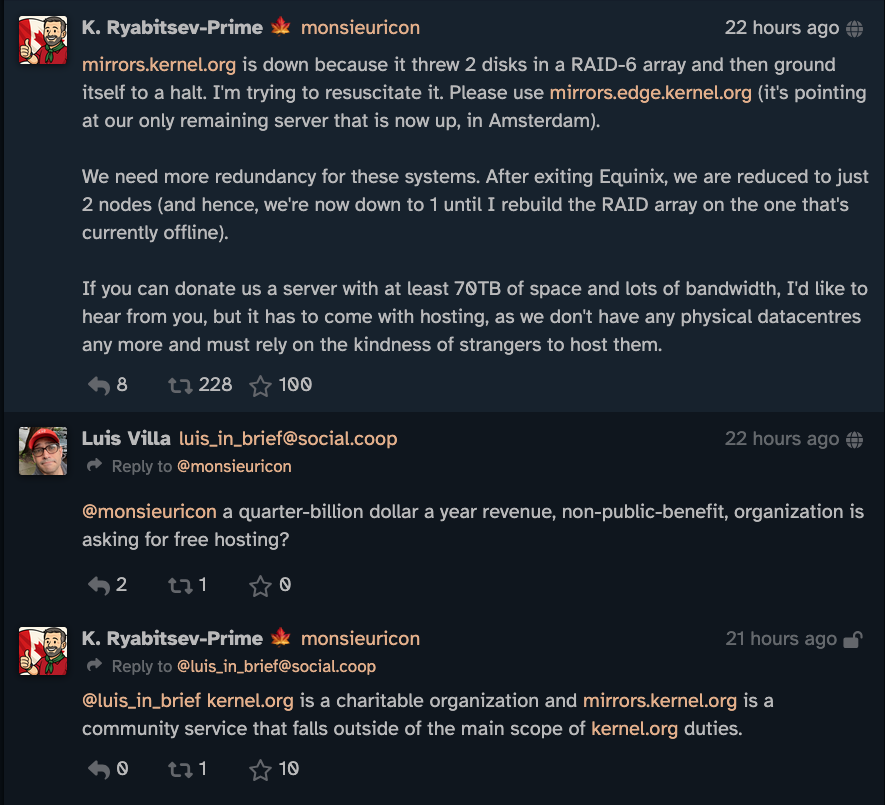
These two images are the entire story of open source software support in this world, in a nutshell.

-
These two images are the entire story of open source software support in this world, in a nutshell.
Exhibit one is the list of companies who are sponsoring the Linux Foundation, a murderer's row of the largest and most powerful hosting and services companies in the world.
Exhibit two is one dude scrambling to keep the lights on after a raid failure because KTLO for the servers that everyone uses to _download Linux_ are "outside the scope" of the Linux Foundation's "main duties".
@mhoye Mind-boggling
-
These two images are the entire story of open source software support in this world, in a nutshell.
Exhibit one is the list of companies who are sponsoring the Linux Foundation, a murderer's row of the largest and most powerful hosting and services companies in the world.
Exhibit two is one dude scrambling to keep the lights on after a raid failure because KTLO for the servers that everyone uses to _download Linux_ are "outside the scope" of the Linux Foundation's "main duties".
@mhoye my understanding is that mirrors.kernel.org (mirrors of a bunch of distros) is operated entirely separately from kernel.org itself (the kernel). But still, yeah

-
@mhoye Mind-boggling
@netopwibby Any one of these orgs could solve this problem for a decade by shaking out the couch in the lobby.
-
@netopwibby Any one of these orgs could solve this problem for a decade by shaking out the couch in the lobby.
@mhoye @netopwibby precarity: blatantly a designed feature of the system, at this point.
-
These two images are the entire story of open source software support in this world, in a nutshell.
Exhibit one is the list of companies who are sponsoring the Linux Foundation, a murderer's row of the largest and most powerful hosting and services companies in the world.
Exhibit two is one dude scrambling to keep the lights on after a raid failure because KTLO for the servers that everyone uses to _download Linux_ are "outside the scope" of the Linux Foundation's "main duties".
@mhoye I'm not sure how to get in contact with the original poster, but Fastly can help support. austin @ fastly.com
-
@mhoye I'm not sure how to get in contact with the original poster, but Fastly can help support. austin @ fastly.com
@monsieuricon, sounds like @austinspires from Fastly can help get hosting support.
-
These two images are the entire story of open source software support in this world, in a nutshell.
Exhibit one is the list of companies who are sponsoring the Linux Foundation, a murderer's row of the largest and most powerful hosting and services companies in the world.
Exhibit two is one dude scrambling to keep the lights on after a raid failure because KTLO for the servers that everyone uses to _download Linux_ are "outside the scope" of the Linux Foundation's "main duties".
@mhoye This post builds up a straw man just to set it on fire. The logos you posted are from companies that donate directly to kernel.org (not Linux Foundation). Kernel.org is a separate legal entity from Linux Foundation and is a registered charitable organization. Donating to kernel.org is tax deductible whereas contributing to the Linux Foundation isn't. These companies are gladly and willingly donating their resources to kernel.org specifically.
The companies supporting kernel.org operations are:
Akamai: provides free hosting to git.kernel.org and lore.kernel.org.
Constellix: provides free DNS hosting with failover and geoDNS.
Fastly: provides CDN services.
Servers.com: provides mirrors.kernel.org hosting (the two nodes that we currently have in operation).
Google: provides a git mirror at kernel.googlesource.com.
Red Hat: donates RHEL licenses.
Linux Foundation: employs staff operating kernel.org
The reason I'm asking for more hosting opportunities for mirrors.kernel.org is two-fold: it's a community service that hosts distros, and not so much the kernel. Providing mirroring opportunities for distros is not our primary charter -- we provide kernel archives, not distro binaries. However, we've operated mirrors.kernel.org for 30-odd years and if we stop running the service, parts of the Internet break (it's a fact). So, we continue operating it and will do so for the foreseeable future.
The second reason is because for many hosting companies it makes a lot of sense to donate hardware and bandwidth to a charitable organization like kernel.org -- for reasons of tax deductions and because it often benefits them directly (their own cloud hosting can then benefit from a tier-1 mirror in their datacentre). So, it makes commercial sense for them to donate to kernel.org as a tax write-off as opposed to for the Linux Foundation to pay for hosting, plus they get other perks, such as getting a bit of publicity, a good standing with fellow nerds, etc.
Your post is unnecessarily inflammatory and poorly informed. -
@monsieuricon, sounds like @austinspires from Fastly can help get hosting support.
@jbowen @austinspires @mhoye Fastly is already doing a lot for us, for which we love them! However, they are not a great fit for mirrors.kernel.org. I do thank you for the suggestion, though! -
@mhoye This post builds up a straw man just to set it on fire. The logos you posted are from companies that donate directly to kernel.org (not Linux Foundation). Kernel.org is a separate legal entity from Linux Foundation and is a registered charitable organization. Donating to kernel.org is tax deductible whereas contributing to the Linux Foundation isn't. These companies are gladly and willingly donating their resources to kernel.org specifically.
The companies supporting kernel.org operations are:
Akamai: provides free hosting to git.kernel.org and lore.kernel.org.
Constellix: provides free DNS hosting with failover and geoDNS.
Fastly: provides CDN services.
Servers.com: provides mirrors.kernel.org hosting (the two nodes that we currently have in operation).
Google: provides a git mirror at kernel.googlesource.com.
Red Hat: donates RHEL licenses.
Linux Foundation: employs staff operating kernel.org
The reason I'm asking for more hosting opportunities for mirrors.kernel.org is two-fold: it's a community service that hosts distros, and not so much the kernel. Providing mirroring opportunities for distros is not our primary charter -- we provide kernel archives, not distro binaries. However, we've operated mirrors.kernel.org for 30-odd years and if we stop running the service, parts of the Internet break (it's a fact). So, we continue operating it and will do so for the foreseeable future.
The second reason is because for many hosting companies it makes a lot of sense to donate hardware and bandwidth to a charitable organization like kernel.org -- for reasons of tax deductions and because it often benefits them directly (their own cloud hosting can then benefit from a tier-1 mirror in their datacentre). So, it makes commercial sense for them to donate to kernel.org as a tax write-off as opposed to for the Linux Foundation to pay for hosting, plus they get other perks, such as getting a bit of publicity, a good standing with fellow nerds, etc.
Your post is unnecessarily inflammatory and poorly informed.@monsieuricon Respectfully, the various corporate structures or tax write off opportunities involved in this are entirely beside the point; none of these companies could exist at all without the free and open source software they extract staggering benefit from, giving back a pittance if anything in return. If parts of the internet these multibillion-dollar companies have built their entire businesses on will break because of a couple of drive failures, that is worth getting inflammatory about.
-
@monsieuricon Respectfully, the various corporate structures or tax write off opportunities involved in this are entirely beside the point; none of these companies could exist at all without the free and open source software they extract staggering benefit from, giving back a pittance if anything in return. If parts of the internet these multibillion-dollar companies have built their entire businesses on will break because of a couple of drive failures, that is worth getting inflammatory about.
@mhoye Sure, but as evidenced, they *are* actually giving something back to us -- so these are the good guys.
Let's get mad about all the 99.99% of free software contributors who have not received anything out of donating their time and expertise to the open source ecosystem. -
R relay@relay.mycrowd.ca shared this topic