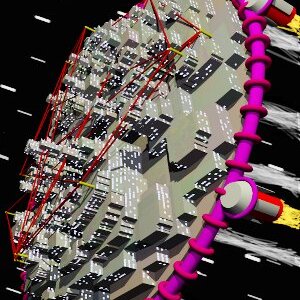
Ants That (Probably) Do Not Exist
-
@futurebird Honestly, at this point, I'm hesitant to make a suggestion because I'm afraid you'll drag up a real-world example and trigger my anxieties...
... don't be shy ... go on ...
-
... don't be shy ... go on ...
@futurebird Nooooo.....

-
That old psudoscience story about a vast vanished ancient civilization that lived on early earth and left little evidence that they existed.
But they were ants. They live 200 million years ago and left for space and we find out about them when they return in their space habitats to check on the old home planet and see how things are going.
@futurebird one of cixin liu short stories is this with dinosaurs and when they come back they eat us and keep us as pets
-
That old psudoscience story about a vast vanished ancient civilization that lived on early earth and left little evidence that they existed.
But they were ants. They live 200 million years ago and left for space and we find out about them when they return in their space habitats to check on the old home planet and see how things are going.
@futurebird I once ran a short-lived TTRPG campaign set in the Cretaceous, where the players were members of a sapient dinosaur species that had learned to make tools of wood, stone and obsidian - and bits of other dinosaurs. I based them on Troodon (because 1. those had unusually large brains for dinosaurs, and 2. they were omnivorous). Unfortunately, the setting was hard for me (at the time at least) to come up with good stories for.
I figured that an undiscovered dinosaur culture could make sense if they never made it to metalworking, and never reached a very large population.
-
Since all ants can walk they are all ped ants I guess. Little know it alls.
-
@futurebird I once ran a short-lived TTRPG campaign set in the Cretaceous, where the players were members of a sapient dinosaur species that had learned to make tools of wood, stone and obsidian - and bits of other dinosaurs. I based them on Troodon (because 1. those had unusually large brains for dinosaurs, and 2. they were omnivorous). Unfortunately, the setting was hard for me (at the time at least) to come up with good stories for.
I figured that an undiscovered dinosaur culture could make sense if they never made it to metalworking, and never reached a very large population.
How much harder would tools and technology be for us to recognize if they were made on an ant-size scale?
No one would look at a tiny flake of flint and think "yes something intelligent worked that into a point"
Also ants would use a lot of bio-tech. Their spaceships would be based on massive pupae.
-
Ants That (Probably) Do Not Exist
1. Cave Ants
2. Sea Ants
3. Time Ants
4. Space Ants
5. Cloud Ants
6. Ice AntsIn the book After Man, they portray future ants who build boat-like colonies that advance out into lakes.
This inspired me to world-build ants who make submarine hives which can sink or float like a nautilus by changing the internal pressure of their home.
-
How much harder would tools and technology be for us to recognize if they were made on an ant-size scale?
No one would look at a tiny flake of flint and think "yes something intelligent worked that into a point"
Also ants would use a lot of bio-tech. Their spaceships would be based on massive pupae.
@futurebird Things that size would be ground to dust 200 million years later.
-
How much harder would tools and technology be for us to recognize if they were made on an ant-size scale?
No one would look at a tiny flake of flint and think "yes something intelligent worked that into a point"
Also ants would use a lot of bio-tech. Their spaceships would be based on massive pupae.
Do you think these ants would be intelligent individually, or only as a collective?
-
There are different levels of cave dwelling. And my understanding was that these ants prefer caves but still reproduce by leaving the cave, they live on the margin.
Which shows that real cave ants could exist. Deep in the earth in a cavern never entered by man.
-
@futurebird Things that size would be ground to dust 200 million years later.
@futurebird (though personally, if I were to make a fictional ant civilization, I'd probably make it all biotech. I mean, there are ants with zinc blades on their mandibles! I think it would be a lot more antish to either breed specialized workers or domesticate (or zombify?) other creatures; clumsily banging stones together seems like more of a primate thing.)
-
Do you think these ants would be intelligent individually, or only as a collective?
I think it would be like what you find in ants today. The individuals are very intelligent as far as insects go, and make a wide range of complex choices, learn, and adapt their environments.
The colony intelligence is like an overlay. The individuals might seem simple, but together they would casually and incrementally do astounding things without totally understanding what they were doing.
So... "both."
-
Ants That (Probably) Do Not Exist
1. Cave Ants
2. Sea Ants
3. Time Ants
4. Space Ants
5. Cloud Ants
6. Ice Ants*takes notes for his comic fantasy novels*
-
@futurebird Things that size would be ground to dust 200 million years later.
@futurebird I mean, we probably wouldn't even realize for a long time if actual current-day ants started using tiny flint chips as handaxes, but there'd very likely be nothing left at all in a hundred years, let alone 200 million.
But I'm also not really sure how useful flint tools would even be for ants? They live in a world where surface tension is a bigger worry than gravity is, and I'm not sure how much useful work they'd even be able to do with stone tools that they can't do with their natural bodies.
-
There are different levels of cave dwelling. And my understanding was that these ants prefer caves but still reproduce by leaving the cave, they live on the margin.
Which shows that real cave ants could exist. Deep in the earth in a cavern never entered by man.
Real cave ants would paint the walls of their caves with representations of ants, and the local wildlife (aphids, bees, wasps, *shudder* anteaters!).
-
@futurebird Nooooo.....
@grumpydad @futurebird MASSIVE ants.
-
@futurebird I mean, we probably wouldn't even realize for a long time if actual current-day ants started using tiny flint chips as handaxes, but there'd very likely be nothing left at all in a hundred years, let alone 200 million.
But I'm also not really sure how useful flint tools would even be for ants? They live in a world where surface tension is a bigger worry than gravity is, and I'm not sure how much useful work they'd even be able to do with stone tools that they can't do with their natural bodies.
The ways ant use their front legs and mandibles astound me. For example, if an ant needs to dig she my pick up a ball of dirt and move it in her mandibles as you'd expect. But if the soil is dry and sandy she will turn around and fling dirt between her four back legs using her two front legs.
Ants use their front legs to deftly position objects so they can pick them up in their mandibles at the correct angle, they use their antennae and front legs to pack down sand.
-
I think it would be like what you find in ants today. The individuals are very intelligent as far as insects go, and make a wide range of complex choices, learn, and adapt their environments.
The colony intelligence is like an overlay. The individuals might seem simple, but together they would casually and incrementally do astounding things without totally understanding what they were doing.
So... "both."
@futurebird @Phosphenes Individual bees are *shockingly* intelligent. They need to be, really - they need to communicate as complex things to each other as ants do, but they can't leave chemical trails (obviously) so they need a more complex system of "talking" to each other and good memory.
Ants' "collective intelligence" can accomplish more things than bees', though, precisely because they can coordinate rapidly in ways that bees can't.
-
The ways ant use their front legs and mandibles astound me. For example, if an ant needs to dig she my pick up a ball of dirt and move it in her mandibles as you'd expect. But if the soil is dry and sandy she will turn around and fling dirt between her four back legs using her two front legs.
Ants use their front legs to deftly position objects so they can pick them up in their mandibles at the correct angle, they use their antennae and front legs to pack down sand.
There is just so much complexity and responsiveness in the way ants manipulate their environment, in just their basic locomotion that I think we take for granted.
I think about how one would program a robot to do such things and my mind boggles.
How does the ant decide *how* to move the soil? It could be as simple as trying each more energy intensive method until one works. But that still means that the ants must have some notion of the abstract goal of moving the soil.
-
There is just so much complexity and responsiveness in the way ants manipulate their environment, in just their basic locomotion that I think we take for granted.
I think about how one would program a robot to do such things and my mind boggles.
How does the ant decide *how* to move the soil? It could be as simple as trying each more energy intensive method until one works. But that still means that the ants must have some notion of the abstract goal of moving the soil.
I've seen ants with larger mandibles using their head like a snow plow to move debris.
Is that just an instinctive pattern, or do the ants invent these ways of solving the problem?
Once an ant finds a method thats effective she sticks to it and does it more often. So I think there must be some learning. And little ants never do the "snow plow" move because presumably, if they tried it, it wouldn't be as effective.