I am begging website owners to always provide a light mode.
-
I am begging website owners to always provide a light mode. It’s an accessibility issue for me: my aging eyes are no longer able to view light-on-dark text for extended periods without severe ghosting/afterimages.
@drahardja Thanks so much for that post. I have the same problem.
-
@VanuPhantom I’m sure light-on-dark design has been discussed extensively since the days of print. I’m not a usability expert, but I can tell you what affects me personally.
I’m most sensitive to anything that look like bars: repeating strips of high contrast light against dark, like prison cell bars in old cartoons; these patterns cause severe afterimages, often lasting minutes.
My pet theory is that *light areas* in general cause afterimages for me overall. However, in light mode, the entire window is light, so it makes less difference because I basically get a diffuse, white-rectangle afterimage which doesn’t really interfere with details that I’m trying to focus on (it may reduce contrast somewhat in my brain but it’s fine). But in dark mode, the only bright things that cause afterimages are the fine detail (text), so as I move around these afterimages interfere severely against the new details I’m trying to read. A similar thing happens with bars when I’m in light mode.
@VanuPhantom Body text fonts matter too. A font with tall counters and good variation between characters are easier to read for me. For serifs, I don’t like fonts that have very thin parts (e.g. Bodoni) for text because they tend to make the thicker parts look like bars. I prefer fonts like Schoolbook that have more modest thick/thin contrast, or Adelle that has basically uniform line widths.
-
I am begging website owners to always provide a light mode. It’s an accessibility issue for me: my aging eyes are no longer able to view light-on-dark text for extended periods without severe ghosting/afterimages.
@drahardja 2c: the web browser should manage this.
-
@drahardja 2c: the web browser should manage this.
@dannyman I mean, it does to an extent. CSS has the color-scheme and light-dark() colors that respond to the browser’s settings.
But the browser can only do so much. CSS doesn’t convey the *intent* of elements, only their *appearance*. It’s much worse with React-style pages, in which the CSS *and* html elements have basically zero semantic meaning.
I use Reader mode to get around dark mode, which works sometimes for sites with mostly static blog contents, but a wholesale rewriting of the page style basically requires reading the minds of the developers.
-
@dannyman I mean, it does to an extent. CSS has the color-scheme and light-dark() colors that respond to the browser’s settings.
But the browser can only do so much. CSS doesn’t convey the *intent* of elements, only their *appearance*. It’s much worse with React-style pages, in which the CSS *and* html elements have basically zero semantic meaning.
I use Reader mode to get around dark mode, which works sometimes for sites with mostly static blog contents, but a wholesale rewriting of the page style basically requires reading the minds of the developers.
@drahardja so ... HTML is fundamentally semantic ... there are a bunch of words that you want to read and some markup explaining how the author wants it to render ... but what happens on the clients side is fundamentally up to the client ... to represent the words ... that's why blind folks can browse the web with screen readers -- it's just words -- and you ought to be able to access a web browser that can cater to your own abilities as well.
This is more reliable than asking millions of random web sites to somehow understand every nuance of crafting CSS for each audience.
I believe the mainstream operating systems and web browsers already have a variety of accessibility settings, each frustratingly limited in its own way. We all know how to crank the font size up and down!
(Personally, I tend to avoid web sites that DON'T support a dark mode, which I find easier to read, but not to a degree that I need an accommodation. Kagi slow web has a neat switch for rendering random sites in light/dark mode.)
-
@drahardja so ... HTML is fundamentally semantic ... there are a bunch of words that you want to read and some markup explaining how the author wants it to render ... but what happens on the clients side is fundamentally up to the client ... to represent the words ... that's why blind folks can browse the web with screen readers -- it's just words -- and you ought to be able to access a web browser that can cater to your own abilities as well.
This is more reliable than asking millions of random web sites to somehow understand every nuance of crafting CSS for each audience.
I believe the mainstream operating systems and web browsers already have a variety of accessibility settings, each frustratingly limited in its own way. We all know how to crank the font size up and down!
(Personally, I tend to avoid web sites that DON'T support a dark mode, which I find easier to read, but not to a degree that I need an accommodation. Kagi slow web has a neat switch for rendering random sites in light/dark mode.)
@dannyman HTML *can* be semantic, but only if the web developer cared. Many websites now use an intermediary framework like React that renders everything as divs, without any further meaning.
Some websites are considerate enough to use semantic tags like <article> but this is by no means universal, or even widespread in my experience.
-
I am begging website owners to always provide a light mode. It’s an accessibility issue for me: my aging eyes are no longer able to view light-on-dark text for extended periods without severe ghosting/afterimages.
@drahardja I have a similar problem in Zoom meetings. They have changed the chat box to dark mode, and Zoom keeps recommending ways to change it back to light mode that just don't work on my computer.
-
@drahardja YES! I have astigmatism so it makes light on dark immensely hard and uncomfortable to read unless I bump up the text size

@ghalldev @drahardja That’s so curious. I too have astigmatism and need reading glasses but I find light backgrounds extremely uncomfortable on the eyes.
Dark mode has been a god send to me. I don’t like white on black - I use dark grey and some very light shade of grey, and on my kobo I use a yellow tint.
I have trouble with brightness in general and wear transitions lenses, or very dark sunglasses when the day is too bright. That may be the reason the light mode bothers me so much.
-
@ghalldev @drahardja That’s so curious. I too have astigmatism and need reading glasses but I find light backgrounds extremely uncomfortable on the eyes.
Dark mode has been a god send to me. I don’t like white on black - I use dark grey and some very light shade of grey, and on my kobo I use a yellow tint.
I have trouble with brightness in general and wear transitions lenses, or very dark sunglasses when the day is too bright. That may be the reason the light mode bothers me so much.
@catzilla @drahardja That is interesting re: brightness, I have the opposite problem I have trouble in the dark and I never wear sunglasses.
Oddly I will occasionally switch to dark mode if it’s a rainy day because I get headaches.

Eyes are weird.
-
@dannyman HTML *can* be semantic, but only if the web developer cared. Many websites now use an intermediary framework like React that renders everything as divs, without any further meaning.
Some websites are considerate enough to use semantic tags like <article> but this is by no means universal, or even widespread in my experience.
Nah, that's not React's fault. That's developer's. You can use semantic HTML in react as well.
-
I am begging website owners to always provide a light mode. It’s an accessibility issue for me: my aging eyes are no longer able to view light-on-dark text for extended periods without severe ghosting/afterimages.
@drahardja
I'm far from expert at web stuff. But I will try to implement this on my sites. -
I am begging website owners to always provide a light mode. It’s an accessibility issue for me: my aging eyes are no longer able to view light-on-dark text for extended periods without severe ghosting/afterimages.
@drahardja and also light-on-dark because some folk have so many floaters it's not worth the effort of reading in light mode.
-
I am begging website owners to always provide a light mode. It’s an accessibility issue for me: my aging eyes are no longer able to view light-on-dark text for extended periods without severe ghosting/afterimages.
@drahardja@sfba.social
I will always loudly advocate for every site to support both, default to the user's setting, and have a prominent control to switch theme. -
@drahardja
I'm far from expert at web stuff. But I will try to implement this on my sites. -
I am begging website owners to always provide a light mode. It’s an accessibility issue for me: my aging eyes are no longer able to view light-on-dark text for extended periods without severe ghosting/afterimages.
And not just dark mode/light mode. Some folks build their sites with light gray on dark gray or the reverse. Cataracts reduce one's ability to decode low contrast; before I had my cataract surgery I could not read sites with gray on gray text, whether light or dark mode.
-
R relay@relay.publicsquare.global shared this topic
-
I am begging website owners to always provide a light mode. It’s an accessibility issue for me: my aging eyes are no longer able to view light-on-dark text for extended periods without severe ghosting/afterimages.
You should try the Dark Reader plugin
Despite the name, you can compel it to make sites light.
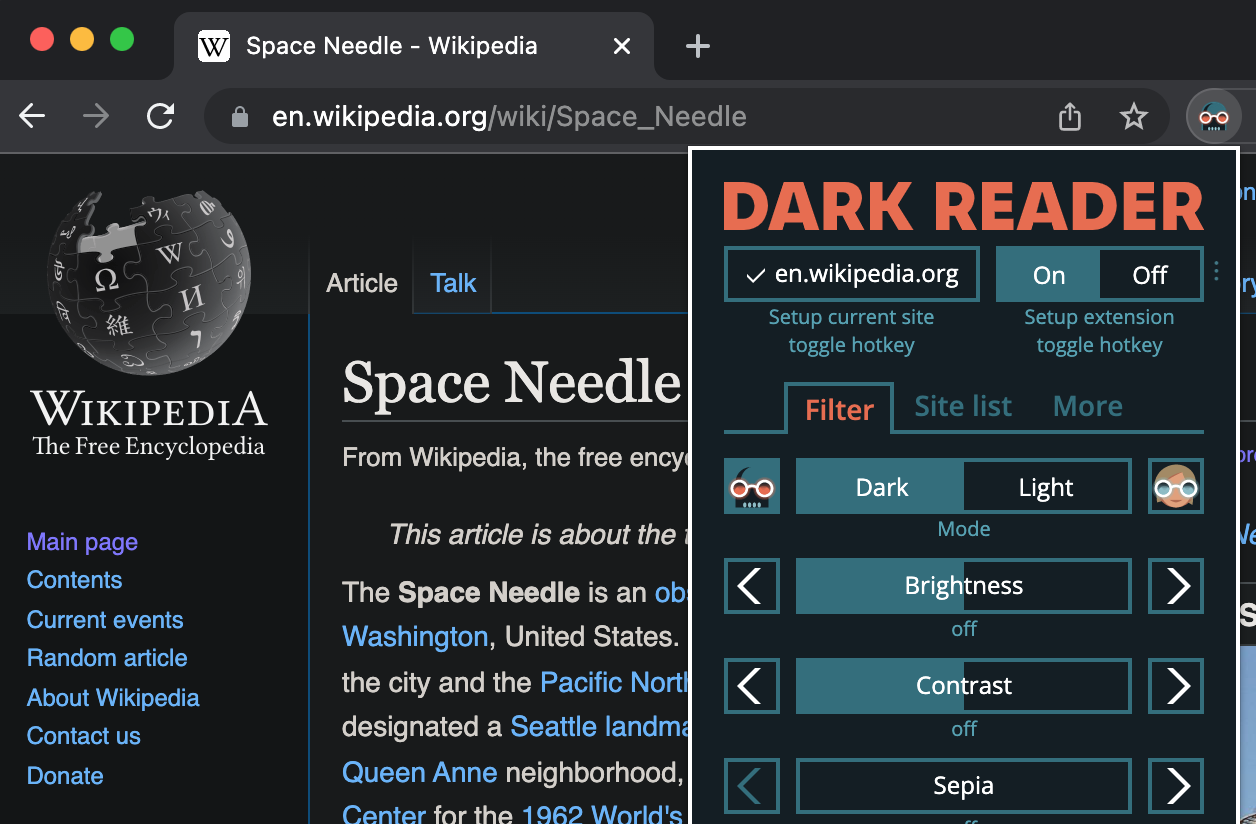
Dark Reader — dark theme for every website
Enable dark mode (night mode) on all websites

Dark Reader (darkreader.org)
-
You should try the Dark Reader plugin
Despite the name, you can compel it to make sites light.
Dark Reader — dark theme for every website
Enable dark mode (night mode) on all websites
Dark Reader (darkreader.org)
@dr_barnowl I’ll give it a try!
-
I am begging website owners to always provide a light mode. It’s an accessibility issue for me: my aging eyes are no longer able to view light-on-dark text for extended periods without severe ghosting/afterimages.
@drahardja I completely agree. If a site is dark only I just leave. I can't be bothered with it.
I've moaned a few times.
https://forkingmad.blog/dark-web-sites/ -
I am begging website owners to always provide a light mode. It’s an accessibility issue for me: my aging eyes are no longer able to view light-on-dark text for extended periods without severe ghosting/afterimages.
@drahardja Better yet, have them honor the browser foreground and background colors (which follow the system theme) and font selection. That would simplify a lot of accessibility issues.
-
R relay@relay.infosec.exchange shared this topicR relay@relay.mycrowd.ca shared this topic