Wow.
-
@ravenonthill @cstross The US attempt to abolish the slave system did not work (it failed, completely) in the case of the US Civil War, which is why the US slave system is run by government entities in forced labour institutions called prisons. Such attempts generally can't work because we live in a system under selection, not a moral universe.
Effective opposition to slavery has to combine greater distribution of agency and greater power (including economic). Otherwise is gets crushed.
@graydon @cstross please. The Civil War ended chattel slavery. Jim Crow was awful but slaves got legal rights, their marriages were respected by law, their children and spouses could not be sold at the whim of a master. Through the 20th century the position of Blacks in the United States improved, though there has also been backsliding. No, racism is not done. But rejecting all progress because it's not complete is vulgar Marxism.
-
@graydon @cstross please. The Civil War ended chattel slavery. Jim Crow was awful but slaves got legal rights, their marriages were respected by law, their children and spouses could not be sold at the whim of a master. Through the 20th century the position of Blacks in the United States improved, though there has also been backsliding. No, racism is not done. But rejecting all progress because it's not complete is vulgar Marxism.
@graydon @cstross that is also one of the arguments China uses to excuse their expanding slave system. And it is expanding. They've gone from polysilicon and plant fibers (yes, cotton) to all kinds of car parts and especially parts for those electric cars that are doing so well in international markets.
The US founders thought that slavery was going to wither on the vine, then the cotton gin was invented. I fear the sudden global push for renewables may work similarly in China.
-
@cstross This honestly sounds almost like terraforming?
-
RE: https://horche.demkontinuum.de/display/2196d4ee-7669-dbc1-1f9e-200464952498
Wow.
In addition to this, apparently farm yields INCREASE if you mix ground-dwelling crops with overhead PV panels, which provide shade/humidity traps for the plants and livestock.
@cstross Meanwhile there's a whole lot of people trying to convince us that solar farms cause heat under the panels and it just doesn't compute how they come to that conclusion.
-
@cstross Meanwhile there's a whole lot of people trying to convince us that solar farms cause heat under the panels and it just doesn't compute how they come to that conclusion.
-
@cstross If only the polysilicon in many of them was not made by slaves.
@ravenonthill
"We should improve society somewhat."
https://thenib.com/mister-gotcha/
@cstross -
-
@cstross not just in the desert, also in temperate regions like France:
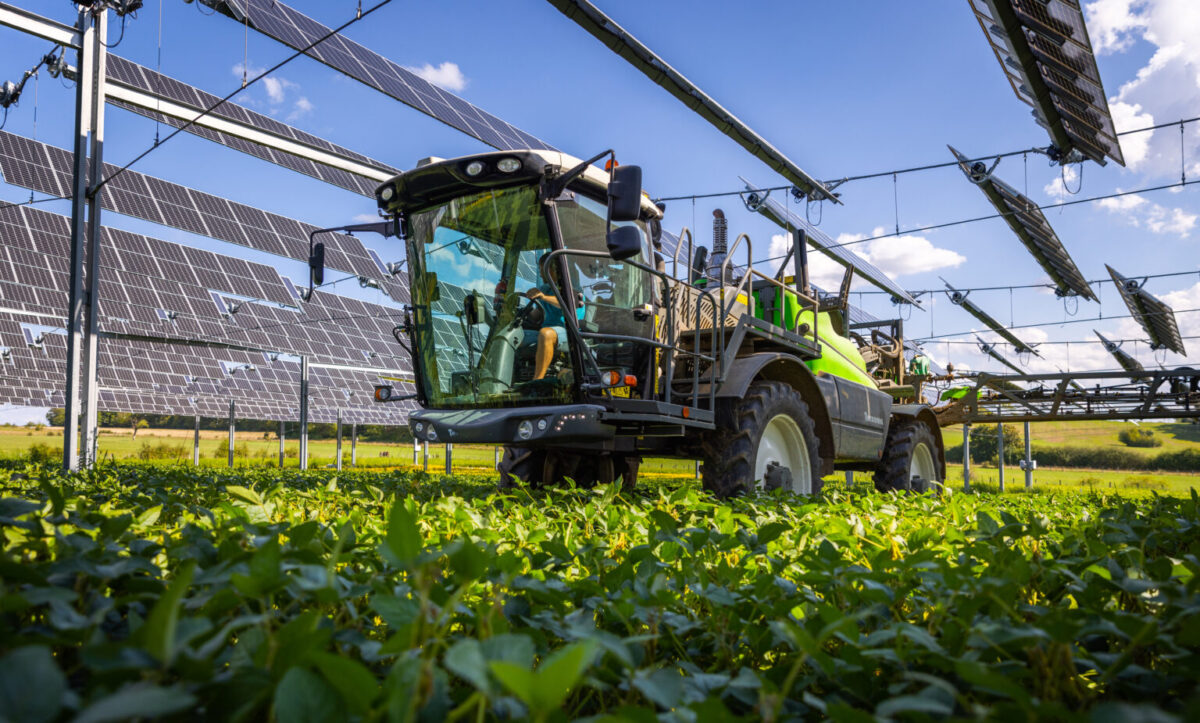
France agrivoltaics trials show early crop and livestock gains
Data from agrivoltaic canopy trials in France, developed by energy producer TSE and the French National Research Institute for Agriculture, Food and the Environment (INRAE), indicate measurable temperature, water-balance, and yield effects that reinforce the role of managed agrivoltaics in farm-level climate adaptation.
pv magazine International (www.pv-magazine.com)
What most people don't realise, is that photosynthesis was an optimum temperature range. That range changes, between species, based on anatomy.
-
@futuresprog I think their argument is based in the idea that we have more humidity here, so in Australia having moisture under the panels would be a welcome thing but here it has the potential to create an environment that supports facial eczema spores.
I mean that sounds within the realms of possibility but also very much like reckons and not something that will have been studied.
A far bigger danger for facial eczema is generally higher temps and wetter summers from climate change.
-
@futuresprog I think their argument is based in the idea that we have more humidity here, so in Australia having moisture under the panels would be a welcome thing but here it has the potential to create an environment that supports facial eczema spores.
I mean that sounds within the realms of possibility but also very much like reckons and not something that will have been studied.
A far bigger danger for facial eczema is generally higher temps and wetter summers from climate change.
@futuresprog Additionally, FE is generally picked up during low grazing (eg it lives in the base of the pasture). If the panels increase pasture growth you'd be less likely to be grazing the base.
Also, grass that grows in shade is less palatable so the grass directly under the panels won't be grazed as hard.
Finally, FE creates photosensitivity, so if you have sheep with it in your flock, they will absolutely love having easy shade to hide in.
Does that help?
-
@futuresprog Additionally, FE is generally picked up during low grazing (eg it lives in the base of the pasture). If the panels increase pasture growth you'd be less likely to be grazing the base.
Also, grass that grows in shade is less palatable so the grass directly under the panels won't be grazed as hard.
Finally, FE creates photosensitivity, so if you have sheep with it in your flock, they will absolutely love having easy shade to hide in.
Does that help?
@futuresprog PS I doubt that solar panels would necessarily improve fleece yield and quality here except by having generally healthier sheep.
Given how robust our sheep are and how little their fleece is worth compared with Australian merinos, I can see the $$ benefits to us being less than for them.
-
R relay@relay.mycrowd.ca shared this topic