Skip to content
  • Categories
  • Recent
  • Tags
  • Popular
  • World
  • Users
  • Groups
Skins
  • Light
  • Brite
  • Cerulean
  • Cosmo
  • Flatly
  • Journal
  • Litera
  • Lumen
  • Lux
  • Materia
  • Minty
  • Morph
  • Pulse
  • Sandstone
  • Simplex
  • Sketchy
  • Spacelab
  • United
  • Yeti
  • Zephyr
  • Dark
  • Cyborg
  • Darkly
  • Quartz
  • Slate
  • Solar
  • Superhero
  • Vapor

  • Default (Cyborg)
  • No Skin
Collapse
Brand Logo

CIRCLE WITH A DOT

  1. Home
  2. Uncategorized
  3. Now, more than ever, I find myself contemplating the last two sentences from this page of Acton's "Numerical Methods that (usually) Work".
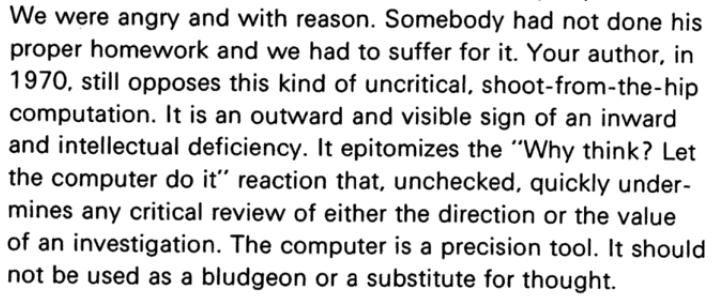
Now, more than ever, I find myself contemplating the last two sentences from this page of Acton's "Numerical Methods that (usually) Work".

Scheduled Pinned Locked Moved Uncategorized
12 Posts 6 Posters 0 Views
  • Oldest to Newest
  • Newest to Oldest
  • Most Votes
Reply
  • Reply as topic
Log in to reply
This topic has been deleted. Only users with topic management privileges can see it.
  • amenzwa@mathstodon.xyzA amenzwa@mathstodon.xyz

    @tpfto
    😍😍😍
    I hadn’t seen it. Thanks so much mate. Love it!

    And that book title….🀣

    tpfto@mathstodon.xyzT This user is from outside of this forum
    tpfto@mathstodon.xyzT This user is from outside of this forum
    tpfto@mathstodon.xyz
    wrote last edited by
    #3

    @AmenZwa I am sure Acton knew what he was doing when he picked that book title. (In fact, in the original edition of the book, the title was ostensibly just "Numerical Methods That Work", and the "Usually" was in a faded shade of gray, like he was trying to sneak it in.)

    amenzwa@mathstodon.xyzA 1 Reply Last reply
    0
    • tpfto@mathstodon.xyzT tpfto@mathstodon.xyz

      @AmenZwa I am sure Acton knew what he was doing when he picked that book title. (In fact, in the original edition of the book, the title was ostensibly just "Numerical Methods That Work", and the "Usually" was in a faded shade of gray, like he was trying to sneak it in.)

      amenzwa@mathstodon.xyzA This user is from outside of this forum
      amenzwa@mathstodon.xyzA This user is from outside of this forum
      amenzwa@mathstodon.xyz
      wrote last edited by
      #4

      @tpfto
      Bold, that. Ya gotta love it.

      1 Reply Last reply
      0
      • tpfto@mathstodon.xyzT tpfto@mathstodon.xyz

        Now, more than ever, I find myself contemplating the last two sentences from this page of Acton's "Numerical Methods that (usually) Work".

        nxskok@cupoftea.socialN This user is from outside of this forum
        nxskok@cupoftea.socialN This user is from outside of this forum
        nxskok@cupoftea.social
        wrote last edited by
        #5

        @tpfto This is, as a whole, a pleasantly opinionated book.

        tpfto@mathstodon.xyzT 1 Reply Last reply
        0
        • nxskok@cupoftea.socialN nxskok@cupoftea.social

          @tpfto This is, as a whole, a pleasantly opinionated book.

          tpfto@mathstodon.xyzT This user is from outside of this forum
          tpfto@mathstodon.xyzT This user is from outside of this forum
          tpfto@mathstodon.xyz
          wrote last edited by
          #6

          @nxskok I find that Acton is a little like Velvel Kahan (he of IEEE floating point standard fame) or Edsger Dijkstra: you don't always have to agree with what they wrote, but you should at least give them some serious thought.

          nxskok@cupoftea.socialN 1 Reply Last reply
          0
          • tpfto@mathstodon.xyzT tpfto@mathstodon.xyz

            Now, more than ever, I find myself contemplating the last two sentences from this page of Acton's "Numerical Methods that (usually) Work".

            arclight@oldbytes.spaceA This user is from outside of this forum
            arclight@oldbytes.spaceA This user is from outside of this forum
            arclight@oldbytes.space
            wrote last edited by
            #7

            @tpfto It's a fantastic book

            1 Reply Last reply
            0
            • tpfto@mathstodon.xyzT tpfto@mathstodon.xyz

              @nxskok I find that Acton is a little like Velvel Kahan (he of IEEE floating point standard fame) or Edsger Dijkstra: you don't always have to agree with what they wrote, but you should at least give them some serious thought.

              nxskok@cupoftea.socialN This user is from outside of this forum
              nxskok@cupoftea.socialN This user is from outside of this forum
              nxskok@cupoftea.social
              wrote last edited by
              #8

              @tpfto my take with this kind of thing is "the author has done some serious thinking about these issues, so if I'm going to disagree with them, I'd better have a good reason".

              1 Reply Last reply
              0
              • tpfto@mathstodon.xyzT tpfto@mathstodon.xyz

                Now, more than ever, I find myself contemplating the last two sentences from this page of Acton's "Numerical Methods that (usually) Work".

                kbob@chaos.socialK This user is from outside of this forum
                kbob@chaos.socialK This user is from outside of this forum
                kbob@chaos.social
                wrote last edited by
                #9

                @tpfto Interesting book, thanks. I found it digitized on archive.org.

                https://archive.org/details/numericalmethods00form/page/n11/mode/2up

                tpfto@mathstodon.xyzT 1 Reply Last reply
                0
                • kbob@chaos.socialK kbob@chaos.social

                  @tpfto Interesting book, thanks. I found it digitized on archive.org.

                  https://archive.org/details/numericalmethods00form/page/n11/mode/2up

                  tpfto@mathstodon.xyzT This user is from outside of this forum
                  tpfto@mathstodon.xyzT This user is from outside of this forum
                  tpfto@mathstodon.xyz
                  wrote last edited by
                  #10

                  @kbob I don't know how appealing it would be to non-specialists, but let me just say that it's one of the books I read because I really like reading it (e.g. I'd read it before bedtime), as opposed to just needing to refer to it for an application (though I've done that for this book, too).

                  1 Reply Last reply
                  0
                  • tpfto@mathstodon.xyzT tpfto@mathstodon.xyz

                    Now, more than ever, I find myself contemplating the last two sentences from this page of Acton's "Numerical Methods that (usually) Work".

                    F This user is from outside of this forum
                    F This user is from outside of this forum
                    failedlyndonlarouchite@mas.to
                    wrote last edited by
                    #11

                    @tpfto

                    maybe I am totally wrong, but wasn't this once very influential book sort of about using the computer as a partial substitute for thought ?
                    https://www.amazon.com/Exploratory-Data-Analysis-John-Tukey/dp/0201076160

                    tpfto@mathstodon.xyzT 1 Reply Last reply
                    0
                    • F failedlyndonlarouchite@mas.to

                      @tpfto

                      maybe I am totally wrong, but wasn't this once very influential book sort of about using the computer as a partial substitute for thought ?
                      https://www.amazon.com/Exploratory-Data-Analysis-John-Tukey/dp/0201076160

                      tpfto@mathstodon.xyzT This user is from outside of this forum
                      tpfto@mathstodon.xyzT This user is from outside of this forum
                      tpfto@mathstodon.xyz
                      wrote last edited by
                      #12

                      It has been a good long while since I looked at Tukey, but what I took away from his body of work back then (setting the FFT algorithm aside) is that even the simplest tools can be used to reveal a lot about data (which he then amply illustrated in that book you display, e.g. stem-leaf plots). Just like Tufte, he does not strike me as the sort who'd surrender his capability to think and make sense of things to the computer.

                      1 Reply Last reply
                      0
                      • R relay@relay.infosec.exchange shared this topic

                      Reply
                      • Reply as topic
                      Log in to reply
                      • Oldest to Newest
                      • Newest to Oldest
                      • Most Votes


                      • Login

                      • Login or register to search.
                      • First post
                        Last post
                      0
                      • Categories
                      • Recent
                      • Tags
                      • Popular
                      • World
                      • Users
                      • Groups