Skip to content
  • Categories
  • Recent
  • Tags
  • Popular
  • World
  • Users
  • Groups
Skins
  • Light
  • Brite
  • Cerulean
  • Cosmo
  • Flatly
  • Journal
  • Litera
  • Lumen
  • Lux
  • Materia
  • Minty
  • Morph
  • Pulse
  • Sandstone
  • Simplex
  • Sketchy
  • Spacelab
  • United
  • Yeti
  • Zephyr
  • Dark
  • Cyborg
  • Darkly
  • Quartz
  • Slate
  • Solar
  • Superhero
  • Vapor

  • Default (Cyborg)
  • No Skin
Collapse
Brand Logo

CIRCLE WITH A DOT

  1. Home
  2. Uncategorized
  3. "The history of #Emacs completion frameworks is a progression from monolithic solutions toward composable ones."

"The history of #Emacs completion frameworks is a progression from monolithic solutions toward composable ones."

Scheduled Pinned Locked Moved Uncategorized
emacsverticoorderlessmarginaliaconsult
23 Posts 10 Posters 58 Views
  • Oldest to Newest
  • Newest to Oldest
  • Most Votes
Reply
  • Reply as topic
Log in to reply
This topic has been deleted. Only users with topic management privileges can see it.
  • jameshowell@fediscience.orgJ jameshowell@fediscience.org

    "The history of #Emacs completion frameworks is a progression from monolithic solutions toward composable ones."

    This is a comprehensive summary, with a thorough and fair history. A long read, but worth it.

    I plateaued at #Vertico #Orderless #Marginalia #Consult years ago. Maybe time to learn the others, one at a time.

    Link Preview Image
    VOMPECCC: A Modular Completion Framework for Emacs

    Completion is not a feature or UI, but instead it is a system composed of at least half a dozen orthogonal concerns that most users never think about separately...

    favicon

    Charlie Holland's Blog (www.chiply.dev)

    @oantolin @minad

    #emacs

    minad@mastodon.worldM This user is from outside of this forum
    minad@mastodon.worldM This user is from outside of this forum
    minad@mastodon.world
    wrote last edited by
    #5

    @jameshowell I definitely recommend to add Embark to the mix. Embark is like a left click or right click menu for objects at point (or in the completion minibuffer), but keyboard driven. @oantolin

    jameshowell@fediscience.orgJ 1 Reply Last reply
    0
    • minad@mastodon.worldM minad@mastodon.world

      @jameshowell I definitely recommend to add Embark to the mix. Embark is like a left click or right click menu for objects at point (or in the completion minibuffer), but keyboard driven. @oantolin

      jameshowell@fediscience.orgJ This user is from outside of this forum
      jameshowell@fediscience.orgJ This user is from outside of this forum
      jameshowell@fediscience.org
      wrote last edited by
      #6

      @minad @oantolin I've had Embark installed all this time and once a year or so I think to try it. It always startles me. I feel like an australopithecine who found a blowtorch.

      Seems a small effort would pay off disproportionately though. Sometimes I'm just an old man stuck in my habits.

      minad@mastodon.worldM aksharvarma@mathstodon.xyzA 2 Replies Last reply
      0
      • tchauhan@mastodon.mit.eduT tchauhan@mastodon.mit.edu

        @jameshowell @oantolin @minad

        A fantastic read, thanks for sharing !

        Have to find the time to look at prescient and embark. Cape is too complex for me. I do use corfu and it works great except for the python-shell.

        minad@mastodon.worldM This user is from outside of this forum
        minad@mastodon.worldM This user is from outside of this forum
        minad@mastodon.world
        wrote last edited by
        #7

        @tchauhan What do you find difficult about Cape?

        Cape basically provides a bunch of completion backends, so called Capfs. You can either add the Capfs to the `completion-at-point-functions` list, or invoke them directly, for instance `M-x cape-emoji` or `M-x cape-file`.

        Another way to think of it - Cape is to Corfu what Consult is to Vertico.

        @jameshowell @oantolin

        minad@mastodon.worldM tchauhan@mastodon.mit.eduT 2 Replies Last reply
        0
        • jameshowell@fediscience.orgJ jameshowell@fediscience.org

          @minad @oantolin I've had Embark installed all this time and once a year or so I think to try it. It always startles me. I feel like an australopithecine who found a blowtorch.

          Seems a small effort would pay off disproportionately though. Sometimes I'm just an old man stuck in my habits.

          minad@mastodon.worldM This user is from outside of this forum
          minad@mastodon.worldM This user is from outside of this forum
          minad@mastodon.world
          wrote last edited by
          #8

          @jameshowell Embark is easy to get started with. For example move point to a symbol and run `M-x embark-act`. It should display the available actions. If you want to invoke the standard action, e.g., jump to symbol, invoke `M-x embark-dwim` on a symbol to point. Of course Embark recognizes many more object types at point than symbols. This means we get lots of context dependent commands.
          @oantolin

          1 Reply Last reply
          0
          • minad@mastodon.worldM minad@mastodon.world

            @tchauhan What do you find difficult about Cape?

            Cape basically provides a bunch of completion backends, so called Capfs. You can either add the Capfs to the `completion-at-point-functions` list, or invoke them directly, for instance `M-x cape-emoji` or `M-x cape-file`.

            Another way to think of it - Cape is to Corfu what Consult is to Vertico.

            @jameshowell @oantolin

            minad@mastodon.worldM This user is from outside of this forum
            minad@mastodon.worldM This user is from outside of this forum
            minad@mastodon.world
            wrote last edited by
            #9

            @tchauhan Another example is `cape-history` vs `consult-history`, which you can use in Comint, Shell or Eshell buffers. `cape-history` displays the candidates via in-buffer completion (e.g. Corfu) while `consult-history` displays the candidates via `completing-read` (e.g. Vertico).
            @jameshowell @oantolin

            oantolin@mathstodon.xyzO 1 Reply Last reply
            0
            • jameshowell@fediscience.orgJ jameshowell@fediscience.org

              @minad @oantolin I've had Embark installed all this time and once a year or so I think to try it. It always startles me. I feel like an australopithecine who found a blowtorch.

              Seems a small effort would pay off disproportionately though. Sometimes I'm just an old man stuck in my habits.

              aksharvarma@mathstodon.xyzA This user is from outside of this forum
              aksharvarma@mathstodon.xyzA This user is from outside of this forum
              aksharvarma@mathstodon.xyz
              wrote last edited by
              #10

              @jameshowell @minad @oantolin Karthinks has a nice article on embark that I've been meaning to figure out for a while. You might want to take a look at it:
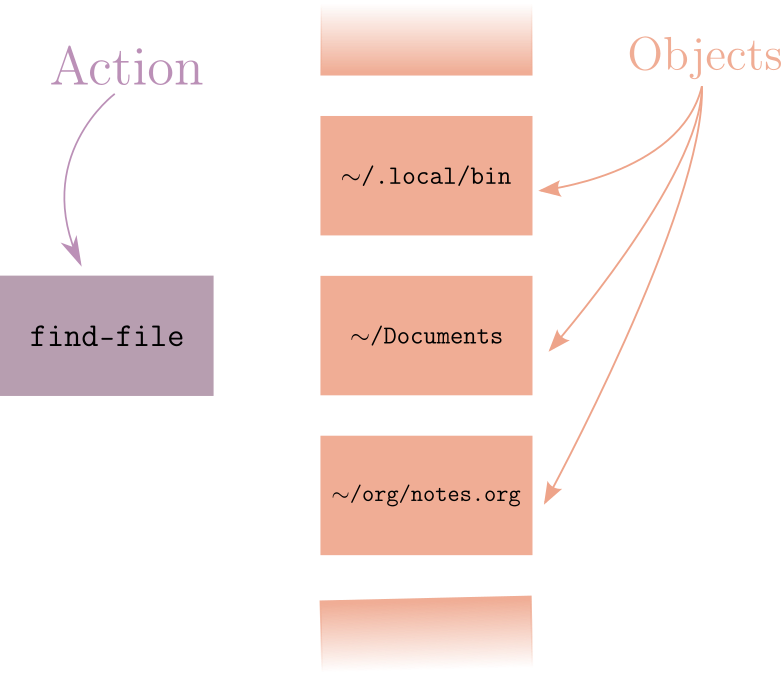
              Link Preview Image
              Fifteen ways to use Embark

              Where I collect notes. Sometimes you have to write to be able to think.

              favicon

              (karthinks.com)

              1 Reply Last reply
              0
              • jameshowell@fediscience.orgJ jameshowell@fediscience.org

                "The history of #Emacs completion frameworks is a progression from monolithic solutions toward composable ones."

                This is a comprehensive summary, with a thorough and fair history. A long read, but worth it.

                I plateaued at #Vertico #Orderless #Marginalia #Consult years ago. Maybe time to learn the others, one at a time.

                Link Preview Image
                VOMPECCC: A Modular Completion Framework for Emacs

                Completion is not a feature or UI, but instead it is a system composed of at least half a dozen orthogonal concerns that most users never think about separately...

                favicon

                Charlie Holland's Blog (www.chiply.dev)

                @oantolin @minad

                #emacs

                oantolin@mathstodon.xyzO This user is from outside of this forum
                oantolin@mathstodon.xyzO This user is from outside of this forum
                oantolin@mathstodon.xyz
                wrote last edited by
                #11

                @jameshowell I'm currently listening to the previous post in the series¹ and agreeing with pretty much everything.

                ¹ https://www.chiply.dev/post-icr-primer

                @minad

                kickingvegas@sfba.socialK 1 Reply Last reply
                0
                • minad@mastodon.worldM minad@mastodon.world

                  @tchauhan Another example is `cape-history` vs `consult-history`, which you can use in Comint, Shell or Eshell buffers. `cape-history` displays the candidates via in-buffer completion (e.g. Corfu) while `consult-history` displays the candidates via `completing-read` (e.g. Vertico).
                  @jameshowell @oantolin

                  oantolin@mathstodon.xyzO This user is from outside of this forum
                  oantolin@mathstodon.xyzO This user is from outside of this forum
                  oantolin@mathstodon.xyz
                  wrote last edited by
                  #12

                  @minad Now that I've gotten used to corfu instead of consult-completion-in-region, I should probably switch to cape-history in REPLs and shells. For minibuffer history, I might stick with consult-history. Which do you use for minibuffer history, Daniel? @tchauhan @jameshowell

                  minad@mastodon.worldM 1 Reply Last reply
                  0
                  • oantolin@mathstodon.xyzO oantolin@mathstodon.xyz

                    @minad Now that I've gotten used to corfu instead of consult-completion-in-region, I should probably switch to cape-history in REPLs and shells. For minibuffer history, I might stick with consult-history. Which do you use for minibuffer history, Daniel? @tchauhan @jameshowell

                    minad@mastodon.worldM This user is from outside of this forum
                    minad@mastodon.worldM This user is from outside of this forum
                    minad@mastodon.world
                    wrote last edited by
                    #13

                    @oantolin I use consult-history for both (repl and minibuffer), but mainly because I've bound it to the more convenient key (M-r).
                    @tchauhan @jameshowell

                    oantolin@mathstodon.xyzO 1 Reply Last reply
                    0
                    • minad@mastodon.worldM minad@mastodon.world

                      @oantolin I use consult-history for both (repl and minibuffer), but mainly because I've bound it to the more convenient key (M-r).
                      @tchauhan @jameshowell

                      oantolin@mathstodon.xyzO This user is from outside of this forum
                      oantolin@mathstodon.xyzO This user is from outside of this forum
                      oantolin@mathstodon.xyz
                      wrote last edited by
                      #14

                      @minad Same here, except I use M-h (not a lot paragraphs to mark in that type of buffer). @tchauhan @jameshowell

                      1 Reply Last reply
                      0
                      • oantolin@mathstodon.xyzO oantolin@mathstodon.xyz

                        @jameshowell I'm currently listening to the previous post in the series¹ and agreeing with pretty much everything.

                        ¹ https://www.chiply.dev/post-icr-primer

                        @minad

                        kickingvegas@sfba.socialK This user is from outside of this forum
                        kickingvegas@sfba.socialK This user is from outside of this forum
                        kickingvegas@sfba.social
                        wrote last edited by
                        #15

                        @oantolin @jameshowell @minad While I largely agree with the points made in the completion post, I wonder if there’s a need to introduce more jargon. Isn’t a completion framework just another name for an IME (input method editor)? https://en.wikipedia.org/wiki/Input_method

                        oantolin@mathstodon.xyzO 1 Reply Last reply
                        0
                        • kickingvegas@sfba.socialK kickingvegas@sfba.social

                          @oantolin @jameshowell @minad While I largely agree with the points made in the completion post, I wonder if there’s a need to introduce more jargon. Isn’t a completion framework just another name for an IME (input method editor)? https://en.wikipedia.org/wiki/Input_method

                          oantolin@mathstodon.xyzO This user is from outside of this forum
                          oantolin@mathstodon.xyzO This user is from outside of this forum
                          oantolin@mathstodon.xyz
                          wrote last edited by
                          #16

                          @kickingvegas I thought IMEs were mechanisms to type single characters and that most of them do not involve incremental completion and filtering!

                          EDIT: Your Wikipedia link agrees with my recollection. @jameshowell @minad

                          kickingvegas@sfba.socialK pjacock@fediscience.orgP 2 Replies Last reply
                          0
                          • oantolin@mathstodon.xyzO oantolin@mathstodon.xyz

                            @kickingvegas I thought IMEs were mechanisms to type single characters and that most of them do not involve incremental completion and filtering!

                            EDIT: Your Wikipedia link agrees with my recollection. @jameshowell @minad

                            kickingvegas@sfba.socialK This user is from outside of this forum
                            kickingvegas@sfba.socialK This user is from outside of this forum
                            kickingvegas@sfba.social
                            wrote last edited by
                            #17

                            @oantolin
                            This text on Chinese IMEs and seeing what contemporary implementations of it can do has shown me how much incremental completion and filtering has changed the game for computer input.

                            Access Denied

                            favicon

                            (mitpress.mit.edu)

                            @jameshowell @minad

                            1 Reply Last reply
                            0
                            • minad@mastodon.worldM minad@mastodon.world

                              @tchauhan What do you find difficult about Cape?

                              Cape basically provides a bunch of completion backends, so called Capfs. You can either add the Capfs to the `completion-at-point-functions` list, or invoke them directly, for instance `M-x cape-emoji` or `M-x cape-file`.

                              Another way to think of it - Cape is to Corfu what Consult is to Vertico.

                              @jameshowell @oantolin

                              tchauhan@mastodon.mit.eduT This user is from outside of this forum
                              tchauhan@mastodon.mit.eduT This user is from outside of this forum
                              tchauhan@mastodon.mit.edu
                              wrote last edited by
                              #18

                              @minad @jameshowell @oantolin Wow, hello Daniel and Omar, so wonderful to run into you on here. Much respect for your contributions to making emacs usable for forever-noobs like me!

                              I think last time I used cape I couldn't understand how cape-dabbrev is different from dabbrev (I understand now...). I will give it a go too!

                              I am especially struggling with my python vterm REPL though. I see a wall-of-text dump of all the candidates from the code as well as the REPL buffer! Any pointers?

                              minad@mastodon.worldM jameshowell@fediscience.orgJ 2 Replies Last reply
                              0
                              • tchauhan@mastodon.mit.eduT tchauhan@mastodon.mit.edu

                                @minad @jameshowell @oantolin Wow, hello Daniel and Omar, so wonderful to run into you on here. Much respect for your contributions to making emacs usable for forever-noobs like me!

                                I think last time I used cape I couldn't understand how cape-dabbrev is different from dabbrev (I understand now...). I will give it a go too!

                                I am especially struggling with my python vterm REPL though. I see a wall-of-text dump of all the candidates from the code as well as the REPL buffer! Any pointers?

                                minad@mastodon.worldM This user is from outside of this forum
                                minad@mastodon.worldM This user is from outside of this forum
                                minad@mastodon.world
                                wrote last edited by
                                #19

                                @tchauhan cape-dabbrev is similar to dabbrev-capf, but a little more polished. dabbrev-capf had bugs in the past, but I think they are fixed at least in Emacs 31. Regarding Python REPL completion I cannot help. All I know is that the Capf is broken. @jameshowell @oantolin

                                minad@mastodon.worldM 1 Reply Last reply
                                0
                                • minad@mastodon.worldM minad@mastodon.world

                                  @tchauhan cape-dabbrev is similar to dabbrev-capf, but a little more polished. dabbrev-capf had bugs in the past, but I think they are fixed at least in Emacs 31. Regarding Python REPL completion I cannot help. All I know is that the Capf is broken. @jameshowell @oantolin

                                  minad@mastodon.worldM This user is from outside of this forum
                                  minad@mastodon.worldM This user is from outside of this forum
                                  minad@mastodon.world
                                  wrote last edited by
                                  #20

                                  @tchauhan @jameshowell @oantolin You could try Drepl for a Python REPL with better completion. I have not used it so far, so I don't know how well it works in practice.

                                  Link Preview Image
                                  GitHub - astoff/drepl: REPL protocol for the dumb terminal

                                  REPL protocol for the dumb terminal. Contribute to astoff/drepl development by creating an account on GitHub.

                                  favicon

                                  GitHub (github.com)

                                  1 Reply Last reply
                                  0
                                  • tchauhan@mastodon.mit.eduT tchauhan@mastodon.mit.edu

                                    @minad @jameshowell @oantolin Wow, hello Daniel and Omar, so wonderful to run into you on here. Much respect for your contributions to making emacs usable for forever-noobs like me!

                                    I think last time I used cape I couldn't understand how cape-dabbrev is different from dabbrev (I understand now...). I will give it a go too!

                                    I am especially struggling with my python vterm REPL though. I see a wall-of-text dump of all the candidates from the code as well as the REPL buffer! Any pointers?

                                    jameshowell@fediscience.orgJ This user is from outside of this forum
                                    jameshowell@fediscience.orgJ This user is from outside of this forum
                                    jameshowell@fediscience.org
                                    wrote last edited by
                                    #21

                                    @tchauhan Yes. #Emacs-sphere, these two are your guys and they deserve your thanks!

                                    @minad @oantolin

                                    1 Reply Last reply
                                    0
                                    • oantolin@mathstodon.xyzO oantolin@mathstodon.xyz

                                      @kickingvegas I thought IMEs were mechanisms to type single characters and that most of them do not involve incremental completion and filtering!

                                      EDIT: Your Wikipedia link agrees with my recollection. @jameshowell @minad

                                      pjacock@fediscience.orgP This user is from outside of this forum
                                      pjacock@fediscience.orgP This user is from outside of this forum
                                      pjacock@fediscience.org
                                      wrote last edited by
                                      #22

                                      @oantolin @kickingvegas @jameshowell @minad Nah, not just character by character. Japanese IME for example you typically type in a whole sentence phonetically (and see the kana and first choice kanji appear as you go - sometimes that charges as you type in more giving it more context), then manually fix up any wrong inferences (eg left/right cursors to jump to position in sentence, then up/down or space/shift-space to cycle suggestions for that fragment). Then enter to finalise that sentence.

                                      1 Reply Last reply
                                      0
                                      • jameshowell@fediscience.orgJ jameshowell@fediscience.org

                                        "The history of #Emacs completion frameworks is a progression from monolithic solutions toward composable ones."

                                        This is a comprehensive summary, with a thorough and fair history. A long read, but worth it.

                                        I plateaued at #Vertico #Orderless #Marginalia #Consult years ago. Maybe time to learn the others, one at a time.

                                        Link Preview Image
                                        VOMPECCC: A Modular Completion Framework for Emacs

                                        Completion is not a feature or UI, but instead it is a system composed of at least half a dozen orthogonal concerns that most users never think about separately...

                                        favicon

                                        Charlie Holland's Blog (www.chiply.dev)

                                        @oantolin @minad

                                        #emacs

                                        wirthy@functional.cafeW This user is from outside of this forum
                                        wirthy@functional.cafeW This user is from outside of this forum
                                        wirthy@functional.cafe
                                        wrote last edited by
                                        #23

                                        @jameshowell Composability, where each module does one thing well and has a clean interface to the others, is a worthy goal. But from the user perspective, completion _is_ one thing, so why should we need to coordinate and configure seven or eight packages to get it working?

                                        Yes, as the article says, there are many _potentially_ orthogonal concerns in completion, but when you separate them into different user packages, you've pushed too much of the complexity of their interaction onto the user.

                                        The solution, apparently, is to add another layer of abstraction: emacs configuration kits. It all seems a bit much.

                                        1 Reply Last reply
                                        0
                                        • R relay@relay.infosec.exchange shared this topic
                                        Reply
                                        • Reply as topic
                                        Log in to reply
                                        • Oldest to Newest
                                        • Newest to Oldest
                                        • Most Votes


                                        • Login

                                        • Login or register to search.
                                        • First post
                                          Last post
                                        0
                                        • Categories
                                        • Recent
                                        • Tags
                                        • Popular
                                        • World
                                        • Users
                                        • Groups