Another 3D-printing suggestion from Colm Mulcahy:
-
Another 3D-printing suggestion from Colm Mulcahy:
Archimedes proved that if you slice a sphere of radius r with two planes a distance h apart, the surface area is 2πrh—the same as a cylinder of the same radius and height. So, it doesn't depend on where the slicing occurs.
1/2@divbyzero reminds me of the Martin Gardner problem where you drill though a sphere. If the length of the hole ends up at six inches, what is the volume of the remaining material? I won’t spoil it, but I always found the simplest way to the solution pretty enjoyable.
-
@divbyzero reminds me of the Martin Gardner problem where you drill though a sphere. If the length of the hole ends up at six inches, what is the volume of the remaining material? I won’t spoil it, but I always found the simplest way to the solution pretty enjoyable.
@divbyzero oh! I should have scrolled down farther. Then I’ll spoil it and add that what I liked about it is that knowledge that it’s a brain-teaser can help you solve it. It’s not really a brain teaser unless the solution is interesting since Martin Gardner probably isn’t going to lob calculus questions at you, so we can guess that the solution is constant, and if there’s no dependence on the particular geometry, the hole might as well have radius zero, leaving a sphere, which trivially has volume 36pi, which happens to be correct in general!
-
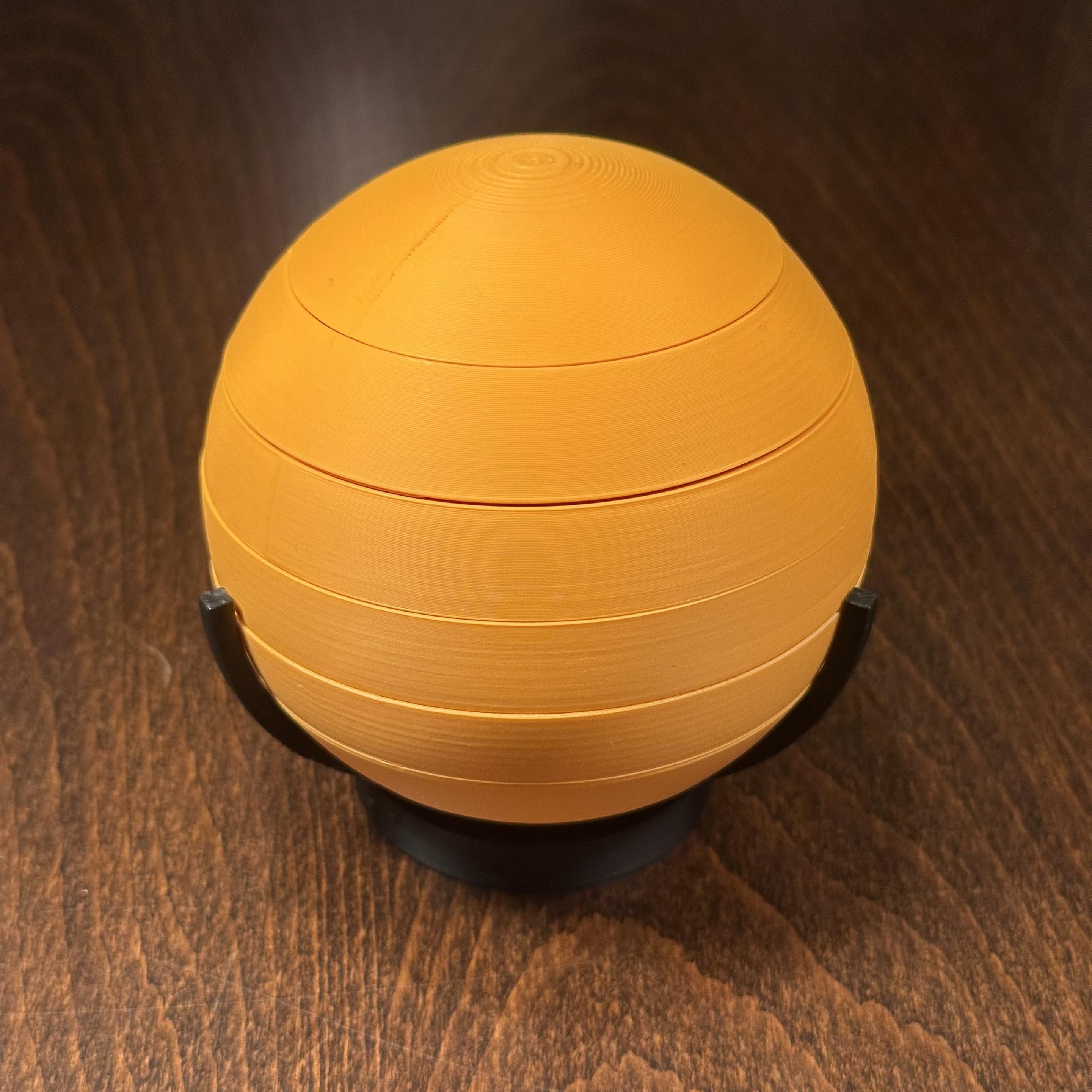
Idea: Produce 3D-printed slices of a (hollow) sphere, all of the same height. Print with 100% fill. They should all weigh the same.
Bam!
I propose you try it with a hollow sphere of 30.0 cm diameter and a shell thickness of 14.9 mm, printing slices of 1mm thickness, one taken near the middle, and one just at the top of the sphere.
-
R relay@relay.an.exchange shared this topic
-
I propose you try it with a hollow sphere of 30.0 cm diameter and a shell thickness of 14.9 mm, printing slices of 1mm thickness, one taken near the middle, and one just at the top of the sphere.
@sibrosan Did you see the second of the two posts? That's essentially what I did (but with different dimensions).
-
@sibrosan Did you see the second of the two posts? That's essentially what I did (but with different dimensions).
If you did it with the dimensions I suggested, you would find that the slice from the middle weighed much more than the slice from the top.
In your case (with a much thinner shell) the difference might be small enough to dismiss as measurement error, but if accurately printed and weighed it will be there.
-
If you did it with the dimensions I suggested, you would find that the slice from the middle weighed much more than the slice from the top.
In your case (with a much thinner shell) the difference might be small enough to dismiss as measurement error, but if accurately printed and weighed it will be there.
@sibrosan Ah! I misuderstood your original comment. I thought you just wanted me to make the model larger. You are 100% correct. In fact, this is version 2.0. For version 1.0, the sphere was smaller with the same thickness walls, and when I sliced the sphere straight across, the difference in weight was measurable. So, in this version 2.0, I made the sphere larger and the slices are sliced along cones converging at the origin rather than along flat planes. That way, the "height" of each radial shell in the thin solid object is the same. (It has the added benefit that one ring sits slightly inside its neighbor, which is nice.)
-
If you did it with the dimensions I suggested, you would find that the slice from the middle weighed much more than the slice from the top.
In your case (with a much thinner shell) the difference might be small enough to dismiss as measurement error, but if accurately printed and weighed it will be there.
With a thin shell the slopes of the slicing surfaces are negligible.
With a thicker shell (outer diameter D and inner diameter d) such a surface should have a slope such that the outer edges have vertical distance D/n and the inner edges have vertical distance d/n. Thus a slicing surface is a part of a cone with its apex at the center of the spheres. This way the slices should have the same weight again.
Edit: Ok, I was too slow. You already wrote essentially the same.
-
With a thin shell the slopes of the slicing surfaces are negligible.
With a thicker shell (outer diameter D and inner diameter d) such a surface should have a slope such that the outer edges have vertical distance D/n and the inner edges have vertical distance d/n. Thus a slicing surface is a part of a cone with its apex at the center of the spheres. This way the slices should have the same weight again.
Edit: Ok, I was too slow. You already wrote essentially the same.
With a thick shell it's also negligible, it just depends on how much you are willing to neglect...
Anyway, my point is that the claim that the weight/volume of any slice is the same, is simply not true, no matter how thin the shell.
-
With a thick shell it's also negligible, it just depends on how much you are willing to neglect...
Anyway, my point is that the claim that the weight/volume of any slice is the same, is simply not true, no matter how thin the shell.
I think I did get your point. There are differences in weight/volume with planar cuts. (And the diffs are small for thin shells and get bigger for thick shells.)
But these differences go away *completely* with the conic cuts.
-
Idea: Produce 3D-printed slices of a (hollow) sphere, all of the same height. Print with 100% fill. They should all weigh the same.
Bam!
@divbyzero ok, now do the cone vs. cylinder question... cylinder = 3•cone volume. Or cone vs (cylinder – cone) which would be 2•cone volume.
Or my absolute favorite: truncate a cone to make a frustum. Then the removed cone part and the frustum have volume ratio cone : frustum = cone height: (cone + frustum height) -
I think I did get your point. There are differences in weight/volume with planar cuts. (And the diffs are small for thin shells and get bigger for thick shells.)
But these differences go away *completely* with the conic cuts.
I don´t doubt that you can adjust the inner shape of the slices to get them the exact same volume. Whether the cone cut, as you describe, does that, i'm not so sure. You're a mathematician, right? Can you prove it?
-
Idea: Produce 3D-printed slices of a (hollow) sphere, all of the same height. Print with 100% fill. They should all weigh the same.
Bam!
I just put these files on Thingiverse for anyone to download and print https://www.thingiverse.com/thing:7305536
-
R relay@relay.mycrowd.ca shared this topic