I'm mad about linux distros again today and I think I am realizing why this is so hard for me to write about systemically: I have a software engineer brain and so I try to model the various problems as technical problems.
-
@cthos @miss_rodent less flippant answer:
there are of course efforts to unify the platforms around certain abstractions which paper over the differences. and some of them (flatpak included) are even close enough to kinda work some of the time. but developing a flatpak and getting it deployed, while *possible*, does not have zero marginal cost per distro.
@cthos @miss_rodent and to the extent that it succeeds, it succeeds by creating a meta-platform, flatpak, that floats on top of the distro and makes all the distinctions between them irrelevant anyway. it also doesn't fully succeed (flatpak filesystem permissions are a user-interface nightmare)
-
@miss_rodent the consolidation is going to happen anyway. I am suggesting a way it could happen with democratic involvement of volunteers. which I realize is a bit of a pipe dream.
realistically, everyone will just pivot what it means to make "linux desktop" software to mean "works on SteamOS" and then Valve gets to write the specs that everyone else follows, and the viability of a desktop Linux distro will be scored according to the accuracy of its SteamOS emulation
@glyph Honestly, I think that is a reason to move further in the other direction, and become more diverse and hostile to corporate interests.
I think consolidating and trying to act more like the commercial-capitalist OSes is an ethical and social failure; the diversity and chaotic aspect of the ecosystem are a functional pillar of the community.
-
In short, all the volunteer-based distributions need to have a gigantic conference where they all come together and *agree to stop working on about 99% of them*, to pool efforts to make a real Linux platform. A lot of people will need to put their egos aside and decide to acquiesce to solutions they believe to be technically inferior, in order to be able to address the diffusion of labor into pointlessly recreating basically the same toolchain a thousand times.
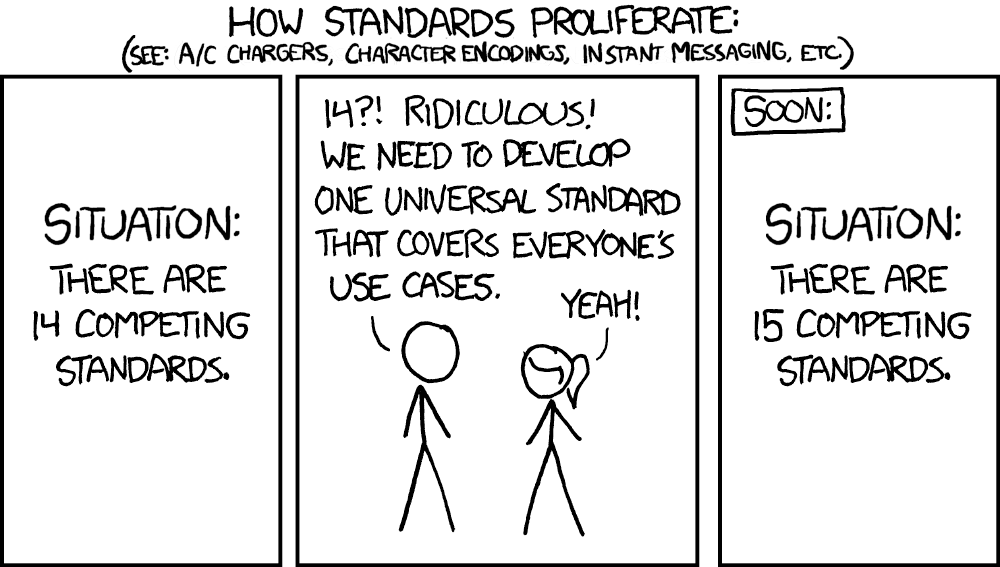
@glyph so XKCD “15 standards”…. but somehow in reverse?

(I do agree that it’s almost entirely a set of social problems though. It always has been. Indeed the whole “15 standards” problem is basically social problems translated into tech.)
-
@glyph mmm, not just because of "interesting and engaging problems", but many people came into it specifically because of their egos: *my* distro will be better (and I will be famous). Basically, you're advocating for abandoning the core motivation (or one of the main ones anyway) for tinkering around the free code.
@glyph my thinking was always that it's fine to have a gazillion distributions, but I'd prefer one of them to clearly win. And for that they need to care about the whole stack: from hardware to apps (like Apple). Canonical was in this position, but Mark Shuttleworth very clearly said they were not interested in hardware. @elementary does seem to care about the whole stack, but they lack resources. System76 does hardware + desktop, but not the apps…
-
@cthos @miss_rodent and to the extent that it succeeds, it succeeds by creating a meta-platform, flatpak, that floats on top of the distro and makes all the distinctions between them irrelevant anyway. it also doesn't fully succeed (flatpak filesystem permissions are a user-interface nightmare)
@glyph @miss_rodent Do... do we need to discuss just how many apps run on Electron on Mac and PC?
-
 P pixelate@tweesecake.social shared this topic
-
@glyph my thinking was always that it's fine to have a gazillion distributions, but I'd prefer one of them to clearly win. And for that they need to care about the whole stack: from hardware to apps (like Apple). Canonical was in this position, but Mark Shuttleworth very clearly said they were not interested in hardware. @elementary does seem to care about the whole stack, but they lack resources. System76 does hardware + desktop, but not the apps…
@isagalaev @elementary I mean *ideally* we'd have a healthy fringe of biodiversity around the edges where users could move to a new platform provider with relatively low friction to pick a new "winner" if the biggest one started to enshittify the ecosystem, so a bunch of different free operating systems that are friendly to ISVs and low-effort to port to, but that does not seem to be what's happening
-
@glyph @miss_rodent Do... do we need to discuss just how many apps run on Electron on Mac and PC?
@cthos @miss_rodent Electron is definitely a more successful Flatpak than Flatpak
-
@cthos @miss_rodent Electron is definitely a more successful Flatpak than Flatpak
@glyph @miss_rodent Cool, problem solved, just run Electron everywhere.

-
In short, all the volunteer-based distributions need to have a gigantic conference where they all come together and *agree to stop working on about 99% of them*, to pool efforts to make a real Linux platform. A lot of people will need to put their egos aside and decide to acquiesce to solutions they believe to be technically inferior, in order to be able to address the diffusion of labor into pointlessly recreating basically the same toolchain a thousand times.
@glyph I don’t necessarily disagree (or 100% agree) but the odds of this seem… small.
Our problems really aren’t technical - they’re social and political. The same problems that keep us from solving other political and social problems: we just can’t seem to put things aside for the common good or organize for such things without personal interests, tribalism, and greed getting in the way.
-
@glyph Honestly, I think that is a reason to move further in the other direction, and become more diverse and hostile to corporate interests.
I think consolidating and trying to act more like the commercial-capitalist OSes is an ethical and social failure; the diversity and chaotic aspect of the ecosystem are a functional pillar of the community.
@miss_rodent but nothing is hostile to corporate interest here; the corporate interest can quite happily co-opt all the labor in any case; SteamOS has already proved that concept. You can either accept the corporate takeover *by* corporate leadership, or you can consolidate into an organization that protects user agency.
The logic here is "we shouldn't have a union, because that's just the same as a corporation". I specifically called out "volunteer-driven" distros (Debian, Fedora(ish), Arch)
-
@miss_rodent but nothing is hostile to corporate interest here; the corporate interest can quite happily co-opt all the labor in any case; SteamOS has already proved that concept. You can either accept the corporate takeover *by* corporate leadership, or you can consolidate into an organization that protects user agency.
The logic here is "we shouldn't have a union, because that's just the same as a corporation". I specifically called out "volunteer-driven" distros (Debian, Fedora(ish), Arch)
@miss_rodent To put it another way, Capital is already organized. Do you want to be organized too, or just accept defeat?
-
@glyph I don’t necessarily disagree (or 100% agree) but the odds of this seem… small.
Our problems really aren’t technical - they’re social and political. The same problems that keep us from solving other political and social problems: we just can’t seem to put things aside for the common good or organize for such things without personal interests, tribalism, and greed getting in the way.
@jzb I would say it's impossible! But still, I'm just tootin' out a dream here.
-
@glyph @miss_rodent Cool, problem solved, just run Electron everywhere.
@cthos @miss_rodent … and that's exactly why I wish Linux *were* a platform
-
@jzb I would say it's impossible! But still, I'm just tootin' out a dream here.
@glyph keep tooting. Dreams are important.
-
@glyph keep tooting. Dreams are important.
@jzb remember to like and subscribe
-
@glyph so XKCD “15 standards”…. but somehow in reverse?
(I do agree that it’s almost entirely a set of social problems though. It always has been. Indeed the whole “15 standards” problem is basically social problems translated into tech.)
@ewenmcneill yep that's the idea and that's also why it's intractable
-
@glyph @miss_rodent The list includes but is not limited to:
- Manjaro on a 2015 Macbook Air 11" with XFCE
- Bazzite on a Framework 13" with KDE
- ZorinOS on Starlabs Starlite (which IIRC is highly skinned GNOME)
- Vanilla Ubuntu on a weirdo 10" tablet PC thingie from Chuwi (Required some config to enable because Ubuntu really loves snaps and they shouldn't)And all my applications just work.
@cthos @miss_rodent FWIW it's not *impossible* for this to work, but it is wildly beyond *cost-effective* for most ISVs
-
@miss_rodent To put it another way, Capital is already organized. Do you want to be organized too, or just accept defeat?
@glyph I'm not opposed to the *community* organizing to tell valve to go fuck themselves -
I'm opposed to consolidating the outputs of the community into something that more resembles commercial software.Community actions like re-licensing everything (especially libraries) under the GPL to make corporate types recoil in horror, I'd be much more in favour of.
-
@cthos @miss_rodent FWIW it's not *impossible* for this to work, but it is wildly beyond *cost-effective* for most ISVs
@glyph @miss_rodent I mean, I regularly come across Flatpak wrappers around software that the maintainers did not themselves package that also just works and is maintained by one person occasinally running a CI script though so I don't think this is necessarily true for all applications.
Also RE: filesystem permissions, it's now extremely rare that I have to fire up flatseal and make any changes at all for my normal software.
-
@glyph I'm not opposed to the *community* organizing to tell valve to go fuck themselves -
I'm opposed to consolidating the outputs of the community into something that more resembles commercial software.Community actions like re-licensing everything (especially libraries) under the GPL to make corporate types recoil in horror, I'd be much more in favour of.
@glyph Basically - I think the better response, if the community is all coming together anyway, is not to standardize and make the ecosystem more homogenized.
But to actively make linux harder to monetize and commodify according to corporate models.