What are the implications for #ActivityPub user interface design?
-
@smallcircles @benpate @strypey @EUCommission @nlnet good reflection. If things here look copy pasted from the corporate captured web, it might be because the same people keep making the same limiting decisions with their cronies all the way since https://en.wikipedia.org/wiki/OpenSocial
Big believer in Conways Law and also moreso
Good point Ben. And there’s a delicate balance of giving people something good and unique vs. something they’re familiar with and will use
Remember, nobody can force you to use the Fediverse, so our tools have to meet people where they are.
It’s like weaning an addict off of cigarettes, or sugar.
-
Good point Ben. And there’s a delicate balance of giving people something good and unique vs. something they’re familiar with and will use
Remember, nobody can force you to use the Fediverse, so our tools have to meet people where they are.
It’s like weaning an addict off of cigarettes, or sugar.
@benpate @smallcircles @strypey @EUCommission @nlnet I’ve been using this website for almost a decade and the way it does the fediverse protocols has changed a great amount over that time. There wasn’t any informed consent about the way in which I use this app does “fediverse” during that whole time. These cloud oriented platforms on the fediverse effectively force people to use new “fediverse” all the time.
-
@benpate @smallcircles @strypey @EUCommission @nlnet I’ve been using this website for almost a decade and the way it does the fediverse protocols has changed a great amount over that time. There wasn’t any informed consent about the way in which I use this app does “fediverse” during that whole time. These cloud oriented platforms on the fediverse effectively force people to use new “fediverse” all the time.
@benpate @smallcircles @strypey @EUCommission @nlnet People do need to take responsibility for which kind of fediverse they use by interacting with the fediverse not through a web page served by a platform, but through clients that aren’t served by web platforms. Choose the code you run. Beware networks that “give” you opaque behavior that changes without your informed consent because https://en.wikipedia.org/wiki/Moral_hazard
-
@benpate @smallcircles @strypey @EUCommission @nlnet People do need to take responsibility for which kind of fediverse they use by interacting with the fediverse not through a web page served by a platform, but through clients that aren’t served by web platforms. Choose the code you run. Beware networks that “give” you opaque behavior that changes without your informed consent because https://en.wikipedia.org/wiki/Moral_hazard
Very true. That’s a great case for each person controlling their own identity/experiemce/etc.
I’m fascinated how different people can look at the same evidence and take away such different conclusions.
I usually see apps as a kind of lock in. Someone’s more likely to find you on the open web first, then MAYBE “convert” and upgrade to your app.
I totally see your point too (esp regarding security) but there are so many paths up the mountain.
-
Very true. That’s a great case for each person controlling their own identity/experiemce/etc.
I’m fascinated how different people can look at the same evidence and take away such different conclusions.
I usually see apps as a kind of lock in. Someone’s more likely to find you on the open web first, then MAYBE “convert” and upgrade to your app.
I totally see your point too (esp regarding security) but there are so many paths up the mountain.
Thx @bengo for Matthew and Planck principles, new for me as named social phenomena. Our social dynamics are truly fascinating, but almost totally unaddressed in how we end up 'landscaping' our collective gardens when all tech gets plugged together, beyond apps, and "wild emergence" kicks in.
> there’s a delicate balance of giving people something good and unique vs. something they’re familiar with and will use
@benpate totally. If you want to "rescue" people asap, the urge is to go for the familiar. But is that the best option, and sustainable long-term? This bears thinking on more, but as a collective, and how to achieve that, right? That's where #SX positions itself. Between hard tech and best societal outcome of its introduction.
Grassroots nature of #fedi is a strength, but does not necessarily yield best outcomes. Most likely we get visited by #Conway.
My next blog post (not yet published) ponders the #ParadoxOfEmergence
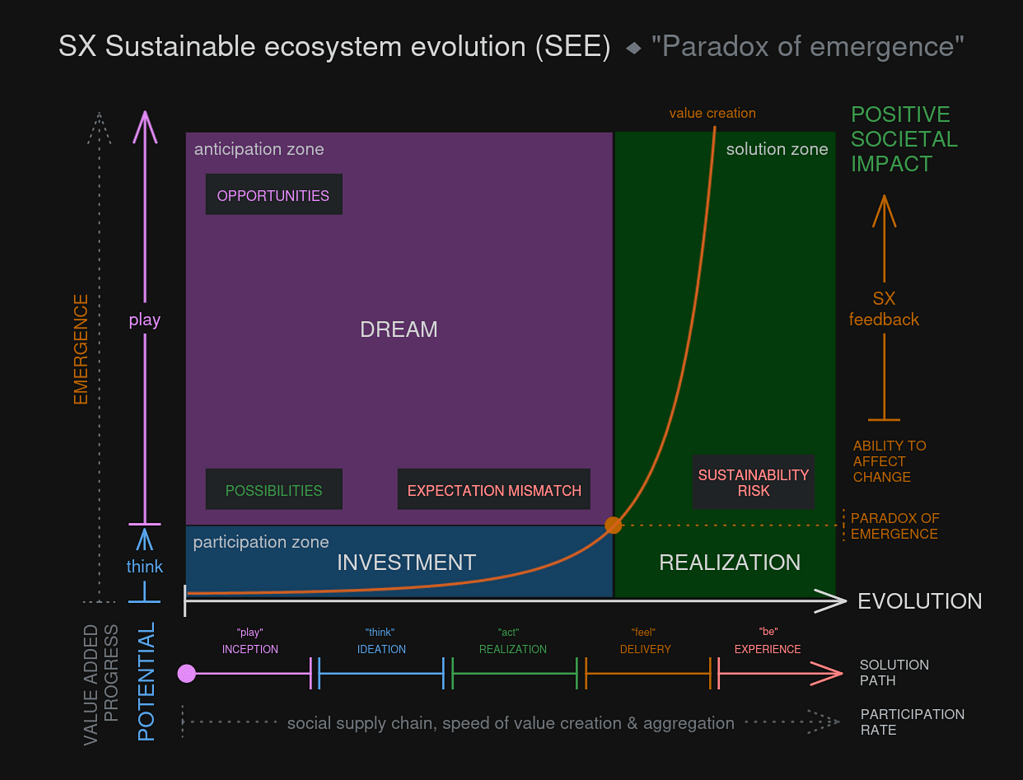
SX: Sustainable ecosystem evolution (SEE)
Sustainable ecosystem evolution (SEE) :information_source: Note: The diagram depicts SEE simplified. The full SEE model evolves commons-first.
Click to expand the Alt-text to the diagram.The diagram shows an expo…
Discuss Social Coding (discuss.coding.social)
-
Thx @bengo for Matthew and Planck principles, new for me as named social phenomena. Our social dynamics are truly fascinating, but almost totally unaddressed in how we end up 'landscaping' our collective gardens when all tech gets plugged together, beyond apps, and "wild emergence" kicks in.
> there’s a delicate balance of giving people something good and unique vs. something they’re familiar with and will use
@benpate totally. If you want to "rescue" people asap, the urge is to go for the familiar. But is that the best option, and sustainable long-term? This bears thinking on more, but as a collective, and how to achieve that, right? That's where #SX positions itself. Between hard tech and best societal outcome of its introduction.
Grassroots nature of #fedi is a strength, but does not necessarily yield best outcomes. Most likely we get visited by #Conway.
My next blog post (not yet published) ponders the #ParadoxOfEmergence
SX: Sustainable ecosystem evolution (SEE)
Sustainable ecosystem evolution (SEE) :information_source: Note: The diagram depicts SEE simplified. The full SEE model evolves commons-first.
Click to expand the Alt-text to the diagram.The diagram shows an expo…
Discuss Social Coding (discuss.coding.social)
Long term, no. It's not the best outcome.
But this is the difference between thinking like a "tech person" and thinking like a "sales person" (excuse by rough analogy)
Relationships are a journey. They start with a loose commitment, then slowly build trust over time and ratchet up the customer's investment in the product.
Super-secure apps may be the end goal, but you won't get there without the initial state: discovery via the open web.
-
Thx @bengo for Matthew and Planck principles, new for me as named social phenomena. Our social dynamics are truly fascinating, but almost totally unaddressed in how we end up 'landscaping' our collective gardens when all tech gets plugged together, beyond apps, and "wild emergence" kicks in.
> there’s a delicate balance of giving people something good and unique vs. something they’re familiar with and will use
@benpate totally. If you want to "rescue" people asap, the urge is to go for the familiar. But is that the best option, and sustainable long-term? This bears thinking on more, but as a collective, and how to achieve that, right? That's where #SX positions itself. Between hard tech and best societal outcome of its introduction.
Grassroots nature of #fedi is a strength, but does not necessarily yield best outcomes. Most likely we get visited by #Conway.
My next blog post (not yet published) ponders the #ParadoxOfEmergence
SX: Sustainable ecosystem evolution (SEE)
Sustainable ecosystem evolution (SEE) :information_source: Note: The diagram depicts SEE simplified. The full SEE model evolves commons-first.
Click to expand the Alt-text to the diagram.The diagram shows an expo…
Discuss Social Coding (discuss.coding.social)
@strypey @EUCommission @nlnet @bengo
> That’s a great case for each person controlling their own identity/experience/etc
> I usually see apps as a kind of lock in
@benpate this!
One's own experience is literally what "social experience" in SX stands for. And then projects upwards from Personal Needs, via motivated action based on them, to how they relate to other people, and ultimately at largest societal scale how they contribute to our hypercomplex 'construct of society'. See Pyramid of Perspective model at: https://coding.social/blog/reimagine-social/#pyramid-of-perspective
Related notion in that article is Personal social networking. An approach that encourages making comparison and analogy with familiar social constructs offline, where we do social networking for ages.
And then tell me e.g. where your local Moderation force operates, ready to slap you on the wrist for saying something nasty. Or ostracizes / silences you, 3-strikes you're out (if you are lucky). Countless things we build online are ultra-weird offline.
-
Long term, no. It's not the best outcome.
But this is the difference between thinking like a "tech person" and thinking like a "sales person" (excuse by rough analogy)
Relationships are a journey. They start with a loose commitment, then slowly build trust over time and ratchet up the customer's investment in the product.
Super-secure apps may be the end goal, but you won't get there without the initial state: discovery via the open web.
@benpate @smallcircles @strypey @EUCommission @nlnet i don’t know what you mean. I already discovered great secure apps via the open web on websites called signal.org, matrix.org, wire.com, etc etc.
And btw I’ve sold plenty of software in my day, with a diverse group of people, and there’s rarely consensus on how to think amongst tech/sales roles, at least not on diverse teams.
-
@benpate @smallcircles @strypey @EUCommission @nlnet i don’t know what you mean. I already discovered great secure apps via the open web on websites called signal.org, matrix.org, wire.com, etc etc.
And btw I’ve sold plenty of software in my day, with a diverse group of people, and there’s rarely consensus on how to think amongst tech/sales roles, at least not on diverse teams.
@benpate @smallcircles @strypey @EUCommission @nlnet in my experience fwiw, the most frequent challenge with sales teams tends to be structuring the incentives so they don’t make unrealistic promises that hurt the company equity in the long run just so they can maximize this years cash comp.
-
@benpate @smallcircles @strypey @EUCommission @nlnet i don’t know what you mean. I already discovered great secure apps via the open web on websites called signal.org, matrix.org, wire.com, etc etc.
And btw I’ve sold plenty of software in my day, with a diverse group of people, and there’s rarely consensus on how to think amongst tech/sales roles, at least not on diverse teams.
We're probably just looking at two loosely related issues. I'm answering @smallcircles's statement about Fediverse servers "rescuing" people from other platforms.
Yes, you and I are already plugged in to all of the techie tools.
But we can't expect regular people to be all in on day one. They may not immediately choose a platform, pick an instance, sign up, install the app, and so on.
We need to make a smooth path for people to walk.
@bengo@strypey@mastodon.nzoss.nz @EUCommission @nlnet
-
We're probably just looking at two loosely related issues. I'm answering @smallcircles's statement about Fediverse servers "rescuing" people from other platforms.
Yes, you and I are already plugged in to all of the techie tools.
But we can't expect regular people to be all in on day one. They may not immediately choose a platform, pick an instance, sign up, install the app, and so on.
We need to make a smooth path for people to walk.
@bengo@strypey@mastodon.nzoss.nz @EUCommission @nlnet
I'd like to add that: the initials for "Sales and Marketing" are "S&M" and that can't be a coincidence.
I'm happy to NOT relive my days doing sales and marketing. I'm sure you are, too. But onboarding people is more than a technology problem. We can't expect success if the initial hurdles are so damned high (as they are today).
If we want to advocate for new people to join this network, we'll need to meet them where they are.
-
I'd like to add that: the initials for "Sales and Marketing" are "S&M" and that can't be a coincidence.
I'm happy to NOT relive my days doing sales and marketing. I'm sure you are, too. But onboarding people is more than a technology problem. We can't expect success if the initial hurdles are so damned high (as they are today).
If we want to advocate for new people to join this network, we'll need to meet them where they are.
@benpate @smallcircles @EUCommission @nlnet good points. Totally agree about meeting people where they are. From my perspective, the majority of the people on the fediverse in 5 years aren’t on it now. So designing for them is different than designing for the smaller total addressable audience that is on it.
you’re right some folks will only want to use web pages. I’m glad they’ll have many options too.
-
@benpate @smallcircles @EUCommission @nlnet good points. Totally agree about meeting people where they are. From my perspective, the majority of the people on the fediverse in 5 years aren’t on it now. So designing for them is different than designing for the smaller total addressable audience that is on it.
you’re right some folks will only want to use web pages. I’m glad they’ll have many options too.
@bengo @benpate @EUCommission @nlnet
I just tooted how the focus on people gets lost when we allow ourselves to be so deeply mired in this technosphere (because of our fascinations and aspirations) that tend to forget what software really is.
Software constitutes abstractions of reality with the purpose of serving people's needs. Even where the dev is the only stakeholder, creating hobby code, and then exponentially when their FOSS project gains traction. And how that works is totally overlooked.
Under SX saying "user" is a 'forbidden word'. When using it, you lost already half the game.
🫧 socialcoding.. (@smallcircles@social.coop)
@johannab@cosocial.ca > FOSS has a very unfortunate weak spot in its foundation, that being the idea that “free” implies “without ownership” rather than “equitably shareable” 💯! Just dropped a #meme depicting how #SX considers #FOSS: https://social.coop/@smallcircles/116433599463361421 #Equity is the word. I wrote a blog on #SharedOwnership earlier: https://coding.social/blog/shared-ownership Note, that "libertarianism" is emergent, comes with scale. I avoid the term for its political heat it often introduces, and how that stifles #solution-orientation. > I make product actually meet the users’ needs, cuz damn, you didn’t! It's funny how actual #Needs are often totally unknown, esp. in FOSS. The #technology then quickly exists mostly for the sake of itself. Damn the externalities. Social coding commons defines FOSS as the pure software artifact. Code + an open license. Period. All the rest is #SocialCoding where all #expectations we have are either implied and unjustified, or warranted with mutual understanding. The latter is hardly done.

social.coop (social.coop)
Also SX considers FOSS to be nothing more than the software artifact + an open license. The FOSS movement and its inherent unsustainability then becomes a problem of organization. How do you organize chaotic commons? How do you compete with Big Bizz & Industry, who are able to run hypercomplex global supply lines?
Simple: #ChaordicCommons
Not easy.
How We Reimagine the Social Web
We find novel ways to collaborate and create value together.

Social coding commons (coding.social)
-
Good point Ben. And there’s a delicate balance of giving people something good and unique vs. something they’re familiar with and will use
Remember, nobody can force you to use the Fediverse, so our tools have to meet people where they are.
It’s like weaning an addict off of cigarettes, or sugar.
@benpate @bengo @smallcircles @strypey @EUCommission @nlnet literally just re-implement tumblr, with the exact same reblog chain UX, and the same fusion of likes+reblogs into "notes" (before Matt Mullenweg ruined that, which was the subject of much caustic backlash from the userbase, many of whom have been there for ≥ 15 years) … and see what happens.
and no, Wafrn hasn't done this. I did have a good chat with the Wafrn guy about why the OG tumblr UX is important (its emergent effects) though.
-
@benpate @bengo @smallcircles @strypey @EUCommission @nlnet literally just re-implement tumblr, with the exact same reblog chain UX, and the same fusion of likes+reblogs into "notes" (before Matt Mullenweg ruined that, which was the subject of much caustic backlash from the userbase, many of whom have been there for ≥ 15 years) … and see what happens.
and no, Wafrn hasn't done this. I did have a good chat with the Wafrn guy about why the OG tumblr UX is important (its emergent effects) though.
Honestly, I'm not super familiar with Tumlbr. Could you point me to an example of this in action?
We are limited (to a degree) by some design choices made in ActivityPub long ago. "Likes", "Boosts", and "Replies" are all separate things that are hard (but perhaps not impossible) to combine into a single unit.
@deutrino @bengo @smallcircles @strypey @EUCommission @nlnet
-
Yeah, not impossible, just awkward and fragile. It complicates interop because other apps are expecting things to be separate. E.g., how to display something if a Mastodon user just clicks one, but not all three?
I dunno, maybe we’re overthinking it. We could just shove them all together, display a “best guess” UI, and ignore the screams from the ActivityPub purists?
@strypey @deutrino @bengo @smallcircles @EUCommission @nlnet