Skip to content
  • Categories
  • Recent
  • Tags
  • Popular
  • World
  • Users
  • Groups
Skins
  • Light
  • Brite
  • Cerulean
  • Cosmo
  • Flatly
  • Journal
  • Litera
  • Lumen
  • Lux
  • Materia
  • Minty
  • Morph
  • Pulse
  • Sandstone
  • Simplex
  • Sketchy
  • Spacelab
  • United
  • Yeti
  • Zephyr
  • Dark
  • Cyborg
  • Darkly
  • Quartz
  • Slate
  • Solar
  • Superhero
  • Vapor

  • Default (Cyborg)
  • No Skin
Collapse
Brand Logo

CIRCLE WITH A DOT

  1. Home
  2. Uncategorized
  3. Very exciting discovery in Velasco Labs right now!

Very exciting discovery in Velasco Labs right now!
Scheduled Pinned Locked Moved Uncategorized
22 Posts 9 Posters 0 Views
  • Oldest to Newest
  • Newest to Oldest
  • Most Votes
Reply
  • Reply as topic
Log in to reply
This topic has been deleted. Only users with topic management privileges can see it.
  • mle_online@social.afront.orgM mle_online@social.afront.org

    Very exciting discovery in Velasco Labs right now!

    People keep sending me links to that German feminist hacker collective that made wild clay PCBs, and while i think that's pretty cool, the way they applied the conductive traces felt a little like a cheat to me because they were sort of painted on.

    Last night after someone linked me to it again, i suddenly remembered my experiments with adding copper powder to ceramics glazes, and how, by smothering the red-hot ceramics in sawdust, i was able to reduce the copper oxides into something that looked like metallic copper. That got me pondering.

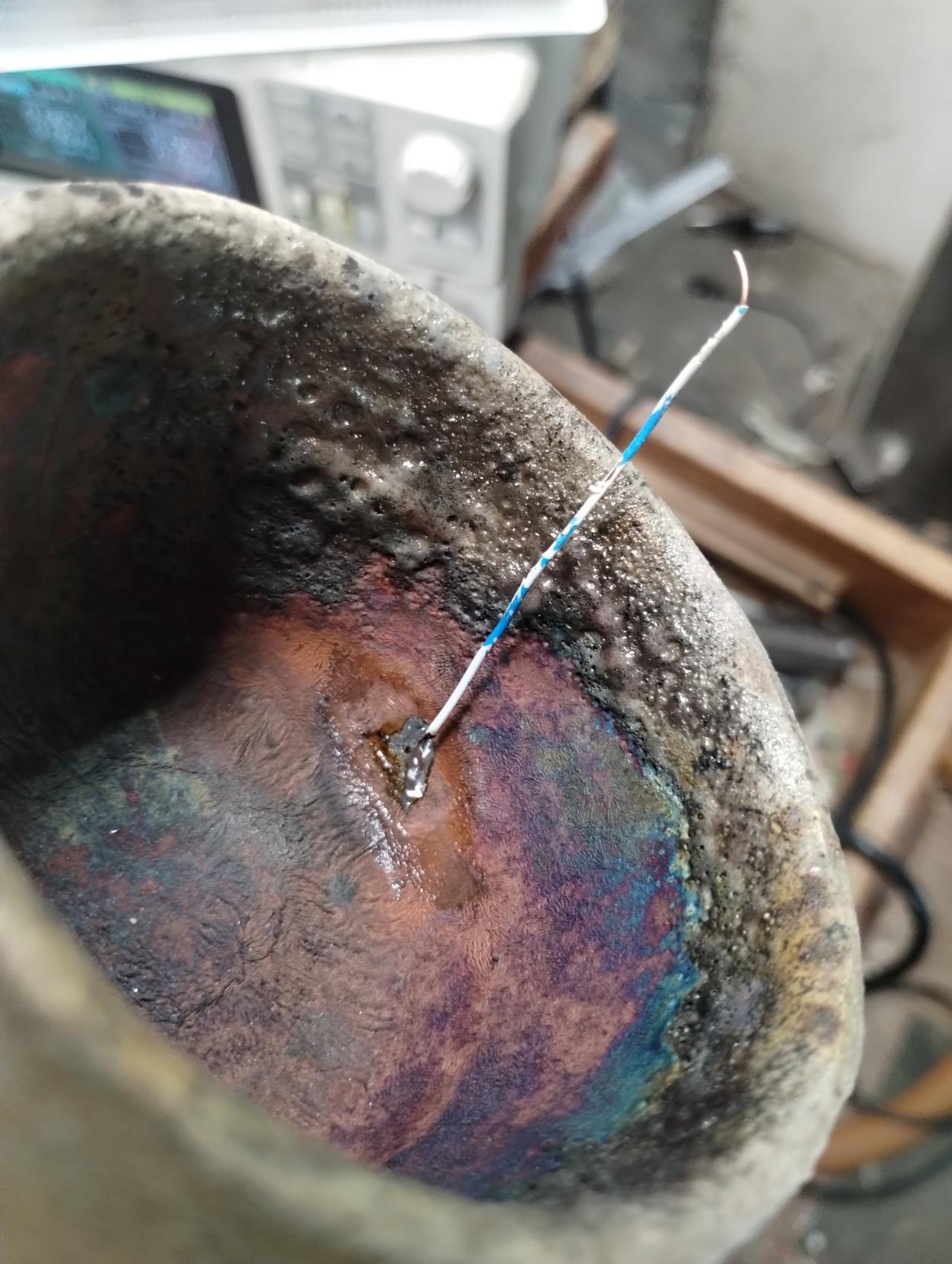
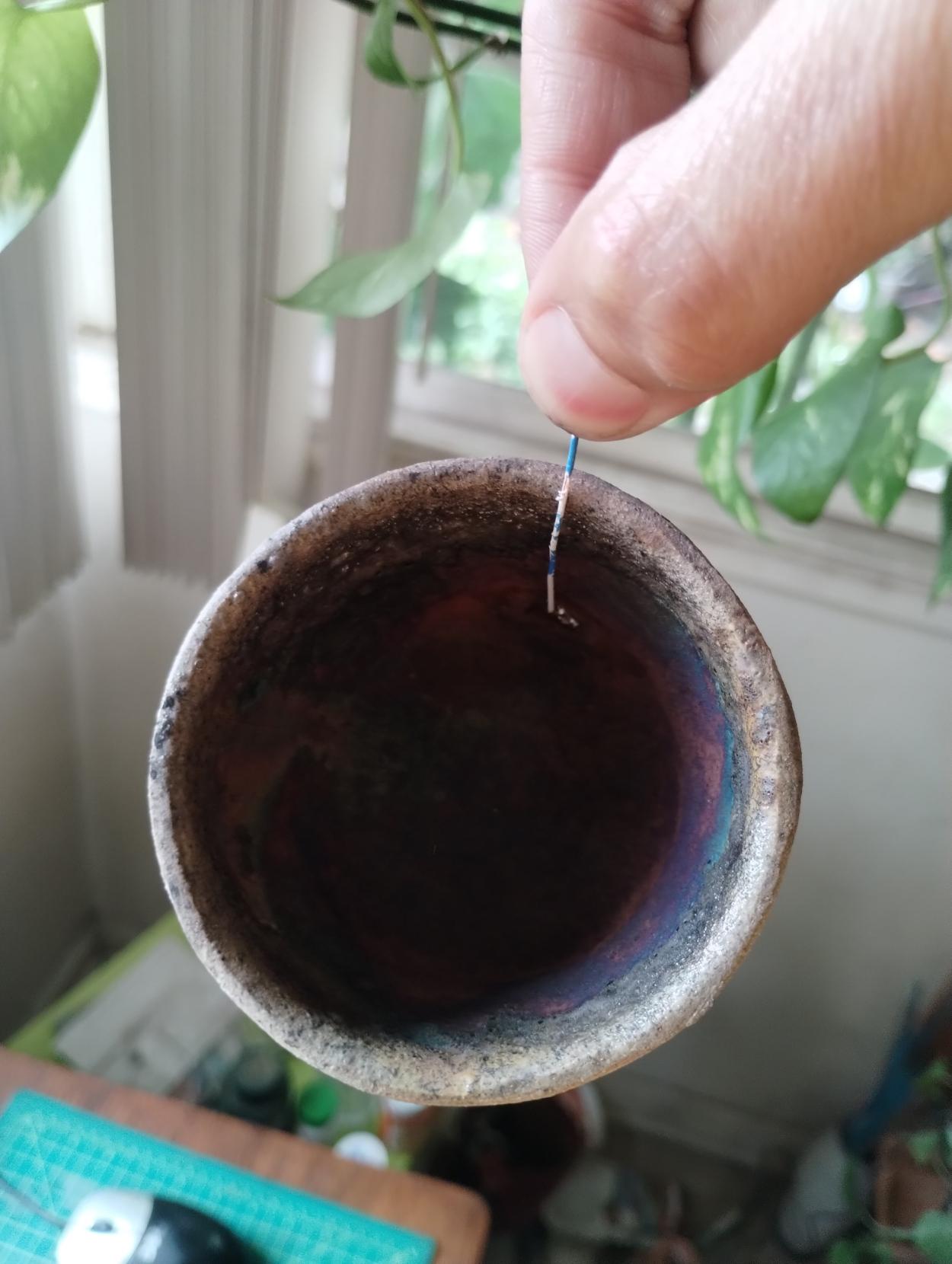
    So, i applied some tinning flux meant for plumbing to a small spot on this test piece from last year and hit it with my soldering iron. Sure enough, it tinned the copper, and with that, i was able to solder a piece of wire to it.

    Your eyes to not deceive you. This is copper wire soldered to a piece of ceramic pottery and it is firmly attached.

    michael@social.chrisco.meM This user is from outside of this forum
    michael@social.chrisco.meM This user is from outside of this forum
    michael@social.chrisco.me
    wrote last edited by
    #10

    @MLE_online got a link to that article?

    mle_online@social.afront.orgM 1 Reply Last reply
    0
    • michael@social.chrisco.meM michael@social.chrisco.me

      @MLE_online got a link to that article?

      mle_online@social.afront.orgM This user is from outside of this forum
      mle_online@social.afront.orgM This user is from outside of this forum
      mle_online@social.afront.org
      wrote last edited by
      #11

      @michael https://feministhackerspaces.cargo.site/Clay-PCB-Tutorial

      1 Reply Last reply
      0
      • mle_online@social.afront.orgM mle_online@social.afront.org

        I am going to make a 3D printed stamp that creates depressed traces in a slab of clay. That way I can pour copper powder into the traces and let it do its thing where it chemically melds with the glaze, but without flowing anywhere

        hackaweek@mastodon.socialH This user is from outside of this forum
        hackaweek@mastodon.socialH This user is from outside of this forum
        hackaweek@mastodon.social
        wrote last edited by
        #12

        @MLE_online here's some inspiration. You could totally build this amplifier on a ceramic circuit board. Of course, the components would be just as small, but it still might be kind of fun. I'm sure you'll come up with some functional circuit board though.
        https://youtu.be/nMrNFcf7FtE?si=1cRgGQgWI9zzRdhq

        mle_online@social.afront.orgM 1 Reply Last reply
        0
        • mle_online@social.afront.orgM mle_online@social.afront.org

          Very exciting discovery in Velasco Labs right now!

          People keep sending me links to that German feminist hacker collective that made wild clay PCBs, and while i think that's pretty cool, the way they applied the conductive traces felt a little like a cheat to me because they were sort of painted on.

          Last night after someone linked me to it again, i suddenly remembered my experiments with adding copper powder to ceramics glazes, and how, by smothering the red-hot ceramics in sawdust, i was able to reduce the copper oxides into something that looked like metallic copper. That got me pondering.

          So, i applied some tinning flux meant for plumbing to a small spot on this test piece from last year and hit it with my soldering iron. Sure enough, it tinned the copper, and with that, i was able to solder a piece of wire to it.

          Your eyes to not deceive you. This is copper wire soldered to a piece of ceramic pottery and it is firmly attached.

          celestestormysea@yiff.lifeC This user is from outside of this forum
          celestestormysea@yiff.lifeC This user is from outside of this forum
          celestestormysea@yiff.life
          wrote last edited by
          #13

          @MLE_online eureka! what beauty you bring to us today!

          1 Reply Last reply
          0
          • hackaweek@mastodon.socialH hackaweek@mastodon.social

            @MLE_online here's some inspiration. You could totally build this amplifier on a ceramic circuit board. Of course, the components would be just as small, but it still might be kind of fun. I'm sure you'll come up with some functional circuit board though.
            https://youtu.be/nMrNFcf7FtE?si=1cRgGQgWI9zzRdhq

            mle_online@social.afront.orgM This user is from outside of this forum
            mle_online@social.afront.orgM This user is from outside of this forum
            mle_online@social.afront.org
            wrote last edited by
            #14

            @HackAWeek I'm thinking an astable multivibrator. It' a simple circuit without too many components, and the blinking LEDs show you it's working.

            hackaweek@mastodon.socialH 1 Reply Last reply
            0
            • mle_online@social.afront.orgM mle_online@social.afront.org

              Very exciting discovery in Velasco Labs right now!

              People keep sending me links to that German feminist hacker collective that made wild clay PCBs, and while i think that's pretty cool, the way they applied the conductive traces felt a little like a cheat to me because they were sort of painted on.

              Last night after someone linked me to it again, i suddenly remembered my experiments with adding copper powder to ceramics glazes, and how, by smothering the red-hot ceramics in sawdust, i was able to reduce the copper oxides into something that looked like metallic copper. That got me pondering.

              So, i applied some tinning flux meant for plumbing to a small spot on this test piece from last year and hit it with my soldering iron. Sure enough, it tinned the copper, and with that, i was able to solder a piece of wire to it.

              Your eyes to not deceive you. This is copper wire soldered to a piece of ceramic pottery and it is firmly attached.

              ferrix@mastodon.onlineF This user is from outside of this forum
              ferrix@mastodon.onlineF This user is from outside of this forum
              ferrix@mastodon.online
              wrote last edited by
              #15

              @MLE_online nearly a smart mug

              mle_online@social.afront.orgM 1 Reply Last reply
              0
              • ferrix@mastodon.onlineF ferrix@mastodon.online

                @MLE_online nearly a smart mug

                mle_online@social.afront.orgM This user is from outside of this forum
                mle_online@social.afront.orgM This user is from outside of this forum
                mle_online@social.afront.org
                wrote last edited by
                #16

                @ferrix never!

                1 Reply Last reply
                0
                • mle_online@social.afront.orgM mle_online@social.afront.org

                  @HackAWeek I'm thinking an astable multivibrator. It' a simple circuit without too many components, and the blinking LEDs show you it's working.

                  hackaweek@mastodon.socialH This user is from outside of this forum
                  hackaweek@mastodon.socialH This user is from outside of this forum
                  hackaweek@mastodon.social
                  wrote last edited by
                  #17

                  @MLE_online perfect!

                  1 Reply Last reply
                  0
                  • mle_online@social.afront.orgM mle_online@social.afront.org

                    I am going to make a 3D printed stamp that creates depressed traces in a slab of clay. That way I can pour copper powder into the traces and let it do its thing where it chemically melds with the glaze, but without flowing anywhere

                    ruenahcmohr@infosec.exchangeR This user is from outside of this forum
                    ruenahcmohr@infosec.exchangeR This user is from outside of this forum
                    ruenahcmohr@infosec.exchange
                    wrote last edited by
                    #18

                    @MLE_online I think the glass acts as a flux.

                    mle_online@social.afront.orgM 1 Reply Last reply
                    0
                    • mle_online@social.afront.orgM mle_online@social.afront.org

                      So, now what? Well, I am now compelled to try making a ceramic PCB with integrated copper traces in the ceramics studio

                      abortretryfail@mastodon.socialA This user is from outside of this forum
                      abortretryfail@mastodon.socialA This user is from outside of this forum
                      abortretryfail@mastodon.social
                      wrote last edited by
                      #19

                      @MLE_online
                      Start simple: make a capacitor.

                      mle_online@social.afront.orgM 1 Reply Last reply
                      0
                      • abortretryfail@mastodon.socialA abortretryfail@mastodon.social

                        @MLE_online
                        Start simple: make a capacitor.

                        mle_online@social.afront.orgM This user is from outside of this forum
                        mle_online@social.afront.orgM This user is from outside of this forum
                        mle_online@social.afront.org
                        wrote last edited by
                        #20

                        @abortretryfail i don't want to make that

                        1 Reply Last reply
                        0
                        • ruenahcmohr@infosec.exchangeR ruenahcmohr@infosec.exchange

                          @MLE_online I think the glass acts as a flux.

                          mle_online@social.afront.orgM This user is from outside of this forum
                          mle_online@social.afront.orgM This user is from outside of this forum
                          mle_online@social.afront.org
                          wrote last edited by
                          #21

                          @RueNahcMohr I'm not sure what you mean

                          ruenahcmohr@infosec.exchangeR 1 Reply Last reply
                          0
                          • mle_online@social.afront.orgM mle_online@social.afront.org

                            @RueNahcMohr I'm not sure what you mean

                            ruenahcmohr@infosec.exchangeR This user is from outside of this forum
                            ruenahcmohr@infosec.exchangeR This user is from outside of this forum
                            ruenahcmohr@infosec.exchange
                            wrote last edited by
                            #22

                            @MLE_online I think the glaze protects the copper from oxidizing. (flux)

                            1 Reply Last reply
                            1
                            0
                            • R relay@relay.infosec.exchange shared this topic

                            Reply
                            • Reply as topic
                            Log in to reply
                            • Oldest to Newest
                            • Newest to Oldest
                            • Most Votes


                            • Login

                            • Login or register to search.
                            • First post
                              Last post
                            0
                            • Categories
                            • Recent
                            • Tags
                            • Popular
                            • World
                            • Users
                            • Groups