Hearing the feelings in this rant, which does touch a nerve, I can’t help think about how different the developer community reaction to the LLM push might be if the focus were on quality instead of efficiency.
-
But that’s me; I don’t think my ethical concerns are shared widely enough for companies to have to be ramming AI down developers’ throats the way they are. The token quotas etc are a symptom of something large and deep.
Maybe that post about MTBF vs MTTR helps explain it.
/end
@inthehands This, but applied to translation, is why en masse translators are not grabbing at LLMs either. They produce something almost, but not entirely, quite unlike an actual translation. They can't remember context, they don't do consistency even inside a single sentence, let alone an entire article, their "suggestions" pollute the human brain the instant you see them so you can no longer imagine how you'd have approached that sentence... And the bias inherent in their corpuses is horrific.
I could go on and on, but I'm so tired of the whole thing, and particularly of being the canary in the coal mine for an entire world still blithely going "well it's fine for translation" when we've been dead on the floor of the cage for YEARS at this point.
-
This is, if I understand it correctly, the same contrast that the OP’s distinction between MTBF and MTTR points to:
MTBF = quality (It rarely breaks)
MTTR = efficiency (It breaks all the time but we recover so fast!)
6/
@inthehands I think this is incredibly relevant. I think it's capitalism's attempt to turn software development into what it produces elsewhere. Cheap, disposable, quickly and easily replaced. It doesn't care about quality almost by definition - if you build a product that lasts for years, you'll limit your sales opportunities. In my opinion, LLMs are capitailists' latest attempt to turn software development and products into something that's cheap, disposable, and almost non-durable and resilient by design.
-
@gildilinie @inthehands we're approaching a point where "i got me a hundred gigabytes of ram" will once again be an actual flex
@Andres4NY @inthehands i have 96gb RAM and I looked up how much to replace it... yikes
-
There’s a classic thought experiment about quality vs efficiency for machine learning in medical diagnosis. I can’t remember where I first heard it, but @pluralistic laid it out in a blog post:
2/
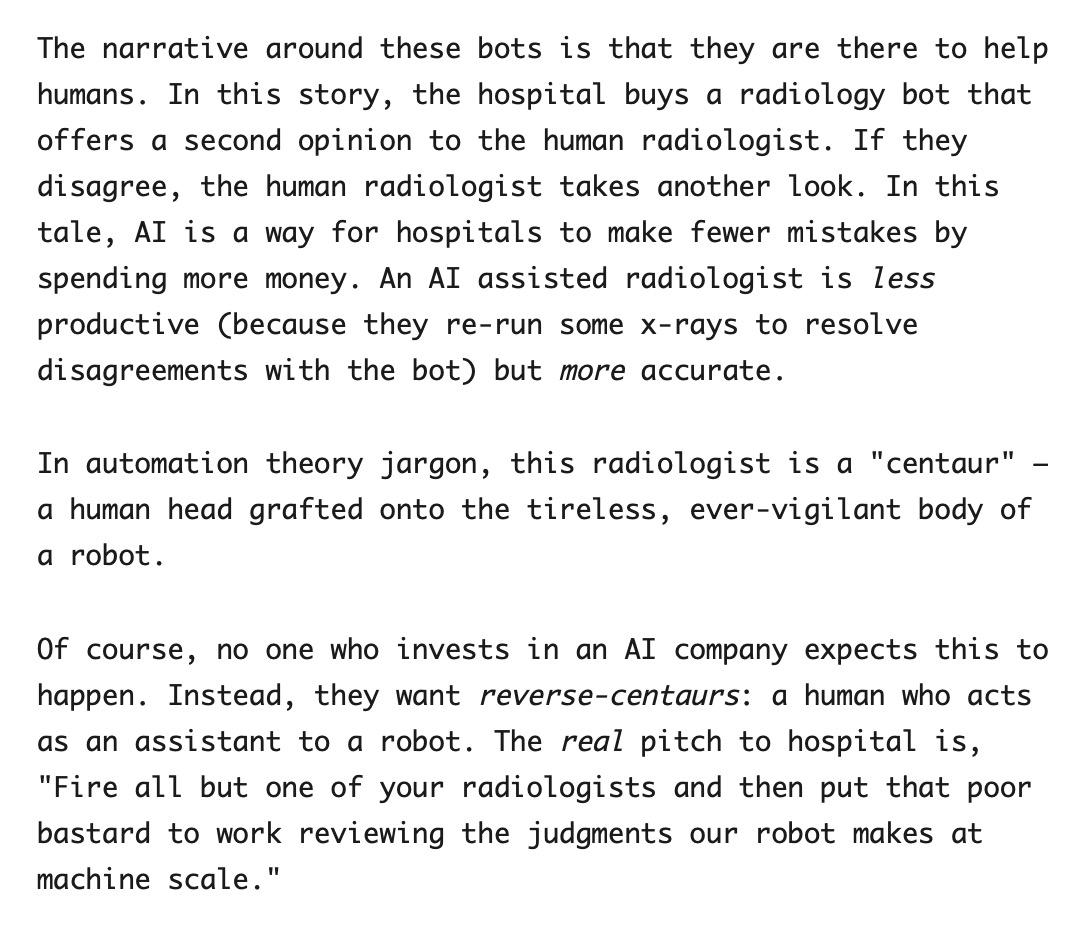
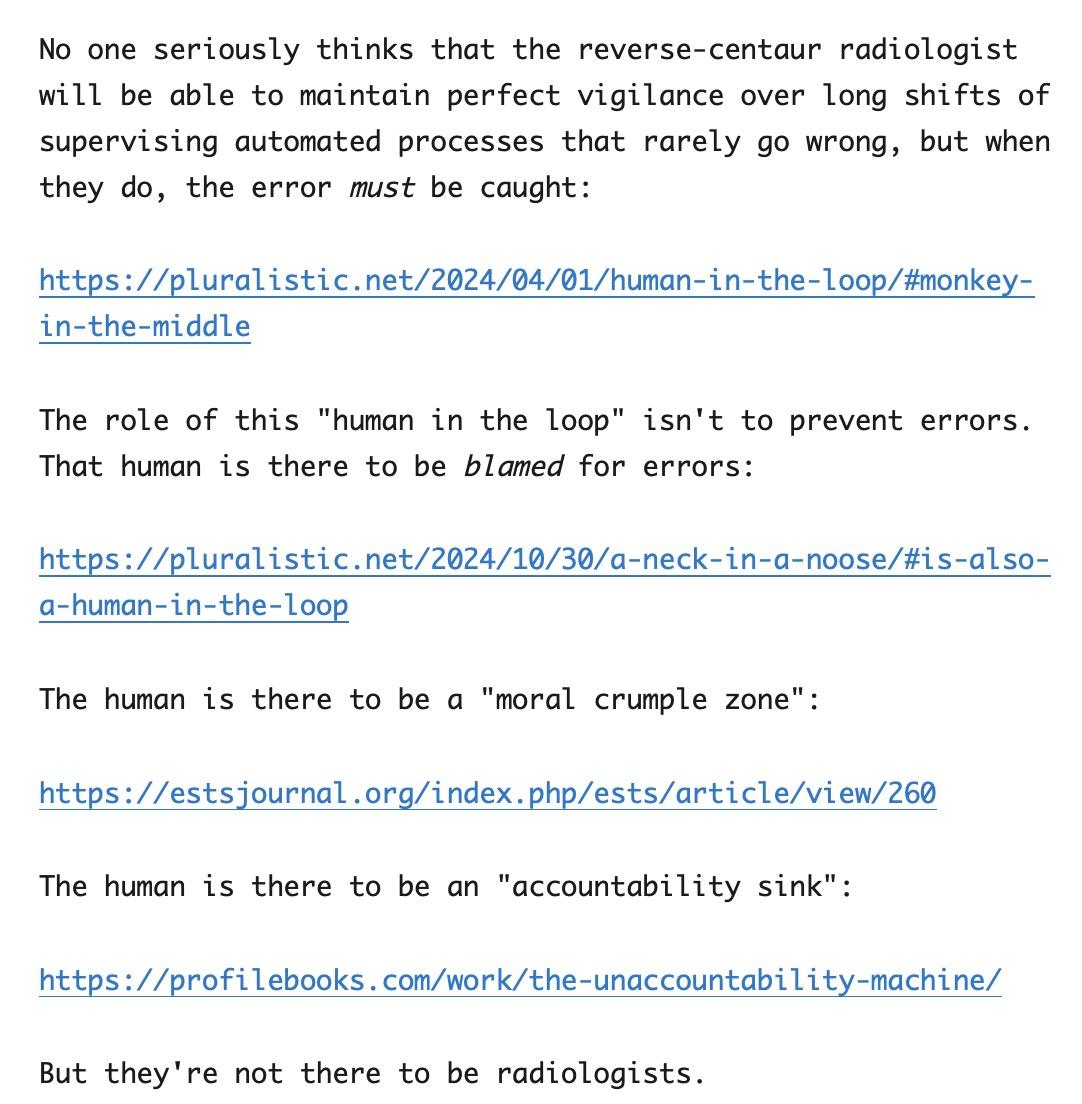
@pluralistic @inthehands I started reading the post and snatched this: “The role of this "human in the loop" isn't to prevent errors. That human is there to be blamed for errors”. That evoked a sad, knowing chuckle.
-
@inthehands I think you apprehend the situation correctly. These days, nobody cares about developer experience unless it reaffirms the dominant narrative. I have explicitly asked the VP of Engineering at my employer and was told straight up that velocity is the only true measure of success.
We will not survive this without a reckoning.
ಠಠ_ಠ_ಠ__ಠ_ಠ_ಠಠ
-
@r343l
I want to share that romantic feeling for the past, but if I’m honest with myself, I’ve seen that pendulum swing wildly in my many decades of software dev between different companies, different projects, and different days of the week.I give students in one of my classes this podcast episode as a reading (well, listening) assignment, and it’s a story of 1982:
https://99percentinvisible.org/episode/the-worst-video-game-ever/
(Seriously, listen to the developer talk in his own voice about the dev process, and the •astonishing• lack of quality control of any kind!)
@inthehands Well over my career at least quality process (that can't be done by devs) seems to be steadily less and less valued. The stuff that could be automated by software has admittedly gotten better (eg automated tests and daily or continuous build, etc). we all live in our little time-experience bubble.

-
The “efficiency” pitch I’m describing upthread isn’t really “go faster;” it feels more like “making good things doesn’t matter, what you cared all along about doesn’t really matter, and we don’t think •you• matter.
We always just wanted to built absolute shit, and you always tried to stop us. But now at long last we can.”
9/
Oh, without a doubt, this is it:
The “efficiency” pitch I’m describing upthread isn’t really “go faster;” it feels more like “making good things doesn’t matter, what you cared all along about doesn’t really matter, and we don’t think •you• matter.
We always just wanted to built absolute shit, and you always tried to stop us. But now at long last we can.”
-
Oh, without a doubt, this is it:
The “efficiency” pitch I’m describing upthread isn’t really “go faster;” it feels more like “making good things doesn’t matter, what you cared all along about doesn’t really matter, and we don’t think •you• matter.
We always just wanted to built absolute shit, and you always tried to stop us. But now at long last we can.”
And the rank hypocrisy of it all as well.
Oh, we’re looking for the sharpest, most responsible, most super geniuses - because what we make is Soooooooo important AND difficult that quality and aptitude are absolutely critical.
Soooo critical that we will build mazes of impenetrability and call it “hiring” so that we weed out all those candidates except the best of the best of the best!!
Pssst, I’ll sell you an expensive gadget that’ll spit out all the spaghetti code no one will ever understand that you could ever want.
Sold! We love it! This is amazeballs!
-
@inthehands @pluralistic the "one radiologist" example is giving me flashbacks to that Futurama episode where Hermes automates a process so efficiently that it ends up all being done by a single guy, depicted in supreme mind-melting agony.
-
There’s a classic thought experiment about quality vs efficiency for machine learning in medical diagnosis. I can’t remember where I first heard it, but @pluralistic laid it out in a blog post:
2/
@inthehands @pluralistic i love "moral crumple zone"
-
I can’t think of another time when software devs had to be •forced• en masse to use a new technology that was supposed to help them. Usually we’re kind of stupid for the shiny new things: jamming them in when they solve nothing, doing unnecessary rewrites just to use the new hotness because it’s so cool and fun. Usually we’re the one trying to shove it down mgmt’s throat (or sneak it by them) rather than the reverse.
But not this time.
7/
@inthehands some of this push has developers as useful idiots, taking advantage of our kernel exploits of being stupid for shiny new things, playing with editor config instead of doing actual valuable work, and conflating busyness/novelty for productivity
-
RE: https://hachyderm.io/@mitchellh/116580433508108130
Hearing the feelings in this rant, which does touch a nerve, I can’t help think about how different the developer community reaction to the LLM push might be if the focus were on quality instead of efficiency.
1/
I have to say devs focusing on quality often get labelled as slowing things down and being perfectionist.
It is universal in big and small organizations. In places where they focus on quality it was usually hard fought for.
Working in organizations that focus on quality is very much a pleasure. It has always been worth it to focus on quality and you should prioritize working with folks who prioritize quality.
-
The “efficiency” pitch I’m describing upthread isn’t really “go faster;” it feels more like “making good things doesn’t matter, what you cared all along about doesn’t really matter, and we don’t think •you• matter.
We always just wanted to built absolute shit, and you always tried to stop us. But now at long last we can.”
9/
@inthehands my gut feeling as a developer: if the code is low-quality but efficient, then your metric for efficiency is probably broken.
-
@inthehands @pluralistic i love "moral crumple zone"
@Viss @inthehands It comes from Madeleine Clare Elish
-
Why? The common explanation is that software devs are worried about job security and don’t want to be replaced. And…maybe? But again: past technologies promising greatly improved dev speed we’ve embraced headlong with no regard to large-scale employment effects.
I wonder if this quality vs efficiency thing upthread isn’t a big part of the explanation here.
8/
@inthehands I've heard about this so many times but I've never been so sure of my employment as I am now. Even before the LLM craze the industry was piling up so much complexity that we were barely able to manage it. Now that's been turned up to 11, so we're producing even more complexity with an utter disregard to quality. At some point shit hits the fan and you need someone who actually understand how things work to fix this mess, and boy what a mess are we in.
-
@inthehands I've heard about this so many times but I've never been so sure of my employment as I am now. Even before the LLM craze the industry was piling up so much complexity that we were barely able to manage it. Now that's been turned up to 11, so we're producing even more complexity with an utter disregard to quality. At some point shit hits the fan and you need someone who actually understand how things work to fix this mess, and boy what a mess are we in.
@inthehands don't forget that we've been focusing a lot on user-facing software development, or web-facing at most. But this is going to end up into all kind of systems we use every day: firmware for your motherboard, graphics card, WiFi & BT adapter, disk controller. Your car. Your phone. Your bank accounting system. Our societies are dependent on computers functioning and we've decided to break them while making ourself virtually unable to fix them.
-
@inthehands This, but applied to translation, is why en masse translators are not grabbing at LLMs either. They produce something almost, but not entirely, quite unlike an actual translation. They can't remember context, they don't do consistency even inside a single sentence, let alone an entire article, their "suggestions" pollute the human brain the instant you see them so you can no longer imagine how you'd have approached that sentence... And the bias inherent in their corpuses is horrific.
I could go on and on, but I'm so tired of the whole thing, and particularly of being the canary in the coal mine for an entire world still blithely going "well it's fine for translation" when we've been dead on the floor of the cage for YEARS at this point.
@janeishly @inthehands good quality translators I know have moved on to other work in stead of following the race to the bottom on the payment/word rate that all intermediaries use.
-
@inthehands This, but applied to translation, is why en masse translators are not grabbing at LLMs either. They produce something almost, but not entirely, quite unlike an actual translation. They can't remember context, they don't do consistency even inside a single sentence, let alone an entire article, their "suggestions" pollute the human brain the instant you see them so you can no longer imagine how you'd have approached that sentence... And the bias inherent in their corpuses is horrific.
I could go on and on, but I'm so tired of the whole thing, and particularly of being the canary in the coal mine for an entire world still blithely going "well it's fine for translation" when we've been dead on the floor of the cage for YEARS at this point.
-
But that’s me; I don’t think my ethical concerns are shared widely enough for companies to have to be ramming AI down developers’ throats the way they are. The token quotas etc are a symptom of something large and deep.
Maybe that post about MTBF vs MTTR helps explain it.
/end
@inthehands my husband reminds me that companies don't give away anything for Free. There is always the cost, our cognitive abilities. And if it is free, a gift, do we trust the hands giving it to us? I trust musk/Thiel/altman/etc to destroy humanity, so no, I don't want this gift. Or this free extention. Or to outsource my intelligence. It's not free if it's stealing water and land rights.
-
@janeishly @inthehands good quality translators I know have moved on to other work in stead of following the race to the bottom on the payment/word rate that all intermediaries use.
@wiert @janeishly @inthehands Have lost their work as a result of agencies insistence on llms (personal experience).